
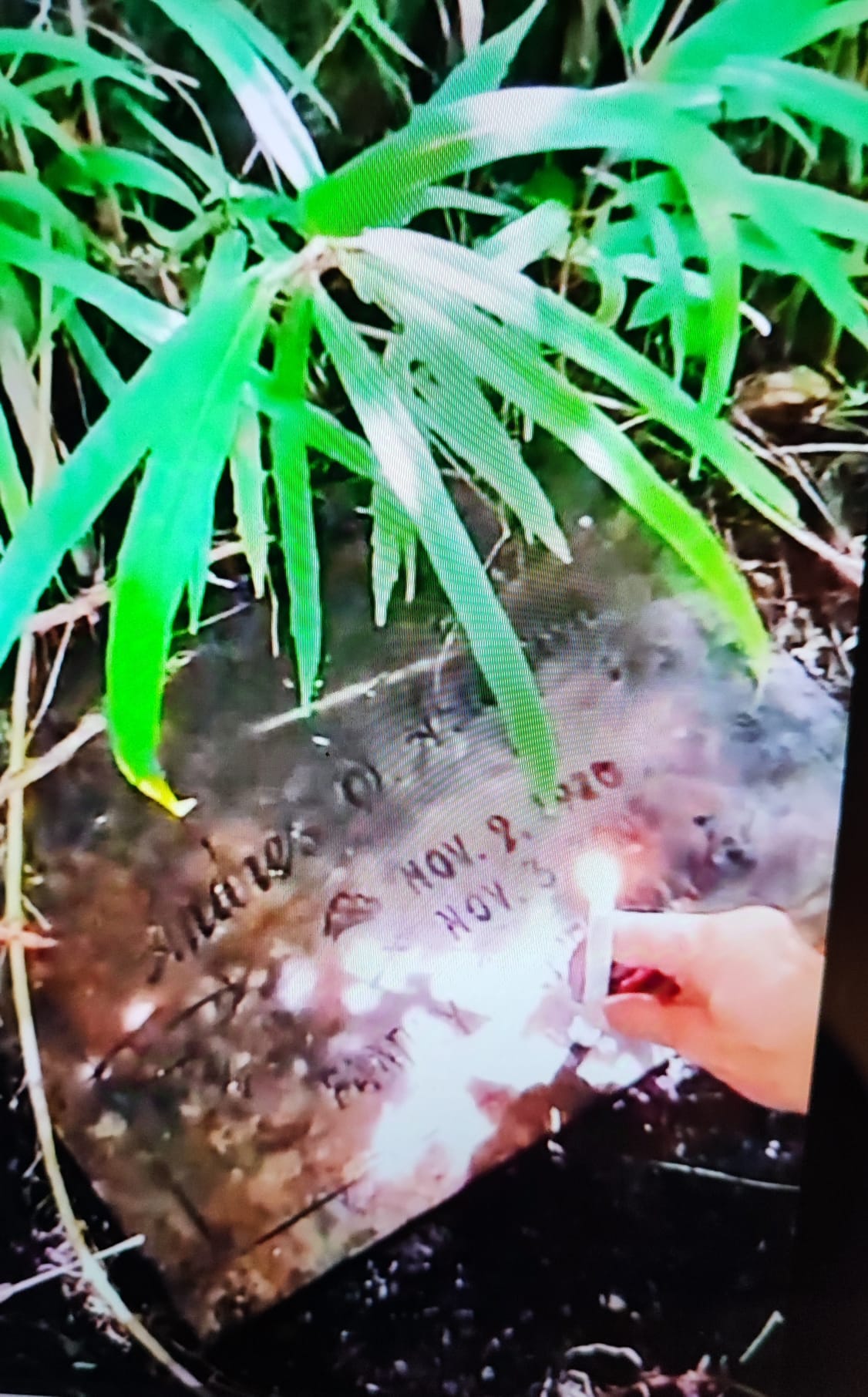
November 9, 1920, my father’s birthday, Andres Sus Asuncion,Sr., son of Adonis Ramirez Asuncion. He was a public school teacher, the last assignment being in Barrio Magsaysay, Bulan, Sorsogon.
He left this world last November 3, 2005, six days before his birthday. However I have always considered that dying is a form of being born in another world that we don’t see. So death anniversary is actually a birthday anniversary at the same time. It may sound not realistic in our normal terms, but my intution tells me so.
But there could be in this simple reflections of mine on life and death a deeper philosophical insight: the idea that death might be not an end, but a transition—a birth into another state of existence. This perspective captures the continuity of life, framing both birth and death as gateways, linking one existence with another in ways that may transcend our understanding. By viewing death as a “birth” into an unseen realm, my thoughts actually resonate with philosophical and spiritual traditions that interpret existence as cyclical or interconnected across multiple planes.
Imagine the moment of birth: it is a sudden entry into a vast, mysterious world, a place unknown to us prior to arriving. In that sense, death might be seen similarly—a moment of passing into a reality beyond the grasp of our current senses and intellect. In this framework, just as our physical birth brings us from the unknown into a tangible, visible life, our death could similarly carry us from this visible world into an unseen realm, one with its own mystery and potential for being.
This perspective challenges the conventional view of death as a final cessation of existence. Instead, death becomes a pivotal transformation, a return to the unknown or the unseen, and even the beginning of something new. We often consider life to be defined by physical presence, sensory experience, and measurable events. But if death is a “birth” into another world, then existence may not be limited to the visible and measurable. My father’s passing might then be perceived as both an end to his physical journey and the beginning of a different journey—one that remains invisible to us but might be just as real within a broader sense of life.
In this light, a death anniversary could indeed be thought of as a kind of birthday—a day marking not only loss but the possibility of rebirth. This view offers comfort by suggesting that life, in some form, continues, and it aligns with beliefs that life and death are part of an ever-ongoing cycle. Celebrating a loved one’s “birth” into the next realm could add meaning to the day, honoring both the life they led here and the continuation of their journey beyond.
In expanding on this idea, we might ask: if birth and death are both transitions, what is the nature of the soul or essence that crosses between worlds? What does it mean to live if every end is a beginning and every beginning an end? This perspective suggests that life is a series of transformations, connected by an unseen thread. To contemplate death as a birth is to trust in the enduring mystery of existence, to hold that every threshold may lead to another—an endless journey through different expressions of being. In that sense, the essence of a person might persist beyond the visible, offering a comforting view that, though unseen, they are never truly absent…
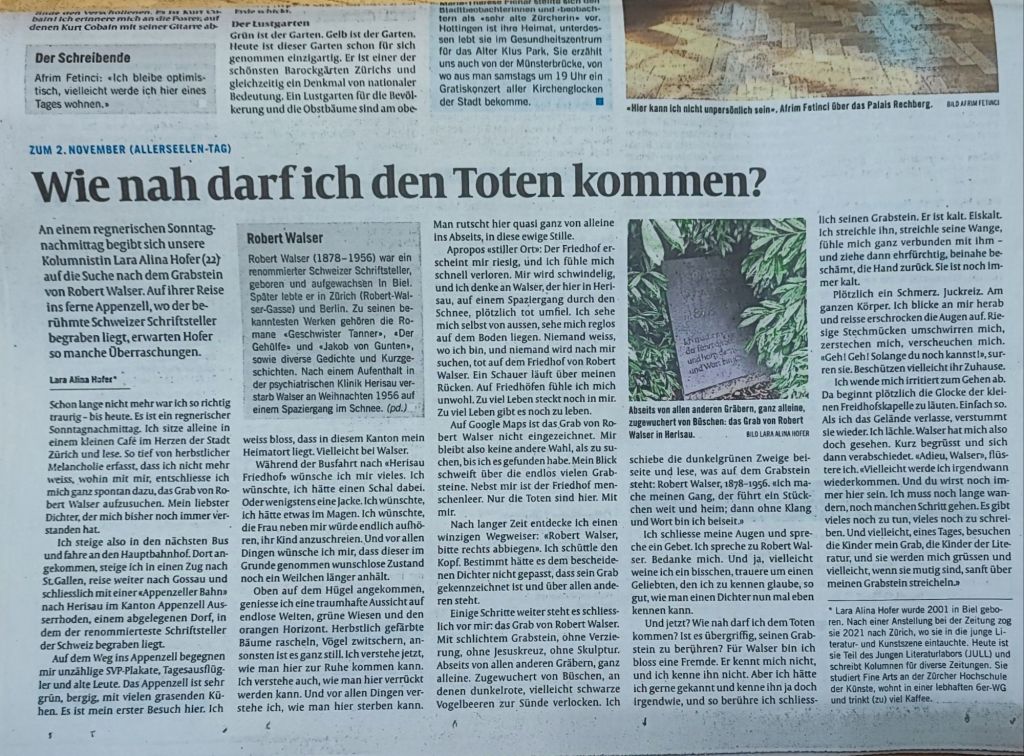
The second gravestone below belongs to the Swiss writer Robert Walser (April 15, 1878- December 25, 1956). The newspaper article was written by a 22-year old Swiss columnist Lara ALina Hofer. Here, she describes poetically her difficult search for the grave of Robert Walser which resonates perfectly with my search for my father’s gravestone last year when I was in Bulan with my wife Mila. Like Lara, we went through bushes and lots of other graves and help from some people around to locate our father’s resting place, overgrown with bushes, grass and trees. It was a touching moment whe we finally found him.





 Bulan Observer