Through The Waves Of Time

By Jun Asuncion

Dear Asuncion Family, young and old, near and far,

As we come closer to this beautiful day of our reunion, I invite you to pause and reflect with me—not just on what we will be celebrating, but on who we are, and where we came from,- and what we would possibly become.

The story of the Asuncion Clan begins not in modern cities or schools, but in the crossing of cultures and the quiet power of love and resilience. It began with the union of Mariano Kagalitan and Maria de La Paz, whose father,a wise apothecarist from ancient Middle Kingdom, sailed across oceans to the Philippines—perhaps not knowing then that he would also be involved in planting the roots of a family that would one day grow into the remarkable Asuncion clan. And in marrying Anastacia Michaela, a native Filipina, he did not just form a union—but became one of those who sparked a legacy.

That legacy carried through the Spanish colonial times in Manila, where our ancestors painted and sculpted, taught and healed, fought and led. In narrow alleys and open plazas, in homes filled with music and prayer, they planted the seeds of who we are today: a family of artists, of thinkers, of builders, of dreamers.

To our younger Asuncions: you are the next bearers of this rich legacy. Know this: you carry within you more than just a surname. You carry centuries of courage, creativity, sacrifice, and honor. You walk with the quiet strength of Mariano Asuncion, Sr.and those who came before him, the grace of Maria De La Paz and those who came before her. When you sing, paint, write, teach, lead, or love—you are echoing their spirit.

But with legacy comes responsibility.

This reunion is not just a celebration. It is a call to unity—a reminder that no Asuncion, from any corner of the Philippines or abroad, should ever feel forgotten or disconnected. We are one great tree with many branches, and it is our duty to reach out, to listen, to include, and to reconnect.

As we prepare for this reunion, let us carry with us the words of The Asuncion Hymn—which you can find on the Bulan Observer—a hymn where I tried to capture in words (and hopefully soon in music) the soul of our journey:

“Through the waves of time, you sail,
Connected souls, your bond won’t fail.
With fortune’s blessing and love’s embrace,
Asuncion clan, your legacy we embrace.”

Let us indeed embrace that legacy—with pride, with humility, and with love.

To our forebears, we say: thank you.
To the present generation, we say: stand proud.
And to the young, we say: carry the flame forward—together.

Mabuhay ang Pamilyang Asuncion!

One in Bulan, one in Appenzell

November 9, 1920, my father’s birthday, Andres Sus Asuncion,Sr., son of Adonis Ramirez Asuncion. He was a public school teacher, the last assignment being in Barrio Magsaysay, Bulan, Sorsogon.

He left this world last November 3, 2005, six days before his birthday. However  I have always considered that dying is a form of being born in another world that we don’t see. So death anniversary is actually a birthday anniversary at the same time. It may sound not realistic in our normal terms, but my intution tells me so.

But there could be in this simple reflections of mine on life and death a deeper philosophical insight: the idea that death might be not an end, but a transition—a birth into another state of existence. This perspective captures the continuity of life, framing both birth and death as gateways, linking one existence with another in ways that may transcend our understanding. By viewing death as a “birth” into an unseen realm, my thoughts actually resonate with philosophical and spiritual traditions that interpret existence as cyclical or interconnected across multiple planes.

Imagine the moment of birth: it is a sudden entry into a vast, mysterious world, a place unknown to us prior to arriving. In that sense, death might be seen similarly—a moment of passing into a reality beyond the grasp of our current senses and intellect. In this framework, just as our physical birth brings us from the unknown into a tangible, visible life, our death could similarly carry us from this visible world into an unseen realm, one with its own mystery and potential for being.

This perspective challenges the conventional view of death as a final cessation of existence. Instead, death becomes a pivotal transformation, a return to the unknown or the unseen, and even the beginning of something new. We often consider life to be defined by physical presence, sensory experience, and measurable events. But if death is a “birth” into another world, then existence may not be limited to the visible and measurable. My  father’s passing might then be perceived as both an end to his physical journey and the beginning of a different journey—one that remains invisible to us but might be just as real within a broader sense of life.

In this light, a death anniversary could indeed be thought of as a kind of birthday—a day marking not only loss but the possibility of rebirth. This view offers comfort by suggesting that life, in some form, continues, and it aligns with beliefs that life and death are part of an ever-ongoing cycle. Celebrating a loved one’s “birth” into the next realm could add meaning to the day, honoring both the life they led here and the continuation of their journey beyond.

In expanding on this idea, we might ask: if birth and death are both transitions, what is the nature of the soul or essence that crosses between worlds? What does it mean to live if every end is a beginning and every beginning an end? This perspective suggests that life is a series of transformations, connected by an unseen thread. To contemplate death as a birth is to trust in the enduring mystery of existence, to hold that every threshold may lead to another—an endless journey through different expressions of being. In that sense, the essence of a person might persist beyond the visible, offering a comforting view that, though unseen, they are never truly absent…

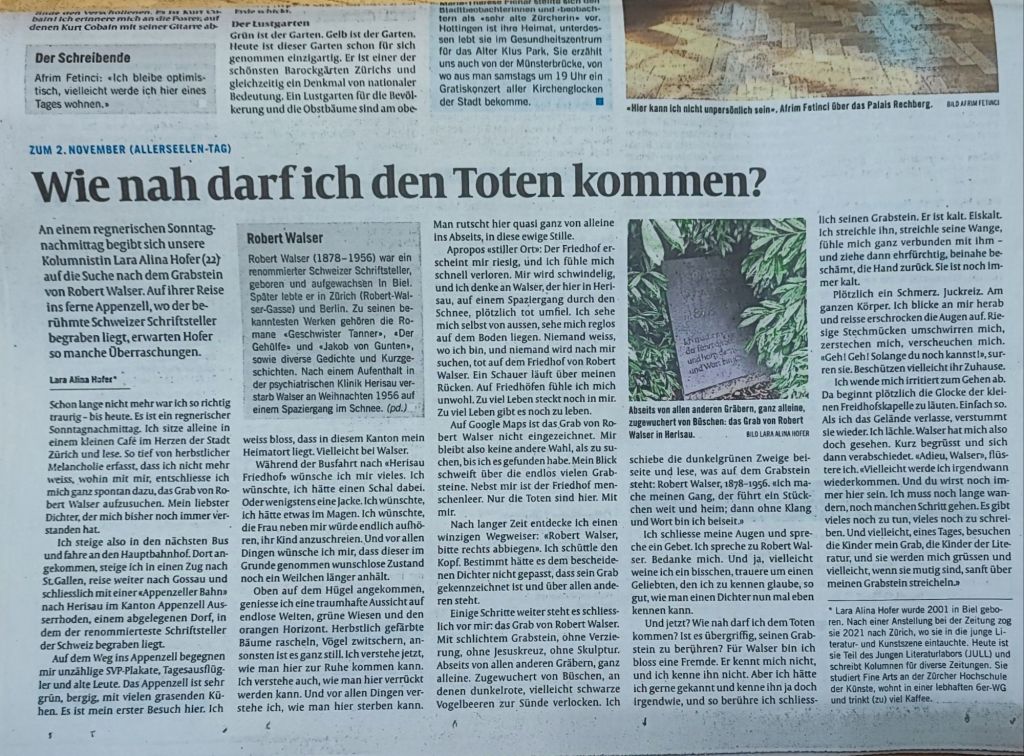
The second gravestone below belongs to the Swiss writer Robert Walser (April 15, 1878- December 25, 1956). The newspaper article was written by a 22-year old Swiss columnist Lara ALina Hofer. Here, she describes poetically her difficult search for the grave of Robert Walser which resonates perfectly with my search for my father’s gravestone last year when I was in Bulan with my wife Mila. Like Lara, we went through bushes and lots of other graves and help from some people around to locate our father’s resting place, overgrown with bushes, grass and trees. It  was a touching moment whe we finally found him.

Ang ating Dasal

(words & music jun & mila asuncion. Ito ay handog namin sa darating na Asuncion Clan reunion)

Intro:

Ihanda ang sariling mabuhay ng tahimik

Sa piling ng Maykapal, ang buhay ay kayamanan

Pagkat may patutunguhan.

Bridge:

Malayo man at mahirap ang daan

Ito ay tahakin, lumakad ka kaibigan.

Chorus:

Likas ng tao ang matakot sa daan

Hindi alam kong saan patutungo.

Huwag mabahala, kaibigan

Pagkat ika’y hindi nag-iisa

Kung tatanggapin mo siya

Ng buong puso’t kaluluwa.

Outro:

Siya ang may-alam

Daang ating patutunguhan

Hawak Niya ang ngayon, bukas at kahapon.

(repeat Chorus and Outro /… End )

Warrior’s Blues

(words and music: jun asuncion)

I
I’ve been through the fire and the rain,
Lost some friends, gained some pain.
But I’m stll standing, I’m still here,
This loneliness is nothing to fear.

II
I’ve been through the ups and downs,
Lost my parents’ other children along the way.
But I’ll walk this lonely path with my head held high
For I carry my father’s name, my solid pride.

Chorus:

If it be my fate that I stand alone one day,
I’ll embrace with grace this destiny.
I’ll face this truth and no one else I’ll blame,
The warrior in me keeps me stronger ever more.

III
Here today, gone tomorrow, they say.
The truth that all must face at the end of day.
But I find solace in the memories of my parents so dear,
For, be it in deeds or in thoughts, never had I betrayed them, that’s clear.

IV
My destiny is here to stay, so let it be,
In this moment I live, so I flow with it.
Sorrows and pain they journey with me,
They will be my best friends by the break of day.

(repeat chorus)

Childhood Song

It came to my mind in a moment of reflection how inspiring and life-strengthening it is indeed to have spent my childhood and teenage years in our Asuncion Family compound in Canipaan, Bulan, Sorsogon with my grandparents, uncles aunties plus a host of relatives and friends coming in and out all those years. I realized how blessed I was then to have shared my young life with all those loving people in the compound. I cherish those memories and sometimes wished to turn back the hands of time and be there again. The truth is, this is possible only mentally. The song below is proof that I was there. I dedicate it to this Asuncion Family compound which I so dearly love. / jun asuncion

(Verse I)

In the fields of youth, we roamed so free,

Unburdened hearts and dreams in our sleeves.

Our laughter echoed through the golden sun,

A time of innocence, where dreams had begun.

(Verse II)

But as the years passed, the world turned gray,

With challenges and hardships in our way.

Yet, deep within, a spark remains,

A light from childhood that forever sustains.

(Chorus)

Oh, the beauty of childhood, a precious sight,

An inspiration in the darkest night.

Through the trials we face, we’ll find our way,

For the spirit of our youth will never fade away.

(Verse III)

With every stumble and fall we endure,

The echoes of our past keep us secure.

Imagination’s wings still carry us high,

As we spread our dreams beneath the endless sky.

(Verse IV)

In moments of doubt, we’ll look back and see,

The fearless child that once danced freely.

The memories ignite a fire so bright,

Guiding us through the toughest fight.

(Bridge)

In the tapestry of life, both joy and sorrow blend,

But our inner child reminds us, our strength has no end.

With wonder in our hearts, we’ll journey through the storm,

For the lessons from our youth will keep us safe and warm.

(Verse V)

Let’s cherish the magic that once we knew,

When dreams were born and skies so blue.

In the face of struggles that may arise,

We’ll hold onto the innocence in our eyes.

(Verse VI)

For every heartache, we’ll find relief,

In memories of games and boundless belief.

With the spirit of our youth by our side,

We’ll embrace life’s journey with arms open wide.

(Chorus)

Oh, the beauty of childhood, a precious sight,

An inspiration in the darkest night.

Through the trials we face, we’ll find our way,

For the spirit of our youth will never fade away.

(Outro)

So, as we walk this road, let’s never forget,

The child within us is a constant asset.

With the essence of youth, we’ll overcome strife,

And bask in the hope that reignites our life.

/

Blues For Ma

(For my dearest mother Pacita)
(Blues in E major /by jun asuncion)

Verse 1:
I’ve been searching high and low,
For the place where my mama lays,
I’ve been traveling far and wide,
Through the nights and through the days.

Chorus:
It’s been a long, lonely journey,
Trying to find my mama’s grave,
But I finally found today,
The place where she rests in peace.

Verse 2:
It’s been three long years of pain,
Since the day that she passed on,
And I’ve been searching ever since,
For the place where she is gone.

Chorus:
It’s been a long, lonely journey,
Trying to find my mama’s grave,
But I finally found today,
The place where she rests in peace.

Verse 3:
I’ve been walking through the rain,
And I’ve been walking through the storms,
I’ve been searching high and low,
For the place where she would go.

Chorus:
It’s been a long, lonely journey,
Trying to find my mama’s grave,
But I finally found today,
The place where she rests in peace.

Verse 4:
Now I stand here at her grave,
And I feel a sense of peace,
For I know that she’s in heaven,
And her soul has found release.

Chorus:
It’s been a long, lonely journey,
Trying to find my mama’s grave,
But I finally found today,
The place where she rests in peace.

Outro:
I’ll always cherish the memories,
Of the love that she gave to me,
And I’ll never forget the journey,
That brought me to where I need to be.

A minute of silence, long hours of work

by junasun

Two weeks after the super typhoon Haiyan, we are faced with the herculean task of recovery and rebuilding. How do we build homes to the hundreds of thousands of homeless people and how do we give medical care to the wounded and sick among them without water and electricity and existing hospitals – and even medical staff for they, like all others, were victims themselves. This is such  an unimaginable logistical problem. Though help and support of all kinds are coming from the international community and the national government, still it takes time to build the most needed infrastructures like roads, hospitals, water and electric plants, bridges and the hundreds of thousands of homes needed. Many have died the day the typhoon hit these areas, but many more will die in such conditions of hunger, shock, trauma, homelessness and zero infrastructures, services and facilities. The government is doing everything but it needs time, – and time is running out to save the weakest and vulnerable among the survivors.

Most of the dead were buried by now. And while we still have hundreds of hours of work before us, to take a minute of silence that will bring us to that quiet place in us where no typhoon can ever penetrate, a place where we all feel at home together as a people, will do us good.

In the face of all these  destructive calamities that have recently befallen the country, we shall all agree that life shall go on and that the life and dignity  of every human shall be respected and protected. And also, as we now pick up our tools to start rebuilding, we should not neglect to treat nature with respect  and consider her in our planning so that she will treat us the same way. We are inseparable from nature, therefore, it’s just wise to live by her rules.

The Philippine archipelago is endowed with natural beauty, but beauty has its price. The Philippines is on the front line of natural calamities and danger may come from above and below. Danger from above are the typhoons. The Philippines is the only large country that is geographically very exposed to tropical cyclones. There are about 20 to 24 typhoons that hit the Philippines, and a few of them are devastating. The most recent one, super typhoon Haiyan, has occurred just two weeks ago and which has practically obliterated Tacloban city and many more places in this region. Around 44,000 of 55,000 houses were wiped out, the rest may still be standing but heavily defaced. Those buildings near the shore just disappeared with the storm surge and over 5,000 people disappeared in a wink of the eye of the storm.

Typhoons are just normal  for Filipino people that a child by the time he is ten years old will have already experienced around 240 typhoons. But this month’s typhoon has surpassed them all. And this typhoon Haiyan has given us a glimpse of the probable nature of typhoons yet to come, – that some of them could be as strong or even stronger than Haiyan. That’s a grim reality to come we have to brace ourselves for.

The danger from below our feet and houses are the earthquakes. The Philippine islands lie in the so called Pacific Ring Of Fire, hence, many earthquakes occur in the islands. The last one just last October 2013 which damaged among others Bohol and Cebu. If this happened that a strong earthquake and a super typhoon occurred in  just a few weeks of interval, the worst that one could imagine is if they would happen at the same time sometime in the future. Better not.

If beauty has its price, then it’s a high price. A single typhoon costs millions or billions of pesos. This typhoon Haiyan alone has cost around P25 billions. But that’s the loss and how about the cost of rebuilding? Aside from thousands of human lives, the country losses therefore tens of billions of pesos from typhoons and earthquakes alone every year.  And we  don’t even add to that the cost of the damages of the typhoons of political corruption that befall our senate and house of representatives and the provincial and municipal buildings. A total shame.

One thing is clear: We cannot move the Philippines away from these typhoons and earthquakes.The people have to  live with it, have to stay in their homeland and rebuild their cities and homes. For the responsible and sensible world citizens (or Netizens) who live in fortunate locations, their only option is to help. The Philippine islands have a life-saving role to play, – as a typhoon shock absorber or shield because after a typhoon has hit the Philippines with its full impact,  it normally continues its course to Vietnam, Laos or Cambodia but already weakened to a certain degree, hence, saving countless lives in these neighboring countries. Haiyan was already over 100 km/h slower when it approached Vietnam. Tha’s a big deal.

Typhoons here, earthquakes there, still life must go on like that of one father in Tacloban who lost his wife and five of his children instantly as the killer waves surged into their village that he is now left with only one child who survived with him. He said that the pain of loss was  hard to bear but he still has a child who needs him that’s why he chose life.

For us then who are not regularly affected by such devastating natural calamities, let’s choose to help them recover from their severe nightmare.

——————————–

CREMATION AS A RITE OF PASSAGE

JGL Eye

By JOSEPH G. LARIOSA

(© 2012 Journal Group Link International)

“In the sweat of thy face shalt thou eat bread till thou return to the earth, out of which thou wast taken: for dust thou art, and into dust thou shalt return.”   Genesis 3:19

CHICAGO (jGLi) – The recent death of my first cousin (on my maternal side), Milagros “Yangos” or “Young Goose” Garra Chua, of Matnog, Sorsogon in the Philippines of lung cancer left some of my relatives scratching their heads when she decided before she died that she wanted to be cremated.

Like a typical closely-knit Roman Catholics, our extended family has never considered cremation as an option until Young Goose’s decision. Cremation is a dreaded word that is better left unspoken.

Among its main objections is its perceived denial of the resurrection of one’s body as shown by Jesus, who was given a traditional burial, not cremation, after the Crucifixion before He could rise from the dead.

Young Goose’s only child, Dave Simon G. Chua, told me in an email that it was his Mom’s decision to be cremated. But Dave did not tell me the reason or reasons for his Mom’s decision.

But I got an idea from Chicago, Illinois’ Consul General Leo Herrera-Lim: it is cheaper.

The top Chicago Filipino diplomat told me the cost of shipping human remains from Chicago to the Philippines alone comes in the range of US$4,000 to US$6,000 while shipping cremated ashes could be less than US$1,000. (Note: You can lose an arm and a leg if you try to smuggle an urn containing cremated remains by stuffing it in an airline baggage or in Balikbayan boxes and get caught!) That’s why more Filipino Americans prefer to be buried in the U.S. than in the Philippines because it is costly for their loved ones to ship their remains unless they bought life or burial insurance!

I emailed the customer service of Loyola Plans Consolidated, Inc. in Makati City in the Philippines, requesting for the comparative rates for cremation and traditional burial after it provided cremation service to Yangos. But I did not get an answer.

The National Funeral Directors Association in the United States says the average funeral cost in the U.S. is about US$6,500 and the average associated cost for buying a burial plot, funeral flowers and services can add up to US$10,000.

 CREMATION 80 % CHEAPER

 On the other hand, the Cremation Association of North America says the average cost of cremation is $1,600 but could reach $5,000. But cremation is usually 80 percent less expensive than a traditional burial. But if cremation services such as coffin, complete funeral, an ornate urn and visitation hours may cost as much as burial.

One of my second cousins, Ramon “Tamoy” Garra, also of Matnog who is now an OFW (Overseas Filipino Worker) in Saudi Arabia and close to Young Goose family, asked me in an email, if the “(cremation) was orally willed by Yangos?  

“’Tho cremation has become prevalent, I cringe at the thought of burning the dead body especially of my dear ones as Manay Yangos.  Wonder if the Roman Catholic Church do recommend disposing a dead body in this fashion?”

According to Wikipedia, the Roman Catholic Church discourages cremation because, aside from denying the resurrection of the holy body, the body, as the instrument through which the sacraments are received, is itself a sacramental, holy object; and that as an integral part of the human person,it should be disposed of in a way that honors and reverences it, and many early practices involved with disposal of dead bodies were viewed as pagan in origin or an insult to the body.

But cremation was, in fact, never forbidden in and of itself; even in Medieval Europe, where there were multitudes of corpses simultaneously present, such as after a battle, after pestilence or famine, and there was an imminent fear of diseases spreading from the corpses, since individual burials with digging graves would take too long and body decomposition would begin before all the corpses had been interred.

But cremation is now permitted as long as it is not done to express a refusal to believe in the resurrection of the body.

 INURNMENT ON THE 40TH DAY

 Current Catholic liturgical regulations requires that, if requested by the family of the deceased, the cremation must not take place until after the funeral Mass. This way the body may be present for the Mass so that it, symbolizing the person, may receive blessings, be the subject of prayers in which it is mentioned, and since the body’s presence “better expresses the values which the Church affirms in those (funeral) rites (or Mass).” 
Once the Mass itself is concluded, the body could be cremated and a second service could be held at the crematorium or cemetery where the cremated remains are to be interred just as for a body burial.

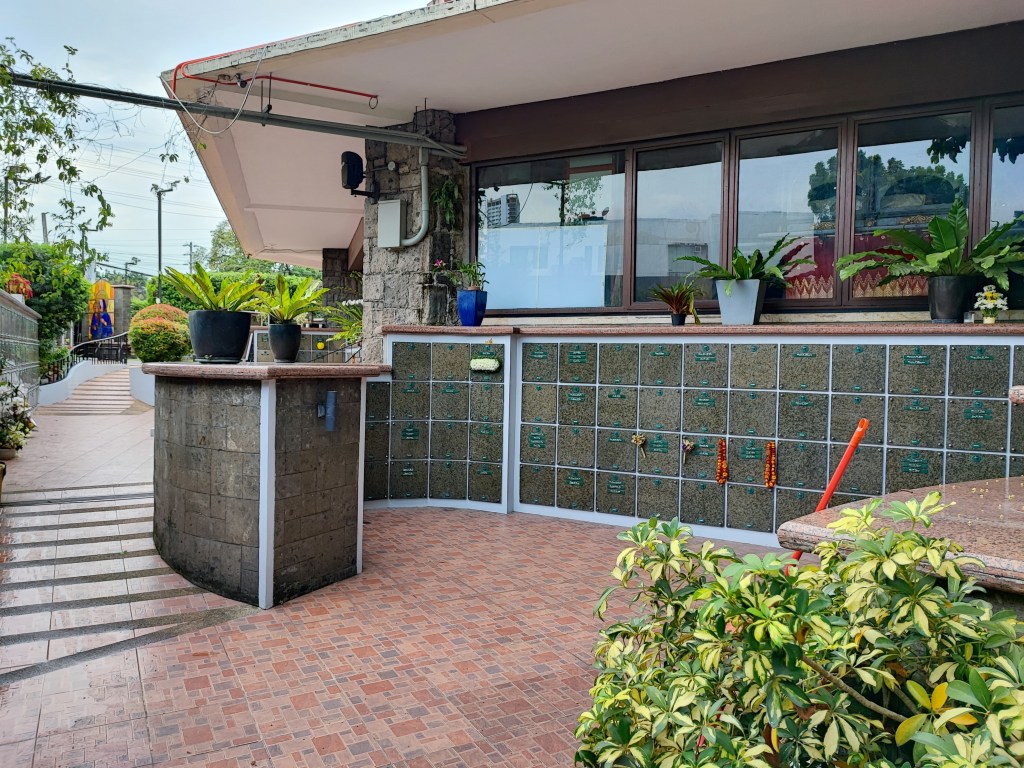
Dave told me he brought the ashes of his Mom home. Inurnment at the columbary will be on the 40th day also at the Loyola Commonwealth. Inurnment is the process of placing cremated remains in an urn. The urn is placed either above the ground in a niche, or below ground in a grave.

As early as Dec. 30, Dave emailed me, saying, “My mother is still fighting the happy battle together with God. She’s slowly regaining her appetite and physical strength but unfortunately we cannot prevent other complications to arise because of her illness. Her feet are beginning to swell “nagmamanas” possibly due to kidney failure. We put our trust in God with everything my mother is going through that He will continue to give her that fighting courage and spirit to fight the happy battle.

“Thank you very much for all your prayers and concern! Keep in touch!

Happy Holidays! God Bless!

“Dave”

By Monday (Manila time), Jan. 2, my other first cousin (Rosario “Sayong” Garra Burgos) emailed me, “Kaninang 6 a.m. iniwan na tayo ni” Yangos. (At 6 a.m., Yangos left us.) “Hindi me makatulog kaya pala. (That’s why I could not sleep.) (At) 7 a.m., tumawag c Manoy Uyi at nag text daw c Dave na wala na Ma2 n’ya.” (At 7 a.m., Jorge (elder brother of Yangos) called me, telling me Dave texted him his Mom is gone.).

Yangos is survived by Dave, Dave’s wife, Jackie, their two-year-old son, Danny, Yangos’ elder sisters, Panching and Belen and elder brother, Jorge. Her husband, Danny Chua, died five years ago. Yangos was the youngest daughter of the late Dominador G. Garra, a retired treasurer of Matnog and elder brother of my late mother, Consolacion Garra Lariosa.

Yangos studied education at University of Santo Tomas and celebrated her 62nd birthday last Dec. 21st. She worked at the real estate department of the Social Security System in Quezon City for a long time.
In my last phone conversation late last year with Yangos whom I had not seen in more than 50 years, she blamed her smoking habit and her lifestyle for her lung cancer.

We will miss you, Yangos. (lariosa_jos@sbcglobal.net)

——————————————-