Bulan Observer Supports Swiss-Asian Chamber Of Commerce Task Force Asia

by jun asuncion


The devastation of  typhoons Ondoy and Pepeng to the Philippines was unprecedented in scale and magnitude. The whole world was witness to this natural catastrophe and the drama of the Filipino people as they fought to survive. Videos and  photos uploaded in internet platforms are documents of our suffering: A whole family on a roof that has been violently carried away by the gush of the swollen river only to be smashed against the concrete support of the bridge and be drowned as others were helplessly watching; a woman and a child carried by the strong current crying out for help. We can only wonder what she said to her baby before they were swallowed down the depths of the river…

 Now that the storm is over, the only thing left is to help those victims  make their miserable destiny bearable to them-  and to us. We know that catastrophes do not distinguish between rich and poor. The only difference is that the rich may recover materially much easier than the poor ones. The rich victims may already be under the shower and dressed with fine clothings  dining in fine restaurants and sleeping in comfortable rooms in hotels or fine apartments provided by their rich friends. But where are the poor? They are still there with their poor companions, stuck in the muds among the debris and sleeping in evacuation centers- if these were quickly provided by the government. Otherwise they are still  in the streets, wallowing in muddy waters, hopelessly lost, hungry and cold.

We may have been thousands of  miles away from Ondoy and Pepeng, thousands of miles away from the deep waters of Marikina and from our drowning citizens. Yet their crying voices seemed to have been heard in the farthest reaches of the universe. It is painful for those who heard them, even to those who do not share the color of our skin.

These crying voices echoed also in the alps of Switzerland and in the noble streets of Zurich. The Swiss were quick to respond, the humanitarian tradition being firmly rooted in their heart and soul. A Swiss lawyer, Dr. Martin Kurer, chairman of the Swiss-Asian Chamber of Commerce- Philippine Chapter and co-founder of the Taskforce Asia, quickly connected himself with two Filipino nurses here in Zurich, Franklin Patricio and Milagros Asuncion, who are both working in Hirslanden Clinic, to ask for  their help on fundraising for our fellow Filipinos who are still stuck in the miry streets of Manila. Milagros Asuncion is a photographer of Bulan Observer. She also had a taste of flooding  when Storm Dante battered Bulan last May. Now the engagement to flood victims continues even when far away from home.

 In order to help raise funds, she endorsed SACC by way of offering her  testimonial to the Taskforce Asia, appeared in the Caritas, a humanitarian organization with seat in Zürich, will be appearing on  a radio interview and will be- together with Franklin-  organizing a piano concert in Zürich. I am, on the other hand, just sitting quitely at the background with my laptop-, writing for some websites here and writing letters for donors. All for the benefits of our bedraggled homeless Ondoy victims in the Philippines.

The SACC Task Force Asia was set up by the Philippine Ambassador to Switzerland, H.E. M aria Theresa P. Lazaro, and Martin Kurer, Chairman of the SACC Philippine Chapter.

Here’s the Website of the Swiss-Asian Chamber of Commerce with our two  Filipino “ambassadors of goodwill” Mila and Franklin:


Milagros Asuncion, Nurse at Hirslanden Klinik in Zurich, Heart-Thorax Surgery Station.

Mila SCC “My name is Milagros Asuncion. I am a nurse at Hirslanden Klinik. For the past 28 years I have been working as a nurse in Switzerland. We have experienced very bad storms in the Philippines before, but this Ketsana, or Ondoy, is worse than anything I…( click here for more…)


Franklin Patricio, Nurse at  Hirslanden Zürich, Heart-Thorax Surgery Station

22I am Franklin Patricio. I am working as a nurse in a hospital in Zurich. The Philippines are very much affected by the storm which has hit Metro Manila and Northern Luzon, as the fate of my sisters’ family shows. Please support the… (click here for more…)


Bulan Observer will be supporting more humanitarian projects of the Swiss-Asian Chamber Of Commerce  in the future.

(Photos supplied by Swiss-Asian Chamber Of Commerce- with special thanks to Dr. Martin Kurer!)

——————–

Realted Articles


But we are not destroyed (as published in Taskforceasia.ch)

 by Maribel Oana, Zurich, Switzerland

I still have my family: my mother, a widow for 43 years, who has been blind for almost 15 years, and crippled- because of a car accident last 2005- but saved; with her is my youngest brother with his wife and their 3 children, they are the ones taking care of my mother. Venue:  our  two-floors Residential house in Vista Verde Executive Village in Cainta Rizal, one of the most devastated areas hit by Typhoon Ondoy.

This is their story, as related to me by my mother and my sister-in-law.

September 26, 2009, Saturday at about 8 o’clock in the morning; the water in the streets were we lived were already ankle high (our house is one meter elevated from that of the street). After less than 15 minutes, the water rose and have reached our main gate and Garage, so my brother told my mother that he will accompany her in going to the second floor because the water is rising fast. My mother didn’t took this seriously because she knew that it never flooded in our house even when our neighbor subdivisions are under water, ours never was.

My brother and his 2 sons started putting the appliances such as the Refrigerator, washing machine and electric cooking range on the dining table while my sister-in-law and her daughter brought some biscuits, rice, noodles and water upstairs and nothing else (they were caught unprepared for this situation). Another 15 minutes gone by, the water was already inside our house on the first floor and 1 inch below the knee. My brother hurried to my mother and let her stand on her feet to make her believe that the water is truly inside our house and she was very much frightened and shocked as she felt the water on her knees.

My brother carried my mother upstairs for there is no more time left because the water is rising up every minute. Then he and his sons took the light furniture upstairs as fast as they can and that within 5 minutes then after that is history: a huge amount of water flooded our first floor.

My brother was nearly drowned for he was caught unaware, because the appliances that were on top of the table fell on the water and bumped him, he was trap in the middle of the swimming appliances and the swimming piano, thanks God, his sons pulled him up.

Not long ago on the second floor, they heard voices from outside calling for help; they saw our neighbors swimming outside crying and shouting for help. Their houses (only one floor-Bungalow style) were under water with only the roofs seen. My family welcomed our neighbors

(2 families and the youngest was a 5-year old boy). Before 9 o’clock (within less than one hour), the whole place was flooded 2 meters high, and remained there 2 days and 2 nights, with no electricity, 3 liters of water and only biscuits to eat (for they cannot cook without electricity). We were able to communicate with them through cellphone on a limited basis, since cellphones need to be recharged, too.

We may not be with our family physically during this Ondoy Tragedy, but they were always in our prayers and we motivated and encouraged then to pray, too and continue to trust in God even this times of suffering, for we know that God is still in control! My eldest brother and his family, and my eldest sister’s family were saved, but we are still looking for our cousin living in Provident Village in Marikina who until now is missing. My mother is a prayerful woman and she told me this; “my child, we may be struck down, but we are not destroyed, Praise be the name of the Lord!

The Aftermath: as of now death toll is rising up, a lot of people is still missing and thousands of people are homeless and hungry. In behalf of my countrymen, I’m asking and pleading you to please help us in cash of any amount or in kind (any old clothes, old shoes, old linen)./

———–end————-

The Final Insult To The Filipino Mind

by jun asuncion

This SONA 2009 sounds like a desperate appeal to the public of one of the most unpopular presidents of the Philippines- Gloria Arroyo- to change their perception of her for the better before she steps down the throne of power where, for years, she overstretched the meaning of political corruption in the Philippines. Aside from that, she tarnished badly the image of a woman politician in the Philippines- to the disadvantage of some promising and competent women politicians in the country like Loren Legarda.

To divert the attention of the public, she used strategically such positive words as “work”, “lead”, “protect”, and “preserve”. To qoute her: “I did not become President to be popular. To work, to lead, to protect and preserve our country, our people, that is why I became President. When my father left the Presidency, we were second to Japan. I want our Republic to be ready for the first world in 20 years..”

She associated her name with the memory of her father who allegedly placed the Philippines second to Japan during his time. These are all cheap psychological tricks employed to manipulate the public mind and shape their perception of her- in other words, to polish her image. This going back to history to use it to one’s advantage in face of the actual desolate situation of the country in many levels- social, political and economic- is a typical myopic perception of somebody from a political dynasty. Myopic because vested interest has always the self- or ego, or the clan if you prefer it- as point of reference, and not the all-encompasing goals set by the Philippine Constitution.

 It is this megalomanic and egocentric political system in the country that prevents it from joining the first world, a goal set by Arroyo to achieve within 20 years. This is an illusion, a wishful thinking, and should not be confused with positive thinking and visonary leadership for she did not possess this patriotistic and moral uprightness characteristic of a visonary leader like Gandhi, Mandela or Obama. An illusion leads a country to nothing. To insult the Filipino mind several times by the number of corruption scandals within her family, the high records of human rights violation and killings of investigative journalists during her administration, the high rate of emigration of Filipino nationals, the astronomic foreign debts of the country which doubled during her presidency, etc. – all attest to misgovernace and dissatisfaction of her government and to the reality of her delusion. To join the first world, the Philippines must in the first place build a stable  political base, reform the electoral process, penalize corruption practices and must have a nationalistic, democratic and morally strong national leader. I think Arroyo have missed correcting these flaws in our country and even missed correcting her own self. So this good sounding dream of joining the first world lacks sincerity, just thrown into the air to insult you and me.

When people flee, it’s never a sign of happines. When killings and corruption scandals are never solved, it’s never an indicator of democracy, social justice and functioning five pillars of justice or checks and balance system- but of strings being pulled behind to the center- the self. Economic statistics never tell the truth when used by an unpopular president whose intention is to repair her broken public image. So it’s hard to buy the figures she’s selling out here. They are designed to insult the Filipino mind.

Being an economist, she claims authority on this subject, claiming that the world finacial crisis did not ruin the Philippines as it did to other countries. The Philippines was spared of it- thanks to her economic programs- like the OFW which sends her billions of dollars annualy. Again one must exercise caution here. The world crisis was a bank crisis in the first place. The Philippines do not have giant banks that invested huge amounts outside the country- like the UBS of Switzerland where it lost billions of dollars in the US. But this involves mainly the UBS and not the whole country of Switzerland. Jobs were lost naturally, but the whole Swiss economy is as strong as before. It is mainly because of a stable social and political system- not because of its giant banks like UBS and CS. Local and foreign investments abound because of peace and political stability.

 As we all know, political stability is never a strength of the Philippines since decades  already- so don’t expect economic stability as stressed in SONA 2009 by Arroyo. Her very own administration was from the very beginning  also unstable. It is ridiculous how she stands all alone before the nation and flamboyantly cites  proofs to the rising economic wealth of the Philippines under her presidency- but immediately calls the aid of her lawyer to explain for her before a group of inquiring concerned citizens  her own remarkable growth in wealth she has accumulated up to now. Why a lawyer? Does she honestly not consider her own wealth as a direct result of the rising economy of the Philippines under her own economic programs?It’s funny how she displays her honesty.

 Here’s the latest proof of this instability and the all-pervasive odor of corruption that has engulfed her administration from the beginning till the present:

***

 MBC asks Arroyo to explain remarkable growth in wealth

RUBY ANNE M. RUBIO, GMANews.TV 08/14/2009 | 07:08 PM | |

 An influential business group joined the growing calls for President Gloria Macapagal-Arroyo to explain her accumulated wealth after her net worth doubled every three years as a public servant for 16 years. In a statement, the Makati Business Club said the business community would be particularly interested in the remarkable growth of Mrs. Arroyo’s net worth when her personal wealth soared by 2,032.84 percent to P143.54 million in 2008 from P6.73 million in1992 based on a report by the Philippine Center for Investigative Journalism (PCIJ). “Held against the light of economic reality and the First Couple’s declared assets and income sources, the impressive growth of Mrs. Arroyo’s wealth is difficult to fathom,” MBC said.

MBC noted Mrs. Arroyo’s stock portfolio grew by 41 percent per annum from P55 million in 2006 to P110 million in 2008, at a time when the Philippine Stock Exchange index fell by 21 percent. “Like Caesar’s wife, the President must be above suspicion. As the highest public servant in our country and in the interest of good governance, Mrs. Arroyo must set an example by making a full and transparent accounting of her and her family’s wealth. She owes the Filipino people an explanation,” the group added.

The group lauded PCIJ for a “job well done” on its three-part series on Mrs. Arroyo’s “still-to-be-explained wealth.” “The press serves a watchdog function and, disagreeable as it may be to those who have suffered its nasty bite, we must allow the press to perform this function, without coercion or threats,” MBC said. “It now behooves the President to personally respond to the issues raised by the PCIJ article. It is unfortunate that instead of clarifying matters, the President has opted to call in her legal advisers who have tried to attack the message as well as the messenger rather than respond in any meaningful and germane manner,” it added. Mrs. Arroyo’s lawyer, Romulo Macalintal, defended the President, saying his client did not manipulate her statement of assets, liabilities and net worth (SALN).

Macalintal has served as her lawyer in an electoral protest. “Through her lawyer, the President has stated that she stands by the ‘truth and veracity’ of her SALN, but it is difficult to accept her statement at face value if all that she has to substantiate her claim is the paltry information provided in the document and her spokespersons’ explanations that only lead to more unanswered questions,” the MBC said.

See related articles:

“RP gets poorer, Arroyo gets richer”

‘Arroyo foreign travels cost P1.6-B more’

——————————end—————————-

The Eye Of The Storm

There is also calmness not only before but after the storm only that there is much to be done: rebuild bridges or homes, look for missing friends or family members, nurse the wounded and eventually bury the dead.

For the government and rescue leaders that’s the time for damage assessment and evaluation of its disaster management performance: To what extent ist the damage to persons, crops and infrastructures? How did the rescue team perform according to  its operating standards, in which area is it especially successful and in which did  it miserably fail?

These are routine questions asked after any disaster. The main thing however is to draw concrete lessons from the whole event and use them to improve the disaster management system- and put more money in it in terms of personnel training and acquisition of technical facilities and equipments.

It is wise to invest in such things because typhoons and flooding will continue to be our number one natural calamities as opposed to earthquakes, volcanic eruptions or meteoric attacks.

So why not consider this problem seriously and sincerely by now by creating an expert group that will study the general patterns of typhoons as they enter Bulan and how flooding  generally develop by pinpointing flood „epicenters“ in Bulan. The main goal of this is to gather Bulan-specific data (histories of typhoons and floods, catch-basins, damages, etc…) that will guide any program related to typhoon and flood management. Scientific prediction is never based on an empty paper or entrails of chicken but on collection of data. Therefore, any disaster management not based on the locally-collected data is blind, incomplete, unsystematic and not optimized. This is more costly in the long run. Whereas prediction and estimates supported by science is effective and less-costly with time.

Again, flooding reminds  us of one important aspect which is adequate canal systems under the streets of Bulan and construction of pumphouses in key areas of Bulan. As I have seen we have no canal system that channels household and rain waters to a place outside the town or ideally to a sewerage plant. Functioning underground canals reduce the water level above in case of flood.

The whole thing demands political will and people’s participation- and attitudinal change! A town official may take pride of his great income and luxurious life style only if such problems had been solved first and when he doesn’t have to leave his luxury house and flee uphill in times of flood. Otherwise, such a display of luxury and vanity is out of place  and only attest to illegal practices which choke the town people and flood the town with unsolved problems. This being-out-of -place reminds me of Iglesia Ni Kristo church amidst the shanties, making the poor people appear dirtier and poorer against such a well-built and cleanly-maintained Gothic religious edifice. You’ll intuitively know why these poor people near such a church  are ten-percent poorer than those who are far away  from it. The good thing is that you can run away from such a religious mafia and settle somewhere else.

In any case, we don’t want  the town people to appear dirtier and poorer beside the municipal building or beside their municipal officers and their families. But when the government behaves like an Iglesia Ni Kristo establishment, then there is a grave problem  for you cannot run away from it. People will be more than just  ten-percent poorer, and if you live far from the town you maybe  much more impoverished. However, be it the church or the government that’s making the people  poor, the people must not only be self-reliant but must be politically conscious and active and must resist the corrosion of their collective values.

There is, however, one stumbling block to the collective- and that is the problem of jealousy that looms in each Bulaneño. This may sound very ordinary but this is the crab mentality that we have been talking about which is very real not only in paper but in the daily life of Bulaneños. But we display such mentality (or emotion) rather discretely- and quietly in the true sense of the word.  In short, we don’t talk about things over which we are jealous  for some reasons. Not to talk about something  is almost synonymous with not supporting that something.

Exactly the same with things or topics that we hide or want to avoid. You would easily sense that somebody is hiding or avoiding something by the contortion of his face, the sudden jerking of the body to one side as if avoiding a Pacquiao  left uppercut  once you hit a hot issue-  or one simply hides  behind somebody as you pass by to prevent you from smelling the pungent odor of  his or her dishonesty.

Not many things escape your eyes when you come to observe things and people. But it’s funny to find out that those who are observing you are usually the people you come to observe.

So be calm and let the eye of the storm go by.


jun asuncion

Bulan Observer

Pawa Hospital Is Sick: Let’s Do Something And Help

My email and open letter to the president of the Philippine Hospital Association (PHA).

May 27, 2009

Bulan, Sorsogon


To the incumbent president of the Philippine Hospital Association (PHA):

Dear Sir:

I am fascinated by your motto Take That Big Leap to the issue of strengthening the hospitals of the Philippines which I copied from the PHA website and reproduced hereunder :

“TAKING THE BIG LEAP, STRENGTHENING THE HOSPITALS OF THE FUTURE”


I come from Bulan, Sorsogon, Region 5 and also would like that our Pawa Hospital not be forever forgotten and left behind but be part of that Big Leap. I am not for strengthening our hospitals of the future but of the hospitals that exist today. Pawa is a member of PHA and has been around for many years already but it hasn’t improved since its establishment but deteriorated. It is very weak and very sick and requires strengthening now!

It is in a very desolate situation in all its aspects:

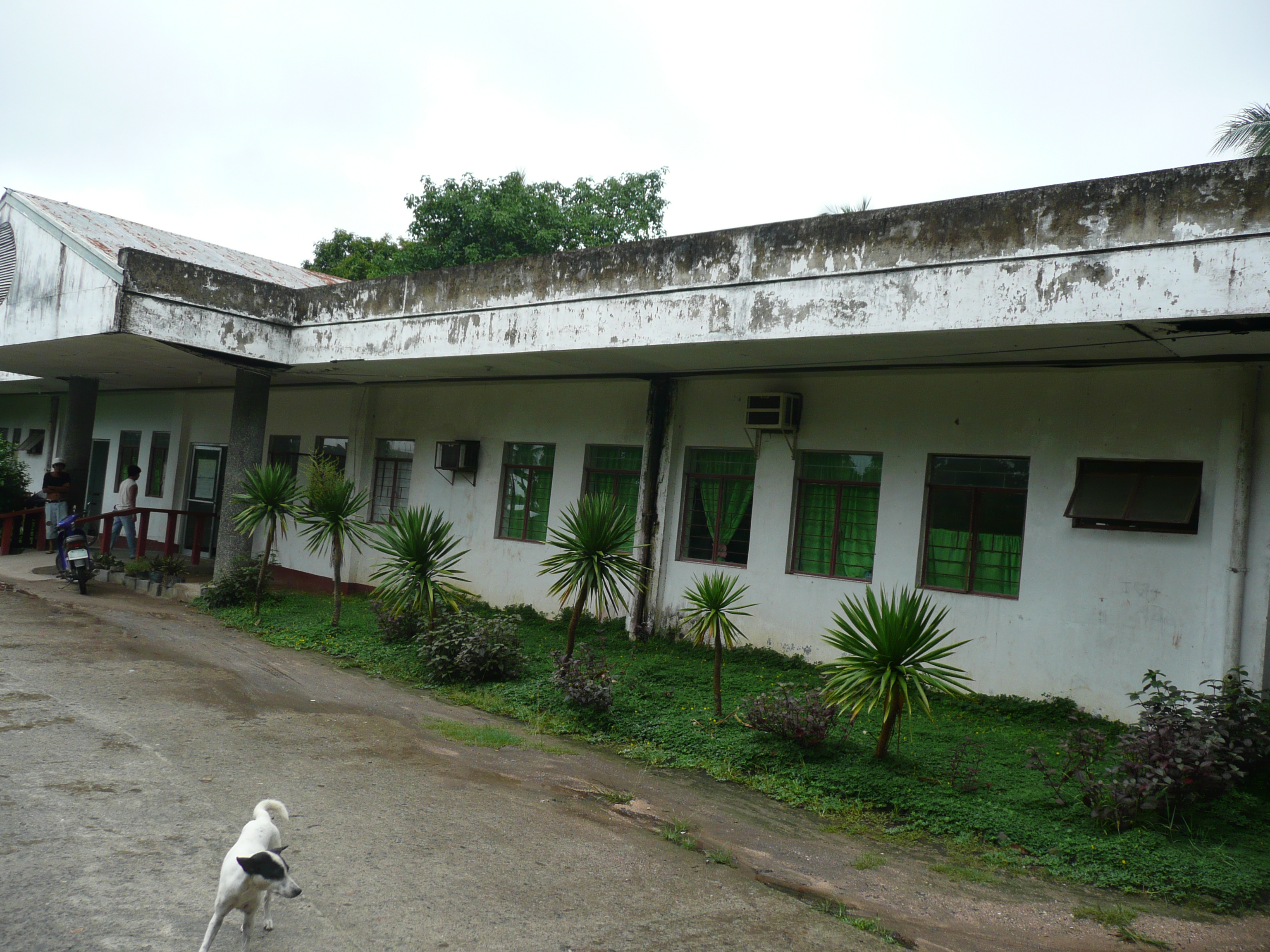
-the building has never been repaired as it looks dilapidated, dirty façade and moldy walls both outside and inside, dark corridors and broken floors, very poor illumination, dirty toilets and generally very poor sanitary hygiene. Indeed, by modern standard, it is a ruin but still continue to admit patients.

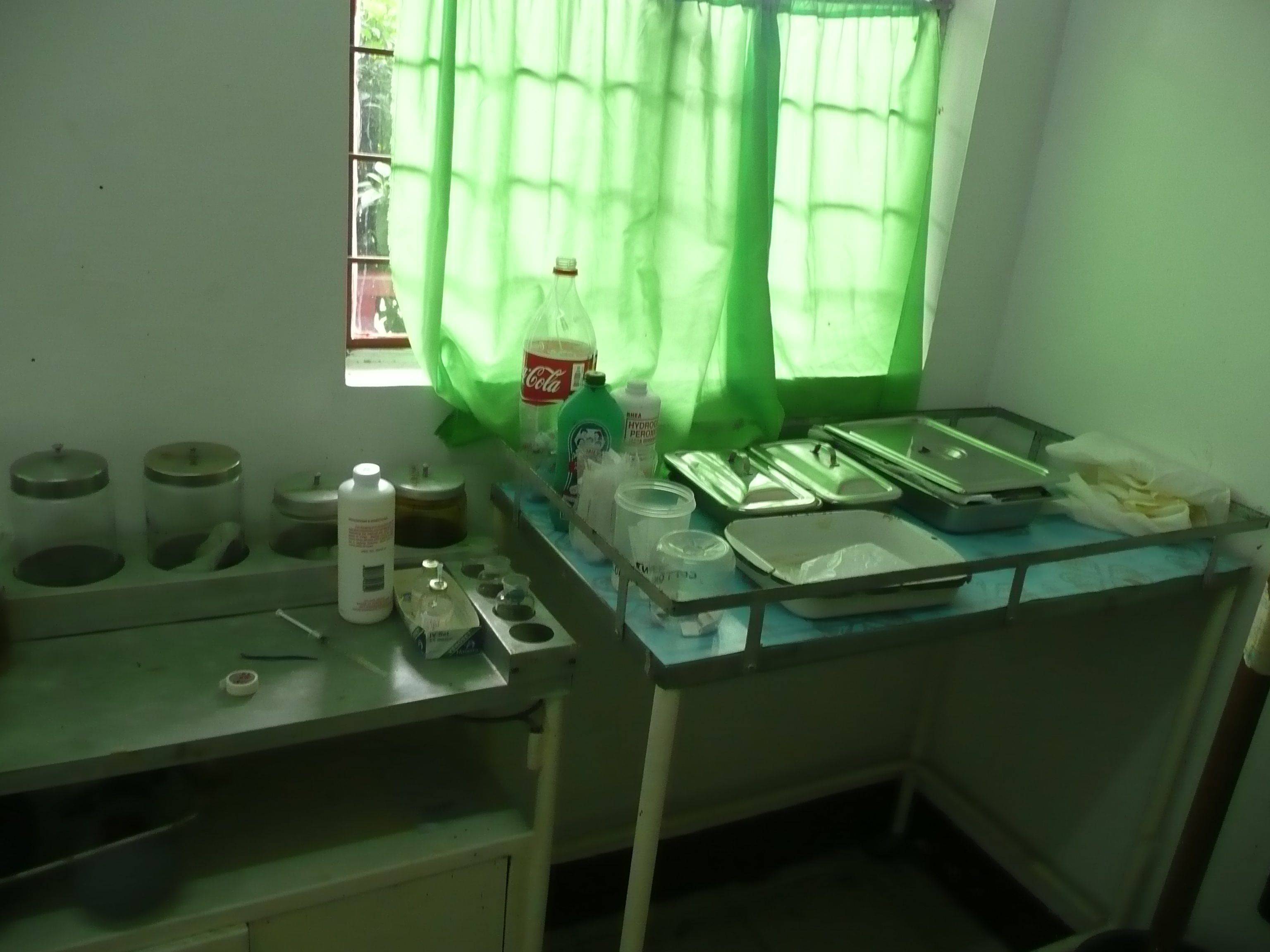
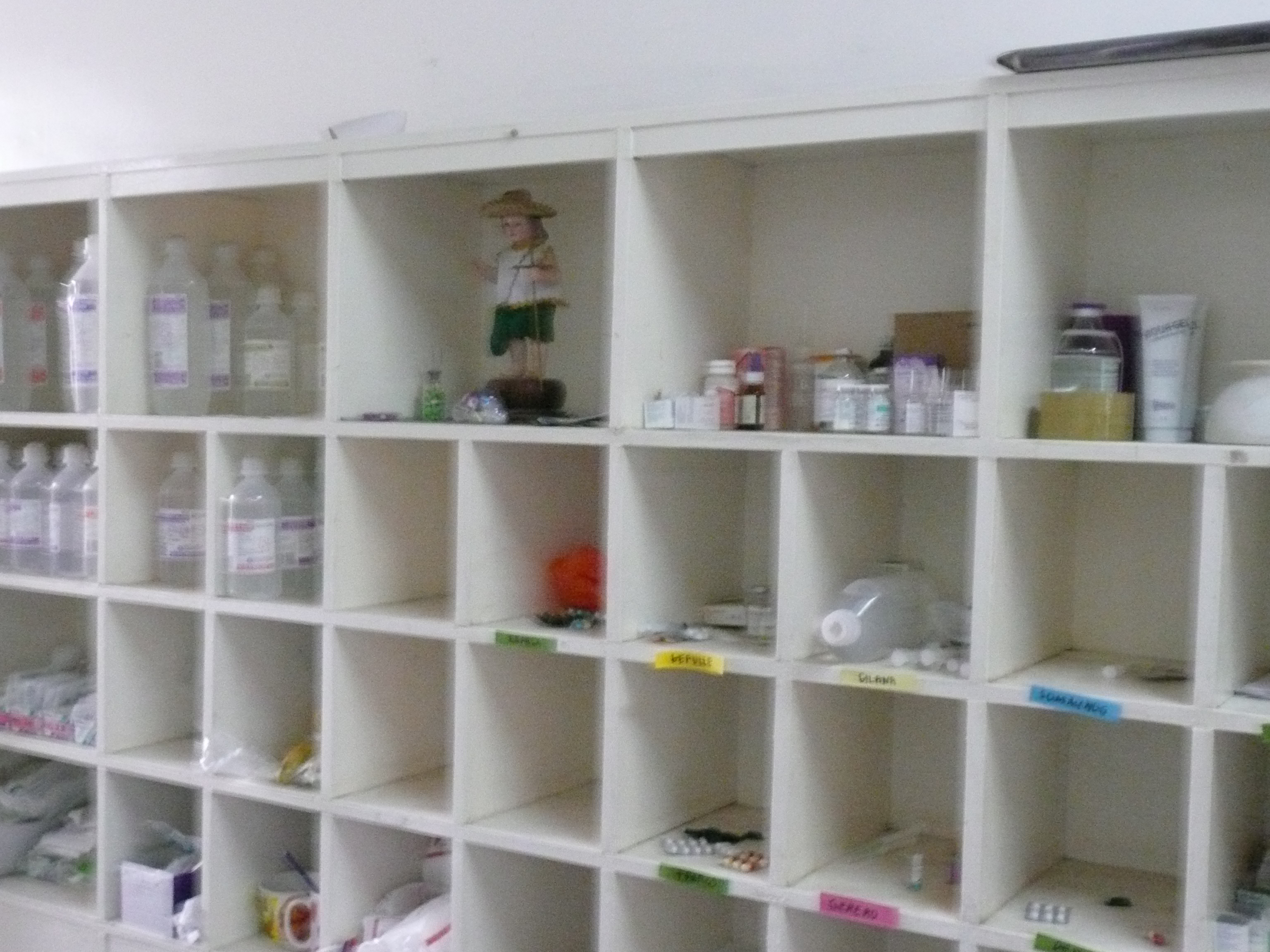
-the medical facilities and instruments  are practically missing, even the most basic ones like stethoscopes, blood pressure gadgets are very limited and partly defective, etc.

Yet, the medical personnel of Pawa are willing to work and continue helping their patients. But as we know, the lack of the right instruments and medicines and the very poor facilities limit also the capacities of medical workers no matter how good and willing they are.

Our local government has done something to increase the number of medical doctors in Pawa and help where it can. But technically, Pawa Hospital falls on the provincial responsibility, hence the LGU Bulan does not receive or does not possess the allocated budget for the maintenance of Pawa Hospital.

The photos I posted will speak louder than words. And should you come for a visit to Pawa Hospital you would- as a healthy person- hesitate to get inside in the interest of your health and hygiene. This would be understandable. You in turn would understand then what a sick patient has in mind being delivered in Pawa Hospital for “treatment and recovery”.

I ask you in your capacity as PHA president to do something for Pawa Hospital that would bring Pawa  to public consciousness and to governmment authorities directly responsible for this hospital and, last but not least, to any activities that would bring in financial resources for its repair or renovation and for the upgrade of its medical facilities.

I thank you for your attention and for all the efforts you will be undertaking for Pawa Hospital.

Sincerely yours,

Jun Asuncion

Bulan Observer

 ————

P1070788


At first glance, you might think this is a deserted military camp.


P1070790


P1070789


 But this is a hospital, the Pawa Hospital in Bulan.

P1070792


Young and friendly nurses at work. They deserve a cleaner and modern hospital to work to.

P1070806


 Admission room? No computers, not even a type writer.

P1070809


 Oxygen tanks, perhaps empty, beside trash bins and broom.

P1070808


Sterile materials?


P1070811


The very minimal medical materials, lacking medicines.


P1070794


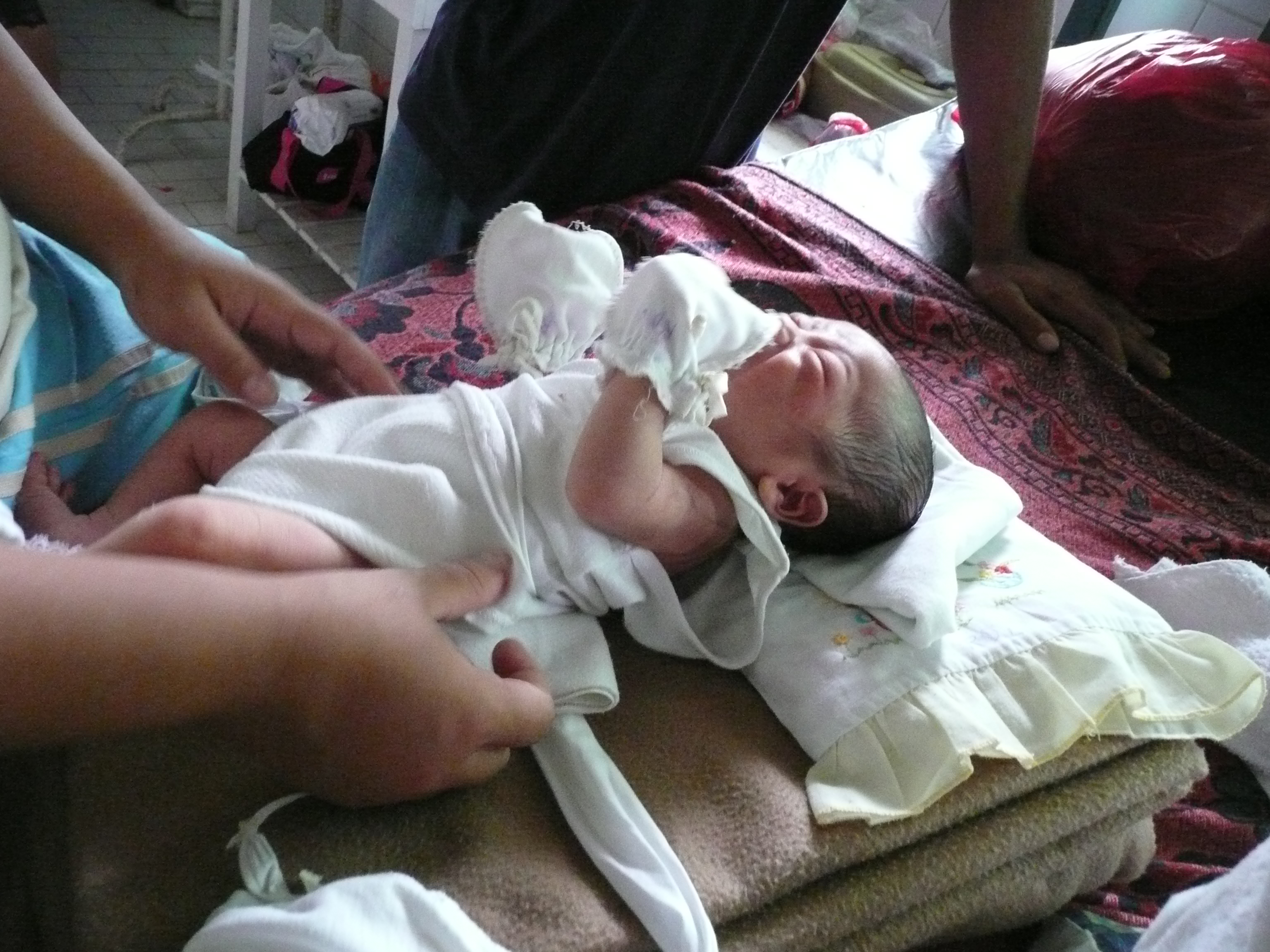
Yet, a newly born Pawa baby.


Pawa Hospital should be improved and upgraded so that it can serve our people better.

Let’s create a forum to discuss ways how we can help and eventually create an aide scheme.

I have created under Categories on the right the Pawa Hospital Forum for this purpose.

Please help Pawa Hospital.

(View all photos.)


jun asuncion

—————————————————————————————

The Way To Bulan Eco-Park

By: jun asuncion +* LGU- Bulan Mayor Helen De Castro and Tony Boy Gilana


We have taken all these photos by ourselves on that sultry summer morning last April 2009.  As I was sorting out the photos for this documentary article, I realized that I couldn’t provide myself  the necessary informative captions for each photo.  So I called up Mayor Helen De Castro and asked her if she could help provide the needed information. I caught her right in the middle of a meeting about H1N1 Virus (Swine Flu) but she was really  kind enough to listen to my concerns and promised she would send Bulan Observer the materials. I also knew how busy her team was at this point because of the upcoming town Fiesta. So it took awhile, but we have patience for good things.

The purpose of this little documentary is to give readers of  Bulan Observer especially those who are away from home a visual tour of the Bulan Eco-Park so that they will have a concrete image of it. Interestingly enough, my own mental picture of the Eco-Park before my visit did not diverge far from the real picture of it – at least as far as I could roam around and shoot photos and videos of it. Lack of a guide and time prevented me from exploring the whole park for it is really big.

Now, with the additional captions written in our Bulan dialect and other article-related substantial information in English sent by LGU-Bulan, it is practically a guided tour as you go from one photo to the next. The added facts and updates  at the end of the report will  round up your knowledge about the park. So enjoy your way to Bulan Eco-Park!  jun asuncion

———

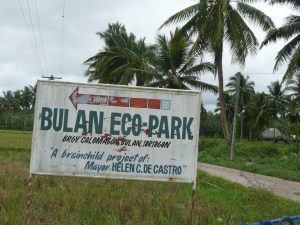
It was a nice April morning when we drove to  Calomagon  to visit the BulanEco-Park. It’s not far from the center of the town. After Somagonsong  we found the signboard on the left side. We were excited and took photos along the way to -and from the Eco-Park. (For your sound as you travel, click the first photo and then minimize your media player)

P1070494


P1070495


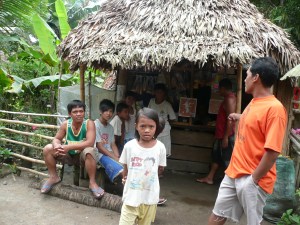
 A local Kiosk with young bystanders just passing the time, curios-looking eyes to passing strangers.


P1070496


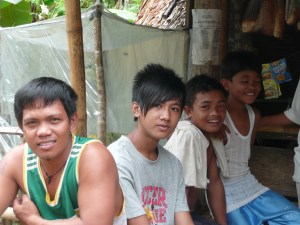
  Yet friendly and smiling faces.


P1070500


 Turn left again to a long and winding – and rough road, naturally.


P1070502


 Here’s the road in front of us, looking  quite and deserted, windless day, indeed a calm before the storm.


P1070503


 (A quarry pit over there?)

Photo No. 6:

*Mao tabi ini an inkukuwaan ta baras na pangtahob ta sa mga basura saato dumpsite. Regular (weekly) tabi na in-uusong, hinuhulog san heavy equipment unit an basura sa bangin. Pakahulog tabi, tatahuban ini san baras (soil cover).


P1070504


Looking like a natural gate marking the border to another town.


P1070508


 Coconut plantation, an almost magical ambiance, like an oil painting from afar, palm leaves silvery and shining.


P1070515


 Here we are, the Welcome signboard.


P1070516


The certiicate of recognition to our Mayor De Castro  for excellence in environmental governance on Solid waste Management.


P1070518


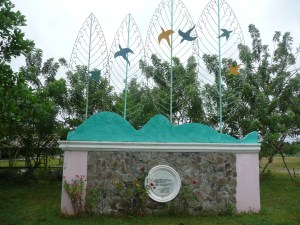
 A symbol for natural harmony- at least the way I see it.


P1070517


Photo No. 12:

*Mao tabi ini an demo garden para saurbanagriculture o container gardening. Laom tabi sini na maipaimod sa mga tawo na sa halip na itapok an mga old containers o butangan (plastic, empty milk cans, platic cups, sako, nan iba pa) sa basurahan, pwede pa tabi ini gamiton bilang plant pots para sa mga ornamentals nan gulay). Intended/designed tabi ini lalo na sa mga urban areas o poblacion areas kun haen limitado o wara na tabi lugar para pagtanuman.

P1070520


Photo No. 13:

*Parte tabi ini san kampanya san Lokal na Gobyerno sa pag-implementar san waste segregation

P1070521


 A cow discretely resting beside a bahay kubo, seems to be observing us.

P1070525


Photo No. 15:

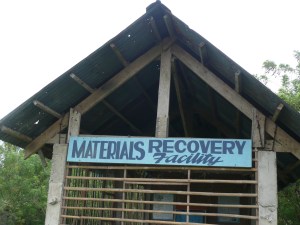
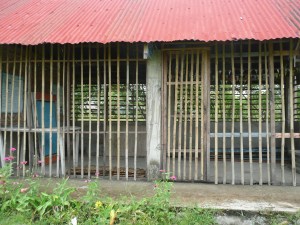
*Mao tabi ini an istruktura kun haen tabi naka locate an Materials Recovery Facility. Pagsakat tabi sin trak para magtapok basura, didi muna tabi ihuhulog an mga basura na puede pa pakinabangan nan ipabakal. Ini tabi na istruktura, hinati sa tolo na kuwarto (Lecture Room, Materials Recovery Facility, Ecology Center).

P1070526


Photo No. 16.

*Lecture Room. Didi tabi inhihimo an briefing o orientation sa mga bisita (LGU, estudyante, empleyado, o grupo na interesado maaraman an programa san Municipio sa Solid Waste Management) sa Ecopark. Didi man tabi inhihimo an demo san paghimo san mga manalaen-laen na activators para sa composting.

P1070527


Photo No. 17.

“An sulod tabi san Lecture Room

P1070528


Photo No. 18.

*Mao tabi ini an section para sa Materials Recovery Facility.

P1070530


Photo No. 19:

*Mao man tabi ini an section para sa Ecology Center. Showcase room tabi ini para sa mga recycled products, information, nan mga pictures/documentation san programa sa Solid Waste Management.

P1070534


Photo No. 20:

*An nasa left side tabi na structure, sayo po sa mga rest areas o cottages sa Ecopark. An sa right side tabi, mao an vermiculture nan vermicomposting facility. Sa sulod man tabi sini nafacility an shredding area kun haen naka takod po an shredder.

An vermiculture nan vermicomposting facility tabi, sayo na proseso san composting kun haen an ginagamit tabi ulod. Sa Ecopark tabi, an species tabi na may-on, mao an African nightcrawler. Pinapakaon tabi ini na mga ulod sin shredded na mga nabubulok na basura (market waste, grass clippings, etc.), an manure tabi nira, mao an produkto san composting. Mao man tabi ini an ginagahoy na vermicompost na pwede gamiton bilang soil conditioner o fertilizer sa mga tinanom.

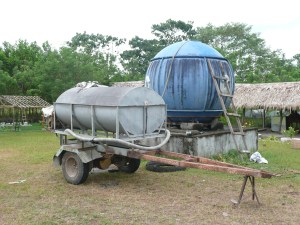
An kulay blue tabi, mao an sayo sa duwa na tanke tabi san tubi sa Ecopark na ginagamit pangsaribo sa mga tinanom nan sa operation san MRFnan composting facilities.

An kahiwasan tabi na nasa letrato, mao an inkokonduktaran san mga programa sa Ecopark pareho san Fiesta sa Kabubudlan (film showing, games, concert, disco, nan iba pa).

P1070535


Photo No. 21:

*Mao tabi ini an tanke san tubi sa Ecopark. Ini tabi na inguguyod na tanke, mao tabi an nagdadara san tubi sa Ecopark

P1070536


Photo No. 22:

*Mga nakasako tabi ini na mga nabubulok na basura (balat nan iba pa na parte san prutas nan gulay, dahon, buto, nan iba pa) na hale sa Public Market. Ini tabi kukuwaon san in-charge sa composting facility para darahon sa shredding area para gilingon, paaguihon sa 2 weeks na anaerobic decomposition saka ipapakaon sa mga ulod.

Maiimod tabi sa upper left side san letrato an shredder. Sa upper right side naman tabi, an mga composting beds o vermi beds.

P1070540


Photo No. 23:

*Mao tabi ini an mga tanom na puno san gmelina (about 2 years old). Sa likod tabi ini san vermiculture nan vermicomposting facility.

May-on man tabi didi sin hukay (0.75m x 0.75m x 0.50m) na pag nag-uuran, nabubutangan tubi. Ini tabi nakukuwaan man tubi pangsaribo sa mga tinanom nan compost piles sa likod..

P1070538


Photo No. 24:

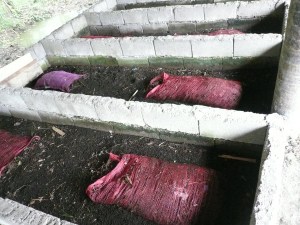
*Mao tabi ini an vermiculture nan vermicomposting beds. Kapag an shredded na basura tabi na binutang sa bed, halos puro manure na tabi san ulod, ibubutang na tabi ini na mga sako na may laman na fresh (although nag-agui na tabi ini sa 2-week na anaerobic decomposition process) na pagkaon para sa mga ulod. Mao tabi ini an paagui para makuwa an mga ulod nan mabalyo sa iba naman na beds.

Ini tabi na mga manure na, hahayaan mun-a tabi for 1 month sa lugar para maka-recover pa sin mga baby worms sa bed. After 1 month, pwede na tabi ini sakuhon nan i-stock sa bodega.

P1070541


Photo No. 25:

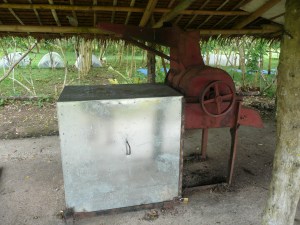
*Mao tabi inian shredding machine na ginagamit sa shredding process. Sini-shred tabi an mga basura para mas madali malupa nan makaon san mga ulod.

P1070544


Photo No. 26:

*An inkukuwaan tabi letrato san photographer mao tabian tree planting site san naka-agui na Fiesta sa Kabubudlan 2008. Sa left side tabi sini na lugar, mao man an campsite.

P1070545


Photo No. 27:

*Mao tabi ini an close up picture san demo garden para saurbanagriculture o container gardening. An bubong tabi sini mao an pakanapan para sa ampalaya, karabasa, nan iba pa na nagkakanap na tinanom. Maiimod tabi an mga lata, sako nan plastic cups.

P1070547


Photo No. 28:

*Sa sulod tabi ini san urban agriculture demo garden. Talong tabi ini na nasa sako. Pina-paimod lang tabi na an mga sako san semento, pwede man gamiton na patubuan san gulay/tinanom.

P1070548


Photo No. 29:

*Sa sulod man tabi ini san urban agriculture demo garden. Mga kamatis tabi ini na nasa sako man san semento. An kawayan tabi sa taas san tinanom, mao an pakanapan.

P1070550


Photo No. 30:

*Sa sulod man tabi ini san urban agriculture demo garden. Manlaen-laen tabi na gulay an nakatanom didi sa mga sako.

P1070552


Photo No. 31:

*Tanuman man tabi ini na kawayan. Naka-design lang tabi siya na A-Frame. An mga irog tabi sini, pwede ibutang sa mga roof top san balay.

P1070555


Photo No. 32:

*Signage tabi ini san Opisina.

P1070556


Photo No. 33:

*Mao tabi ini an Ecopark Office. Nagsisirbi man tabi ini stock room san Ecopark.


P1070558


Photo No. 34:

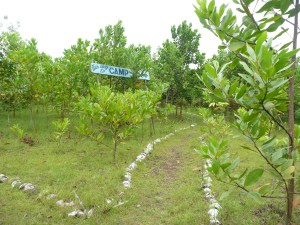
*Signage tabi pakadto sa Campsite. Kaupod tabi sa letrato an mga Acacia mangium trees (about 1 ½ years old).

P1070559


Photo No. 35:

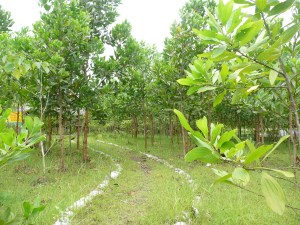
*Pathway pakadto tabi sa rest areas o cottages. Maiimod man tabi an mga puno san Gmelina arborea nan Acacia mangium sa palibot.

P1070561


Photo No. 36:

*Pathway pakadto tabi sa campsite

P1070563


Photo No. 37:

*Sayo sa mga rest areas/cottages. Kada rest area tabi, may signboard manungod sa solid waste management / waste segregation to inform the park goers about the policy of the LGU.

P1070564


Photo No. 38:

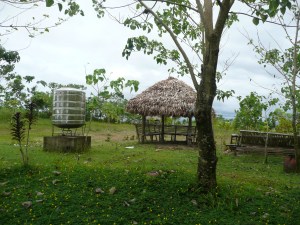
*An sayo pa tabi sa duwa na tanke san tubi sa Ecopark. Naka-locate man tabi ini harane sa bungad san Ecopark. Inbubutangan man tabi ini tubi para pangsaribo man sa mga tinanom na nakatanom sa parte na ini san Ecopark.

P1070565


 Driving back after a relaxing time inside the park.


P1070571


A good segment of the road, smooth driving.


P1070576


 This time a quintet of Calomagon boys. I’m very happy to see them as they look very natural, uncontaminated and safe from the dangers of  too much civilization.


P1070578


Towards the end of our journey before the exit to the town, a nipa hut  surrounded by flowering birds of paradise! They would cost a fortune in Europe.


If you would see the Eco-park as it is, it is surely a big accomplishment for our local government knowing that it is also a place where environmental agendas are being held every year. I would be very glad to see the Feast Of the Mountains, or to attend a lecture or workshop on solid waste management or global warming. How about a Music Festival- or a Jazz Festival? My own fantasy, as I walked on the ground of  Bulan Eco-park with my mind filled with ideas on how it could be improved  with time as Bulan progresses.

I would have wished it was a guided tour when I was there so that I could ask questions about things that were not clear for me. Maybe next time I would have this privilege. One thing that would make you happy are the young trees planted all over the Campsite and the well-kept paths. I wanted to know the names of the trees so I suggest that they’d be written in their local and scientific names. Included would be short information about each specific tree like distribution, importance to Bulan ecology, status ( endangered or not yet), etc.

I haven’t seen a source of drinking  water like a faucet , a well, water pump or  a grilling area , a multi-functional pavilion, garbage cans, a toilet and wash room for Park visitors. And I haven’t seen anybody there- except for a cow behind the signboard which says “Waste Segregation Suportado San KadaBulaneño”. Was that cow segregating also her waste? Cows by the way are one of the biggest culprits of this global warming. /  jun asuncion

—–

*LGU-Bulan Mayor Helen De Castro and Tony Boy Gilana

ANSWERS TO OTHER QUERIES OF MR. ASUNCION:

1. SPECIES OF FOREST TREES PLANTED AT THE ECOPARK:

Gmelina arborea (Gmelina) – exotic

Acacia mangium (Mangium) – exotic

Acacia auriculiformis (Acacia auri) – exotic

Swietenia Macrophylla (Big Leaf Mahogany) – exotic


Tinanom tabi ini na species maski aram ta na exotic tabi ini sa dahilan na ini tabi, fast growing kaya sa panahon tabi na nagbabatog pa lang an pag-develop san Ecopark, kaipuhan tabi shade. Although exotic tabi, widely distributed naman na tabi siya sa Pilipinas for how many years.

Pterocarpus indicus (Narra)

Albizia saman (Acacia, Rain Tree)

Leucaena leucocephala (Ipil-ipil)

Fruit trees:

Artocarpus heterophyllus (Langka)

Mangifera indica (Mango)

Carica papaya (Papaya)

Annona squamosa (Atemoya)

Canarium ovatum (Pili)

Cocos nucifera (Coconut)

Theobroma cacao (Cacao)

Ornamentals:

Gumamela

Mac Arthur Palm

Yellow Bell

Bougainvillea

Senyas

Santan

2. SOURCE OF DRINKING WATER / FAUCET / WELL / WATER PUMP /

GRILLING AREA

None yet, pero may plano na.

3. MULTI-FUNCTIONAL PAVILION SA ECOPARK

Sa niyan, an ginagamit lang tabi na area para sa mga activities, an kahiwasan san lugar na kahampang san vermiculture nan vermicomposting facility. Nagbubutang tabi stage nan big tents kun may mga lecture, demonstrations, programs, etc.

4. Garbage cans

Dire tabi kami nagbubutang san basurahan sa mga rest areas o cottages dahilan sa ini-encourage namo na paghale san mga park goers sa cottages, dara tabi nira an basura nira para ibutang sa garbage receptacles na naka-locate sa gilid san tinampo.

5. Toilet

Dire lang tabi siguro nakuwaan letrato an mga toilet rooms. May 3 sets (one cubicle for men, one cubicle for women) tabi na toilet strategically located tabi sa Ecopark. Pa-triangle tabi an location san mga toilet since masyadong malaki ang lugar. An sayo sa may campsite banda, an sayo sa may durho na cottage, an sayo sa may centro san Ecopark.


 BULAN SOLID WASTE MANAGEMENT PROGRAM

The “Bulaneño Ako, Basura Ko, Sini-segregate Ko!” Program is one of the priority thrusts of the Local Government Unit of Bulan. It was first conceptualized in 2004, launched in 2005 and strictly implemented in 2008. The program encompasses the whole solid waste management program of the LGUandwas designed for: a.) sanitation and environmental protection, b.) sound solid waste management systems, c.) provision and enhancement of livelihood opportunities through intensive resource recovery and recycling, and d.) minimization of public expenditures.

Prior to the program implementation, there were clear violations of RA 9003 which were really detrimental to the environment and lives of the people. Rampant burning of solid wastes in the household and in the municipal dumpsitewas prevalent. Throwing garbage at the different waterways seemed to be a normal scenario. Moreover, dumping of unsegregated wastes at the municipal dumpsite posed hazards not only to the environment but also to more than thirty (30) scavengers in the dumpsite seekingfor possible resources. Although Republic Act 9003 mandating all LGUstoimplement waste segregation and close all the existing open dumpsites was passed into law in 2001, implementation was difficult to materialize.

In 2004, the call for the execution of the mandates of the Act was very intense. It is the time when incumbent Mayor Helen C. De Castro decided to include Solid Waste Management (SWM) as one of her priority thrusts. To immediately act and address the existingsituation, Mayor De Castro formed a Technical Working Group (TWG). A plan of action was made and a series of multi-sectoral meetings, orientations and seminars for LGU key implementers and other stakeholders followed.

On June 30, 2005, the “Bulaneño Ako, Basura Ko, Sini-segregate Ko!” Program was officially launched. A month after, Mayor De Castro spearheaded the launching also of the Bulan Ecopark, with an aim of transformingthe existing open dumpsiteinto an ecological park. However, the first implementation of the program had not been successful. The problems were eventually traced to lack of regular monitoring and evaluation coupled with some operational deficiencies on the part of the LGU. Mayor De Castro realized the problem and tried to address it.

On November 2005, the Municipality of Bulan was enrolled to the DILGGO-FAR Project. In 2006, Mayor De Castro along with four (4) members of the TWG went to Linamon, Lanao Del Norte to attend the Replication Inception Workshop (RIW) on SWM. The good practices to be replicated then were the operation of Materials Recovery Facility (MRF) and the preparation of two (2) compost activators. On the same year, Mayor De Castro spearheaded the replication process. Relevant facilities were established and more intensive IECs on RA 9003 and Municipal Ordinance on SWMwerere-packaged. Finally, on March 24, 2008, the program was strictly enforced givingemphasis on the following; a.) strict implementation of waste segregation-at-source, b.) collection of segregated wastes-at-source, c.) application of waste treatment (4Rs) / alternative technologies, d.) implementation of segregated waste disposal system, and e.) conversion of waste disposal facility into an Ecological Park.

With the efforts of the LGU and the massive participation of the community, the program earned various awards and recognitions both from the local and national levels. In 2007, the municipality was an awardee of the prestigious DENR Saringaya Awards, LGU Category for excellence in Local Governance and Environmental Protection on the field of SWM. In 2008, the DILG through its Secretary, Hon. Ronaldo Puno declared the Municipality of Bulan as Model Town on SWM. In view of being a Model Town, Bulan was expected to host RIWsfor interested replicating LGUs all throughout the country. At present, four (4) LGUsfromfour (4) provinces and two (2) schools including the U.P. Diliman – National College of Public Administration and Governance (UP-NCPAG) have already visited Bulan for its SWM Program. In 2008 also, Mayor De Castro reaped the Punong BayanAward of Excellence for championing the program. No less than the Vice President of the Republic of the Philippines, Hon. Noli De Castro and LMP National President Hon. Ramon Guicogavethe award at the Manila Hotel during the LMP General Assembly.

At present, the program is workingand regular monitoringand evaluation is being observed. The Bulan Ecopark, a brainchild project of Mayor De Castro is continuously building a big space of hope in the big wide face of Mother Earth.


The program since has been enrolled and awarded by the DILG as Model Town on Solid Waste Management on October 2008 caters LGUs, barangays, schools, and other groups interested to visit, observe and replicate the program. Some of the LGUs and groups who have already visited Bulan for its SWMProgram are the following:

a. Personnel from Cataingan, Masbate

August 2008

b. Students from U.P. National College of Public Administration and

Governance (NCPAG), Diliman Campus

September 19-20, 2008

c. Youth for Environment in Schools Organization (YES-O)

Division of Sorsogon

October 28, 2008

d. Sorsogon National High School Students

November 20-21, 2008

e. Liga ng mga Barangay, Tigaon, Camarines Sur

December 15,. 2008

f. Barangay Officials of Poblacion, Sta. Elena, Camarines Norte

December 22, 2008

g. LGU Officials of Prieto Diaz, Sorsogon

January 9, 2009

h. South East Asia – Urban Environmental Management Application Project Executives

March 2, 2009

i. Members of Provincial Solid Waste Management Board (PSWMB), Sorsogon

March 20, 2009

———————-

Video Of BulanEco-Park coming soon.

—————————————————end——————————————

Sta. Remedios Charity Medical Clinic

 By: Angelita de Guzman Kowalewsky

(click photo to enlarge)

P1080918

COMPASSION, yes, it was compassion for the sick, the helpless and the vulnerable, that made all of these happen. Sta. Remedios is a small village located in the town of Bulan, Sorsogon, the southern province of Luzon islands in the Philippines. This is the village where I grew up and saw the existing poverty that affects so many lives. It is COMPASSION for the people that drove me to help and make a difference in the lives of the sick and vulnerable, the hungry, the poor children who need education and food. And because of COMPASSION, and through hard work, sacrifice and strong belief that it can be done, Sta. Remedios Charity Clinic was founded. And this is …

HOW IT ALL BEGAN…

My name is Angelita de Guzman Kowalewsky and I have been a registered nurse for twenty five years. Three years ago, I went home to see my ailing mother confined in the local hospital. I brought with me precious medicines, antibiotics that were desperately needed. I went straight to the hospital from Ninoy Aquino International Airport which took fourteen hours by bus. I found my mother feeling better and getting ready to go home. While I was waiting for her, I had the chance to look around. I saw poor emaciated patients with sad look in their eyes, waiting for the family to bring back the much needed medicines from outside pharmacy. Apparently, the system in the hospital is for the physician to asses the condition of the patient, write prescription, and ask the family to buy the necessary medicine and medical supplies like IV tubing, IV fluids, etc. If the family has no money to buy the prescribed medicine and supplies, the patient will have to go home. I noticed some old gloves hanging by the window sill. The nurse told me that they had to wash the used gloves so that they can reuse it. I left the hospital with a heavy heart and feeling helpless. I wished I could do something to alleviate the suffering of those patients. I know in my heart that if they do not get the much needed medicine, they will die one by one.

While I was at home, I noticed one of the carpenters looking very sad. My sister told me that the carpenter’s son, Aldo, and eighteen year old boy, was dying. He had an infected abscess at the right side of his back as big as a grapefruit. Apparently, out of desperation, the parents sold their only carabao (the animal which the family uses for plowing the field) and a pig to take their son to the provincial hospital. When the family could no longer afford the cost of the hospitalization and medicine, they brought him back home to die or wait for a miracle to happen. I asked the carpenter to take me to his house to see the boy. He was very emaciated and barely able to raise his hand to greet me. He was lying on a makeshift bamboo bed. He weighed between 85 to 90 lbs. I offered my help to the family. I told them that I brought with me the best antibiotics and medicines from America which my mother did not use. They brought Aldo to my house in a hammock. I called the local physician in town to help me. We started him an intravenous hydration, gave him antibiotics, multivitamins and nutritious food. After two days of treatment, Aldo was able to sit up and walk with the help of his mother. On the tenth day, he was well enough to go home. His abscess was completely healed except for a little hole where the pus material drained out. I gave him a three month supply of multivitamins. His parents were crying and very grateful. I told them to thank the Lord for I was just His instrument. My mother got well without using the medicines. Those medicines were actually intended for their son so that he may live. God had answered their prayer for a miracle.

The story of Aldo spread around like a wildfire in the village. People various ailments started to come to my house. The cases ranged from simple headaches to urinary tract infection, influenza, to children with fever and cough. There was this young woman who came to me and was crying. She had been sick for several months. She appeared to have the classic symptoms of UTI. I called the physician whom I befriended when we treated Aldo. She was treated for UTI and instructed to come back after a week. When she returned, her eyes were bright and happy. She is clutching a chicken with her husband behind. She told me that for the first time in months she was not in pain. She had no money but she wanted to give me the chicken as payment. I told her that she didn’t have to give me anything. The fact that she felt better was good enough for me. Her husband was smiling in the background and I knew that chicken (a rooster) was his pet.

These are a few of the examples why I want to build a clinic. It is for the people who need medical help. I promised the people in the village that I would come back and build them a clinic with free medicine and free consultation. I came back to the United States, worked hard, worked extra hours, saved money and prayed to God to help and guide me for the task that I was about to embark on was a tremendously great task.

May 25, 2005, the grand opening of:

STA. REMEDIOS CHARITY MEDICAL CLINIC

P1080917This charity clinic is dedicated to the people of Sta. Remedios Village especially those who cannot afford basic medical services so that the poorest man, woman and child can get the care they need. The clinic has a consultation room, a holding bed, 2 medicine cabinets, thermometer, and sphygmomanometer. It is a multipurpose clinic. It provides free medical check-ups, free medicine, milk for the children, nutritional supplements for the very old and malnourished, and education on sanitation, diabetes, environmental protection, ecology, and pregnancy and infant care. It also serves as a children’s library after clinic hours. The clinic is staffed by one physician and four helpers. Word spread that there is a clinic where poor people can avail of free medical check-up and treatment.

 Here are some photos of the Clinic:

P1070821

P1070825

P1070827

P1070826

 P1070829                                                                                                       P1070824


The following were some 0f the medical cases we have already encountered:

1. A man with a large cut on his leg- We did not have sutures so we had to send him to the provincial hospital which was a three-hour ride by tricycle.

2. A patient with pneumonia.

3. Several diabetic patients with problems of hypertension and hyperglycemia, renal failure, edema.

4. A five year old girl carried by her mother to the clinic (see picture in the brochure) She was severely malnourished and at risk of dying.

5. Several malnourished elderly patients suffering from abdominal pain (most probably from gastric ulcer) need nutritional supplements like Ensure plus, etc.

6. Several cases of influenza, gastroenteritis, typhoid, dengue, anemia

We are now serving many villages, patients from as far as the Island of Masbate which is across the San Juanico Strait. Very sick people accompanied by their families are crossing the sea by motorized canoe to seek medical help. This is the situation. We are running out of medicine and medical supplies. I had been supporting this clinic for over four years now. I need your help desperately. Please help save one more life. Let us all get together and continue these humanitarian services.

We need the following:

1. Over the counter medicines for cough, fever, pain, gastric ulcer, headache, hypertension, etc. We accept any medicine you can give.

2. Medicine samples: Don’t throw it away. We can use it.

3. Canned foods for malnourished old people and powdered milk for the children or anything you can give is very well appreciated

4. Multivitamins for children/infant, prenatal vitamins for women, vitamin supplements for men, women. Vit.b-12, B-6, Iron supplement, Vit. C, etc.

5. We need disposable thermometer to prevent cross-infection, Sphygmomanometer(blood pressure apparatus)

6. Old or new EKG machine and supplies

7. Surgical instruments for simple surgical procedures, sutures, scalpels lidocaine 1% or 2%

8. Infant warmer for newly born, forceps, stainless steel basins for durability

9. Medical supplies

Thank you very much for any help you can give. Every donation you give counts. All donations are tax deductible.

——————

Photos by jun and mila asuncion April 29, 2009

Bulan Observer

On this day we went to Sta. Remedios to visit the Clinic founded by Angelita de Guzman Kowalevsky. We have been wanting to see this Clinic for quite a time already and so we made use of this opportunity last month when we went home.

But when we came it was off the clinic hours so we haven’t seen any patient and medical workers but we were greeted by Angelita’s niece who toured us around the clinic.

The Clinic is small but it symbolizes something very big which is the love for one’s own people and the hope for brighter Bulan’s future. Love moves each of us to sacrifice ourselves to  help improve the situation; in the case of Angelita she used her profession to give something back to her humble beginning.

The hope lies in reaching out other people who would offer their help  to the Sta. Remedios Charity Medical Clinic in any form- for any help counts, as Angelita says.

For now Bulan Observer helps spread this hope  to all its readers from many different places. May we indeed get some positive reactions from the people and other  institutions who are in a better situation to help what has been started.

We  thank Angelita for her great efforts in realizing her vision to help. It is now for all of us to help her keep this vision alive.

For A Brighter Bulan!

jun asuncion

Part II: The MDCC And The Bulan Rescue Team

The Municipal Disaster Coordinating Council or  MDCC and the Bulan Rescue Team deserve once again the highest respect for their selfless efforts and efficient performance in saving the lives of many Bulaneños and of coordinating the whole disaster management at the height of  typhoon Dante last May 1 and 2.

Under the leadership of  Vice-mayor Gogola and the young  and competent Municipal Administrator Luis De Castro, Jr., the dangerous risks  to the lives of our town people had been maintained to the minimum. I’ve observed these men at work in a situation where I know would also have triggered the highest emergency alarm and stress even among most advanced cities in the world. Our men worked with the serenity of spirit, bravery and heroism of a real Bulaneño amidst the chaos in the whole of  Bulan and the limited technical resources they have at their disposal. And I approached them and talked with them to know more about the disaster from their own perspective-  with Vice-Mayor Gogola as he inspects the evacuees in Bulan South Central School and with Mr. Luis De Castro in the MDCC office which is  housed in the old Municipal vicinity as he instructs the men of the rescue Team.

Mr. Luis De Castro has retained this  attitude of thankfulness in the midst of a disaster for the very little effort our Canipaan Team has done to the very first wave of evacuees that occupied the Bulan North Central School in the early hours of May2. I sensed also a deep sincerity in him when he told me ” sana walang maging casualty” (we pray that there will be no casualty).

These words had warmed my wet body and wearied soul for actually I came to bury my sister this very day- and not to roam around in the flooded streets of Bulan, an experience I never had for the last decades. Bulaneños still care for Bulaneños is the insight I have learned in my short exchange of words with Mr. Luis De Castro, Jr. I also somehow felt rewarded in return for the indignation and caring that I felt when as a young boy our then mayor Mr. Luis de Castro, Sr. met his tragic end. I think this inter-connectedness-in some-ways- in -a -deeper -level is the essence of being one people.

Our Kudos then to our competent young leaders who can practically manage the town on their own and who are present not only in peaceful and joyful times but in times of great calamities that even reached international news reports. Born good leaders seem to be always  at the right place and time and are there when the whole town is in distress and when  the padabas need them the most.

I violated my argument that if pictures speak louder than words, then let them be, which means words are unnecessary. My defense is that I cannot photograph my thoughts and feelings so again, I used words to convey them in this short tribute to our leaders.

For now let these following images speak louder than me:


P1080058


Municipal Adninistrator Luis De Castro, jr.  instructing his men.

P1080059


P1080046


 The silhoutte of Vice -mayor Gogola (middle figure) as he inspects the evacuees in Bulan South Central School.


P1080065


Some of the rescue men having their briefing.

P1080066


Getting set…

P1080067


One of the rubber rescue boats.

P1080117


Rescue men in action.

P1080098


P1080106


Hold on tight, children! The water is wall-high.

P1080125


A race against time.

P1080103


Clearing the waters from dangerous objects.

P1080099


Push…..

P1080127


and pull…

P1080120


Young boys on the look out,  ready to help.


These are some of images of Bulaneños’  fight for survival on that stormy days.


jun asuncion

Bulan Observer                                 (photos by jun and mila asuncion)

Part I: The Storm Dante: Images Of Survival


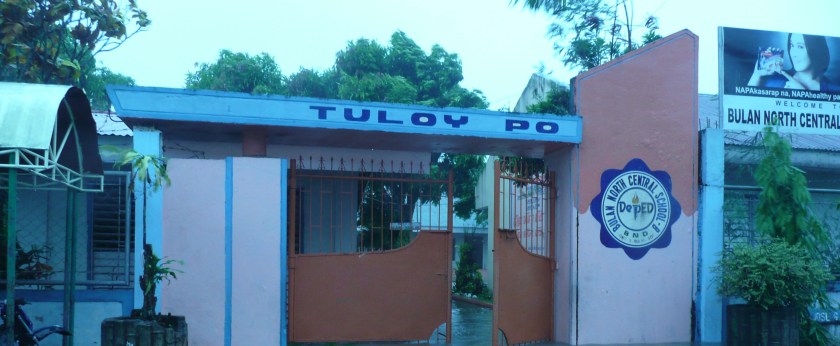
Tuloy Po or Please Come In  is unmistakably Bulaneño hospitality…

 Tuloy Po

 Even when Bulan is  under water brought about by the devastating typhoon Dante last May 1-2.

 P1080016

 But who will come in, what kind of guests when pupils are on vacation and  who will dare when it is flooded?


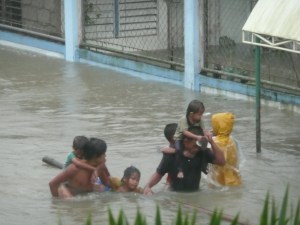
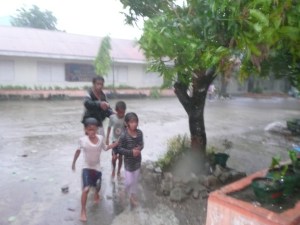
P1070925

 They are the guests- evacuees; children from Managanaga fleeing from high waters that swallowed their bamboo huts,

spending the night of heavy rains awake,  fearful and anxious about their situation.

Storm Dante shows no mercy as it pounded Bulan with strong winds and heavy rains overnight.

P1070923

The classrooms are  still closed and so they find their first refuge under the staircase;

children and even a baby are wet, shivering from cold- and hunger.

 P1070929

Young Bulaneños- pretty girls and handsome boys- soaked in water, sleepless and hungry.

P1070921

We come to their rescue during the first hours in the morning of May 2; nursing and comforting them.

P1070939

 As some fathers are  in great stress running and swimming back and forth

 to Managanaga to rescue their other children who are left behind.

 P1070945


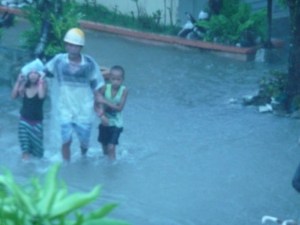
 And this is how it looks by now outside the Bulan North Central School;

more families coming,  taking with them  their most important belongings as the waters continue to rise.

P1070948

 Women….

P1070953

 whole family…

P1070991

 And an old man escorted by his young ones.

P1070916

 A pig is precious, too.

P1080015

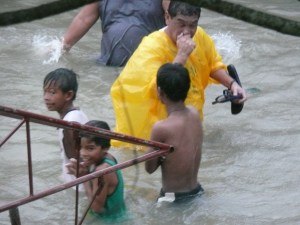
 I am astonished by the gracefulness in their bearing; they retain their dignity and calmness,

as many walk through waters in a meditative posture- which shows that experience

with floods is not extraordinary in the town of Bulan.

P1080013

 A boy joining his family somewhere, behind him the man

 in a meditative rhythm opposing the currents.

P1080018

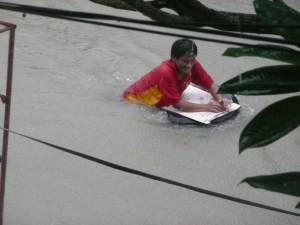
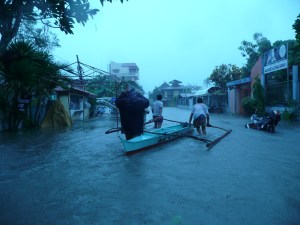
 The day when boats are in the streets of Canipaan…

P1080136

 and a raft made of banana trunks, in place of cars and tricycles.

P1080001

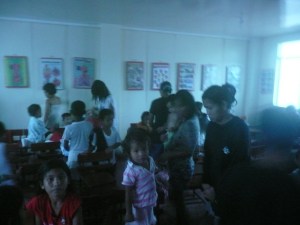
 Meanwhile, these families are now inside a classroom, given towels, hot drinks and biscuits. etc.

P1080009

 Children now dry, visibly feeling better -at least for the time being-,

and mothers continue watching over them.


P1070979(click this photo to view Part II, or  the whole album)

A shy boy with sadness in his eyes in this dark room

with no electricity and drinking water.

If pictures speak louder than words, then let them be.


jun asuncion        

Bulan Observer                                                          ( photos by jun asuncion)


   —-end—-

BULAN TOWN BEARS BRUNT OF TYPHOON DANTE FLOODING; HEROISM DISPLAYED BY MANY BULANENOS

( LGU-PIO ) Bulan, Sorsogon, May 4, 2009 –

 Once more, the spirit of Bayanihan and volunteerism was displayed by many Bulanenos at the height of the massive rains and flooding brought about by Typhoon Dante on May 1-2, 2009. The Municipal Disaster Coordinating Council headed by Mayor Helen De Castro and Municipal Administrator Luis De Castro, provided the impetus in inspiring various groups to volunteer in evacuating families , saving lives and providing for relief operations at the height of one of the worst floods ever to hit Bulan Town in decades.

 Based on partial reports from 26 out of 63 barangays, 2,065 families comprising 10,233 persons were displaced by the floods. 85 houses were partially destroyed, 63 were totally damaged. The Rural Health Unit in Barangay Obrero was partially damaged, together with several schools reporting to be underwater causing destruction to various school facilities and documents. Damage to agriculture, livestock and fisheries was estimated to be around 13 million pesos. Infrastructure was severely affected amounting to 38 million pesos, mostly farm-to-market roads.

 The estimates can go higher with the reports coming in. Fortunately, due to the timely warning system of the Bulan Municipal Government, through the MDCC, majority of the Bulanenos were able to prepare. No casualty was recorded. It can be noted that Bulan people are very much aware of these alarm systems due to the consistent disaster management program of the Local Government Unit.

 The volunteerism of the Bulan organizations were once more brought to the fore with the participation of several responders like the PNP Municipal Station and 509th PPMG, The Philippine Army Scout Rangers based in San Isidro, Kabalikat Civicom 426, USWAG Bulan, TOFY, a youth group, DepED, and the various BDCCs of almost all barangays in Bulan. During the the height of the floods, barangay officials were busy, together with civic-hearted residents in evacuating and helping their community-members. Various areas of the National Highway all the way from Sta. Teresita to Zone 8 were submerged under water preventing all forms of land transportation. The floods started around 3 o’clock in the morning of May 2 and did not easily recede until around 5o’clock in the afternoon. Some areas in Bulan experienced up to 10 feet of floodwater.

 ( Bulan PIO ) PIO-LGU-Bulan 1

BULAN RESCUE TEAM SAVES FOUR FISHERMEN

Bulan PIO-LGU-Bulan 1

Bulan, Sorsogon, May 5, 2009 —

Four fishermen from Barangay Zone 7, Bulan, Sorsogon were rescued by the Bulan Rescue Team headed by Municipal Councilor Simmy Gerona on May 3, a day after Typhoon Dante hit the Bicol Region. These four fishermen, in an attempt to provide for their livelihood, braved the rough waters but unluckily their boat capsized off the Bulan shorelines. Fortunately, it was very timely that the Bulan Rescue Team was immediately informed of the incident and they responded to save the fishermen’s lives. The Bulan Rescue Team was organized by Mayor Helen C. De Castro in 2006 as a component of the Municipal Disaster Coordinating Council to respond to evacuation and rescue efforts during calamities and emergencies. It is headed by Administrator Luis De Castro and SB Member Simmy Gerona. Its members include Ryan Cantre, Antonio”Daday Amilano, and Victor Gubat, who were all involved in the rescue. The Bulan Rescue Team was also involved in the retrieval operations of several corpses involved in the Sulpicio Lines Princess of the Stars accident sometime last year. A day before, at the height of the massive flooding brought about by Typhoon Dante on May 1 and 2, the Bulan Rescue Team has its hands full in providing evacuation efforts to the residents of Barangays San Isidro and San Ramon.

Hostage Update: The Swiss Andreas Notter Released By Captors

Bulan Observer Quick Press


We are happy for the positive turn of events that led to freedom for the Swiss Andreas Notter. We also hope for the best for the remaining hostage Eugenio Vagni.


jun asuncion

Bulan Observer

—————

News from Swissinfo:

April 18, 2009 – 1:16 PM  Swiss ICRC hostage is free

 Islamic rebels in the Philippines have freed Swiss aid worker Andreas Notter but continue to hold another European captive, security officials said on Saturday.
The circumstances surrounding the release of Notter, an employee of the International Committee of the Red Cross (ICRC) were unclear, and he himself said he was not sure how it came about.

“I walked out and am happy to be alive and safe,” Notter told a media conference at the house of the provincial governor on the southern island of Jolo, where he was brought early on Saturday.

The 38-year-old from canton Aargau spent 93 days in captivity.

“I am very glad to be here with you. It happened very quickly. I am still a bit confused how it happened. My concern for now is my companion, Mr Eugenio Vagni. You are all aware that he is injured.”

In a statement, Switzerland’s foreign ministry said it was “relieved and pleased” with Notter’s freedom. It has demanded Vagni be “immediately and unconditionally released”.

Bern remains in close contact with the ICRC and Philippines authorities, spokesman Andreas Stauffer said.

Notter, Italian national Vagni and Philippines national Mary Jean Lacaba, all with the Geneva-based ICRC, were abducted by Abu Sayyaf rebels on January 15 when they were on a field visit to a prison on Jolo, a guerrilla stronghold.

Lacaba was freed by the rebels earlier this month and newspapers have said ransom was paid. The ICRC denies the claim and says it did not pay to free Notter.

“We never received any ransom demand for his release and we therefore have not paid,” said Florian Westphal, a spokesman for the ICRC. Notter’s return to Switzerland was “not foreseen in the coming hours,” Westphal added.

Attempted escape
Philippines Interior Secretary Ronaldo Puno said a group of men holding Notter was attempting to slip out of the security cordon around the guerrilla camp in the interior of Jolo when they were spotted by security forces who gave pursuit.

“The kidnappers left behind Mr Notter because they were not able to drag him with them anymore,” Puno told reporters, adding military pressure forced the rebels to free the hostage.

“We are fortunate that this incident ended without injury to Mr Notter.”

Earlier, a military spokesman had said Notter was found by troops. Richard Gordon, a Philippines senator and head of that country’s Red Cross, said that Notter was found walking near Indanan town, in the interior of Jolo, early on Saturday morning.

“He is relieved and he is glad to be alive,” Gordon said. “I told him the whole country prayed for him. He expressed concern for Eugenio. He said ‘Thank you for all your efforts.”‘

« We are fortunate that this incident ended without injury to Mr Notter. »

Philippines Interior Secretary Ronaldo Puno Notter, unshaven and with long hair, was smiling when he faced journalists after doctors gave him a clean bill of health, although he looked to have lost weight during his captivity.

The former history professor was given time to rest after a glass of milk and a soft meal, Puno said, adding Notter had already contacted family, friends and Red Cross colleagues.

“He is suffering from fatigue and may be a little bit disoriented for the moment,” Puno said.

“In good health”
“When we first heard reports of his extrication from the kidnappers, we were afraid because he was seen walking around with a cane. But he looks in good health. The doctors did not find any serious health problem.”

The Abu Sayyaf, a small but violent militant group based on Jolo and nearby Basilan, had earlier demanded that troops relax the tight cordon they were keeping around the rebel hideout before talks for the hostages’ release could start.

Provincial governor Tan sent a team of Muslim clerics to the rebel camp earlier this week to seek the release of Vagni, a 62-year-old who is reportedly suffering from hernia.

General Alexander Yano, the Philippines military chief said in a statement that disclosing the details of Notter’s rescue “may derail current efforts to ensure the safe release of the remaining victim”.

There was no word on any progress.

The Abu Sayyaf, with links to the Southeast Asian regional militant network Jemaah Islamiah and to al Qaeda, has been blamed for the worst militant attack in the Philippines, the bombing of a ferry in Manila Bay in 2004 that killed 100 people.

It is also notorious for high-profile kidnappings and large ransoms and has a history of beheading captives.

swissinfo with agencies

————————————end—————-

Bulan Priorities: Local Technology and Environmental Protection

by: jun asuncion


THE STATUS OF BULAN. Bulan has all the basic  infrastructures needed to develop itself  to an economically strong town and the potential of becoming a city in the future. Bulan has the sea port integrated in the Central Nautical Highway program of the national government and fully-developed Maharlika  highway that connect it to the rest of the Philippines. And with the addition of the Bulan Airport which is supposed to be operational by 2010, Bulan has completed the requirements for mobilization and transportation and will be practically connected with the whole world. What else does Bulan need? Is it consciousness of  its powerful potentials? A dynamic and proud LGU? A business and technologically- oriented community? A politically active constituency?

BE PROUD OF YOUR TOWN. In any case, Bulan is moving forward, slowly but surely, to the place it is destined to, to a status worthy of its inhabitants. This is something each one of us should be  proud of. To be proud of your town- this is applied Utang na Loob, which is a way of looking back to pinanggalingan, to one’s origin,  a topic we have deliberated  quite at length already. Let us as individual Tagabulans redefine our relationship to our town and ask how we can help each other realize our common dream of a progressive Bulan. If you are a student, study well and perform well and just think of giving out your best. The same way if you are a teacher, a fisherman, a farmer, a businessman, a policeman or a politician- altogether the effect is the enhancement of our town. This is synergia, a Greek concept first demonstrated by the Spartans in ancient Greece, which means  that combined effect of two or more forces is greater than the sum of their individual effects. This concept of synergy should guide our town planning and management.

BULAN DEVELOPMENTS. Development is not only the production of ideas but also the realisation of these ideas materially. Since we know that Bulan is also endowed with marine and agricultural resources, the focus of economic thinking should be not only on the available local raw materials, capital and labor but also in encouraging and supporting new  technologies developed locally geared at harnessing the local resources to the maximum of profitability. This is the other factor needed to boost local economy aside from the infrastructures. From an agrarian and fishing community to a modern IT-Community? From Tricycles to BLRT- Bulan Light Rail Transit System- plying from the Bulan Airport to the other reaches of Bulan? How about a Bulan Mall? A Technorama, a Zoological Garden, a Planetarium, a Bulan Symphony Orchestra, a Concert Hall and a huge Sport Stadium? 

 THE ENVIRONMENT FIRST. It’s all a matter of time, of creative time starting now. A town, once its momentum of  growth  has been set to motion at the right time, develops itself to completion, obeying an inner logic. The main concern is that a town tends to be blinded by its  achievements – becoming a city but forgetting the very foundation of  its success- the natural environment. This has been the case of many cities of today: hardly perfected, are already in the brink of collapse because the rivers and seas are already dead, trees cut, water, soil and air polluted, people sickened-  like some parts of  China today. It is therefore imperative to have a sincere desire to protect and conserve the ecosystem right from the start: each Tagabulan by doing  all the things he knows about environmental protection and the government by educating the public continuously, building and maintaining the appropriate infrastructures and investing in technological research and environmental programs.

THE IMPORTANCE OF A COMMUNITY SEWAGE SYSTEM: But before everything, we should pay attention to this question: What happens when you pull the plug, wash your clothes, have a shower or flush the toilet – where does all the water and wastes go?”. For me, this is the central issue in any environmental program and this should complement solid waste management. Bulan should start realizing this concept for otherwise its environmental program will remain incomplete. This question suggests to us the necessity of a  community sewage system to which ideally every household must be connected. Network of pipes (reticulated sewerage systems) underneath Bulan should be built and should carry sewage from homes to modern sewage treatment plant located in any ideal place in the outskirts of  Bulan. Once treated, only then is this water released into the environment, i.e.. back to the rivers, streams or seas. I am aware that at present this costly project lies somewhere above every Bulan household but this should at least be taken into account in community planning by now.

 MARKETING  BULAN AND ITS PRODUCTS. Marketing of local products is the core of economic life. The Bulan  airport will be a big factor in marketing the local products and in rousing the interest of local, national or maybe international investors. But for the marketing of Bulan, we are all task to do that. Let’s be positive this time and help one another in introducing our town to the rest of the nation and the world. We know that Bulan has made a name in our nation because of its Waste Management Concept and the Ecopark. That’s already a substantial achievement indicative of the vast developmental potentials of Bulan community. But it’s no reason now to rest on one’s  laurels for it is just the beginning. We should defeat this attitude of complacency  which seems to be inherent in us if we want to improve the quality of life and living standards in Bulan, should not be satisfied with little achievements but continue on raising the standard of our concept of quality and on improving already existing and well-recognized programs.

Market synergy means creating an environment that is conducive to business and entrepreneurship growth by developing a local  investment strategy that promotes networking among local  and regional business people, products providers, raw materials suppliers, retailers, consumer organizations, local policy makers, local and regional academe, technological and marketing  research institutions, transportation, etc. The existing town  industry clusters- fish ( marine) and  rice (agricultural) industries in Bulan should be intensified in order to assert their  regional and national competitiveness. The Bulan Airport will bring with it the emergence of new industry clusters like tourism, etc. but an open eye must be kept for other local products that would significantly enhance investments once fully developed and marketed.

A SOLID FOUNDATION FOR BULAN. What is of utmost importance  is a functioning LGU with stable and modern bodyof political concepts translated into actions by visionary yet competent and professional local politicians. A performance-oriented and transparent LGU who leads the people to new frontiers. This is the foundation, a transparent politics and efficient leadership  anchored in public trust without which nothing can be achieved. It’s not a question then of who is running the administration and for how long but of how is Bulan being administered and for whom.

BE READY TO WELCOME GUESTS. Start cleaning your surroundings not only today but everyday so you will not be ashamed when tourists come. Put permanent trashcans in every corner of the town and along the seashores so that people will stop throwing their wastes directly into the  sea or seashores. Now we have in Bulan many good environmental programs like Fiesta Sa Kabubudlan, Ecopark, Tree planting activities, etc. How about calling to life a program like Clean Bulan- whatever you name it- whose goal is community cleaning on a big scale, and this should be held annually. Special attention should be given to our rivers, streams and sea and their natural regeneration. To this effect, the LGU-Bulan should let its creativity work in devising environmental protection programs which involve partnership with the private sectors. Remember that Bulan was twice the cleanest and greenest town of Sorsogon under Mayor Guillermo De Castro, Sr. Our concept of cleanliness should be divorced from the ningas cogon attitude that is somehow always within each of us.

The town should always remain clean and presentable even when there is a change in the administration so that the people- especially the children- will feel good. Take note that children growing up in dirty and squalid places will have a very poor concept of hygiene standards. The town should start now educating the young Tagabulans by example and by regular cleanliness program. As in many other things, cleanliness also begins in the head (consciousness).’This is of high priority that pays off in the long run.

FEATURED ARTICLE. In this post I feature an article from DOST V ( Department Of Science AndTechnology ) I found in the net which was written by my brother Engr. Jerry Asuncion- DOST- Provincial Science Officer- where he introduces the newly-developed technology of Pili pulp oil extraction. Pili is one among the raw materials that could help define positively the future of Bulan if farmers and investors are given the incentives to grow them locally, or at least stimulate investment  in the development of mechanical Pili pulp press  in diverse models and capacities from manually-operated machines that would meet a household need for Pili oil extraction to motorized units for industrial production purposes. For as Jose Dayao- the Department of Agriculture (DA) Regional Executive Director for Bicol – said  “The government is revitalizing the Pili nut industry in Bicol through a program designed to commercialize production of the crop and transform it into one of the Philippines’ export winners”. Bulan should venture into this dream of our national government and find local ways to help realize it. Pili nuts and oil are products unknown yet to European markets but- as to my observation- these are quality products that will easily find its place  in the European palate once introduced to them.

Bulan Observer

————————–

Technology


DOST V Develops Pili Pulp Oil Extraction Technology

            
Written by Engr. Jerry N. Asuncion, S&T Media Service
Friday, 18 July 2008                                                                                             

 
The Department of Science and Technology’s provincial office in Sorsogon developed a simple method of producing oil from pili nut pulp. The process extracts oil from freshly harvested pili nuts using minimal heat and simple cooking and filtration tools. Because the process retains the aroma and natural green color of pili pulp, the resulting oil can be considered of premium or virgin quality.

DOST-Sorsogon provincial office initiated the development of the technology as an alternative to the process introduced by National Institute of Molecular Biology and Biotechnology at University of the Philippines in Los Baños, which uses enzymes in extraction and chemicals in refining pili pulp oil. This technology, while more efficient, is rather complicated and requires substantial investment and may not be suitable in a micro or village scale pili nut-processing venture.
There is also a need to satisfy the demand of local organic groups, which took interest in the product for naturally processed, chemical-free, and virgin quality pili pulp oil for food, health, and cosmetic applications.

 
Oil Yield                                                                                                                       


Using manual extraction, the technology was tested using different varieties of pili obtained from different areas in Sorsogon province. Oil yield, computed as percentage by weight of whole fresh pili nut, varies widely and is clearly associated with the variety of pili nut. However, the maximum yield recorded so far is about 6 percent, which translates to about 65 ml/kg of fresh whole nuts.
Establishing the varietal differences in oil yield requires further study. But oil recovery is expected to increase if a suitable mechanical pulp press or extractor becomes available.

Oil quality


Analyses conducted at DOST V laboratory showed that the oil produced by the process has a very low free fatty acid (FFA) content of 0.06% and moisture content (MC) of only 0.04%, which favors a longer shelf life of the product.
Chemical and Nutritional Analyses
Chemical and nutritional analyses of pili pulp oil are very similar to olive oil. However, pili pulp oil have more beta carotene, a known vitamin A source, and carotenoids, which makes it more nutritious than olive oil.

Other Benefits


Pili oil has always been featured in traditional medicines and herbal remedies in Bicol region where it abounds. Indigenous knowledge gathered attest to its efficacy in treating skin diseases such as scabies and de-worming capability for livestock such as pigs and chicken. Recent testimony to its ability to cure diabetes was published by Fernando Simon of YAMANKO enterprises.
Some groups that advocate and promote organic products reportedly believe in the potential health benefits of pili pulp oil, which they claim could equal or even surpass that of virgin coconut oil.


Technology Transfer


The simplicity of the technology allowed for its easy diffusion through technology transfer trainings to pili processors, traders, and farmers in Sorsogon. Since October 2004, DOST Sorsogon provided technology transfer training to the following:
Melinda Yee[proprietor of Leslie Pili Products, Sorsogon City]
• Pili Producers Association of Sorsogon (PPAS)
• City Agriculture Officers/personnel of Sorsogon City LGU
• The Lewis College
• Prieto Diaz LGU
• Gubat LGU

 
Developing the industry


The introduction of the technology generated renewed interest among local stakeholders and is paving the way for the establishment of the pili pulp oil production industry in Sorsogon. At present, raw pili pulp oil sells at P100 per liter. In support of the industry’s development, DOST V is currently working to develop technologies on mechanical extraction and other non-chemical approach in oil refining.    (Engr. Jerry N. Asuncion, S&T Media Service)

——————————————

Note: I have included here other sources of informations about Pili for further studies. / jun asuncion


New Crop Fact SHEET:

Pili Nut                                                                                                           pili-nuts


Contributor: Francis T. Zee, USDA-ARS, National Clonal Germplasm Repository, Hilo, HI.
Copyright © 1995. All Rights Reserved. Quotation from this document should cite and acknowledge the contributor.

————————————————————————–

English: pili nut
Philippines: pili, anangi, basiad, liputi, pilaui, and pili-pilauai.
Scientific Names
Canarium ovatum  Burseraceae        

                                         canarium_ovatum_pili_small
Uses.

Pili nut kernel is the most important product. When raw, it resembles the flavor of roasted pumpkin seed, and when roasted, its mild, nutty flavor andtender-crispy texture is superior to that of the almond. Pili kernel is also used in chocolate, icecream, and baked goods. The edible light-yellow color oil from the kernel is comparable in quality to that of olive oil, containing 59.6% oleic glycerides and 38.2% palmitic glycerides. The young shoots and the fruit pulp are edible. The shoots are used in salads, and the pulp is eaten after it is boiled and seasoned. Boiled pili pulp resembles the sweet potato in texture, it is oily (about 12%) and is considered to have food value similar to the avocado. Pulp oil can be extracted and used for cooking or as a substitute for cotton seed oil in the manufacture of soap and edible products. The stony shells are excellent fuel or as porous, inert growth medium for orchids and anthurium.
Origin


Philippines: abundant and wild in Southern Luzon, and parts of Visayas and Mindanao in low and medium elevation primary forests.
Crop Status


A minor crop produced only in the Philippines. The bulk of the raw nuts are supplied from wild stands in the mountains around Sorsogon, Albay and Camarines Sur in the Bicol region. The average annual production between 1983-1987 was 2925 tonnes of dried nuts from an estimated 2700 ha. Pili nut has the potential to become a major nut crop. Improvement of nd knowledge in efficient vegetative propagation, ecological and cultural requirements of pili as a commercial crop, and the mechanization for commercial processing are needed.

Taxonomy


Synonyms: Canarium pachyphyllum Perkins, Canarium melioides Elmer.
Description

                                                                                                                       
Pili is a delicious evergreen tree up to 20 m tall with resinous wood pili_tree1and resistance to wind. Leaves are compound and alternate with odd-pinnate leaflets. Flowers are borne on cymose inflorescence at the leaf axils of young shoots. Pollination is by insects. Flowering of pili is frequent and fruits ripen through a prolonged period of time. The ovary contains three locules, each with two ovules, most of the time only one ovule develops. Fruit is a drupe, 4 to 7 cm long, 2.3 to 3.8 cm in diameter, and weight 15.7 to 45.7 g. The skin (exocarp) is smooth, thin, shiny, and turns purplish black as the fruit ripens: the pulp (mesocarp) is fibrous, fleshy, and greenish yellow in color, and the hard shell (endocarp) within protects a normally dicotyledonous embryo. The basal end of the shell (endocarp) is pointed and the apical end is more or less blunt; between the seed and the hard shell (endocarp) is a thin, brownish, fibrous seed coat developed from the inner layer of the endocarp. This thin coat usually adheres tightly to the shell and/or the seed. Much of the kernel weight is made up of the cotyledons, which are about 4.1 to 16.6% of the whole fruit; it is composed of approximately 8% carbohydrate, 11.5 to 13.9% protein, and 70% fat. Kernels from some trees may be bitter, fibrous or have a turpentine odor.


Crop Culture (Agronomy/Horticulture)                     

                                                                                                          
Cultivars
There are three pili cultivars in the Philippines, they are : ‘Katutubo’, ‘Mayon’, and ‘Oas’. ‘Poamoho’ is the only cultivar in Hawaii.
Production Information

 
Pili is a tropical tree preferrring deep, fertile, well-drained soil, warm temperatures, and well distributed rainfall. It can not tolerate the slightest frost or low temperatures. Refrigeration of seeds at 4 to 13C resulted in loss of viability after 5 days. Seed germination is highly recalcitrant, reduced from 98 to 19% after 12 weeks of storage at room temperature; seeds stored for more than 137 days did not germinate. The seedlings take 40 to 50 days to emerge; year old seedlings can be used for rootstock. Asexual propagation is best through patch budding, which claimed to have a success rate of 85-90% in the Philippines. Marcotting is too inconsistent to be used for propagating in commercial  production. Production standards for a mature pili tree is between 100 to 150 kg of in-shell nuts. Most of the production in the Philippines are from seedling trees and are highly variable in kernel qualities and production.
Harvesting

Harvesting is from May to October, peaking in June to August, and requires several pickings. Fruits are de-pulped, cleaned and dried to 3 – 5% moisture (30C for 27 to 28 h). Nut in shell with a moisture content of 2.5 to 4.6% can be stored in the shade for one year without deterioration of qualities.
Germplasm
Collections
College of Agriculture, University of the Philippines at Los Banos, College, Laguna 4031, Philippines.
USDA/ARS, National Clonal Germplasm Repository, Hilo, P.O. Box 4487, Hilo, HI 96720 (limited).

————————————- 

 Latest News About Pili:


Gov’t to make pili nut industry more globally competitive

03/19/2009

The government is revitalizing the pili nut industry in Bicol through a program designed to commercialize production of the crop and transform it into one of the Philippines’ export winners, Department of Agriculture (DA) Regional Executive Director for Bicol Jose Dayao said.

Dayao said the proposed P150-million Pili Development Program (PDP) will involve a massive replanting of seven pili varieties in the Bicol provinces of Albay, Camarines Norte, Camarines Sur, Catanduanes and Sorsogon, which account for 82 percent of the supply of the crop. “Pili has high potentials for being a top export commodity for the Philippines, as it can very well compete with macadamia, cashew, almond and walnut in terms of quality,” he said.

The PDP, Dayao said, will kick off with the production and distribution of quality planting materials through the DA nurseries, the private sector, local government units (LGUs) and research outreach stations. Through the LGUs, the department will also put up technological demonstration farms and pili orchards; distribute organic fertilizers and provide soil analysis services; conduct training and provide extension support to farmers; undertake research and development work, marketing activities and monitoring and evaluation of the PDP.

Dayao said the target areas under the PDPcover5,000 hectares that will include 3,750 hectares in the municipalities of Bacacay, Malilipot, Malinao, Sto. Domingo, Tiwi and Tabaco City; Rapu-rapu, Camalig, Daraga, Manito and Legazpi City; Guinobatan, Libon, Ligao, Pio Duran, Oas, Polangui and Jovellar in Albay.

For Camarines Norte, Dayao said the target area is 150 hectares, while for Camarines SurtheDA is aiming to expand pili production in 600 hectares. For Catanduanes, the covered area is 150 hectares, and Sorsogon, 350 hectares, he added.

Under the PDP, the DA will promote production and processing technology through model farms to be put up at the local level, particularly within the region’s Strategic Agricultural and Fisheries Development Zone.

Dayao said the research, promotion and development efforts under the PDP would involve the production of quality products with vast market potentials; establishment of strong marketing linkages between users and producers; and improvement of the packaging of pili products and by-products.


———————————end——————-

Kidnapped ICRC Workers: Good News And Bad News

by: attybenji 


The good news is – Filipina hostage Mary Jane Lacaba was rescued and recovered alive from the kidnappers (April 2, 2009). Some reports alleged that she was handed-over formally by the captors to the negotiators, not rescued, upon payment of ransom!

The bad news is – the Swiss Andreas Notter and Italian Eugenio Vagni are still under captivity, sad to say, a day after freeing Lacaba, the kidnappers threatened to execute these two remaining captives. We do not know when? May awa ang diyos, huwag po naman sana!

With this new development, authorities are readying the evacuation of over 21,000 residents in 5 towns of Sulu for a possible worst case scenario or armed confrontation between security forces and the Abu Sayyaf bandits, as reported in various newspapers (April 3, 2009)

In retrospect: Filipina Mary Jean Lacaba, Swiss Andreas Notter and Italian Eugenio Vagni have been kidnapped and remained in the jungles of Sulu since January 15, 2009. They were abducted after a visit to a local prison where the Red Cross is funding a water project.

Recall that barely an hour before the ultimatum would lapse, Philippine Red Cross Chairman Senator Richard Gordon asked the Abu Sayyaf kidnappers for proof that the three Red Cross volunteer workers were alive as government troops and tanks moved closer amidst the threats to behead the captives. (April 1, 2009)

Senator Gordon’s messages to the captives, while uttering the words of comfort and inspiration, suddenly tears fell from his eyes, saying – “The whole family of Red Cross prays for you and I’m proud of the way you’ve comported yourself”. “I’m sorry I should be stronger than you because I’m not in the midst of the ordeal you are in now.”

And to the captors he pleaded, – “There was no glory in what the captors are doing. You are just pinning yourself down. These people are not your enemies. They were here to help the prisoners in the city jail by providing them with water and other needs”.

As the crisis deepens, the Catholic Church is urging Filipinos to pray for the release of the kidnapped ICRC workers.

The CBCP circulated copies of a pastoral letter in all catholic churches exhorting all Filipinos as brothers and sisters to reach out to both kidnappers and their hostages with prayers, saying that let it be a whole nation praying that all may experience true freedom and security. Likewise The CBCP is appealing to both kidnappers and the government to use every peaceful means to address thought peaceful process what ever is the root of this on going problem of kidnapping in Jolo, Sulu and the whole country.

We, as peace loving Filipinos, are sympathizing with the plight that the hostages are facing right now in the hinterlands of Sulu. They are facing the uncertainty of tomorrow, “nangangamba tayo na baka gagawin ng mga bandido ang kanilang banta”, God forbids!

– Just try to sympathize with their families, and imagine the sufferings, anguishes, mental torture, psychological-emotional pains, sleepless nights, mental shocks, fears and insecurities. As, anytime from now, the captives would be caught in the crossfire of the battle between the kidnappers and government forces once the latter commences its rescue operations. Also, anytime from now, they can be executed and beheaded by their captors.

From a distance, we can only offer our prayers for the lasting solution to this horrible situation in Sulu and for the release of the two other captives from the hands of the Abu Sayyaf bandits.

After freeing the Filipina, the fate of the hostages is still uncertain and unknown, and the fear of bloodshed is inevitable once the military begins its rescue operations in Sulu. Madaming inosenteng civilians ang madadamay sa bakbakang militar at mga bandidong grupo!

– Also, try to dramatize the situation, and imagine a scenario, or put yourself in the shoes of the families or relatives of one of the hostages, or of all the hostages, coupled with the shocking news update every now and then that the kidnappers are threatening to behead the hostages one by one. For sure, “hindi ka mapapakali, hindi ka makakain, maiihi ka, matatae ka, iikot ang tumbong mo at hindi ka makakatulog”, why? Because these group of kidnappers are known for their barbaric acts in the past. By all means, they have the capacity to exterminate the captives when their demands for ransom, or otherwise, are not heeded, and not taken seriously by the government negotiators, etc.

In fact, I was monitoring this incident for weeks now, and believe me guys while I was watching the news update on TV, a day before Lacaba was released, “naluha ako at naiyak”, because I could not help but to reminiscence the sad memories of the past, similar to the ordeal and nightmare that the hostages have gone thru for months in the mountains, and the tormented mind of the victims’ families as well, …… I cried, and tears fell from my eyes because some years ago my father, Ceferino was kidnapped by the NPAs, and my brother, Edilberto, was also victim of kidnapping years back in Nigeria.

In local parlance, malungkot ang alaala ng kahapon, kaya hindi ko mapigilan ang maiyak at maluha sa ganitong sitwasyun!

——————————

RE; Kidnapping of my father, Ceferino!

Sometime in 1995, my father was kidnapped by the NPAs in San Ramon, Bulan. While my brother, a seaman-engineer, was held captive by the Nigerian rebels in Warri of 2007.

My father, a municipal councilor then, and was active in local politics in Bulan. All of the sudden, one gloomy afternoon, the NPAs had snatched my father in our house and was forcibly brought to the jungle of the unknown, and of place of no return, where most, if not all, of the civilians, who have been held hostage by the rebels were buried thereat after being strangulated, stabbed, or buried alive according the reports; my father used to describe the place as between the boundary of the towns of Juban and Magallanes overlooking the sea from a far. He was held in captivity for almost a week, blindfolded and his hands were tied, and could not sleep well due to the pestering sounds and bites of the mosquitoes, known carriers of malaria virus (hindi pa uso nuon ang sakit na dengue).

Fear of not seeing his husband anymore, my mother has already entertained a thought of committing suicide due to hopelessness, frustration and despair. No news, no update of the incident, or the whereabouts of my father is still unknown, no means of communication, no telephone, no text, no cellular phone to connect thru to the captors at that time. But, worst, the NPAs had advised my mother not to tell anybody about the incident, nor report the kidnapping to the authority, which my mother obligingly did.

Despite said warning, some concerned citizens reported the said incident to the police, and minutes thereafter, the police proceeded to our house in San Ramon to confirm the reported kidnapping of my father, but my mother, for fear of reprisal from the captors opted to remain silent about it and when asked about the incident, she even diverted the interrogation made by the men in uniform saying that my father was in Manila for his regular medical check up, but the men in uniform did not believe her claim, because my mother at that time was uneasy and crying and tears were falling from her eyes uncontrolled by cotton handkerchief.

Luckily, prayers really paid off, because after week long of captivity my father was finally released unharmed somewhere in the mountainous barangay in Irosin.

The reason why he was kidnapped? According to them, my father is a spy for the military, and is having an illicit relationship with another woman. Oh my Gulay, this is a silly accusation? This is a blatant lie and not true. A fabricated and concocted charge purportedly made by his political rivals, who have personal grudge to grind against my father, “mga inggitero” in our barangay. But, this is politics anyway, a dirty politics I should say!

In consideration of his release, a board & lodging had been charged to my father’s account, he was asked to defray of the amount of P45-Thousand pesos, which we obligingly complied with (note: from the first demand of 100thousand pesos, natawaran hanggang umabot ng 45thousand nalang), on the condition that said amount would be treated not as a payment for ransom, but to be referred to as sort of a Donation to the KILUSAN, or as payment for the board & lodging of my father while under captivity. Silly, is it not?

————————————–

RE; Kidnapping of my brother, Edilberto!

My brother, Edilberto, a seaman-engineer, was kidnapped along with the other 23 Filipino crew while their ship was navigating along the Delta River in Warri, Nigeria.

They were held in captivity for 24 days in the jungle of the Warri by the rebels who called themselves, the Movement for Emancipation of Niger Delta (or, “MEND”), the dreaded and most notorious group of rebels in Nigeria, engaged in piracy, kidnapping and extortion, whose leader opted to remain as a mysterious leader of the group, called “General”.

Within 24 days of captivity, we, the families, have suffered several days of sleepless nights, anxieties and mental shock, and like the ICRC Workers’ hostages, we’re also facing the same fate of uncertainty at that time. Because, the MEND rebels also threatened to execute one by one the Filipino hostages as reported in the CNN and BBC if the government of Nigeria and the ship owner would not heed to their demands. To resolve the problem, the Nigerian government has already called its men in uniform to prepare for the worst case scenario to rescue the captives at all costs, but luckily the purported plan did not push through, because the rebels threatened to use their hostages as human shields once the military pursues its plan.

We were then in constant contact with the representatives of the DFA, OWWA and the Hamonia Shipping Agency, the local manning agency, for more updates, these representatives would always advise us (families of the hostages) not to allow each one of us to be interviewed by media people in order not to jeopardize the on-going negotiations between the Nigerian government and the rebels, as well as the representative of the shipowner.

Amidst the advisory from the DFA and OWWA to shun away interviews by media people, feeling uneasy and worried of the situation, I then defied said warning, and taken the cudgel for all the families of the seamen-hostages by writing a letter of appeal to a local newspaper in Nigeria (the “Guardian”) via email. The contents of my letter was published in Nigeria and in also in various newspapers in Manila. Because of that incident, I was summoned by the DFA and that of Hamonia representatives in their office advising me to please avoid further making an appeal to the MEND rebels because in so doing I might be able to complicate or jeopardize the on-going negotiations. Their reason is “lalaki daw ang ulo ng mga rebelde at mas lalong magdedemand ng malaki dahil umaapela ang pamilya ng biktima for humanitarian considerations”.

——————————-

The Picture below, (courtesy of CNN) – where kidnappers displayed their high-powered guns to the Filipino crew hostages in the undisclosed place in Warri, Nigeria.

pix-of-hostages_1

Hereunder is my letter to the Guardian newspaper in Nigeria which was published thereat, viz:

Families’ Plea to Captors: Release Seamen in Nigeria
02/03/2007 | 10:48 AM
Email this | Email the Editor | Print | Digg this | Add to del.icio.us

Families of 24 Filipino seamen abducted in Nigeria last month appealed anew to the captors over the weekend to release their hostages.

In a letter published Friday in the Nigerian newspaper “The Guardian” (www.guardian.newsngr.com), Benjamin Gaspi of Manila sought a win-win solution to end the crisis.

“We, the families of the abducted Filipino seamen, are hereby appealing to the Nigerian militants for the immediate release of the seafarers from weeklong captivity … Once again, we appeal to the kidnappers to release the captives,” Gaspi said in his letter.

“We hope and pray that both the government and the militants should find a way to come up with a win-win solution to end the crisis. The families of these hostages in the Philippines are suffering from severe anxiety, stressful days, wounded feelings, moral shock, depression and sleepless nights,” he added.

Although Gaspi did not specify his relation to any of the abducted seamen, he indicated he was writing the letter on behalf of the families of the abducted seamen.

He said the crewmen should not have been abducted because they were “not interfering nor are they intervening in the internal and political affairs of Nigeria.”

“These seamen have nothing to pay because they have no money to pay the ransom (if any). If they really want money they can let go the crew, then take full custody of the vessel and its cargo, then the owner can now pay as well as all those people who have interest in the vessel and cargo,” he said.

Negotiations are still ongoing for the release of the 24 Filipino seafarers and crew of Baco Liner 2, a German owned-vessel held hostage by Nigerian militants last Jan. 19.

At least seven of the crewmembers were brought to a safe house while the others remained inside the ship under the control of the militants.

Gaspi also voiced concern that the hostages may contract malaria and diarrhea.

“We are very much worried and anxious because we do not even know the names of the seamen who were taken ashore and those who were held hostage inside the ship,” he said.

———————————

 AT HINDI PA RIN PO AKO MAPAKALI, kaya sumulat ako sa Ambasador ng Pilipinas sa Abuja, Nigeria. Ito ang nilalaman ng follow-up letter ko kay Ambasador Umpa, thru email, viz:

February 1, 2007

HON. MASARANGA R. UMPA
Ambassador Plenipotentiary
Philippine Embassy in Abuja
Abuja, Nigeria

Dear Mr. Ambassador,

Warmest Greetings!

Sir, unless the those captives are released from nearly month long of captivity; anxiety, mental anguish, low morale, boredom, sleepless nights, despair and depressions will always be part of the day to day routine of the wives, families and relatives of the 24 abducted Filipino seafarers since they were held hostage last January 19, 2007 by the so called Nigerian Militants-MEND.

Considering Sir, that the DFA has imposed a news black-out on the progress of the negotiation and even told the families to cooperate with them by not entertaining interviews from the local media so as not to derail the negotiations, may we respectfully ask an update or breaking news directly from your good office on the progress or status of the negotiation between the rebels and the delta state government, including the chances of having them released as soon as possible.

We understand also that your good office is doing its best to fast track the release of the hostages. Just to calm down, pacify and appease the feeling anxieties among the families of the kidnapped seamen, please give us an update on this incident.

We hope also that you will not get angry at us for being so “MAKULIT” in asking an update from your office every now and then, after all, the lives of the Filipino people are at stake here.

Thank you so much sir for accommodating always my request.

Very truly yours,

BENJAMIN G. GASPI & FAMILY

——————————

Another picture, (courtesy of CNN) – where kidnappers performed their native dance and rituals carrying with them loaded high-powered guns, firing their guns down the soil and up in the air.

pix-of-hostages_2


Upon receipt of my letter, the Honorable Ambassador Umpa readily replied to my query, as follows:

PASUGUAN NG PILIPINAS EMBASSY OF THE PHILIPPINES
ABUJA

01 February 2007

Mr. Benjamin G. Gaspi
benjiegaspi@yahoo.com
MIS- 43 -2007

Dear Mr. Gaspi:

The Philippine Embassy in Nigeria acknowledges receipt of your letter dated
01 February 2007.
We understand your concern for the welfare of your brother and the rest of the
Filipino seamen abducted in Warri. Rest assured that the Embassy is doing all
its best to work out the release of our Filipino brothers.
I have personally led a six-man Embassy team to make sure that negotiations
are fast-tracked and that the Filipinos are treated well and are in good
condition. Daily contacts with the chief government negotiator are maintained
since Embassy personnel and the Delta State Government officials involved
are staying in the same place.
As regards the conflicting reports, the Embassy assures you that we are
closely monitoring every phase of the negotiations and as such, has the
higher authority to verify and confirm what transpires in the course of the talks
to release the hostages, in close coordination with the chief government
negotiator and other Delta State officials.
Thus, more weight should be given to the Embassy reports than to the articles
written in Nigerian local papers. We reiterate that the 24 Filipinos are safe and
are in good condition. The German office of the ship’s owners, as well as the
representatives of the local manning agency here in Warri have denied being
contacted whatsoever by anyone regarding the critical situation of some of the”
hostages.
Further, the Embassy would also like to inform you that it is coordinating with
the German employers in the event of release of the 24 seamen.
Finally, we are hoping for the best and we are counting on your prayers and
the rest of the Filipino nation’s so that we could see light at the end of the
tunnel soon.

We appreciate your continued support and please feel free to communicate
with the Embassy any time and be up dated with any developments.
Thank you once again and best regards.

Very truly yours,

MASARANGGA A.R. UMPA
Ambassador

——————————

Also, picture below (courtesy of CNN), as told by my brother, sometimes kidnappers would point the barrels of their guns to the captives to intimidate them, and more significantly to catch the attention of the international community. (you see how worried they are in this picture).

pix-of-hostages_3At Last, after marathon negotiation with the kidnappers, the 24-Filipino crew, who were held hostage by the MEND militant rebels, were finally released upon paying of, allegedly more or less, 50M U.S. dollars as ransom.

Released Finally: as published in Manila Times, and other local newspapers and tabloid, viz:

Emotional Reunion for Released Seamen

Monday, February 19, 2007
REUNITED with her husband Roberto, chief engineer of the ship seized by rebels in Nigeria, Jocelyn Arcangel said she and her family would take a holiday before deciding on their future.
Roberto was among the 24 Filipino seamen recently released after being held captive at gunpoint for 24 days. They flew home Saturday to an emotional reunion with loved ones.
“We will have a very long family vacation after this incident and we’ll decide after whether he [Roberto] should leave again,” Jocelyn said.
“My sons don’t want him to leave anymore. It was very traumatic. We have not heard from them for a long time and there are fears that they were harmed,” she said.
Roberto said he just wanted to be with his family before declining to talk further with reporters.
Glenda Cagas said her husband, Herculano Cagas, the ship’s third engineer, would probably ship out again after resting in Manila, despite his traumatic ordeal.

“It is difficult, but we don’t have any other choice. We need the livelihood for the family,” Cagas said, noting that their two children aged six and four have yet to enter primary school.
“The hardest part for us was when we saw them on cable television being threatened with guns by their captors in masks,” she said.
Looking haggard after their ordeal but smiling and waving, the men were met by government officials and a throng of journalists after disembarking from a commercial flight at the Ninoy Aquino International Airport.
“We are very happy. Thank you very much President [Gloria] Arroyo,” they said in unison to an explosion of camera flashes.
They were quickly taken to Malacañang and tearfully reunited with family and friends.
Gunmen seized the oil workers on January 20 from a Nigerian-flagged, German-owned cargo ship off the coast of Nigeria.

They were held captive under constant threat by masked gunmen in muddy swamps of the oil-rich Delta region, as Philippine and Nigerian negotiators worked for their release.
It is still unclear who was responsible for the seizure, although a high-profile militant group, the Movement for the Emancipation of Niger Delta, has fingered a rival outfit identified as Fndic.
The men declined to comment on negotiations that led to their freedom on February 13 for fear of jeopardizing the safety of two other Filipinos seized separately. Filipino diplomats are in Nigeria working to free them.
A Filipina woman was abducted on February 7 in Port Harcourt in Rivers State. Gunmen abducted the woman from the center of the city, at the heart of Nigeria’s oil industry.
A day earlier a Filipino employee of Netco Dietsmann-the Nigerian arm of a Monaco-based oil services company-was seized from a company car heading for the airport in Owerri, the capital of Imo State.
Nigeria is one of the biggest employers of Filipino workers in Africa, with some 3,900 Filipinos employed there at the end of 2006.
The Philippines is one of Asia’s biggest exporters of manpower, with an estimated eight million of its citizens working as maids, seafarers, oil rig workers and in other labor-intensive jobs.
President Arroyo has banned further deployments to Nigeria in the wake of the kidnappings.
On Sunday she instructed embassy officials assigned in conflict areas to ensure the safety of Filipinos in their areas.
Besides Arcangel and Cagas, the crewmembers of Baco Liner 2 are Ruben Roble, master; Elmer Nacionales, chief officer; Carlos Abellana, 2nd officer; Mauro Agacid, 3rd officer; Cirilo Nebit, 2nd engineer; Engr. Edilberto Gaspi, electro tech officer; Sukarno Landasan, Rogelio Garcia, Jonel Bernales, Manolo Isidro, Marlon Mendez, Ronaldo Corpuz, Joven Hidalgo, Jose Talde, Samson Mayo, Henry Sebastian, Jonie Saguid, Edgardo Ellera, Evelio Nacionales, Marcelino Caladman, Nelson Aquino and Herman Valez.

The President said the government would maintain close watch over the welfare of Filipino workers worldwide.
“We continue to pray with the same fervor for the remaining hostages in Nigeria in the hope that their situation will also come to a happy ending,” she said.
The President also thanked the officials of the Department of Foreign Affairs who were involved in the release of the Filipino seafarers.
“To those who work to ensure the safety of our Filipino men, thank you, particularly Foreign Affairs Undersecretary Estevan Conejos Jr. and Special Ambassador to the Middle East Roy Cimatu,” she said.
-AFP and Sam Mediavilla

——————————

The Picture below of jubilant Filipino crew upon their arrival at the NAIA, after being released from the 24 days of captivity. My brother, Edilberto, is at the center raising and waving his left-hand to the media people. He is the tallest among the crew.
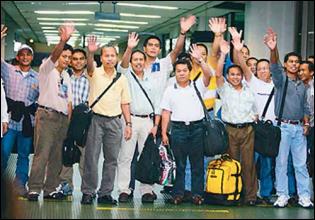
freed-hostages4


PGMA Welcomes 24 Freed Seamen and their Families in Malacañang

SUNDAY, FEBRUARY 18, 2007 | OFW

Twenty-four Filipino seamen, who were freed recently after almost a month of captivity by their Nigerian captors in the oil-rich Niger Delta in Nigeria, thanked President Gloria Macapagal-Arroyo last night for her immediate action to secure their release.

The seamen, who arrived at 6:40 p.m. at the Ninoy Aquino International Airport (NAIA) from Nigeria via Hong Kong, proceeded to Malacañang to personally extend their gratitude to the President.

The President, together with Foreign Affairs Secretary Alberto Romulo, hosted a sumptuous dinner for the 24 seamen along with their family members, relatives and friends at the Palace Heroes’ Hall.

During the emotional family reunions, the President went from table to table and had brief talk with the newly-arrived seamen and their family members.

“Maraming salamat po, Madame President, sa inyong mabilis na pagtugon sa aming panawagan na kami ay mapalaya agad,” said the seafarers as they echoed their gratefulness to the President.

“Welcome back to the Philippines. Praise God! Salamat sa inyong pag-sakripisyo. Have a nice reunion sa inyong mga pamilya,” the President told them.

The Chief Executive had earlier thanked Nigerian President Olusegun Obasanjo for “taking a direct hand” in the release of the Filipino seamen.

She also lauded all diplomats who were involved in the immediate release of the 24 seamen, particularly Foreign Affairs Undersecretary Esteban Conejos Jr. and special envoy to the Middle East Roy Cimatu.

“Salamat sa mga nagtrabaho nating diplomat para masiguro ang inyong kaligtasan, katulad ni Usec Conejos at Ambassador Cimatu. Araw-araw ay sinasabi ko na siguraduhin ang inyong kaligtasan at 24 oras silang
nagtrabaho. Praise God that everything had ended well,” she said.

The released Filipino crew members of Baco Liner 2 who called on the President at Malacañang were Ruben Roble, master; Elmer Nacionales, chief officer; Carlos Abellana, 2nd officer; Mauro Agacid, 3rd officer; Roberto Arcangerl, chief engineer; Cirilo Nebit, 2nd engineer; Herculano Cagas, 3rd engineer; Engr. Edilberto Gaspi, electro tech officer; Sukarno Landasan, Rogelio Garcia, Jonel Bernales, Manolo Isidro, Marlon Mendez, Ronaldo Corpuz, Joven Hidalgo, Jose Talde, Samson Mayo, Henry Sebastian, Jonie Saguid, Edgardo Ellera, Evelio Nacionales, Marcelino Caladman, Nelson Aquino, and Herman Valez.

They were abducted by Nigerian gunmen on Jan. 20 and freed unharmed last Feb. 13 without any ransom paid.

Meanwhile, Press Secretary and Presidential Spokesperson Ignacio R. Bunye said President Arroyo is hopeful that the two remaining Filipino hostages in Nigeria would also be released soon by their captors.

“The government maintains a close watch over the welfare and well-being of our workers all over the world, and President Arroyo always takes a personal hand in critical events such as the last one,” Bunye said.

“Active diplomacy at a high level and the active presence of our diplomats on the ground will continue to be our strategy to keep our beleaguered workers from harm’s way and to bring them home,” he added.
– – – xxx

Actually, may isa pa akong kapatid na seaman na si Alberto, ay muntik na rin makidnap ng mga Somali pirates in 2007, buti nalang daw nai-locked nila lahat ang doors ng ship, kaya hindi nakapasok sa loob at umalis agad,,, the rest is history na.

SANA WALA NG SUSUNOD NA INSIDENTE NG KIDNAPPING NG MGA FILIPINO O BANYAGA SA MINDANAO O SAAN MANG SULOK NG PILIPINAS AT MATIGIL NA RIN ANG SUNUD-SUNOD NA PAGKIDNAP NG MGA PIRATANG SOMALIA SA MGA FILIPINO SEAMEN.

GOD BLESS US ALL. SHALOM!

Long live Bulan Observer.

attybenji

                                                                                 ———–end———-

Chip Tsao: His Missing Chip

Or: When The Servant Is Noblier Than The Master

by. jun asuncion

The article War At Home written by Chip Tsao -where he arrogantly ridiculed his Filipina maid and the whole of the Philippines as a nation of servants -seems to me rather a war inside Chip Tsao after losing the Chip that’s holding his brain together. His case must have been a post-traumatic decompensation to the Mao- indoctrination he underwent, a kind of what the Germans call Dachschaden- a Rooftop (cranium) damage. For his otherwise literary-schooled brain became fragmented like the Spratley Islets he has claimed to be rightfully belonging to China, the master, and not to the Philippines, the servants. Well for sure, I yield to the fact that his fragmented Spratley brain belongs to his China, not to my Philippines. But I do not yield to his arrogant attitude to the Filipino people.

Before I go on, I have to make it clear that this is my personal response directed to the person of Chip Tsao alone in reference to his insulting remarks to his Filipina maid Louisa and to my nation the Philippines.
They said Tsao has written a number of satirical books- books I will surely not want to see-, came from a family of writers, studied English literature, worked for BBC and for diverse newspapers and magazines in Hong kong. All these, even far from being a Nobel candidate, are achievements that attest to intelligence and sanity before March 27, 2009, for from this date on he attested to us quite sarcastically that he no longer can hide the mental derangement that has been dissolving him inwardly- most of all his brain and common sense. He lost his professionalism, his Asian cultural sensitivity- and soon his Filipina maid and the sales of his books.

Symptomatic of decompensation is a diminished ability to think including loss of long and short term of memory.
Chip Tsao admits that “We can live with Lenin and Stalin for they were once the ideological mentors of all Chinese people” and that “The Japanese That’s no big problem-we Hong Kong Chinese love Japanese cartoons, Hello Kitty, and shopping in Shinjuku, let alone our round-the-clock obsession with karaoke”. This is a proof of Tsao’s remaining memory content- which is nevertheless a shallow one, already symptomatic of progressive mental deterioration and regression to infantile developmental stage as shown in his fascination with Japanese cartoons.

Actually, these are all his personal problems and these should bother him alone, not us. What bothered me was where in the world did he derive his justification to viciously ridicule and belittle before the world the Philippines and the Filipina maid working in his household? The problems of one country should not be used by any outsider for insulting honestly and peacefully working Filipinos in Hong Kong and the rest of the world. Chip Tsao is sick; his distorted face seems to reveal to us a long history of pains from feats of convulsions and epileptic seizures, or of a man drowned in alcohol day-in and day out, or of a man’s face adopting itself to the cartoon figures he is watching everyday.

 spratlymap2The Philippines’ claim of some islands, notably the Kalayaan Island Group,  of the Spratley Islands, is not just a product of whims and fancies of the Philippines for it has a long standing historical and legal ground. And as a matter of fact, the Philippines is about to present her Philippine Archipelagic Baseline  Law on May 13, 2009 to the United Nations Convention on the Law of the Sea (UNCLOS).

This was probably the latest news that triggered the convulsions and distorted Chip Tsao’s face – and intellect. Now he lost quite a big deal in his life: Aside from being declared by the Philippines as persona non grata, for sure the Filipinos will boycott his books and anything about him aside from attacking him in Internet- and probably in the streets of Hong Kong. The Internet has been boiling from heated attacks by Filipinos against Chip Tsao since end of March and this will go on, enough for Tsao and his relatives to read for a lifetime- and even beyond that. Many families in Hong Kong with Filipina maids will hate Chip Tsao for now they are no longer sure about the noodle soups being served them and about the security of their children when they (the parents) are working. Not that the Filipinas would go amok for it’s not in their nature, but the minds of these Hong Kong parents have been polluted, made paranoid by Tsao’s unpatriotic misdemeanor.

Louisa should take Tsao on a wheelchair and walk with him into the deeper regions of Chinese history after his meditation on Mao’s teachings or after he has watched his favorite face- distorting Japanese cartoons or doing his round-the-clock obsession with karaoke (round the clock? lack of sleep causes amnesia).

Anyway, here are other facts not mentioned by Chip Tsao of why he can forgive Lenin, Stalin, Mao and love the Japanese:

 1. Lenin and his Bolsheviks  murdered around 4 million people – men, women and children – by mass executions, death camps, and state-caused famine.

2. Stalin and his Regime slaughtered around 20,000,000 people in USSR.
3. The Chinese Mao was not a lesser criminal for Mao Zedong’s  regime butchered around 40,ooo,ooo Chinese, probably including Chip Tsao’s ancestors.
And how about Chip Tsao’s fascination of Japan that makes him forgiving when he writes,  “The Japanese planted a flag on Diàoyú Island. That’s no big problem”.
No big problem? How about this fact he forgot to mention:
1. The Nanking Massacre, 13 Dec. 1937-Feb. 38, when the Japanese butchered around 400,000 Chinese. If  Tsao loves and used photography as an investigative journalist, here are some photos  for him of this Nanking Massacre.  My warning: He should visit this site only if he  has the gut for these are very face-distorting photos. The same with this video:
 
No Dogs, No Chinese- A myth or reality? I have never seen such a signboard and I would never like it if this indeed happened. To my martial arts  idol  Bruce Lee,  it looks like this was a reality. If it were, then at least he was aware of it and protested against it directly and honestly:
Quite earlier than that, in 1882, the U.S. Congress passed  the Chinese Exclusion Act, an immigration law which excluded Chinese labor from entering the United States.
In April 28, 1888, our Dr. José Rizal was in the US – six years  after the Chinese Exclusion Act of 1882 was passed.  He wrote a letter to his parents in the Philippines after his bad experience in America because of this Chinese Exclusion Act:

“Here [in San Francisco] we are in sight of America since yesterday without being able to disembark, placed in quarantine on account of the 642 Chinese that we have on board coming from HongKong where they say smallpox prevails. But the true reason is that, as America is against Chinese immigration, and now they are campaigning for the elections, the government, in order to get the vote of the people, must appear to be strict with the Chinese, and we suffer. On board there is not one sick person.”

 It should be clear by now to Chip Tsao that he missed the lessons of history and failed to notice that the Philippines is not to be found in the list of nations that butchered tens of millions of their own people or other people; it should be clear to Chip Tsao by now that his success in Hong Kong did not really offer him the answer to his search for identity and the right therapy for his feelings of inferiority. Inwardly Chip Tsao is torn between worlds: he wants to be a Chinese but he doesn’t trust his own people, he loves the European nobility but he looks Chinese. Unlike Bruce Lee, he cannot express himself honestly. His article War At Home is double- edged: he attacked his society and his own people by way of attacking the Filipinos. The communist indoctrination has made the Chinese suspicious about each other. A Chinese would rather trust a  foreigner than a Chinese he doesn’t know. This is simply the result of oppressive totalitarianism, not really of an inherent Chinese character. It would take time to overcome this. We understand now how Tsao is divided within himself- at one point he is inside the Great Walls Of China, at another point he is outside of it. This pains his Dasein terribly.

Chip Tsao was said to have made a public apology for this article War At Home. I do not accept such insincere behaviour after callously making fun of the Philippines’ position on the Spratley issue by way of insulting Louisa and the rest of the OFW who are serving the world and their own families back home. Chip Tsao also insulted the Chinese-Filipinos  in the Philippines for many of  them are also workers at home and abroad, servants of lesser degree as Chip Tsao declared, not worthy of self-assertion. Indeed, Tsao is missing his  Chip since March 27.


Bulan Observer

 —————–


 Here’s Chip Tsao’s Clinical Document:

The War At Home
March 27th, 2009

The Russians sank a HongKong freighter last month, killing the seven Chinese seamen on board. We can live with that-Lenin and Stalin were once the ideological mentors of all Chinese people. The Japanese planted a flag on Diàoyú Island. That’s no big problem-we Hong Kong Chinese love Japanese cartoons, Hello Kitty, and shopping in Shinjuku, let alone our round-the-clock obsession with karaoke.

But hold on-even the Filipinos? Manila has just claimed sovereignty over the scattered rocks in the South China Sea called the SpratlyIslands, complete with a blatant threat from its congress to send gunboats to the South China Sea to defend the islands from China if necessary. This is beyond reproach. The reason: there are more than 130,000 Filipina maids working as $3,580-a-month cheap labor in Hong Kong. As a nation of servants, you don’t flex your muscles at your master, from whom you earn most of your bread and butter.

As a patriotic Chinese man, the news has made my blood boil. I summoned Louisa, my domestic assistant who holds a degree in international politics from the University of Manila, hung a map on the wall, and gave her a harsh lecture. I sternly warned her that if she wants her wages increased next year, she had better tell every one of her compatriots in Statue Square on Sunday that the entirety of the Spratly Islands belongs to China.

Grimly, I told her that if war breaks out between the Philippines and China, I would have to end her employment and send her straight home, because I would not risk the crime of treason for sponsoring an enemy of the state by paying her to wash my toilet and clean my windows 16 hours a day. With that money, she would pay taxes to her government, and they would fund a navy to invade our motherland and deeply hurt my feelings.

Oh yes. The government of the Philippines would certainly be wrong if they think we Chinese are prepared to swallow their insult and sit back and lose a Falkland Islands War in the Far East. They may have Barack Obama and the hawkish American military behind them, but we have a hostage in each of our homes in the Mid-Levels or higher. Some of my friends told me they have already declared a state of emergency at home. Their maids have been made to shout “China, Madam/Sir” loudly whenever they hear the word “Spratly.” They say the indoctrination is working as wonderfully as when we used to shout, “Long live Chairman Mao!” at the sight of a portrait of our Great Leader during the Cultural Revolution. I’m not sure if that’s going a bit too far, at least for the time being.


——————end————————–

Please Release Mary Jean, Andreas And Eugenio

After turning off the lights during the Earth Day, Bulan Observer will now turn on additional lights to signal our solidarity with and help save the lives of  the kidnapped  International Committee on the Red Cross (ICRC) workers in Jolo, one of them being threatened to be beheaded on the 31th of March should the government forces do not pull out : They are the Filipina Mary Jean Lacaba, Swiss national Andreas Notter, and Eugenio Vagni, an Italian.

We appeal to the Abbu Sayyaf  group to show their side with Kabutihang Loob (good naturedness) to the World Community and release these humanitarian workers whose main purpose is to help the needy without regards to race, color, religion and political affiliations. Kami po ay nakikingutang ng loob na  pakawalan nyo po sila at huwag po silang sasaktan.


moon2We choose the moon which is maybe the last  neutral thing we could use to remind us all of the beauty when the day is over and darkness begins to fall and how it provides us with light and  payapang kalooban (inner peace). The moon is also called Bulan among our Muslim brothers in Mindanao, Indonesia and Malaysia. Let Bulan connect us altogether to the kagandahang loob (noble mindedness and generosity) that is in each one of us.

                                        We all would be happy to welcome back   Mary Jean, Andreas and Eugenio so that they could resume helping our people in need. Please help them and release them.sunrise And this will be daylight again!


jun asuncion

Bulan Observer

———————————end————————–

Be A Responsible Bulan And Earth Citizen


Bulan Observer congratulates the LGU- Bulan under the leadership of  Mayor Helen De Castro for joining this year’s Earth Hour campaign! Your post have been read throughout the world and is now one of the most viewed posts.

It’s a good sign of solidarity and of  an ever  increasing global consciousness of Bulan community to join this Earth Hour event. One hour without carbon emission, electronic smog or electric consumption for millions of people around the globe- and also one hour of lesser noise pollution when many motors and machines are switched off . It is said that the United Nations building will participate this year for the first time and for an hour it “will save 102 dollars”. Not a big deal really but with all the other millions of buildings participating this year, it would be a saving in billions of dollars for an hour.

But the main thing in this Earth Hour is not saving the dollars but saving our environment- and life on Earth. Many critics of this event claim that it is “too late for such a campaign to have a meaningful impact”. Another critic Andrew Bolt opined that the total savings in Sydney, Australia for instance during  the 2007 Earth Hour event was  “A cut so tiny is trivial – equal to taking six cars off the road for a year”.

I think these critics have missed a very important aspect that is at the root of this Earth Hour campaign and that is the development of consciousness in each individual of environmental protection in general and of a wise and economical use of electricity in particular. Here is the long range effect of this one hour campaign: it could change the attitude of  millions of individuals for a lifetime, that when they go home after this event, they would for instance switch on one instead of three or more light bulbs in their houses, would switch off  TVs, stereos, computers. etc., that have always been left on a standby mode for years. It is said that in Switzerland, if people would not let their electronic gadgets on standby mode for a year, it would lead to the closing of one of their nuclear reactors. A big deal of saving and environmental relief.

So it’s not really late to repair the damage if each individual would combine all the strategies he or she has learned in conserving the environment like using the car less, using  energy-saving light bulbs and avoiding standby modes, segregating household wastes, avoiding chemicals and synthetic materials, not dumping your wastes in the nearby river or sea, planting trees, etc. There are many ways an individual can do to help conserve the ecosystem and contribute to a better quality of life for all  humans, animals and plants, cleaner air, soils, rivers and seas. In short, a happy planet Earth.

So why not give it a try, it’s never too late, join the Earth Hour today and be a responsible Bulan and Earth citizen for a lifetime.


jun asuncion

Bulan Observer

——————————————-end———————————

The Woman Warrior Of The Philippines

by: jun asuncion


It’s astonishing that Senator Loren Legarda and Jing Magsaysay still manage to write me personally in spite of their very tight schedules. These are small gestures that tell  a lot about the character and professionalism of these two super busy people. That in spite of Loren being a national and international figure, her no non-sense legislative duties, her works for her environmental and educational foundations, all the representations that she does, the many visits to her constituents across the country and the many invitations she’s receiving from them and- last but not least-  her children who also occupy a great portion of her time, she still has the time to swift scan Bulan Observer and even write her replies personally. A big honor, indeed.

This tells us that sincerity is part of her natural character, her strength manifesting  in each single action she does which ultimately has carried her up to where she is now. Sincerity is earnestness, seriousness in intent and purpose. In German it is called Aufrichtigkeit, a word which also connotes straightforwardness, singleheartedness and veracity. Aufrichtigkeit is one of the the seven virtues of Bushido- The Way Of  The Warrior- a Samurai code which also emphasizes frugality(simplicity), loyalty and honour- and martial arts mastery. 

A warrior? Little is known of the fact that Senator Loren Legarda, while working as a broadcast journalist, “obtained a master’s degree in National Security Administration from the National Defense College of the Philippines, where she emerged as topnotcher (NDCP awarded her gold medals for Academic Excellence and Best Thesis) and where she was the youngest in the class. She is a Lieutenant Colonel in the Air Force Reserve Corps!” A woman warrior, not in a violent sense, but in a progressive moral sense. And a high-performance senator.

I thank Loren and Jing for their support for our little efforts here in Bulan Observer and wish them more power in their daily fight for progress.

Here are some little concrete samples attesting to their professionalism, earnestness and Aufrichtigkeit of character:

-Re: Thank you for your works and visions! Wednesday, February 11, 2009 11:21 AM
From:  “Jing Magsaysay”
jingmag@yahoo.com  To: junasun05@yahoo.com, loren_b_legarda@yahoo.com.ph

Greetings Jun,

Please tell us which photos you would want to use so we can send you HiRes versions of the photos.

best,

Jing Magsaysay

——————-

On Wed, 2/11/09, Loren Legarda <loren_b_legarda@yahoo.com.ph> wrote:

From: Loren Legarda <loren_b_legarda@yahoo.com.ph>
Subject: Re: Thank you for your works and visions!
To: junasun05@yahoo.com
Cc: “jing magsaysay” <jingmag@yahoo.com>, “honeyrose mercado” <hnyrosemercado@yahoo.com>
Date: Wednesday, February 11, 2009, 2:13 PM

Dear Jun:

 I am endorsing your concerns and propositions to my staff, namely, my press relations head Jing Magsaysay, and Luntiang Pilipinas in-charge of day-to-day activities Honey Rose Mercado, whose respective emails are indicated in this letter. You may directly coordinate with them.

Thank you for your support.

 Loren

—————————–

From: Loren Legarda <loren_b_legarda@yahoo.com.ph>
Subject: Re: Thank you for your works and visions!
To: junasun05@yahoo.com
Date: Saturday, January 31, 2009, 1:04 AM

Dear Jun:

Thank you for your enlightening words of encouragement. There is really hope in the Filipino. Together, we must give our share in our moral crusade.

Best regards,

Loren

—————————end—————

Loren Legarda: Avenue Of Green Trees, Poetry And Dreams

by: jun asuncion                                                                           


Loren Legarda, Joyce Kilmer and The Sniper – What connects them together? It’s their love or need for trees.

loren1Loren Legarda, a  Filipina senator. Loren’s love for trees is known,  a love which manifested itself early in childhood. She claims to have had a happy childhood “climbing trees and playing jackstones” in that Malabon compound where she grew up. She took this love for the trees with her all her life. Last year,  her “Luntiang Pilipinas” (Green Philippines), the urban forestry program founded by Loren which has already planted millions of trees across the Philippines, celebrated its 10th Anniversary launching at the same time the 10 million trees campaign. It’s a plus for all of us Filipinos, for nature and for  the other species dependent on trees. Indeed, it’s much more pleasant to imagine to have 10 million trees more, than to have 10 million trees less in the few years to come.


 logo1

 logo2


kilmer_joyceJoyce Kilmer, an American writer, poet and soldier, a man from another place and time. He was born on December 6, 1886 in New Brunswick, New Jersey. Joyce Kilmer wrote the famous poem  “Trees” on February 2, 1913, in the Kilmer home in Mahwah, New Jersey. Every pupil on earth taking up American literature  knows this poem- or has to memorize this poem at one point in his elementary years. Let’s visit this poem again: 

logo 

                  –  Trees –

   I think that I shall never see
   A poem lovely as a tree.

A tree whose hungry mouth is prest
Against the earth’s sweet flowing breast;

A tree that looks at God all day,
And lifts her leafy arms to pray;

A tree that may in summer wear
A nest of robins in her hair;

Upon whose bosom snow has lain;
Who intimately lives with rain.

Poems are made by fools like me,
But only God can make a tree.


 logo3

         logo4                                                               

sniperThe Unknown, a German sniper.

He, too, was sent to France probably the same year as Kilmer. The training of a sniper was hard and demanded precision in all kinds of situations. Imperial Germany was the first to use snipers in war and they were dreaded by their enemies for their deadliness and efficiency because of their training and their high-quality manufactured scope lenses mounted on their equally high quality rifles. Yet snipers were taught not only to pick off their targets but above all to respect and be one with the environment that conceals them, with the stones, grass, vines and green trees.

logo6logo5

 A Filipina legislator between an American Poet and a German Sniper. Three for the road, three kinds of trade, three nationalities that met in the avenue of green trees, poetry and dreams.

The End. The poet and soldier Kilmer fought for the United States during the First World War against Germany and was killed in France on July 30, 1918 at the age of 31-  by this  unknown German sniper who probably was himself on a tree or beside it when his scope spotted the scouting Kilmer somewhere  on a hill. His bullet pierced through Kilmer’s soft, poetic head, killing him instantly.

“It was a dirty way to die!
To put a bullet through your head
And make a silly woman cry!”

The irony of fate never dies. These lines above were authored also by Kilmer before he went to war, from his poem “To a Young Poet Who Killed Himself”. Time  and space transcending, this German sniper would have  cried out himself:

“It was a dirty way to kill!
To shoot a bullet through your head,
Oh, poor poet Kilmer.
And make a woman senator cry!”

Three events in history, three people doing their duty- and a love that connects them, the love for the tree. The poet Kilmer immortalized the tree with his poem, and if the target in his scope shared his love or need for the trees, that German sniper had no way of knowing it. He was  just doing his duty.

The Beginning. And so is Loren until now, just doing her duty as she keeps on planting trees. For her, it’s a sacred duty, a homage to that old love for the trees in Malabon compound that gave her coolness and shades during those hot summer vacation days, trees that she climbed and in whose bosom she perhaps dreamed of the possibilities that life would offer her once she gets to Manila to study- and to work.

Dreams came true but this was no reason to stop working for long ago she was saddened by the fact that Kilmer’s Trees were disappearing, landslides and floods were taking the lives of farmers and that  the global warming has now come to take its toll.

But now is no time for tears but is high time to act,  to resort to the power of the pen by writing legislation and to take up the shovel and help plant trees. Loren authored a number of legislation including those for our environment which have been passed into laws and her Luntiang Pilipinashas been building urban parks for years already. As she admits, her greening campaign is not aimed at competing the tree planting program by other organizations from other sectors or the annually held Arbor Day but to supplement them by focusing on restoring green in cities and municipalities by developing Forest Parks and planting trees along roadsides.

Sincerity is seen in the constancy of action over long period of time, a moral value that is scarce in a ningas-cogon infested political landscape. We all know that politics is never an easy arena in the Philippines and it is virtually impossible, if not naive, to expect to find a spotless, angelic public servant. For no matter how a politician tries to stay honestly to his belief and good principles, there are just moments in a politician’s life where principles and values collide with each other, where one has to make compromises even between two or more good arguments that seem to contradict each other at a given point in time and situation. But what counts is that the politician stays by his  duty and good intentions for his constituents- which he cannot always please- and that he  is aware that he is sacrificing a good principle for a more higher one. This is not always easy to explain to the conditioned public mind. For man’s perception of things around him is greatly influenced by the past and current events and that man even tends to re-interpret the past differently depending on the current events, also the reason behind why Luntiang Pilipinas is becoming more and more of a necessity than just a style and why Kilmer’s poem- which turned ninety-six years old this month-  is gaining popularity again because of current destruction of trees and the life threatening effects of global warming.

Be that as it may, today’s Filipinos should free their mind from the myriad of trivial things that divert it from the most essential in Philippine politics. Our judgment should never be based upon trivialities that we hear and see that only muddle our mind but on the essence and substance of a political argument or result. Loren’s legislative achievements, the laws and pending  Bills which she authored for us and her staunch engagement to ecological preservation and restoration are solid facts that attest to the essence and substance of this lady senator. These facts should simply guide our judgement when we contemplate about our future.

                               logo12                logo8                logo9   

 Bulan Observer

———————

Note: Official photos provided to Bulan Observer by Senator Loren  Legarda through her press relations head Jing Magsaysay. / jun asuncion

———————-

  For The Record:

 f_lorenmface-21                                                       

Loren seeks Senate probe on relief aid for Bicol folk.

 
Publication: Manila Bulletin
Date: Sunday, August 12 2007
Senator Loren Legarda said the other day she would call for a Senate investigation into complaints by Bicol victims of last year’s disastrous typhoons and floods that the foreign relief assistance intended for them had not been sufficiently distributed.
Loren was reacting to an interview
over radio DWAR in which she was asked to react to the report of Bicol Bishop Lucilo Quiambao that many victims of the previous year’s typhoons and floods in Bicol had complained that foreign and local relief assistance intended for them did not reach them.
“I think this calls for a Senate investigation,” Loren said.
In the same interview, Loren also urged the government and civil society to step up the program of reforestation and dredging of rivers to prevent floods that cost heavy damage to lives and properties during the rainy season.
Loren said that more trees should be planted in urban and rural areas, as well as in deforested localities, to control floods during the rainy season.
She also declared that the national and local governments, as well as the barangays, should conduct sustained and intensified efforts to clean canals, rivers and other waterways of garbage and other debris so as to enable rainwater to flow smoothly.
Loren said she would intensify the activities of her Luntiang Filipinas (Green Philippines) Foundation which has already planted two million trees throughout the country to improve the environment and prevent floods.
Informed about complaints by Bicolresidents that millions of pesos in foreign and local financial assistance given to them in connection with last year’s disastrous floods have not reached them in adequate amounts, Loren agreed that there is indeed need for a Senate investigation on the matter.
Loren said that the Department of Welfare and Social Development and other government relief agencies should see to it that relief assistance to victims of typhoons, earthquakes and other natural or man-made calamities should be fully and immediately given the victims to accomplish the desired relief.
“I think Congress should pass legislation that would ensure that disaster and emergency relief aid should be totally and properly distributed to calamity victims by providing for penalties for fraud and negligence in the distribution of relief goods,” Loren explained.
Asked to react about the latest survey finding of Pulse Asia that she was the “most trusted” public figure in the Philippines, Loren declared that she was indeed thankful to the people for giving her this distinction. “I consider this a great responsibility and a further obligation to work harder for the good of our people in order to fulfill their expectations,” Loren told radio station DZAR.
Informed that the survey could encourage moves to make her run for president in 2010, Loren said that she is not at present thinking of the presidential elections.

—————–

7  of 30 measures passed by Senate penned by Loren                                                                      

loren-official-photo3

Sen. Loren Legarda authored seven of the 30 bills that had been passed on third reading by the Senate, just one year into the 14th Congress.
“I’m inspired and elated considering the number of my colleagues who are all pushing for the passage of their respective pet bills,” said Legarda.

She stressed that the passage of her bills and the veritable adoption by the House of bills for which she had filed counterpart measures at the Senate are motivating her to work doubly hard.

“It’s work, work, work for me, in and out of the Senate session halls. If it’s not physically impossible, I’d like to be a 24/7 senator since there’s no end to what we can do, in and out of the Senate, to fight poverty and improve the quality of life of our people,” Legarda said.

Legarda is also an environmental advocate, being the chair and founder of Luntiang Pilipinas. Likewise, she’s been working to alleviate poverty, improve education, and push women’s health and empowerment through foundations she had established.

Her seven bills that had been passed by the Senate are the Batas Kasambahay Act, the Cheaper Medicines Act, Environmental Awareness through Education Act, Decriminalizing Vagrancy, Strengthening and Expanding the Special Program for the Employment of Students, the Pre-Need Code, and Act Lowering the Amusement Tax on the Film Industry.

Of the 52 bills passed on third reading by the House, seven have Senate counterparts that Legarda also authored.

Theseare House Bill 375 or the Billion Trees Act, HB 3293 on amendments to the Bureau of Food and Drugs Act, HB 4114 amending the Provincial Water Utilities Act, HB 4253 creating the National Commission on Muslim Filipinos, HB 3956 or the Career Executive System Act, HB 4193 or the Renewable Energy Act, and HB 1387 creating the Disabilities Affairs Office.

 ———-

RP’s Sen. Loren Legarda: The first to be appointed “Champion” for disaster risk reduction
December 2, 20086:44 pm by pna
KUALA LUMPUR, Dec. 2 – The United Nations International Strategy for Disaster Reduction (UNISDR) secretariat has appointed Senator Loren Legarda of the Philippines as the first “champion” for disaster risk reduction.
The is the first time UNISDR, the UN body which promotes disaster prevention, is engaging a high level parliamentarian to champion and support its advocacy work.

UNISDR Director Salvano Bricenoannounced the appointment at a news conference in conjunction with the Third Asian Ministerial Conference on Disaster Risk Reduction which began here today at the Putra World Trade Centre.

Speaking to reporters, Legarda said, the appointment would inspire her to work harder.

“There is no more fitting time to say that reducing disaster risks is a moral imperative, a social responsibility, than in these times of growing vulnerabilities and persistent poverty and suffering caused by disasters,” she said.

She said now was the time to translate political commitment into concrete actions at national and local government levels, as countries were still far from achieving the goals of the Hyogo Framework for Action.

Legarda, a former broadcast journalist, among other things, founded the “Luntiang Pilipinas” (Green Philippines) in 1998 to promote public awareness on various issues concerning the environment and had also received the Philippines’ Ten Outstanding Young Men and Women Award.

More recently, in October this year, Legarda, together with UNISDR, convened the first consultative meeting with parliamentarians on disaster risk reduction and climate change adaptation in Manila.

The Philippines is one of the most disaster-prone countries in the world. (PNA/Bernama)

———————

People urged to remain vigilant on Cha-cha drive

 
Sen. Loren Legarda called on the people yesterday to be vigilant in discerning the true intentions of those pushing to amend the Constitution.
Legarda said Filipinos have reason to be wary that the government may be floating the idea of Charter change anew to extend the term of the present administration.

She lauded the Catholic Bishops Conference of the Philippines led by its president, Archbishop Angel Lagdameo, for taking a stand against tampering with the organic law of the land to serve ulterior motives.

“Charter change per seis not bad, but because of the seeming underhanded intention of the government, people are left wondering why Charter change is being pushed,” Senator Legarda said.

The senator was among the first to question the Memorandum of Agreement (MoA) on Ancestral Domain between the government and the Moro Islamic Liberation Front (MILF). She said the Arroyo administration may have seen it as an opportunity to revive the call for Charter change when constitutional issues were raised on certain provisions in the MoA.

“Now that the MoA is scheduled for a thorough review, there is no apparent necessity to revive the call for Charter change at this time” Legarda said.

…..

Manila Bulletin Online

Loren wins Indian environmental award

Former senator Loren Legarda will be conferred the prestigious Global Award in the Field of the Environmentby the Priyadarshni Academy of India during its 20th anniversary celebration at the Hotel Oberoi Towers in Mumbai, India on Sept. 19.
Listed in 2001 in the Global 500 Honor Roll of the United Nations Environmental Program (UNEP), Legarda was recognized by the Indian organization for leading a successful environmental conservation program and helping craft Philippine conservation laws while serving as senator.

“It affords us great pleasure to inform you that the Priyadarshni Academy has decided to confer upon you its prestigious Global Award,” said academy chairman Nanik Rupani and Global Awards advisory committee chairman Dr. Ram Tarneja in their letter to Legarda.

“The Academy�s awards function is an opportunity for us to accord acknowledgment and felicitate outstanding achievements of distinguished individuals in their respective disciplines like literature, fine arts, athletics, environment protection, science and technology and such endeavors that promote social welfare and contribute to national and global development,” they said.

Legarda would be joining the ranks of Priyadarshni honorees like Indonesian President Megawati Soekarnoputri, former British Deputy Prime Minister John Prescott, Sir Adrian Cadbury of Cadbury Schweppes, and Sharp Corp. Japan President Katsuhiko Machida, among others.

The academy is a sociocultural organization founded in 1985 to promote internal relations, national integration and brotherhood, adult and children�s literacy, nutrition, and care for the handicapped and to raise awareness about drug addiction and diseases like AIDS.

Like the UNEP, the Priyadarshni Academy has decided to make Legarda its honoree for the protection of the environment for her highly successful environmental campaign that includes planting over a million trees all over the country through her Luntiang Pilipinas Foundation.

She was also cited for her active participation in the enactment of significant environmental legislation like the Philippine Clean Air Act (RA 8479), Mt. Kitanglad Protected Area Act (RA8978), Batanes Protected Area Act (RA 8991), and the Integrated Solid Waste Management Act (RA 9003).

Among her priority measures when she was a senator were the Clean Water Bill, Sustainable Forest Management Act, and the National Landmarks Conservation Act.


—————-

Loren tops Pulse Asia survey on RP’s most trusted public figures
By HANNAH L. TORREGOZA

Senatorial candidate Loren Legarda, a consistent survey topnotcher, is also the most trusted public figure in the country, according to the latest Pulse Asia nationwide poll conducted from April 21 to 25.
The Genuine Opposition candidate garnered 65 percent of the votes of 1,800 respondents.

Legarda is followed by Senator Manny Villar, 57 percent; Representative Francis Escudero 54 percent; Senator Francis Pangilinan, 52 percent; Representative Noynoy Aquino, 51 percent; Senator Panfilo Lacson, 50 percent; Representative Alan Peter Cayetano, 48 percent; Senator Edgardo Angara, 48 percent; Senator Mar Roxas, 47 percent; and Senator Joker Arroyo, 44 percent.

“I am honored by this survey result as it is not easy to earn someone’s trust, much more the trust of the entire nation,” Legarda said.

Like Legarda, Villar, Escudero, Aquino, Lacson and Cayetano are running under the opposition slate.

The former senator also topped the Pulse Asia survey held on the same dates getting a 59.6 percent acceptance rating.

In the same trust rating survey, President Gloria Macapagal-Arroyo only got 26 percent while former President Fidel V. Ramos was two points lower with 24 percent.

On the other hand, former Presidents Corazon Aquino and Joseph Estrada got 42 percent, and 38 percent respectively.

The Commission on Elections (Comelec) scored 32 percent, but Chairman Benjamin Abalos Sr. got a measly 18 percent.

The election watchdog National Movement for Free Elections (Namfrel) got 33%.

Independent senatorial candidate former Senator Gringo Honasan and 1990 bar topnotcher Aquilino “Koko” Pimentel III have trust ratings of 43% and 39%, respectivel

For more Facts about Senator Legarda, please click here  for the Archives of Manila Bulletin Online

or here  for the Senate Press Release Archives.

 …………………………………..  End  …………………………..

Arroyo’s AO 255: The Last Insult To The Filipino Mind


Chiz Escudero seems to be reading Bulan Observer for now he just dared President Arroyo to “show sincerity in her moral renewal campaign”, this just after I have posted Strengths And Weaknesses Of  The Filipino Political Character where I used the concept of sincerity as the foundation of a sustainable political culture. Yet,  kidding aside, such a simple concept as sincerity can make a big world of difference to the status of a nation. This is the very reason why the Philippines is not Switzerland – it’s because of the lack of sincerity among our heads of states. Take away sincerity among the Swiss politicians and you’ll get a poor and languishing Switzerland, perhaps poorer than the Philippines because its geography is poor, just piles of gigantic rocks and ice.  No matter how  the Philippines islands abound with natural wealth, poverty is everywhere when leaders are not sincere,  though one thing  is sure to abound: corruption.

But Eduardo Ermita declares that corruption is unknown in Malacanang, suggesting that his president is a very sincere public official when he points out that, “There’s no question whatsoever that President Arroyo has the highest moral standard to make a call on moral recovery” being elected president and head of some 89 million Filipinos.

Again, such statement can only come from the logic of greed – that’s why the distortion of facts. First, Arroyo achieved the highest ascendancy of power by electoral fraud  and vote buying, not by having the highest  ascendancy of moral standard during and after the election. The end does not always justify the means. She partly bought herself to power ( ask Joc-Joc Bolante for details) and partly “called”  herself to power (call Garci also for details). Second, becoming a president by whatever means does not automatically put you into the highest ascendancy of moral standard, you  have to work for it once in office and in case of Mrs. Arroyo she should have instructed her husband Mr. Arroyo to stay away from Broadband and World bank projects and other frauds.  An Abbu Sayyaf rebel, were he to become president would not automatically remove the terrorist in him. Third, she’s head only to those who elected her legally and out of free will and choice but certainly not the head to all the other Filipinos who

  • elected her not by by free choice,
  • did not exist or once existed before 2004 but dead since then ( but whose names appeared on the list of voters)
  • and to those who did not elect her at all.

Ermita is good at reminding us that there are now 89 million Filipinos, but his logic of greed would want us to believe his shallow  trick again with this figure by associating it with  calculated subtlety the pleasant adjectives “elected” and “head of state”, suggesting to our subconscious the  mandate of 89 million Filipinos to Arroyo. What a head is this Ermita. I guess, he attended some lectures in general psychology, if not, a magician school somewhere in Quiapo. Without Arroyo, he might have been a successful executive magician by now. Again, be that as it may, I hope the Ifugaos, Igorots, Tausugs, Samals and all the other national minorities, the MILF including  Abbu Sayaf and his people, the  communist NPA and the opposition sector, the many OFW’s, the missing student and union leaders and journalists, those millions of jobless, those parents and relatives of the victims of extra-judicial killings, the Smoky Mountain people, those  living families housing in cemeteries, those children in prisons or children working in mines and all the sex workers  were also included in this 89 million Filipinos who- as Mr. Ermita claims- consider Mrs. Arroyo as their head. Again, what a head.

In summary, the 2004 election was not an affirmation of Arroyo’s moral ascendancy, as Ermita claims, but a negation thereof.

Do you consider somebody your president even if you did not elect her? Perhaps a good performance would change your mind, but in Arroyo’s case the Philippines plummeted into abysmal depths of corruption scandals and human rights violations, rated very low internationally in all categories, so I don’t think you would change your mind. It’s  not only too late, but your trust is simply not there. And she is not being sincere. And without sincerity, how would she lead a moral renewal program-  and all that  in the last minutes? She reminds me of Jose De Venezia whose logic is familiar to us; he also called for a last minute- moral revolution.

Arroyo implemented last January 30 the Administrative Order 255 (AO 255) “directing the heads of the executive departments to lead moral renewal in their agencies”. Again, a tricky order for if you examine it closely, this is an empty order for the agencies for it doesn’t hit the core of the issue- i.e., the whereabouts of the stolen money or money to be stolen in the future. But this maybe is  substantial for her own interests in connection with the corruption charges facing her husband. Empty for it doesn’t provide solid legal  mechanisms that could help investigators in the corruption hearings  in the senate to-date and in the future. All in all, this AO 255 sounds fairly similar to a Sunday sermon that people listen to but forget the next moment.

Escudero countered and showed more substance when he –  in conjunction with this AO 255- dared Arroyo to “show her sincerity by endorsing the passage of SB No. 1746, which aims to exempt government officials from the Bank Secrecy Act, and SB No. 1242 that seeks to penalize influence peddling or the mere act of representing oneself to another person having a transaction or request with the government.”

That’s what has been lacking in this administration,- substance,  a substance that would have assured each Filipino family three square meals a day and send their children to  school and find employment. We know that Arroyo neglected our educational system, sacrificed national interests for her own private interests, that her administration has practically squeezed out everything that is positive in the Filipino and stripped the country of its remaining decent clothing before the world. Now, she wants to make up for everything by calling for a moral renewal, which is the last-  we hope – of her series of  insults to the Filipino mind. For her dance with Cha-Cha we know that she has no more chance and barely the time that should hold her calculating, capricious mind.

 Hence, it is propitious that we have vigilant young senators like Escudero, Lacson and Legarda that serve as our windbreak from the typhoons that come from Malacañang that have  for years blown the Filipino spirit to apathy and catapulted millions of citizens out of the country. We have to respect these young senators, judge them not according to some trivial issues, but to the substance of their legislative works and political arguments.


 jun asuncion

Bulan Observer


—————-Related News———————————-

Senate Press Release

February 18, 2009

Show sincerity in moral renewal drive
Chiz dares Arroyo to back 2 anti-corruption measures

Senator Chiz Escudero on Wednesday dared President Gloria Macapagal Arroyo to show sincerity in her “moral renewal” campaign by backing two anti-corruption bills seeking the exemption of government officials from the Bank Secrecy Law and imposing penalties on influence peddlers in government.

He made the call after Arroyo ordered Cabinet officials to lead a “moral renewal” campaign following the latest allegations of corruption involving the First Gentleman and other former solons and officials of her administration. “A legacy of corruption is the last thing you want the public to remember you by when you step down from office,” he said in a statement.

Escudero said Arroyo can show her sincerity by endorsing the passage of SB No. 1746, which aims to exempt government officials from the Bank Secrecy Act, and SB No. 1242 that seeks to penalize influence peddling or the mere act of representing oneself to another person having a transaction or request with the government.

He pointed out that the allegations of bid-rigging in the World Bank road-building project, as well as the purported payoffs in the case of the “Alabang Boys”, requires immediate, strong corrective responses from government.

“The law should not be a refuge of scoundrels posing as public servants,” said Escudero.

Last January 30, Arroyo issued Administrative Order 225 ordering cabinet officials to launch “moral renewal” campaigns in their respective agencies.

“The public trust in government has been eroded by numerous allegations of wrongdoing by government officials and personalities close to the administration,” the opposition senator said.

As chair of the committee on constitutional amendments, revision of codes and laws, Escudero held a hearing last Tuesday on proposed changes to the government procurement act. He filed SB No. 1476 in 2007 in a bid to plug loopholes in the Government Procurement Act.

“Transparency and open governance should be the norm because that’s the only way we can truly clean up the system and restore public trust,” he emphasized.

Escudero said it is the poor who are ultimately the victims of corruption in government, pointing out that it diverts funds intended for crucial social services – such as healthcare, education and housing.

—-

PGMA’s election in 2004 affirmed her moral ascendancy, says Ermita , Press secretary

As an elected leader of the land, President Gloria Macapagal-Arroyo has all the qualifications, particularly the moral ascendancy to lead the nation in the implementation of a moral renewal program for government agencies.

Executive Secretary Eduardo Ermita pointed this out in reply to some administration critics questioning the credibility of the President in the implementation of Administrative Order 255 (AO 255), which she signed on Jan. 30 “directing the heads of the executive departments to lead moral renewal in their agencies.”

“There’s no question whatsoever that President Arroyo has the highest moral standard to make a call on moral recovery,” Ermita said noting that in 2004 she was elected president of the philippines and head of some 89 million Filipinos.

Last week, the President issued AO 255 tasking all her Cabinet officials and agency heads to implement a moral renewal program in their respective agencies in coordination with religious and civic groups that include measures for values formation and zero tolerance for corruption.

Under the AO, the President wants all Cabinet officials and heads of offices to ensure that all attached agencies and bureaus adopt and implement the Integrity Development Action Plan (IDAP), which is part of the National Anti-Corruption Framework for the executive branch.

The President said the department heads should also expand and strengthen the membership of the integrity committee in every department, agency, bureau and office and the moral renewal should also include the conduct of values formation activities with the Presidential Council on Values Formation.

All agencies shall submit their respective action plans for their Moral Renewal Program to the Presidential Anti-Graft Commission (PAGC), copy furnished the President, within 90 days upon the effectivity of the administrative order.

Agencies were also directed to allocate a portion of their maintenance, operations and overhead expenditures budget to fund values formation and anti-corruption programs.

The President said the PAGC would monitor and evaluate the implementation and effectiveness of the moral renewal program to include surveys of personnel from all levels.
————————–

Cactus Of The Week

cactusWho likes Cactus? From afar, no doubt Cacti are beautiful ornamental plants especially when in bloom, but Noli Mi Tangere- Dont’ Touch Me, or Stay Away From Me- is the clear message of this thorny succulent plant that we find everywhere in Bulan. Hence, for security purposes, Cacti are often used by homeowners as fences around their houses to prevent intruding animals or persona non grata (unwelcome or unauthorized person) from entering private properties.

Now, since February 2009 we have a new species of cactus in Bulan called the Fabricae Cactaceae, Fabrican Cactus, for the failure of Mayor Helen de Castro and her PIO-chief Tony Boy Gilana to officially inform the public about the alleged NPA attack on the property of the mayor in Fabrica is a clear message of Noli Me Tangere to the general public. The public is considered unauthorized to know more about the truth of the said NPA raid. However, the mayor cannot contend that it was purely a private affair for the quality and magnitude of that incident in her household warrants public interest and scrutiny- and being the mayor she is- also in such events- accountable to the people anytime and anywhere.

We can only hope that the sharp thorns of this Fabrican Cactus fence around the house of Mayor Helen De Castro will be enough to provide security, to deter and hurt only real intruding persona non grata in the future- but not the concerned and observing people of Bulan.

For all their efforts in evading public information regarding the NPA raid, Bulan Observer awards the Cactus Of The Week to Mayor Helen De Castro and Tony Boy Gilana.

Bulan Observer

/jun asuncion

————————

Comment:

Dondon De Castro

donge81@yahoo.com

203.87.179.166

Submitted on 2009/03/20 at 7:25am

Good day to all, this is the first time I visited your website and this is also the first time I read this article of yours. The NPA raid that occurred in our home was not in Brgy. Fabrica, our home is currently located in Brgy. J.P. Laurel. It occurred on February 3, 2009. At that time, Mayor Helen de Castro and former Mayor Guiming de Castro was not at home. They were both in Manila at that time. I was the only person left in our home and I was the one who encountered the armed men. On that day itself, after the raid I immediately reported the incident to the proper authority and on the same day also some of the members of the media came to our home. This included the ABS-CBN, local radio stations from Sorsogon City, media men from Bulan Sorsogon and on the next day, Bombo radyo of Legaspi City also called and asked about the incident. As I also believe, that my interview on ABS-CBN was also aired on ABS-CBN Legaspi on Feb. 4, 2009.

Mayor Helen de Castro, arrived in Bulan on Feb 12. My parents Ex-Mayor Guiming as being the father of the house and Mayor Helen de Castro as a public official made a press con on February 15, 2009 to talk and react about the incident. Almost all of the media from the province of Sorsogon was there; you can verify it to them. A press release was also made by the NPA that they were responsible for the said raid. The incident was tackled and talked about in the media for almost a week not just here in Bulan but also in the whole province of Sorsogon and Legaspi City. The Bombo Radyo legaspi also published the incident in their website as well as the Philippine Star and the Manila Tonite.

The truth is, we did not hinder the public to be informed about the incident. We were open for interviews because we know that the whole town is concern about the incident. Although we may have short comings of not publishing it on the internet, rest assured that next time an issue should be informed to the public. We will try to ask for your help in informing our other kababayans from abroad knowing that your website is garnering more and more viewers and visitors from different countries each day. I am also willing to further enlighten you of the incident if you are interested.

DIOS mabalos sa ato.

Comment:

junasun

bulanobserver.wordpress.com

junasun05@yahoo.com

84.74.185.231

Submitted on 2009/03/20 at 11:26pm

To Mr. Dondon De Castro

It’s good to have you here in Bulan Observer to address your Kabungtos a first-hand report of the NPA raid that happened in your household. I thank you for that and I know that your visit already generated much interest from our Kabungtos and other readers as well who are interested about our town Bulan for as you can see under the Ten Most Viewed Posts Today -which is a site statistics automatically generated (counted) by wordpress.com – this quick post Cactus Of the Week rose quickly to the top.

You know that we meet here in Bulan Observer for only one purpose, and that is to put our views and concerns for our town, there is really nothing personal in intention, though I cannot discount the possibility that people’s feelings are never touched just because I say nothing is personal. I cannot seek protection from this phrase “nothing is personal”for politics is always dealing primarily with people, not with non-living things. But I can only assure you and everybody else that- like you- my purpose is to help put our town forward. If we are aware of the fact that politics- as anything else that points to civilization- begins in the mind, then Bulan Observer has also a role to play in the progress of our town for here one will find the thoughts and emotions of our Kabungtos- as reflected in their views and concerns they post.

Information is extremely important and we all know that distance has been made virtually non-existent with today’s technology. I can be first informed about- let’s say a house fire in Bulan if a friend from there would send me right away an sms (text)- than the neighbor (or even dweller) of that burning house who is watching television, for instance. At the same time I could be instantly mis-informed also by the same technology. What I am driving at is the importance of using this technology to the fullest to one’s advantage.

The LGU-Bulan should use this technology to its advantage now. It’s no more an excuse for today’s young leaders who grew up with this technology to be the last to be informed about what is going on in his constituents’ mind or how the nation or the world is watching his town. Obama’s extensive use of this technology has helped him a lot to become the first black president. Senator Escudero and Senator Legarda are active in Internet beside their full agendas. They even visited Bulan Observer.

For the errors in this post Cactus Of The Week, I take the Cactus back- however only the half of it, the other half should remain by Mayor Helen de Castro and Tony Boy Gilana. For as you said you have informed several media agencies after that NPA raid. This is true for I have read them all. But about that press conference and interviews called by Mr. and Mrs. Mayor De Castro, there was no record of it. All the printed news related to this event were just normal news, written in concise form and addressed to an unknown public. What I was expecting was a clarifying official report of our Mayor addressed specifically and directly to the people of Bulan- for it was no ordinary event, it was a state of emergency for our little town- and for you being held at gun-point. But she might have done this over the local radio station as she used to do in the past- usually Radio Fm1, and Mr. Imbing Asuncion of Radio Patrol may not have uploaded the recordings of this report or maybe he is no longer working as a radio man. But this can be verified easily.

To recapitulate, it was a case of not using actively today’s technology to the advantage of Bulan. I used the technology immediately to condemn that raid (see We Condemn Violence in Bulan) even while at work right after I have read about it. I asked other people about it, some knew about what happened, some didn’t know. It is for this “some didn’t know “- group of people who heard about it only later but who wanted to catch up and know more about the details that we could draw our advantage from today’s technology by using it in time to place any audio or visual (video or printed) documentation that would help this group. In politics, you can secure your position only by helping your people.

Bulan Observer is there to help and support publicly any argument that puts our town forward. Feel free to make use of this platform for future messages.

I thank you for your post – and for your works for our town. For A Brighter Bulan!

jun asuncion

Strengths And Weaknesses Of The Filipino Political Character

by: jun asuncion

Part 1: The Virtue Of Sincerity As The Foundation Of Sustainable Political Culture

Lack or flawed sincerity  underlies our socio-political underdevelopment. What is sincerity? Webster dictionary defines it as honesty of mind and intention. It is therefore closely related to honesty. The political Filipinos have the fondness of making things complicated; they corrupt a simple thought or action habitually and they are now trapped within this system they created themselves. The whole nation seems to have been trapped by this system. Personal interaction is reflected in national politics. For after all, the individual trees define the quality of the forest.  This is implied in the Confucian’s Analects which contain the following statement in Chapter I:

(主忠信。毋友不如己者。過,則勿憚改。)Hold faithfulness and sincerity as first principles. Then no friends would not be like yourself (all friends would be as loyal as yourself). If you make a mistake, do not be afraid to correct it.”

Simply put, a sincere leader produces sincere followers. A sincere president gathers around him sincere public officials.  Just look at what the insincere presidents in the past and the insincere incumbent president have done: They have ruined the political culture and the national economy. These presidents produced insincere politicians all over the country and an overall primitive and stupor political culture, making all existing political structures dysfunctional. While blessed with abundant natural resources and enough labor force inside and outside (OFW), and while the world organizations are sincerely sending their developmental funds to Manila, the  character-deformed and greed-driven politicians were- and are busy channeling these funds to their own bank accounts under the protective shields of  Bank Secrecy laws  and the constitutional Right Of Privacy.

Lack of sincerity complicates and weakens human transactions of all kinds. Not to support Abbu Sayaf, Al-Qaeda  and any form of terrorist or mafia organisations or rebels like the Tamil Tigers, NPA or MILF, etc., but I guess,  viewed within their organisational and operational context, sincerity is not a rare commodity among these people for the price of insincerity is very high. The result of their success is obvious for until now government forces the world over have failed to destroy them and the truth of their indestructibility is proven with each day. On the other side, our laws paradoxically protect the insincere and erring government servants. It appears therefore that all efforts displayed publicly of fighting poverty, corruption, insurrection and a better political system are helpless for  until now we still do not have a government that’s sincerely addressing these issues.

It’s not that we Filipinos are born thieves but we are not sincere with our ethical-moral standards, leading us easily to transgress them in case of  material insufficiency, opportunity or  power afforded to one by virtue of his office. The Philippines is one of the most plundered nations in the world- by its own civil servants. And when a president, a state prosecutor or an agrarian under-secretary steal public funds, it is definitely  not only a case of character weakness but  an act of treachery. This logic of greed cascades from top to bottom at high speed from the national to the local governments down to the barangays, thus destroying the very foundations of political culture and the socio-economic structures of the nation almost irretrievably.

What is Character?

Again our Webster: 1. Character is the sum of qualities by which a person (or a thing) is distinguished from others ; 2. Charater is the stamp impressed by nature, education or habit.

Filipino Weaknesses: 

1. Utang Na Loob (Debt Of Gratitude). Up to a certain point it is a virtue, but too much is a trap in itself.  We Filipinos exaggerated this trait unwittingly believing this was natural to us, hence, good. In truth, this is a colonial residue. This is not strength but rather a weakness for it is built upon our belief that we Filipinos were of lesser value. This resulted to over-subjugation in order to survive. Filipinos did survive, but heavily damaged from within. This exaggerated Utang Na Loob prevented the Filipinos from developing that Selbst-Bewusstsein or Self -Confidence necessary to get out of our miserable situation. The revolutions freed the Filipinos from the oppressors physically, but the oppressed has remained in their psyche. Applied into  politics, this trait is at the core of corruption for this prevents the mind from siding to the ideals of common good but rather reduces it to side with things or with people whom the political Filipinos are indebted to -or beholden to- in one way or another.

2. Crab-Mentality. This is what divides the Filipinos as one people and therefore prevents the building of a  progressive nation. For instead, we pull each other down out of envy or just plain egotism. We cannot replace  burdensome administration  if each of us chooses rather to solo his fight and achieves nothing. This is the weakness of the opposition against the incumbent administration: Each prominent opposition politician is running for presidency instead of rallying their forces together behind one candidate of their own. The opposition in the Philippines is splittered, kanya-kanya. In politics, nothing great is accomplished by a lone wolf. The administration has the greater command because aside for its  established political machinery, they have the support of local governments who are dependent on them, and so it is  most likey that the administration’s candidate will win the election. And so the stupor of governance remains; our nation doesn’t move forward but rather backwards- like a crab.

3. Ningas-Cogon. This reinforces the crab in us for this means total retreat after taking a few steps to the front. Good politics can achieve something substantial if it is held on a steady course over time. The same way with fighting for a cause. Nothing will happen if the people cannot stay and fight to the end. To come and go as you wish is never a big help to your team. With this, nothing will ever be accomplished.

4. Mañana Habit. This is the reason why everything has been delayed in our country. We push everything for tomorrow, so don’t ask for progress now for with this habit, progress will never be a thing of today but will always be a thing of tomorrow. This habit, combined with ningas-cogon, utang na loob and with the crab on top with bad choice and lacking in sincerity, then you have the perfect picture of the Philippine society of today – and, maybe, of tomorrow. A number of beautiful laws have been created but their implementations are pushed for tomorrow, good bills are made to wait for years before passed into laws therefore allowing crimes  to happen which could have been prevented.

Hiya or Shyness, false modesty, self-deprication are interrelated qualities which are typically overemphasized among Filipinos. Again, depending on the degree of manifestation they could be “strengths” in that they give the Filipino character that distinctive flavor or even attractiveness for other observers. Psychologically, it is an expression of a deep-seated complex of inferiority – being hit by the rod for centuries.

 Filipino Strengths:

1. Strong Family Orientation (Family-ties). After all these years, I still consider this trait as our strongest strength for it is the reason behind why the Philippines is still existing even in the face of high migration, internal conflicts, political and economic crises: The Filipino families just stay together. Filipinos abroad normally go back home even after years of being away simply because of their loyalty to their family and relatives. This is not class-specific for it is indeed a strong trait observed not only among the poor but even among the affluent Filipino families.

2. Utang Na Loob (Debt Of Gratitude). As mentioned, this is a Filipino strength when kept in proper place (private life), hence doesn’t rob us of our objectivity and correct performance of our public duty. This trait shows our thankfulness- or of looking back- to people and situations that have touched our lives positively. This is inherent in all other strengths of the Filipinos.

3. Pakikisama (Social Flexibility).This is the result of long experience and contact with foreign cultures since the beginning of Philippine history. Closely related to Pakikiramdam or Pakikipagkapwa-tao, I translate this as social flexibility for this what is all about being a Filipino in a social setting – that of striving for harmony in our interpersonal relationships. This makes us attractive to other nationalities for we can easily connect with them and give them the feeling that we understand and accept them. To this belongs the habit of subordinating ourselves to others- especially to the white skinned-nationals, which I consider a learned reflex developed during our long history of ambivalence-eliciting colonialism. The rod had for centuries shaped our reflexes that we still have today, conditioned our pattern of responses to certain social ideas and situations. The idea for instance that to be involved in politics is “meddling” with the affairs of others (the politicians) when in fact politics is everybody’s business.

But Filipinos’ early exposure to other languages like Spanish, English, Chinese and Japanese contributes to this flexibility and social competence facilitating social connections even in international settings. The many Oversea Filipino Workers scattered all over the globe has also the effect of contributing to the Philippines’ linguistic know-how for many of these OFW and expatriates bring with them the languages they have learned in their many years of working and living in many countries of the world. I suppose the Philippines is one among the polyglott countries in the world.

4. Endurance. Also a product of our difficult historical struggles. Extreme social, political and economic problems resulting from colonizations, wars and recurring natural catastrophies have moulded the Filipinos into a strong people when it comes to dealing with difficult situations over an extended period of time. This is the foundation of our patience. Patience is never a natural gift but is a result of experience. With this strength, Filipinos survive difficult situations at home or away from home. Resoluteness is very much related to this, a trait we badly need in our political leadership and for us to counter the ningas-cogon tendency.

 As you can see, strengths and weaknesses of character of the people are to some extent interrelated and dependent on the context and to the degree in which they are manifested. Like the trait of Utang na loob, this is inherently a social strength but its presence in political affairs seems to rob the Filipinos of their objectivity and sense of duty. Endurance is in itself a positve attribute but this reinforces the mañana habit in a certain way which in turn prevents the Filipino to develop that attitude of urgency, causing him not to look for solutions to the problems immediately. Strong family orientation is a virtue but it easily slides to clanism, hence builds up political dynasties,  augments expediency, kanya-kanya attitude and crab mentality but diminishes the  perception of common good and  nationalism.

Technically, if character is a collection of habits, and habit  a conditioned behaviour or sets of responses, and character determines our behavior to a particular situation or groups of situations, modifying habits through training can therefore effect a change in character and ultimately our behavior.

This is what the politicians, civic and church leaders mean by moral revolution, which is a term so vague that they end up not really knowing what to do but  to the  false belief  that reciting long litanies and holding hands together in circles  they could already solve this national dilemma.

Of course, nature (genetics) also accounts for the development of character but this is another topic by itself. What interests us is the effect (stamp according to Webster dictionary) of culture and habit (experience)  for this is the more practical way of explaining the Filipino political character and of devising a model of political character building with the habit as the starting point of modification.

 Part II: Is Utang Na Loob- Debt Of Gratitude Or Debt Of Goodwill?

We begin with the language by agreeing that Debt Of Gratitude is the commonly accepted English translation of Utang Na Loob in our Philippine culture. Taken at face value, this English translation suffices to explain what Utang Na Loob means to a non-Tagalog speaker,- and it’s just alright if we Filipinos, not the Americans, have decided to use Debt of Gratitude as the equivalent English translation. The main point now is not to debate about the suitable English translation for there is none, but to describe what Utang Na Loob means in our culture. Utang Na Loob really means more than Debt of Gratitude if one would dig deeper beyond the semantic usage. The source of confusion is surely in its English translation, for as Filipinos we know exactly what is meant by Utang Na Loob. Debt of Gratitude should be shipped back to America where it is rightfully used and understood.
Utang Na Loob is more than just being able to pay back the performance you received and then to have no more obligation thereafter- as in a contractual transaction between you and a plumber whom you hired to fix your drainage. In interpersonal relations the western people will thank you for the favors you have given them- and that’s it, the thing is settled, no other obligations.
In our country favors received are paid back with a moral obligation that is long lasting. It is not merely being indebted to somebody that ceases once repaid, but it is being unquantifiably indebted to somebody be it your parents who nurtured you, your older brother or sister who sent you to college,  your doctor who saved your life- or the politician who gave you the job or your share of the graft.

Translated literally, Loob means within, interior, inside, internal, inward, inner, deep : hence Utang Na Loob could mean by way of:

1. Negative definition- as to be deeply indebted to somebody morally, obliging involved party or parties to a reciprocal responsibility;

2. Positive definition -as the Filipino attitude of Sincere Deeper Thankfulness.

Debt Of  Gratitude-as we understand this English equivalent is more of common ethical condition of being indebted , whereas Utang Na Loob as we practice it is a cultural attitude of sincere deeper thankfulness.

This is my understanding or definition of this traditional Filipino value. Debt of Gratitude is very much similar to Schuld der Dankbarkeit– its German counterpart. At the surface, these two foreign equivalents mean the same as our Utang Na Loob. The difference enters in practical application for then other cultural traits mingle with it and so the resulting different expressions causing observers to a qualitatively different observation and understanding of it, hence the incongruence and inadequateness of the English and even German translation.

Other traits/constructs that may explain the difference:

Personalism vs. Impersonalism:

Personalism emphasizes the rights and centrality of the individual human being in his or her social, political, intellectual, etc. milieu.

Impersonalism is the practice of maintaining impersonal relations with individuals or groups.

To simply illustrate: Filipinos are often heard complaining about the Westerners as cold, lacking human emotion or warmth, lacking in compassion. The Whites or Westerners in turn complain about the emotionality, close to hysterical reactive behaviour and exaggerated friendliness of the Filipinos. The reason for this is the personalistic trait or approach of the Filipinos and the impersonalistic trait or approach of the Whites. This trait explains partly the difference between Utang na Loob and Debt of Gratitude or the German Schuld der Dankbarkeit; personalized approach to life and events are as a rule is emotionally charged. In general, Filipinos put a higher emotional value to his experiences than say a white American or European who take things rather with a business-like, impersonal attitude. In other words, Filipinos tend to sentimentalize experience and cling longer to its effect as opposed to the emotional distance observed among Westerners.

This personalistic approach to life and events has its advantages in areas and situations where “human touch” or feelings are sought for by the recipients, Orientals or Westerners alike. An example to this are our medical and health workers who are in demand abroad for their known compassionate approach in nursing their patients and in their dealing with their patients’ relatives as well as with their co-workers and superiors.

Personalism permeates the Filipinos society- among people in the streets, in business and politics. This is evident in the bondingswe Filipino unconsciously form among ourselves in our social transaction. Men address each other as Pare (Kumpadre) or Brod, Kuya, Kapatid and women call each otherAte, Kumare or Tita even when they are not blood- related at all or even among strangers who just met.

Hence, it can be said that we have an inclusive attitude in our dealing with one another and even with strangers or guests- as opposed to the exclusive, separatistic and individualistic Western attitude. The term Kapwa (fellow, togetherness or own kind)) along with Pakiramdam (one’s estimation of other’s emotions or sensitivities) also play a big role in our social psychology. Our famous Hospitality Trait can only come about because of these elements mentioned.

Circular Thinking:

If our social approach can be characterized as not direct, less offensive and considerating, then we can already infer that our thinking also follows a circular pattern, a pattern which we share with our fellow Asians. This thinking is largely guided by emotional contents and intuitive elements and the centrality of human sensitivities. Our considerate and inclusive approach leads our thinking to take circuitous ways as opposed to the Aristotelian Western logic which is a more linear, hence focused, style of thinking-  goes direct from point A to point B without much regards to feelings and emotions; this thinking is guided primarily by concepts and structures. Asian philosophical, medical and religious traditions- represented in the works of Lao Zu(Taoism) are examples of circular and inclusive thinking; a good outcome of this is the Chinese Traditional Medicine which is primarily based on Chinese old philosophical concept of the interdependence of things and events.

It is in the emotional intelligence that Filipinos excel- a kind of intelligence which Salovey and Mayer (1990) defined as “the ability to monitor one’s own and others’ feelings and emotions, to discriminate among them and to use this information to guide one’s thinking and actions.” On the other side of the globe, conceptual and structured thinking- or cognitive intelligence has produced brilliant minds from Einstein to Beethoven, From Darwin to Karl Marx.

However, this fact should not lead us into wrong conclusion that the West is more intelligent than the East. Intelligence – when we mean by it as the capacity of abstract reasoning- is not a monopoly of the Western people; intelligent- as well as retarded- people are found in any country and an IQ of 160 in a European child has the same quality in a Filipino child when both have taken the same standardized Intelligence Test and scored the same. It is in the different cultural context that the expression of cognitive intelligence differs. A child – Asian or European- with an IQ of 160 raised in a culture where linearity, conceptual and structured thinking is emphasized will have more of his 160 IQ translated into high material performance than if the same child is raised in a culture where circularity, emotionality and intuitive thinking is emphasized.

We are familiar with the idea that Westerners are extroverted type of people, ready to solve the problems and to change the world so it  fits their needs; colonization was (and is) propelled by this type of thinking. While the Easterners are more introverted type of people, concerned with their inner world, ready to adjust their desires to the realities of the world and live with them; hence as a rule no desire to go out and colonize others (except the Imperial Japanese during World War II).

Though we have been exposed to Western mentality, I still consider that our fundamental mindset is still Eastern. Perhaps this explain why we have problem with western concepts as bureaucracy and democracy in our nation: they just do not work as they should. These concepts are products of linear thinking and impersonalism. We all know that we Filipinos are Western in written form, – our Constitution is Western style and is one of the best written body of laws and political concepts in the world, – yet we cannot fullfil the promises of our Constitution because in practice we are simply the Eastern Filipinos, our practical actions being propelled by our very own type of circular thinking and personalistic view of the world.

Democracy and bureaucracy are too abstract for us for they demand equality, rule of law and justice, loyalty not to somebody but to rules and regulations, professionalism, exactness in procedures- concepts that the Western mind adore and put with passion into actions. Whereas we Filipinos also adore them theoretically, but in practice they collide with our passions.

Democracy- as we have taken it over from the West, or forcefully injected in our mind- doesn’t fit with the strengths and weaknesses of our political character. The question that I’ve been carrying a long time already is this: Shall we change ourselves to fit to the concept of Western democracy or shall we slowly adopt a form of government that fits to our strengths and weaknesses? Or, is it easier to change ourselves or the system of government? You may help me wrestle with this question.

Back to Utang Na Loob. From the discourse above, it is implied that the Western mind would see favors as a “problems” to be solved at once, while our mind would see them as “problems” to live with. And all these elements discussed above seem to weave in and out together in our daily social interactions thus giving us a clue to a better understanding of Utang Na Loob and that of typical Filipino social personality profile.

There is more inside our Loob than just Utang Na Loob if we would examine ourselves much deeper.
Loob is a core concept in the psychology of the Filipinos which has been studied in depth by Filipino psychologists. From the very beginning, our culture seemed to have been fascinated with what is inside the Filipino and this word or concept of Loob has been a very useful tool in describing complex internal (emotional, mental and spiritual) events in the Filipino personality leading to the coining of a series of words denoting value contructs with the suffix –loob. I consider this psycho-linguistic phenomenon a very original Filipino achievement and I am even inspired to consider it as a new branch of psychology- the Loob Psychology (or Filipino Depth Psychology), which could easily fit the department of Ethnopsychology.

Loob

Here are some of the compilations by Filipino psychologists in their efforts to understand more the Filipino mind:
Nakikingutang ng loob, to seek a favor from someone
Ipagkaloob – to entrust
lagay ng loob – mood, one’sstate of mind or feeling
lakas-loob – courage
tibay ng loob – inner strength
tining ng loob- clarity of thinking, feeling, volition
kababaang loob – humility, literally “lowness of the inside”
kabutihang-loob – good naturedness
kagandahang loob – generosity, noblemindedness
may kusang-loob- one who does his work without prodding
payapang loob – a peaceful, calm person
mapagkaloob – a generous person
mahina ang loob – a coward
malakas ang loob- a daring person
malamig ang loob – an indifferent person
pikit ang loob – one who is blind to injustice
mabigat ang loob- the state of being sad, heavy-hearted
maluwag sa loob – one’sexperience of a state of being willing, cheerfully ready, literally to feel “loose/open on the inside”
wala sa loob- a state of beingunwilling, literally to “not have it in oneself”
tapat na kalooban- the state of havinga sincere inner being
masasamang-loob – criminals, literally, “those with bad inner beings”
kapalagayang loob – confidante, intimate
pampalubag-loob – consolation
kagaanang-loob – something to pacify intense emotion such as anger
The word loob, simply taken as “inside” and not a construct, is also used for “looban,” which means an interior compound, or community; and for the term “manloloob”, which means “robber,” literally “someone who enters.” (source: wikipedia )

You see now that it is worth examining the Filipino soul- or Loob. I just observed that “Walang Utang Na Loob” is not in the list above (or are there some more ?). Now, it is interesting how you would translate this into English- No Debt Of Gratitude or No Debt Of Goodwill?

But I do think that how we understand it  when somebody tells us “Wala Kang Utang Na Loob!”  is the key to understanding now the real meaning of Utang na Loob. It is not only about being indebted, but of possesing- and expecting from others-  the attitude of sincere and deeper (loob) thankfulness.

Part III   From Code Of Kalantiyaw To Mt. Sinai

 This post is not intended as an academic work but just my personal thoughts on this Independence Day and as my reply to a comment on my earlier post Strengths And Weaknesses Of The Filipino Political Character.

 A Hindu-Muslim Archipelago. We know of Datu Puti as one of the Bornean Datus who ruled in the south during the pre-Hispanic period. During the Spanish time Raja Colambu was the King of Limasawa, Rajah Humabon of Cebu, Sultan Kudarat Of Maguinadanao, Datu Lapulapu of Mactan, Rajah Lakandula of Tondo, Datu Macabulos of Pampanga, Datu Urduja of Pangasinan and Rajah Sulaiman III of Manila. There were many other Datus and Rajas all over the archipelago whom the Spanish colonial power called Las Islas Filipinas, the Islands of the Philippines. Hinduism came to the Philippines via traders between 1350 and 1389 from the island of Java during the Majapahit Empire (1293-1500) and exerted great influence on the natives of the archipelago only to be superseded within a short time by the Islamic conquest of Majapahit empire and the coming of Islamic Indonesians and Arab missionaries in the 15th century.

Hence, the archipelago was dominantly a Hindu- Muslim archipelago as Sultans, Datus and Rajahs are all Hindu-Muslim titles of rulers and nobilities. If I identify myself with the pre-Hispanic archipelago, then I’m a Hindu- Muslim; if I identify myself with the time and culture I was born in then, I am a Christian.

Genetically of Malay race, our dominant ancestral, pre-Hispanic civilized society was a Hindu- Muslim society. However, not all people at that time were Hindu-Muslims as there were people who were trapped or isolated themselves up in the mountains who were not islamized when the Muslims came nor catholicized with the coming of the Spaniards. They still exist today as “cultural minorities” (a label I dislike) like the Igorots, Aetas, Ati (Negritos ethnic group) etc. with their own culture, political organisation and system of beliefs.

The very first people who inhabited the archipelago- or some places of it- long before the invention or evolution of today’s dominant religions were animistic in their belief and world view. If I identify myself with those primal ancestors of 20-30 thousand years ago – in the belief that my family and genetic lineage can be traced back to them- then I am an animist, a being who is one with the forces of nature and see spirits in them, or much later a syncretist of Hinduistic origin who believes in Anitos, Diwatas or Bathala.

Hindu-Muslim Social Hierarchy. The independent Hindu-Muslim barangays in the archipelago and the sultanates in the south all attest to existing social communities, communities with hierarchical systems of Ruling class as Sultans, Datus or Rajahs, of Intermediate class as the Freemen or Maharlikas and of the Ruled or Unfree-class as the Alipins or slaves.

There were interbarangay commerce, cultural exchanges, etc., all transactions suggesting a kind of confederative co-existence,yet no common identity, no common laws, no central government that kept them together or a court that settled interbarangay conflicts. The mythical legal code of Kalantiyaw which was supposed to bring order to the folks of Negros was proven to be a forgery.

From Code of Kalantiyaw to Mt. Sinai. This changed with the coming of the Spanish colonizers who already have in them the concept of national government, of a nation or country, of a central powerful monarchy that rules over vast territories and colonies. But before that there was this catholization that took place, the biblization of the Hindu-Muslims, and later the changing of names, like Rajah Humabon becoming Carlos, or Mariano Kagalitan to Mariano Asuncion.

But the social structures remained the same, more or less. Allowed to keep up their lordships over their barangays, the now catholized datus had to subjugate themselves however to the new ruling class, the Spaniards, or to the new omnipotent Catholic King of Spain. In effect, the whole archipelago with all its barangays was reduced to the lower class level, if not to that of oppressed or slaves, the Alipins. In fact the new ruling class introduced a new form of intricate slavery- the polo y servicio which is a system of forced labor within the encomienda throughout the island colony.

From Suppression to Explosion. The suppression of emotions through centuries of encomienda and  hacienda slavery and injustices ultimately led to explosion. This big-bang in the history of the archipelago gave birth to the concept of freedom and nation during this colonial period which culminated by the end of the 19th century; by June 12,1898, 112 years ago, the Spanish dominion (which historically started in 1649 with the Sumoroy uprising in Samar) has ended and the first Philippine Republic was born.

This short historical review is not meant to refresh our knowledge but to remind us that the past explains a lot of things the way that the Filipinos are now, our character strengths and weaknesses and offer us clues as to why reciprocity. “debt” of gratitude, passive-aggressive traits and the like are so intense and complex among the Filipinos for the Western observers.

As one Western commenter has observed about Reciprocity and Utang Na Loob:

“I am guessing that this (Reciprocity) basically a very deep instinctual drive in all cultures, but I am curious as to why it is so exaggerated and complex in Philippines…Philippines has intensely hierarchical family and tribal structures, probably even before the foreign oppressors arrived. Within such a system those beneath perceive themselves to be powerless and lacking in rights. Without rights, any act of support would therefore seem like a gift rather than a duty. I am guessing the intensity of Utang Na Loob is derived from this.”

Utang na Loob is a form of reciprocity which, as the name suggests, a Filipino version or expression of it. The short historical review has shown that for the majority of the Filipinos- before, during and even after colonial times- their history is a history of slavery or servantry, from our tribal past to the alipin sagigilid or mamamahay during our Hindu- Muslim past and to encomienda, hacienda and peonage slaves during the catholization. (It is said that peonage was the employed by the conquistadores wherein the Filipino workers were granted debt to their own slavery afterwards for failure to work off the debt, becoming permanently tied to their Spanish employers). Even up to now, the servantry is still very much a part of our socio-economic culture. Only that now, the government exports this “labor force” to other countries.

With the coming of other colonizers, the Americans and the Japanese, the Filipinos were again forced to assume the slave mode and to suppress aggression in order to survive.

Nature or Nurture?Against this historical backdrop and if we believe that personality is also moulded by external forces, then we can rightly assume that the Filipino collective personality is a product of his total experience which is layered in complex mixtures of genetics and external circumstances over a long time. The resulting product is a distinctly Filipino character. This explains the complexity of our traits when juxtaposed against other Asian people and other cultural groups.

We Have Our Own Identity. Hence, this cry for the search of Filipino identity is a travesty, a political distortion in my view aimed at controlling the masses by sneakily activating their slave mode. We already have our own identity. I’m very cautious when I hear such phrase as “landslide victory” for then I suspect that the old trick has functioned again, that psychology has been politically abused or misused again. Also, it’s not wrong when a Westerner observes that there is exaggeration in our reciprocity trait, wrong maybe in the sense that it collides with their Western concepts of democracy and bureaucracy but in themselves our Filipino traits can never be wrong. It is not the search for identity but it’s about the search for a political system that fits our own character without sacrificing universal virtues as justice, freedom, human rights, etc.

In truth, the past still lingers in us and this is where self-serving politics get their power. Our Western commenter has mentioned that “a number of deep human traits… could potentially be exploited. One of these was called reciprocity”.

Landslide Win.When politics is just about power, then it’s only there to exploit available resources to support that power. This is very visible in our politics especially during elections. The character traits of the people are the number one target of this exploitation, material resources comes next to it. It’s not the vote that’s being bought but that Utang Na Loob of the people. A politician who is good in that will have that landslide win.

Still In Progress. Indeed, the trait of Utang na Loob- as all other Filipino traits- has evolved out of this collective past, of the confluence of events and the need to survive physically, psychologically and socially. All traits had developed and been retained because they have this survival value. And while our social evolution is still in progress, I think that these traits that we have are also undergoing some mutations. Our Filipino traits are not static and final, we are changing or are being changed by events and time. We ourselves are witnesses to how these traits conflict with things new to us or which requires other cultural tools or constructs that are either foreign or less develop in us.

Our Utang Na Loob is easily related to our slave mode than to our noble or lordship mode. This trait can only develop with such intensity and character out of social and economic survival necessity. You cannot experience the attitude of thankfulness with such intensity for things that are natural to you or that you have in abundance. Hence, for those who live in paradise, don’t expect Utang Na Loob; the same with our Tabon man in Palawan, our pre-historic ancestors who inhabited our caves thousands of years ago. I don’t think they knew Utang Na Loob as we know it now- or Hiya, Delicadeza, Freedom, Corruption, Alipin or Injustice. These things came to the archipelago with Islamization and Catholization. With these foreign oppressors, heaven is won but paradise is lost.

You’ll find this Utang Na Loob in abundance for those who experienced hell or deprivation of basic things. For the majority of us our history was a history of deprivation. Those were hellish times under foreign enslavement. There were some Filipino families who profited from these periods of hell, who maintained their feudalistic vast haciendas even until now, who still practise landgrabbing and colonial slavery practices as peonage and force labor and many of them are in the government posing as public servants. But in truth they are masters of exploiting Utang Na Loob, Hiya and Pakikisama.

Passive-Aggression. Certainly, with such a background of slavery where it was not safe to express anger or opinions but rather safer to resort to suppression and pakikisama in order to survive, we can only expect that passive-aggression is a part of colonized Filipinos coping or defense mechanisms. We know in psychology that families who forbid or deny their children the natural need to express feelings of hostilities produce adults who have this disorder. But it’s out of context to say- as our Western commenter has said- that it is a form of national sabotage if he means by it that Filipinos are using passive-aggression actively and consciously to destroy their nation and political development.

A Happy Nation? Though I can confirm the presence of this negative trait in our society, I disagree with its willful or conscious use of national sabotage. Instead, I look at it as post-colonial form of sabotage. Destruction of the people through colonial oppression doesn’t end with the disappearance of the oppressors but it continues, this trauma, this learned helplessness and passivity. Combined together, i.e. Spanish, Americans, Japanese, those were 425 years of trauma, suppression and slavery, of abuse and insult to the Filipino psyche. And add to that those nightmare decades under Marcos and Arroyo. Do you expect a healthy and happy nation by now?

Still, I wish the Philippines a happy Independence day !

(To be continued)

  jun asuncion

Bulan Observer

We Condemn Violence In Bulan

Bula Observer Quick Press

As stated, Bulan Observer condemns any violence or direct threat to the life of any person in Bulan. The attack on the house of Mayor Helen De Castro and her family last February 3, 2009 by several gunmen was not to the favor of any peace-loving and democratic citizen of Bulan. Though we are not in possession of further details related to the incident, and therefore not in the position to give full objectivity on our judgement, we however consider the act itself of using forced entry and armed threat as a clear violation of  Article 3, Bill Of Rights,  Section 2, which states:

” The right of the people to be secure in their persons, houses, papers, and effects against unreasonable searches and seizures of whatever nature and for any purpose shall be inviolable,..”

We ask  this armed group of people who were involved in this unlawfull act of violence to respect the people of Bulan and to leave them secure in their persons and houses.

We  now wish Mayor Helen De Castro full recovery from this traumatic incident.

jun asuncion

Bulan Observer

…………………

News


February 06, 2009 05:21 PM Friday
Rebels rob local chief exec’s house

By: Alfred P. Dalizon

SUSPECTED New People’s Army rebels raided the house of Bulan, Sorsogon Mayor Helen de Castro and took away several valuables, including a 12-gauge shotgun and 12 units of hand-held radios last Tuesday morning.

Police Regional Office 5 director, Chief Supt. Paterno Bangui said the suspects, who were clad in camouflage uniforms, surprised people at the house of De Castro.

At gunpoint, the armed men ordered them to lie down on the ground before ransacking the place.

The suspects then escaped towards Barangay Calomogan, also in Bulan town, where they engaged pursuing policemen in a gunfight.

Bangui said no casualty was reported in the exchange of fire while troops are still tracking down the suspects.

People’s Journal

____________


Source: The Earth Times

Manila –  Communist rebels raided the house of a town mayor in the eastern Philippines, carting away a shotgun and 12 handheld radios, a regional police spokesman said Wednesday. Superintendent Eliazar Bron said no one was injured when about 20 heavily armed guerrillas barged into the house of Mayor Helen de Castro of Bulan town in Sorsogon province, 390 kilometres south-east of Manila, on Tuesday.
Bron said government troops have been dispatched to pursue the rebels who fled to nearby mountains.
Communist rebels have been fighting the Philippine government since the late 1960s, making the movement one of the longest-running leftist insurgencies in Asia.


Or visit R. Gersalia’s Off The Beaten Path

 ______________

Talking With The Mouse Only


The Mouse says : “The rapacious desire to amass great wealth for own satisfactions. It is a never ending want for more money until the bleeding country falls into catastrophic chaos of pathetic despair and bankruptcy”.

It is a blessing that mice do not need money, that all they need are crumbs of bread (if they are lucky, maybe they’ll find crumbs of cheese) and little shelter to house their families. Mice are unemployed, don’t have salaries, don’t own acres of lands but they don’t  plunder the house where they happen to live, or hide. We know that they also collect in their nests little things they find along the way but we still cannot attribute to them Greed as we know it among us human beings. I was convinced at one point in my life that the Earth would have been better off without the human beings walking on it and making all the mess of wars, pollutions, bankings, ideological and religious extremisms, perverse politics and- according to you Mouse, – greedy and plundering politicians.

As I look  across the clear sky one night, I imagine the planets talking to one another and try to listen what our Mother Earth has to report to her (humans declared the Earth feminine) fellow planets: Is she proud of the humankind that populates her, the bloody wars that occur on her skin, the man-made cities built deep within her surface with all its toxic and pungent refuse, the giant industries, the billions of motorized vehicles, the oppression of man toward man, and man toward animals and plants, rivers and seas. And how about the moralizing Popes, the Jihad-preaching Imams and the brutal types of men in the likes of Marcos, Hitler, Stalin, Polpot, the noises of politics across the globe? And how about social injustice and poverty amidst plenty? Mother Earth finally says, ” It’s heavy with each passing day…”

The other planets pity the Earth, and Mars, being close to the Earth and has witnessed all these events, comes quick with comforting words: ” Well, don’t worry sister, all things shall pass, the human species, too, just a little patience more and soon you’ll have a break “. All the other planets agree and cheer their sister Earth.

The Sun from the other aside has heard the conversation among her children and, being the mother, cannot see any longer how her daughter Earth suffers and so, fair as she is, she comes with the final word: ” My daughter, I think you need a break now, give me right away all these that worry you and I’ll take care of them.” The Moon in between them smiles after he hears everything and shines that night even brighter.

You may wonder Mouse what kind of things will the Earth hand over to her mother Sun before she takes a break. I think you already know that the Earth will never give you away for she’ll keep with her things not greedy and destructive and noisy so that she’ll peacefully enjoy her break. As once a wise man said, “The meek shall inherit the Earth…”.

 Back to our town , I hope that our children above will inherit a brighter smiling Bulan, too, when their elders have grown old after years of hard work. Nothing is given free, everything requires us to exert effort. Even these children have to start fighting for a brighter Bulan now that they are bigger already; fight for their own kind of democracy when they’re old enough to sense the imbalance of events happening around them.

When one of them would someday emerge as their town mayor, I do wish that he would manage the town not with this logic of greed that has destroyed many in the past but wit the logic of compassion and the vision of an eagle. And he should not own vast acres of land to prevent him this feeling that he owns the town and the people are beholden to him, that he is the lord and the rest are his vassals, that only those who can donate land are allowed to lead. Here comes the illusion of power, the illusion of medieval politics, this Feudalism, which was the source of revolutions that changed the face of Europe. In Bulan, this would be the start of his own destruction- as a leader. Great leadership springs only when the mind is free from the burden of material wealth and obsession of one’s security and when the heart is dedicated to serve only.

The world could be so distorted, fractured and broken down that she is, but true models of leadership still exist. Don’t gaze toward Manila to look for it for there you’ll find only countless crooks, but look across the ocean  right into the Capitol Hills, and witness how their new leader who owns nothing leads a big nation which was handed over to him already in the brink of total collapse, and yet manages everything with such a graceful dignity, with Audacity Of  Hope. Yes, it is still possible these days, Mouse. Just never give up hoping.

 jun asuncion

Bulan Observer

Politics and Greed

By Dora The Mouse

Politics is defined as “the process by which groups of people make decisions. The term is generally applied to behavior within civil governments, but politics has been observed in all human group interactions, including corporate, academic and religious institutions. It consists of “social relations involving authority or power” and refers to the regulation of a political unit and to the methods and tactics used to formulate and apply policy.”
Some people enter politics because of their desire to serve their country and to make a change for a better tomorrow. I truly believe that some politicians when they enter the world of politics, their intentions were honest, noble, patriotic and have that great sense of duty to serve the people. They have this belief that they could make a big difference in the way the government operates. There is this euphoria that when elected, change can be done. Some of the elected politicians were good to their promises and did the best they can for the country. They were a rare breed of leaders. They have respectability, integrity and value their honor first before material things and they left us a legacy to follow their footsteps. Unfortunately, there were very few of them.

We elect politicians expecting them to act in the public interest. By electing them, we give them access to public resources and the power to make decisions that impact our lives. By giving them these privileged positions, they can immensely inflict great damage if Greed overcomes their good judgment. Majority of the elected officials fell under the claws of greed. Greed is a powerful motivator. Acquisitiveness and envy are the prime reasons for the corruptions that existed today. The desire to acquire a Mansion or mansions, expensive cars, jewelries, power over the people, billions of money, the demi-god feeling of being on top of the world. That is what happened with these so-called leaders of our country. The rapacious desire to amass great wealth for own satisfactions. It is a never ending want for more money until the bleeding country fall into catastrophic chaos of pathetic despair and bankruptcy. Our elected leaders forgot the promises they made to the people to alleviate their sufferings and poverty. They became callous and blind to the fact that a few kilometers from Malacanang Palace were desperate poor people hungry and barely surviving and living literally amongst the dead. The cemetery became their homes and playground for their children.

Again, in the world of politics today, GREED is the driving force why some people engaged in politics and work hard to get elected for public service. Once elected, greed and corruptions begin. According to the late President Kennedy and I quote “Ask not what the country can do for you, but what you can do for your country.” It is a beautiful quotation but do our leaders believe it? Once elected, it is what the elected officials can get out of the government treasury, stash it away to some foreign banks, and put the bank accounts in several pseudonyms protected by our banking systems. It is not because they love the people and they want to serve them, it is the ticket to acquire wealth and power. The ineptness and inadequacy of the responsible government officials who are supposed to be the watchdog also have their hands tarnished and muddied by corruptions. Everywhere you look, there are so many corruptions that people can not trust their elected officials anymore than they will trust a mad dog nearby. This is what Politics and Greed can do to a person. I hope that one day we will have that special person, honest, dignified, respectable with honorable character to lead the Philippines once more into prosperity.