
(jun asuncion)
There is something strangely comforting about walking among the ruins of ancient civilizations.
I have recently experienced this feeling while wandering through Athens and Istanbul, two extraordinary cities whose histories seem to have been written in layers upon layers of human ambition, faith, conquest, creativity, and eventual decline.
In Istanbul, the former Constantinople, one encounters the successive footprints of civilizations that once believed in the permanence of their power. The Greeks, the Romans, the Byzantines, and eventually the Ottomans each left behind something of themselves. Empires rose from relatively small communities, expanded through courage, organization, ambition, and sometimes sheer force, until they became magnificent political and cultural worlds. They built palaces, temples, churches, mosques, walls, and monuments that seemed destined to outlive their creators.
Yet time has its own way of rewriting human achievements.
What was once the centre of an empire becomes a historical site. What was once a magnificent palace becomes a collection of weathered stones. The voices of emperors, soldiers, merchants, lovers, and ordinary citizens disappear into the silence of centuries.
And yet, strangely enough, these ruins are not abandoned.
Thousands of people travel from distant countries to visit them. They photograph their columns, walk through their ancient streets, admire their architecture, and try to imagine the lives that once animated those places. We stand before the remains of something that has already disappeared, and somehow feel connected to it.
Perhaps we are not merely admiring old stones. Perhaps we are paying our respects to the human experience that once inhabited them.
This thought brings me to another kind of ruins: those that develop quietly within our own lives.
Family relationships and friendships, too, are built over time. They begin, much like the earliest human communities, with simple encounters, shared experiences, trust, affection, and a sense of belonging. Little by little, these connections become something substantial. We establish traditions, create memories, celebrate occasions, endure hardships, and develop a language of togetherness that belongs only to us.
There are years when everything seems firmly connected.
But life is not always kind to the structures we build. Circumstances change. People move away. Responsibilities accumulate. Misunderstandings, disappointments, personal struggles, and the ordinary demands of survival gradually take their toll. Sometimes there is no dramatic ending, no final argument, no decisive moment of separation. The connection simply becomes less frequent, the conversations less spontaneous, the gatherings less regular.
The beautiful architecture of togetherness begins to loosen.
Like an ancient city exposed to centuries of wind and rain, something of its former wholeness gradually disappears.
And yet, I wonder whether the disappearance of togetherness necessarily means the disappearance of love.
Perhaps not.
Perhaps affection and respect remain somewhere beneath the accumulated layers of time, much like the foundations of an ancient civilization beneath the streets of a modern city. We may no longer inhabit those relationships in the way we once did, but their foundations remain part of who we have become.
I sometimes think about how frequently tourists return to ancient ruins. They may visit the same place repeatedly, each time discovering something different. Inwardly, I recognize a similar habit in myself. The frequency with which I revisit certain memories of friendships and family relationships may be my own personal measure of how much those relationships still matter.
I have become a tourist in the geography of my past.
I return to certain moments, not necessarily because I wish to restore everything exactly as it was, but because I want to experience again the beauty that once existed there.
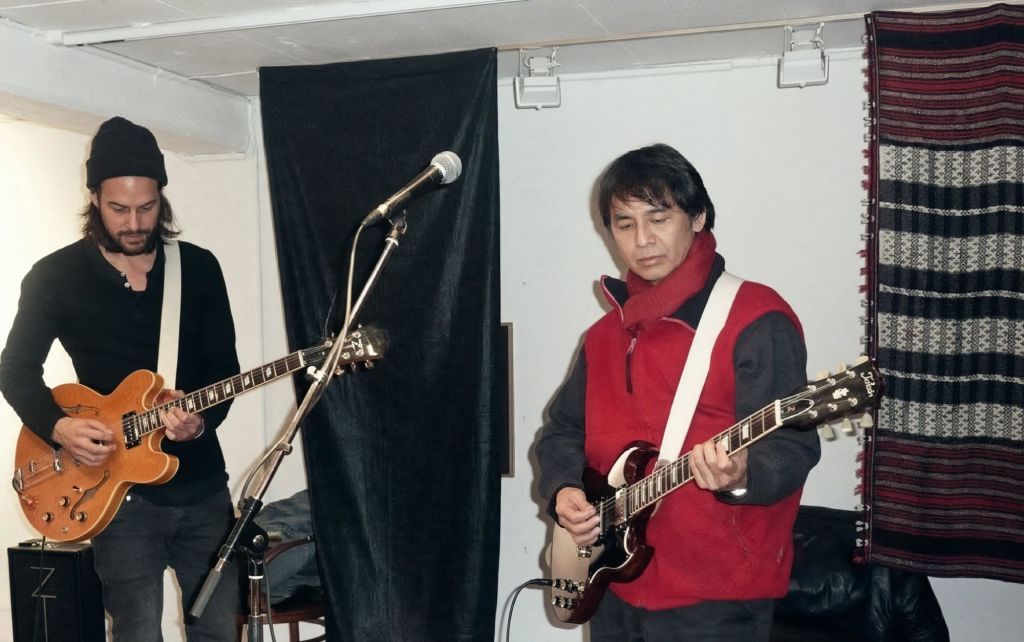
One such memory is captured in a photograph of my nephew Chris and me playing the blues together.
He was wearing a black bonnet, holding his guitar, while I stood beside him with my red jacket and my own guitar. Between us was a microphone, but perhaps the most important thing connecting us was something that no photograph could fully capture: the shared pleasure of making music.
We were playing the blues.
Looking at that photograph today, I find myself thinking about how quickly such moments become part of another time. There was a particular atmosphere, a particular closeness, a particular innocence of togetherness that belonged to that moment. We were simply there, playing music, enjoying one another’s company, without necessarily thinking that one day the photograph would become a small historical monument in my personal life.
Perhaps that is the strange nature of beautiful moments. We rarely recognize their full significance while we are living them.
Only later, when circumstances have changed and time has carried us elsewhere, do we realize that we were once standing inside something precious.
And this is where the blues enters my reflection.
The blues has always seemed to me more than music about sadness. It is a language of remembrance. It acknowledges loss without surrendering to it. Its notes seem to carry the weight of experiences that cannot be recovered, yet remain too meaningful to be forgotten.
A bent guitar string, a lingering note, a slow progression of chords: there is something in the blues that resembles walking through an ancient city at dusk. The music does not attempt to rebuild what has fallen. It gives voice to what remains.
Perhaps this is why I find the blues so deeply human. It does not deny the passage of time. It does not pretend that everything beautiful must last forever. Instead, it allows beauty and sorrow to exist together.
Athens reminds me that even the greatest intellectual and artistic achievements of humanity eventually become part of history. Istanbul reminds me that civilizations do not simply disappear; they leave layers of themselves behind, absorbed into the lives and identities of those who follow.
And our personal lives may be no different.
We carry the remnants of friendships, family gatherings, youthful adventures, conversations, music, and shared experiences. Some relationships remain active and vibrant. Others become distant, almost archaeological. But even those that have faded may continue to influence the architecture of our inner lives.
I do not necessarily wish to return to yesterday. That would be an impossible undertaking, much like attempting to restore an empire to its former glory. People change, circumstances change, and we ourselves are no longer the persons we were when those memories were created.
But I would not want to demolish the ruins either.
They deserve to remain.
Perhaps growing older means learning to walk among these ruins without bitterness. To recognize what has been lost, appreciate what once existed, and preserve a certain tenderness toward the people who shared those earlier chapters with us.
And whenever I pick up my guitar and play the blues, perhaps I am doing precisely that.
I am revisiting an ancient city within myself.
Somewhere among its old streets, I may encounter a familiar face, hear a forgotten conversation, or remember the sound of another guitar playing beside mine.
The buildings may have weathered. The streets may have changed. The people may have gone their separate ways.
But the music remains.
And perhaps, in the end, this is what love does. It does not always preserve the structures of togetherness. Sometimes it simply preserves the meaning of having been together.
The empires of the world leave behind their ruins. We leave behind our memories. And both, in their own way, deserve to be visited with respect.
Let the blues play.

