VFA: a Lick and a Promise?


By W. Scott Thompson and Oliver Geronilla*


“Well, because he looked like a wild boar,” the American serviceman explained his shooting of a Pinoy at Subic Bay forty years ago; was there anything more insensitive he might have said? Oh yes there is. When rich Bill Blair arrived with his wife (Deedee of the ten best dressed women of the world), he said Filipinos were “ungrateful” with respect to the bases and all else America had purportedly done for the Philippines—was he referring to the Thomasites or to the development of the Colt 45 so to be able to kill Filipinos more efficiently in the independence war?

This has always been the worst issue between Filipinos and Americans, so it’s no surprise that Senator Santiago has picked it up. She always knows how to inflame issues for her own advantage. Should the government dance foxtrot with Miriam? With her stance in the senate, it seems that she’s now on the fast beat strutting much faster to ask GMA to renegotiate the executive bilateral agreement. And if all fails, “terminate the agreement,” she opines.

Here’s the nub of the issue. At independence, the Philippines was destroyed by war and destitute; the American star was ascending all over the world. America was—since it was little affected by World War II—half the world product, if only briefly. The Philippine bargaining position wasn’t exactly strong. And the governing elite, more or less the same then as the sugar elite, satisfied itself with the famous American sugar quota, whereby the American consumer paid a 400% bounty for sweets from the archipelago, in return for all the concessions on sovereignty. There was also a lot of talk back then about how the American military commitment to the Philippines was a lot less automatic than to NATO partners, which was true, though with time this has become moot.

Principally, here was the question of jurisdiction over crimes committed by Americans on official duty at and around the bases. Status of forces agreements in almost all cases involved the American request for waivers for soldiers charged with a crime to be tried in their own courts. NATO countries granted 94.8% of the waivers requested as of 1970; the Philippines 00.9%. There just wasn’t a lot of trust in this realm.

For a generation, that’s all we heard of. The agreements here were “second class,” America saw the Philippines as “second class.” Well, yes and no. It is true that the NATO provisions were more favorable to the host countries. But in all fairness, the Philippines was just developing its judicial system and we all know some of the weaknesses. The USA used its economic position for concessions, but it was increasingly—and has been ever since—a comparison of apples with oranges.

Come the base lease endings in 1991, new temporary agreements were concluded. They really encapsulated the best of the past, though one of Cory’s chief advisers thought they were less favorable than those previously existing. Not so, said the then SND, Fidel V. Ramos, when he was interviewed at the time.

But now the atmosphere is heating up all over again. Filipinos are discovering that the 500 Americans merely ‘advising’ in Mindanao (and the moon is made of cheese?) are thick in the fight and they are worried that once again the USA can slip one over on the less powerful Philippines, and spirit away offending American troops. Well, at least the 500 got GMA enough of an excuse to extract a meaningless thirty -minute meeting with Barack Obama, right? And the fight in Mindanao, the leading authority on insurgency in Southeast Asia, Zachary Abuza, has said, is the foremost front in the region against terrorism, right?

That puts all and sundry in limbo.

Seeing the people in the government espouse principles that are poles apart is nothing new. Senator Santiago’s “either A or B” approach in making VFA work for the country is laudable, but things are not always what they seem. All these issues have been there for a long time waiting to be examined. But why just now? People might argue that certain loopholes only become apparent when problems surface out. True. But isn’t it a classical case of healing only when and where it hurts?

Secretary Teodoro sings a different tune. Almost a month ago, he warned the nation against abrogating the agreement as it won’t bode well for the country for “it might send a wrong signal to its allies that it cannot keep its commitment.” Just recently, he issued another statement saying that the discussions on the matter must be done after the elections so as  to avoid putting political color into it. That holds water, doesn’t it? Or, is it just a political posturing?

Legal luminaries have of course asked the Supreme court’s help on this issue zooming in on its constitutionality; however, the Supreme Court has articulated its position not only once but twice– It is constitutional! What happened to Art. VII, Sec. 21 of the Philippine Constitution? It says: “No treaty or international agreement shall be valid and effective unless concurred in by at least two-thirds of all the members of the Senate.” It’s perhaps due to this reason that the Former Senate President, Jovito Salonga, together with the other petitioners who questioned its constitutionality does not lose hope. In fact, they’re keeping their fingers crossed that the other justices would join the four who dissented.

Has the Upper House done its job? For the nonce, yes. Senate Resolution No. 1356 serves as its clarion call aimed at GMA to serve notice to the US to terminate or renegotiate the agreement.

And the Lower House? Well, based on their reactions, it seems that they are not singing from the same hymnbook.

Not too long ago, Senator Joker Arroyo succinctly wrapped up the issue by asking both the legislative and the executive branches of the government to iron things out minus the bickering that we have been seeing on national television.

Clearly, they are at loggerheads. Without a unified stand on the issue, we all know too well that everything is bound to come a cropper. We think that Miriam is doing a disservice. This is a very difficult issue, and as a lawyer, she knows better than to present it all in chiliastic terms. Time for her to consult her, shall we say, “advisers”?

And oh… Let’s all wait till the fat lady sings.

——————-

* W. Scott Thompson, D.Phil., is professor emeritus of International Politics at the Fletcher School of Law and Diplomacy, Tufts University. He wrote this with the assistance of Oliver Geronilla, language instructor at HMA, Dasmariñas, Cavite

                                                                         ……………..  end…………

Madame John Quincy Adams?


By W. Scott Thompson and Oliver Geronilla*


The sixth American president, like GMA, was the child of a previous president: John Quincy Adams was son to second president John Adams. After he lost his bid for reelection in 1828 to the populist Andrew Jackson, he bided his time looking for ways to be useful to the young republic, and stood for election in 1830 to the House of Representatives as a candidate from his home state of Massachusetts.

Is there another parallel emerging? We hear that the 14th president of this republic plans to stand for election to the Filipino House of Representatives from her home province of Pampanga. Is this a horrific loss of face—to go from palace to mere Batasan? Well, Adams refused to consider it as such, and as Congressman Adams in fact achieved far more than as President Adams. His was the essential and eloquent voice against slavery throughout his 17 years in the House, and he is remembered as one of the preeminent men of principle in the history of American politics. So we guess the parallel has already become dubious.

For we know that Congress is not all that GMA has in mind. Hers has been a relentless search for ways to remain in power, and we haven’t found a single suggestion here in Manila that it is because she so deeply wants to serve her country. Rather, it is usually suggested, she doesn’t wish to serve it in jail. For a single page of paper issued by the department of justice can instigate a search for any properties she or any member of her family may have obtained—even with a smidgen of evidence—of laundered or otherwise unlawfully gained funds.

Here’s what could happen. An unfriendly successor in Malacanang can authorize the DOJ to empower any investigator abroad to go to a court (say, in San Francisco) with the slightest of proof that a building was so obtained, and the court will in all likelihood freeze the ownership of this house or building, preventing its sale. The investigator can then go to that American court and through a complicated but brief process demand under oath an accounting for all funds used to acquire it (it’s called ‘Discovery’ in America). The resulting bank records, of course, can be used to follow the flow of funds all over the world. One can hide one end of a bank record—but not both ends—and the resulting search can take the investigator all over the world to discover all related funds in cut-out companies, holding firms, banks, or any other entity used to acquire properties or equities with illegal monies. The results can be, might well be, devastating.

Globalization has proceeded in international law at a breathtaking pace in recent years. Government ministers can be arrested in any of a number of countries. Israeli ministers do not, for this reason, travel to Belgium, which has ‘friendly’ laws for seizing persona of governments so accused. Small wonder Robert Mugabe doesn’t travel without previous assurances of legal immunity. The United States kidnapped the Panamanian head of state; a San Francisco court convicted the former prime minister of Ukraine on 27 counts of felony connected with his acquisition of about $40m of properties in the Bay Area and he has spent quite a time in jail or otherwise restricted there.

Apparently Mrs. Arroyo knows all this. It’s no wonder she wants the protection of high office. But at what cost to the Republic? Her problem though is a different one. A friendly successor can promise her immunity here in the Philippines, but that’s worth nothing abroad. Any properties she or her family hold abroad can be scrutinized for any illegality.

In this instance of course she can avoid travel to the accusing country, but that might be a bit of a problem if she, say for example as prime minister of a newly-formed parliamentary republic, wishes to address the United Nations (or enjoy the properties members of her family are thought to possess abroad).

Now John Quincy Adams didn’t have any of these problems. Though his family wasn’t poor—they’d been merchants prior to Father’s presidency—he didn’t have properties abroad or much at home. But he had honor, honor to burn. And his descendants—though two of his sons had painful careers trying to carry family honor—included the great Charles Francis Adams, diplomat and writer, whose namesakes continue to brighten the Boston skyline.

There is a parallel with the sixth American president for the fourteenth president to consider. She could run for Congress, and of course win, and then serve with honor in the manner that her ample professional qualifications allow her—the macroeconomic record of her presidency is very impressive. She and her family could continue to serve the Philippines in a way that causes no ugly rumors to emerge. One presumes that her financial problems aren’t great; it’s the legal ones that bother her. But if she began anew, let us say in the style of her incorruptible father, she could burnish the golden side of her record impressively—and our guess is that no one would dare challenge her legally. When you have honor on your side, even if it emerges only latterly, foreign courts just aren’t too interested in incarcerating you. And the American president would surely then welcome such a person—it is all too well known that Barack Obama spurned her initial attempts for a meeting simply because of the tarnish that lingers over her presidency.

Eight years ago, it was written that Mrs. Macapagal-Arroyo had an unparalleled opportunity to leave a fantastic legacy, since she almost certainly had most of a decade to do it from Malacanang. It’s never too late to start.

————-

*Oliver Geronilla, a Bulaneño and  co-author of Dr. W. Scott Thompson (a former US Assistant Secretary of State), is a senior language instructor of  Han Maum Academy, Philippines. He has been teaching ESL since 2000.

                                                                                                     ——– end ——-

Of Green Vegetables And Green-Eyed Monster in Bulan

 jun asuncion


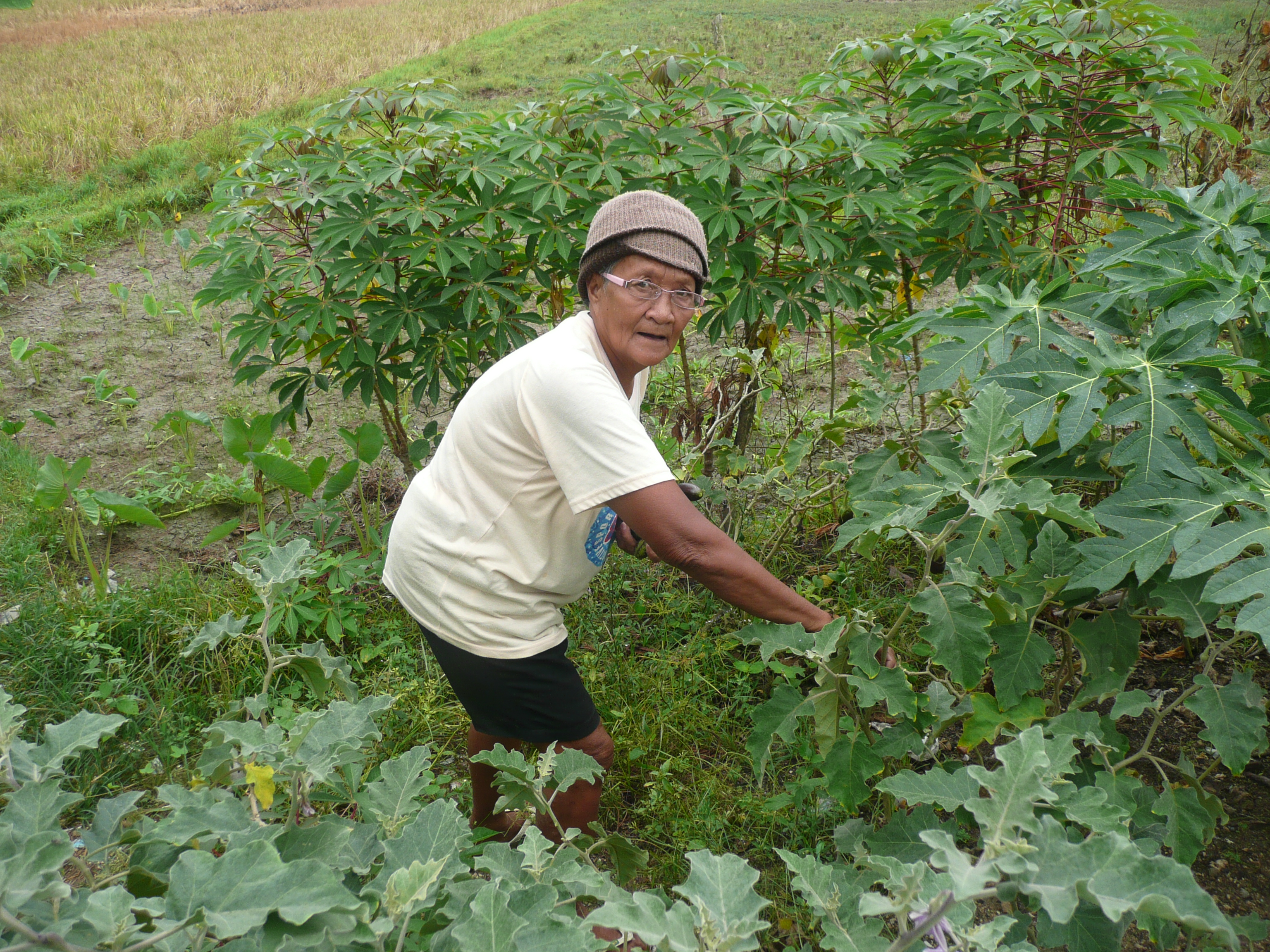
“There is a family that live adjacent to the property. When my nephew planted the vegetables and were almost a foot tall, these people had their little children (ages 8-12) went over the fence and trampled on all the growing vegetables. When my nephew went there to see his plants, almost all were damaged from being trampled. This is the kind of mentality I find it hard to understand.” – Dora The Mouse

It is true. I have experienced this when I was a young pupil in Bulan South Central School. We used to have our gardening class under the late Mr. Gillego who was a strict teacher though,  I think,  was a very kind and considerate person. It just happened that one day we found our rows of vegetable plots all ravaged, pechay (chinese white cabbage)  twisted. So it was already common at that time to take revenge, express resentment or envy indirectly by destruction of plants. I have known this behavior but have forgotten it with the passage of time. Dora’s report made me sit down and write my thoughts about it.

Well, what a way to show crab mentality. For parents to tolerate such an anti-social and anti-nature destructive behavior is  “jenseits von Gut und Böse” (Nietzsche) – beyond good and evil.

In the face of poverty, this attack is also directed against the culprits themselves without them maybe realising this. But there is more to this phenomenon if we try to examine it closer.

Let’s go back to the roots- not the twisted roots of our pechay- but to the motivating forces behind such a behavior.

Envy. It is a very strong human emotion and it is activated only within inter-personal relations;  defined as an “emotion that occurs when a person lacks another’s (perceived) superior quality, achievement, or possession and either desires it or wishes that the other lacked it” or “a feeling of discontent or covetousness with regard to another’s advantages, success, possessions, etc.”

Therefore,  it has something to do with one’s perception of him/herself  in relation to the other. Usually it leads to valuation of oneself in relation to the other, hence, self-esteem is very much connected to the emotion of envy. In general terms, people with low or negative self-esteem tend to be more envious of others. But low self-esteem is a human character trait, hence, not a poor-specific negative trait but is to be found even among the super rich and highly-intelligent  individuals.

Philosophers and psychologists have studied this human emotion at great length. For instance,  Aristotle  defined it  as “the pain caused by the good fortune of others”, and  Immanel Kant as “a reluctance to see our own well-being overshadowed by another’s”. Now, Bertrand Russel goes a step farther when he says that  envy not only renders the envious person unhappy  but also wishes to “inflict misfortune on others.”

To inflict misfortune on others.With these Bertrand’s words, the social component of envy now enters the scene and this is the point where this emotion becomes not only a purely personal affair but it becomes the cause of much of human social-interaction problems. As a rule, one intense negative emotion triggers another one such as anger which then translates itself into overt, aggressive action as trampling the garden vegetables or other things belonging to the other, directly or indirectly  hurting the other or in extreme cases to a much more heavier crimes like burning the other’s house, poisoning or murder. Between  families or clans this has led to vendettas or tribal hostilities, and among nations this has led to great wars- inflicting misfortunes on others.

Instinct of Competition. There is much more hidden in the seemingly normal and harmless emotion of envy. Beneath it is the mother of all survival instinct- that of competition. Biological creatures compete for natural resources as food, water, light, niche and mates and the denser the population in a given area, the more intense is the competition among men, among animals and among plants,- the “fittest” survive, following the law of natural selection.

 Mankind has  been competing for more other things than the plants and animals but as of now not for air to breath, which  may become  a reality in the future when air pollution has advanced to a deadly degree, not in all areas of the earth maybe, but which in turn would trigger spill-over problems to the neighboring countries and finally to competition for land and other resources due  to the exodus of population in search of air to breathe. A horror scenario which I hope only remains in my theoretical consideration.

In my own observation, envy in Bulan greatly mixes with another human emotion-  that of  pride. That people just trample the garden products instead of stealing and eating them is a sign of envy-motivated aggression and pride. It is just aimed to create damage to the neighbor, the object of envy.

Constructive and Destructive. Competition is the driving force behind social change, market economies and human interaction. It improves race,  culture, products, learning and knowledge. Some sociobiologists say that competition can be classified as constructive and destructive competition, whereby the former promotes mutual survival among competing groups whereas the latter seeks only the destruction and elimination of the competing groups. This is true in extreme cases and in lower forms of organisms (which strictly speaking may also be constructive in so far as  it serves in the end the survival or self- propagation of the specific organism).  But I think that these two classifications overlap in practice and among civilized humans it is a matter of degree and conscious choice. For even  two warring groups of human being, for instance, it is in each group’s interest to avoid deadly clashes as much as possible. This behavior already implies an unconscious  need  for mutual survival. In this case, to compete is more closer in meaning to the original latin word  “competere”, which means “to seek together” or “to strive together”.

This problem in Bulan regarding trampling and destruction of garden vegetables  may be classified not only  as a destructive form of competition and- in my view- a fruitless (unproductive one) for the motive is just to destroy and not to gain commercial advantage over the victim. A purely emotional affair that doesn’t benefit anybody in Bulan.

Does election benefit anybody in Bulan? When Bulaneños compete for an elected position, we hope that they don’t trample one another or twist each other’s neck but rather that it be more constructive in nature where each party thinks not only of winning but  strive together to solve the problems of Bulan community-  even after the election. Transcending envy, pride and resentment may not be easy but I guess there is the key  for Bulan’s improvement. In a  town  where green-eyed monsters and hatred rules, there will be no progress. But perhaps progress only for one’s own family or clan.

But here is an interesting point about the theory of evolution and politics: If the strongest and most superior in all aspects and he who has the most of the materials and money to buy votes dominate and win each election,  is he to be considered the fittest, hence,  morally superior being also? And does it improve the moral superiority of his offsprings? Or has the darwinian theory evolution (whose goal is the improvement of the species through natural selection) nothing to do with the genealogy of morals, which means that the most morally base candidates are the “fittest” in the Philippine elections?

The Religious Bulan. Every Sunday, the Bulan Parish Church is filled with more or less the same people occupying more or less the same seats. Hence, it is normal to expect that people should be familiar with the  catholic teaching that envy is considered as one of the seven deadly sins, together with pride, sloth, gluttony, greed, lust and wrath. The corresponding biblical passage is found in The Book of Exodus (20:17) which states:

 “You shall not covet your neighbour’s house; you shall not covet your neighbour’s wife, or male or female slave, or ox, or donkey, or anything that belongs to your neighbour.”

To covet is one of the synonyms for envy. That we should not covet “anything that belongs to your neighbor” – including the neighbor’s  garden with its fruits and vegetables- is a clear instruction for the christian community. Every Sunday the parish church of  Bulan is preaching on this moral value and it is  for each individual- from an elementary pupil to a politician- to implement this into action in his daily life. Small thing that makes a difference.

By the way, looking at this list of seven deadly sins I am inclined to sum it all up in one word- which is corruption.

Schadenfreude or delighting in others’ misfortune. Closely correlated with envy is Schadenfreude, a German word which is used as a loanword in English to denote the pleasure derive from the misfortune of others, a definition that brings us closer to the psychology of sadistic behavior. If according to Aristotle, envy is the pain caused by the good fortune of others, then Schadenfreude is the defense mechanism that reverses it. From pain to pleasure principle. For it is not enough that the envy person suffers. He must do something against it. Pechay or tomatoes trampled and destroyed or if a misfortune occurred to the envied person and thinking  “buti nga sa’ yo” (it serves you right) or giggles within is a typical Schadenfreude manifestation.

Is it right to delight in other’s misfortune? Common sense tells us that it is not right; and parents also do not teach their children to do it among themselves or to delight in their parent’s misfortune like grave sickness, accident, or death. Immanuel Kant would negate it for in his Groundwork of the Metaphysics  he proposes that you should  “Act only according to that maxim whereby you can at the same time will that it should become a universal law ” – his known concept of Categorical Imperative. Thus, strictly speaking,  Schadenfreude is a clear example of something that we cannot will to become a universal law.

Or if you prefer a Biblical passage to justify it, here it is:  “Rejoice not when thine enemy falleth, and let not thine heart be glad when he stumbleth: Lest the LORD see it, and it displease him, and he turn away his wrath from him.” (Proverbs 24:17-18 )

Perhaps Schadenfreude, sadistic thinking- or as the medieval church called it  morose delectation-  is as old as mankind, prohibited by the medieval church, considered morally base by some ethicists, yet exists today and accompanies our daily social life. This cannot be annihilated, yet tempered by training and deep reflection. Cogito, ergo sum– I think, therefore I am-  a mental formula handed over to us by Descartes.

If you think the catholic people do not practice what they learn every Sunday, then visit a Buddhist friend or a Buddhist monk to give you some explanations. For unlike most other people from other churches or religions, Buddhist people practice what they preach or the instruction they receive. They don’t kill because they’ve been  instructed so. In history, we learn that christians have enjoyed butchering one another. They even took joy conquering and colonizing other people, plundering and abusing them for centuries- all in the name of Christianity.

Wisdom and compassion to all characterize Buddhistic philosophy. It is not heaven that will make you happy, but it is in being happy now that will bring you to heaven, a buddhist acquaintance once told me. No wonder why Buddhism possesses also a counter formula to our primitive Schadenfreude or envy- and this is called mudita or happiness in another’s good fortune. Happiness and not pain, herein lies the difference, herein lies the key to understanding what that buddhist friend told me. The Buddhistic logic tells us then that compassion means unhappiness at another’s misfortune, not  “buti nga sa ‘yo” or to celebrate it, dance around and even thank God for it.

Reality Check.  Where else but in a brain research laboratory can we verify the truth in Proverbs 24: 17-18 or the Buddhist compassion. With today’s super computers and medical equipments such as CT (Computer Tomography), MRI (Magnet Resonance Imaging), PET (Positron-Emission Tomography), etc., there is almost no more place to hide your emotions- and soon perhaps your thoughts.  These equipments will scan every millimeter- and maybe  soon every nanometer (a billionth of a meter!) of your brain,  transforming its electrical activities to colorful images.

 Indeed, some studies conducted to measure envy, Schadenfreude and compassion have shown that Proverbs 24: 17-18 was right in its admonishment  to “Rejoice not when thine enemy falleth, and let not thine heart be glad when he stumbleth”. For namely, the brain reward or joy centers of subjects in these studies were stimulated or activated when they heard that people whom they envied had met with a misfortune and the like- our famous Schadenfreude at work!- or their brain empathy centers  lit up when people in the experiment whom they perceived as good (or not as subject of their envy) received electric shock which caused them pains or unjustified suffering.

Well, will the truth really set us free? The coming 2010 election is the best opportunity in Bulan to observe Envy, Schadenfreude and perhaps also Compassion.

Till the next cup of coffee..

jun asuncion

Bulan Observer

What Moved The Con-grAssmen To Dance The Cha(os)-Cha(os)

Two articles I found today which I consider must be shared throughout the country, namely those who signed the “death sentence”  to  the 1987 Constitution and Loren Legarda’s assailing  Gloria for JBC Directive.

– Congressmen Who Signed Con Ass- and perhaps because of the promised P20 million for each by Malacañang – as  posted in Loren Legarda’s politicalarena column:

On P20M more pork for con-ass congressmen

Posted 29/1 5:08AM | Comments (0)

“That’s a disturbing report – that lawmakers had been promised P20 million each by Malacanang just to ram House Resolution 1109, setting up a constituent assembly without Senate participation. If true, the move is akin to dangling a carrot in front of a hare or a quid pro quo. Worse, it may be seen, rightly or wrongly, as a bribe offer. But what else is new? It seems this administration will not spare any means just to extend its term past 2010. They are fooling no one. We all know that they want to amend the Constitution for purposes other than helping the economy take off.”

Jose Solis of Sorsogon 2 District  is again on the list! – as he was on Bolante’s  list.  He’s making a list, he’s checking it twice-  the Santa Claus Of Sorsogon.

In any case I counted all in all 172 Con-Assmen who signed; 172   multiplied by P20million pesos  =  P3, 440 billion! Again, our farmers will be forced to continue their suffering.

——

Reprentatives District/Sector

ABANTE, BIENVENIDO M. Pandacan, 6th District

ABLAN, ROQUE R. JR. Ilocos Norte, 1st District

AGBAYANI, VICTOR AGUEDO E. Pangasinan, 2nd District

AGYAO, MANUEL, S. Kalinga Province

ALBANO (III), RODOLFO T. Isabela, 1st District

ALFELOR, FELIX R. JR. Camarines Sur, 4th District

ALMARIO, THELMA Z. Davao Oriental, 2nd District

ALVAREZ, ANTONIO C. Palawan, 1st District

ALVAREZ, GENARO RAFAEL M. JR. Negros Occidental, 6th District

AMANTE, EDELMIRO A. Agusan Del Norte, 2nd District

– –

AMATONG, ROMMEL C. Compostela Valley, 2nd District

ANGPING, MARIA ZENAIDA B. Manila, 3rd District

ANTONINO, RODOLFO W. Nueva Ecija, 4th District

APOSTOL, TRINIDAD G. Leyte, 2nd District

AQUINO, JOSE S. (II) Agusan del Norte, 1st District

ARAGO, MARIA EVITA R. Laguna, 3rd District

ARBISON, A MUNIR M. Sulu, 2nd District

ARENAS, MA. RACHEL J. Pangasinan, 3rd District

ARROYO, DIOSDADO M. Camarines Sur, 1st District

ARROYO, IGNACIO T. Negros Occidental, 5th district

– –

ARROYO, JUAN MIGUEL M. Pampanga, 2nd District

BAGATSING, AMADO S. Manila, 5th District

BALINDONG, PANGALIAN M. Lanao del Sur, 2nd District

BARZAGA, ELPIDIO F. JR. Cavite, 2nd District

BAUTISTA, FRANKLIN P. Davao Del Sur, 2nd District

BELMONTE, VICENTE F. JR. Lanao del Norte, 1st District

BICHARA, AL FRANCIS C. Albay, 2nd District

BIRON, FERJENEL G. Iloilo, 4th District

BONDOC, ANNA YORK P. Pampanga 4th District

BONOAN-DAVID, MA. THERESA B. Manila, 4th District

– –

BRAVO, NARCISO R. JR. Masbate, 1st District

BRIONES, NICANOR M. AGAP Party list

BUHAIN, EILEEN ERMITA Batangas, 1st District

BULUT, ELIAS C. JR. Apayao Lone District

CAGAS (IV), MARC DOUGLAS C. Davao Del Sur, 1st District

CAJAYON, MARY MITZI L. Caloocan, 2nd District

CAJES, ROBERTO C. Bohol, 2nd District

CARI, CARMEN L. Leyte, 5th District

CASTRO, FREDENIL H. Capiz, 2nd District

CELESTE, ARTHUR F. Pangasinan, 1st District

– –

CERILLES, ANTONIO H. Zamboanga Del Sur, 2nd District

CHATTO, EDGARDO M. Bohol, 1st District

CHONG, GLENN A. Biliran, Lone District

CHUNG-LAO, SOLOMON R. Ifugao, Lone District

CLARETE, MARINA C. Misamis Occidental, 1st District

CODILLA, EUFROCINO M. SR. Leyte, 4th District

COJUANCO, MARK O. Pangasinan, 5th District

COQUILA, TEODULO M. Eastern Samar, Lone District

CRISOLOGO, VINCENT P. Quezon City, 1st District

CUA, JUNIE E. Quirino, Lone District

– –

CUENCO, ANTONIO V. Cebu City, 2nd District

DANGWA, SAMUEL M. Benguet, Lone District

DATUMANONG, SIMEON A. Maguindanao, Lone District

DAYANGHIRANG, NELSON L. Davao Oriental, 1st District

DAZA, NANETTE C. Quezon City, 4th District

DAZA, PAUL R. Northern Samar, 1st District

DE GUZMAN, DEL R. Marikina City, 2nd District

DEFENSOR, ARTHUR D. SR. Iloilo, 3rd District

DEFENSOR, MATIAS V. JR. Quezon City, 3rd District

DEL MAR, RAUL V. Cebu City, 1st District

– –

DIASNES, CARLO OLIVER D. (MD) Batanes, Lone District

DIMAPORO, ABDULLAH D. Lanao Del Norte, 2nd District

DOMOGAN, MAURICIO G. Baguio, Lone District

DUAVIT, MICHAEL JOHN R. Rizal, 1st District

DUENAS, HENRY M. JR. Taguig, 2nd District (2nd Councilor District)

DUMARPA, FAYSAH MRP. Lanao del Sur, 1st District

DUMPIT, THOMAS L. JR. La Union, 2nd District

DURANO (IV), RAMON H. Cebu, 5th District

ECLEO, GLENDA B. Dinagat Islands, Lone District

EMANO, YEVGENY VICENTE B. Misamis Oriental, 2nd District

– –

ENVERGA, WILFRIDO MARK M. Quezon, 1st District

ESTRELLA, CONRADO M. (III) Pangasinan, 6th District

ESTRELLA, ROBERT RAYMUND M. ABONO Party List

FERRER, JEFFREY P. Negros Occidental, 4th District

GARAY, FLORENCIO C. Surigao Del Sur, 2nd District

GARCIA, ALBERT S. Bataan, 2nd District

GARCIA, PABLO JOHN F. Cebu, 3rd District

GARCIA, PABLO P. Cebu, 2nd District

GARCIA, VINCENT J. Davao City, 2nd District

GARIN, JANETTE L. Iloilo, 1st District

– –

GATCHALIAN, REXLON T. Valenzuela City, 1st District

GATLABAYAN, ANGELITO C. Antipolo City, 2nd District

GO, ARNULFO F. Sultan Kudarat, 2nd District

GONZALES, AURELIO D. JR. Pampanga, 3rd District

GONZALES, RAUL T. JR. Iloilo City

GULLAS, EDUARDO R. Cebu, 1st District

GUNIGUNDO, MAGTANGGOL T. Valenzuela City, 2nd District

HOFER, DULCE ANN K. Zamboanga Sibugay, 2nd District

JAAFAR, NUR G. Tawi-Tawi, Lone District

JALA, ADAM RELSON L. Bohol, 3rd District

– –

JALOSJOS, CESAR G. Zamboanga del Norte, 3rd District

JALOSJOS-CARREON, CECILIA G. Zamboanga del Norte, 1st District

JIKIRI, YUSOP H. Sulu, 1st District

KHO, ANTONIO T. Masbate, 2nd District

LABADLABAD, ROSENDO S. Zamboanga del Norte, 2nd District

LACSON, JOSE CARLOS V. Negros Occidental, 3rd District

LAGDAMEO, ANTONIO F. JR. Davao del Norte, 2nd District

LAPUS, JECI A. Tarlac, 3rd District

LAZATIN, CARMELO F. Pampanga, 1st District

LIM, RENO G. Albay, 3rd District

– –

LOPEZ, JAIME C. Manila, 2nd District

MADRONA, ELEANORA JESUS F. Romblon, Lone District

MAGSAYSAY, MARIA MILAGROS H. Zambales, 1st District

MALAPITAN, OSCAR G. Caloocan, 1st District

MAMBA, MANUEL N. Cagayan, 3rd District

MANGUDADATU, DATU PAKUNG S. Sultan Kudarat

MARANON, ALFREDO D. III Negros Occidental, 2nd District

MATUGAS, FRANCISCO T. Surigao del Norte, 1st District

MENDOZA, MARK LEANDRO L. Batangas, 4th District

MERCADO, ROGER G. Southern Leyte, Lone District

– –

MIRAFLORES, FLORENCIO T. Aklan, Lone District

NAVA, JOAQUIN CARLOS RAHMAN A. (MD) Guimaras, Lone District

NICOLAS, REYLINA G. Bulacan, 4th District

NOGRALES, PROSPERO C. Davao City, 1st District

OLAñO, ARREL R. Davao Del Norte, 1st District

ONG, EMIL L. Northern Samar, 2nd District

ORTEGA, VICTOR FRANCISCO C. La Union, 1st District

PABLO, ERNESTO C. APEC Party List

PANCHO, PEDRO M. Bulacan, 2nd District

PANCRUDO, CANDIDO P. JR. Bukidnon, 1st District

– –

PICHAY, PHILIP A. Surigao Del Sur, 1st District

PIñOL, BERNARDO F. JR. North Cotabato, 2nd District

PUNO, ROBERTO V. Antipolo City, 1st District

RAMIRO, HERMINIA M. Misamis Occidental, 2nd District

REMULLA, JESUS CRISPIN C. Cavite, 3rd District

REYES, CARMELITA O. Marinduque, Lone District

REYES, VICTORIA H. Batangas, 3rd District

ROBES, ARTURO G. San Jose Del Monte City, Lone District

Rodriguez-Zaldarriaga, Adelina Rizal, 2nd District

ROMAN, HERMINIA B. Bataan, 1st District

– –

ROMARATE, GUILLERMO A. JR. Surigao del Norte, 2nd District

ROMUALDEZ, FERDINAND MARTIN G. Leyte, 1st District

ROMUALDO, PEDRO Camiguin, Lone District

ROMULO, ROMAN T. Pasig City, Lone District

ROXAS, JOSE ANTONIO F. Pasay City

SALIMBANGON, BENHUR L. Cebu, 4th District

SALVACION JR., ANDRES D. Leyte, 3rd District

SAN LUIS, EDGAR S. Laguna, 4th District

SANDOVAL, ALVIN S. Malabon-Navotas, Lone District

SANTIAGO, JOSEPH A. Catanduanes, Lone District

– –

SANTIAGO, NARCISO D. III ARC Party List

SEACHON-LANETE, RIZALINA L. 3rd district of Masbate

SEARES-LUNA, CECILIA M. Abra, Lone District

SILVERIO, LORNA C. Bulacan, 3rd District

SINGSON, ERIC D. Ilocos Sur, 2nd District

SINGSON, RONALD V. Ilocos Sur, 1st District

SOLIS, JOSE G. Sorsogon, 2nd District

SOON-RUIZ, NERISSA CORAZON Cebu, 6th District

SUAREZ, DANILO E. Quezon, 3rd District

SUSANO, MARY ANN L. Quezon City, 2nd District

– –

SY-ALVARADO, MA. VICTORIA R. Bulacan, 1st District

SYJUCO, JUDY J. Iloilo, 2nd District

TALINO-MENDOZA, EMMYLOU J. North Cotabato, 1st District

TAN, SHAREE ANN T. Samar, 2nd District

TEODORO, MARCELINO R. Marikina City, 1st District

TEODORO, MONICA LOUISSE PRIETO Tarlac, 1st District

TEVES, PRYDE HENRY A. Negros Oriental, 3rd District

TUPAS, NEIL C. JR. Iloilo, 5th District

UNGAB, ISIDRO T. Davao City, 3rd District

UY, EDWIN C. Isabela, 2nd District

– –

UY, REYNALDO S. Samar, 1st District

UY, ROLANDO A. Cagayan De Oro City, Lone District

VALDEZ, EDGAR L. APEC Party List

VALENCIA, RODOLFO G. Oriental Mindoro, 1st District

VARGAS, FLORENCIO L. Cagayan, 2nd District

VILLAFUERTE, LUIS R. Camarines Sur, 2nd District

VILLAROSA, MA. AMELITA C. Occidental Mindoro, Lone District

VIOLAGO, JOSEPH GILBERT F. Nueva Ecija, 2nd District

YAP, JOSE V. Tarlac, 2nd District

YU, VICTOR J. Zamboanga Del Sur, 1st District

– –

ZAMORA, MANUEL E. 1st District, Compostela Valley

ZIALCITA, EDUARDO C. Parañaque, 1st District

.

Read more: http://www.2010-election.com/2009/06/congressmen-who-signed-con-ass/#ixzz0Q57tQTIH

7/8 2:51PM

Loren assails Gloria for JBC Directive

Sen. Loren Legarda yesterday accused President Gloria Macapagal-Arroyo of trying to undermine the independence of the judiciary.

In a statement, Loren said “this could be the only possible motive why she rejected the list of six nominees to the Supreme Court submitted by the Judicial and Bar Council to fill two vacancies in the highest court.”

She declared that if the President “succeeds in packing the highest court of the land with men or women subservient to her will, the independence of the judiciary would be totally undermined.”

“With sensitive and crucial issues expected to be taken to the Supreme Court in the face of the approaching 2010 elections that could affect the future of our country, this move of the President is indeed alarming and ominous,” she asserted.

Among these issues is House of Representatives Resolution 1109 calling for a constituent assembly to amend the Constitution without the participation of the Senate as a separate body. Loren pointed out that more than 70 percent of the people oppose the proposal as shown by poll surveys.

She also stated that electoral protests arising from the conduct of the 2010 elections could be decided by a Supreme Court the majority of whose members could be “dictated to or controlled” by the president.

“Something is being cooked in Malacañang in preparation for the 2010 elections and it smells rotten,” said Loren.

She also asserted that the move of the President could even be considered a violation of the Constitution.

The Constitution states that “The members of the Supreme Court and judges of lower courts shall be appointed by the President from a list of at least three nominees prepared by the Judicial and Bar Council for every nominee” (Sec. 9. Article VIII).

“The JBC was precisely set up by the Constitution to ensure the independence of the judiciary,” Loren stated. “But if the President succeeds in manipulating the JBC to recommend men and women subservient to her will to the Supreme Court, she will have succeeded in undermining the independence of the judiciary.”

Loren dismissed as “unacceptable and shallow” the claim of Executive Secretary Eduardo Ermita that the President only wanted a “wider list”.

According to Loren, the Constitution gave the JBC the authority to submit at least three nominees to any vacancy in the Supreme Court or lower courts, or to expand that list according to its discretion.

“But the Constitution did not give any authority to the President to demand that the JBC submit more than three nominees for each vacancy. The President is bound to make her appointments from at least three nominees submitted by the JBC,” Loren pointed out.

That’s All For Now, Folks!


jun asuncion

BULAN TOWN GIRDS FOR PISTA SA KABUBUDLAN 2009

by Tonyboy-PIO

September 1, 2009 at 10:22 am

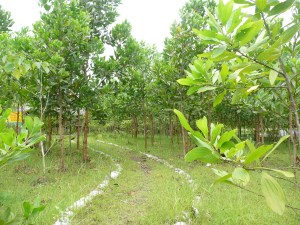
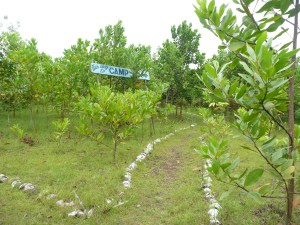
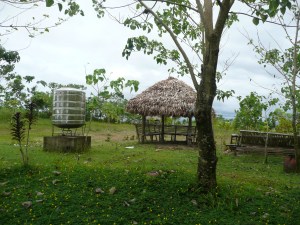
Bulan, Sorsogon – In what appears to be the biggest gathering of participants thus far, the Local Government Unit, through the Office of the Mayor and the Municipal Environment and Natural Resources Office (MENRO) are now preparing for the forthcoming Pista sa Kabubudlan 2009 to be held at the Bulan Ecological Park (Ecopark) on the first Friday and Saturday of October.

Several thousands of participants from all walks of life, especially from the youth sector, the schools, the barangays and from different organizations and sectors, will once more troop to Barangay Calomagon where the Ecopark is located to participate in different ecological activites, to be highlighted by a massive tree planting event in the 14.5 hectare-area.

This will be the fifth consecutive time this event is held since it was first launched in 2005 by the incumbent Mayor Helen C. De Castro, one of whose programs was on Environment Preservation and Protection.

The event will feature several festive activities which include environment film-showings, ecology seminars on recycling and re-use, concerts, disco-dancing, overnight camping, a Holy Mass and other religious activities, a Mutya ng Kalikasan Search, Laro ng Lahi, games and funfare, and the Tree-planting activity.

This year, several government agencies outside of Bulan, including Mayors from other towns will come to observe the Pista.

The Pista sa Kabubudlan and the Ecopark are part of the Mayor’s Environment Programs. The Ecopark was once a garbage site and the mayor was responsible for converting it to an Ecopark. Now it is part of the DILG Replication Program or GO-FAR Program for other LGUs to follow.

Bulan Town has been a consistent recipient of many awards and recognitions for its novel and trailblazing environment programs, among them the Gawad Pangulo sa Kapaligiran, as National Finalist from 1996-1999, Saringgaya Awards in 2007, Outstanding LGU for Solid Waste Mangement Program in 2008 and as GO-FAR Model LGU in 2008.

The MENRO is responsible for preparing all the activities for this year’s Pista. (PIO-Bulan)

The Death Of A Political Dynasty

(Or, Rediscovering Apolinario Mabini)

by jun asuncion


“…  Political dynasty  is also subject to natural death as history has shown us: it dies due to lack of next generation that will continue it or the shift in interest or lack of energy of the new generation, or continued strife with other political dynasties has led to total annihilation of the dynasty/clan members, continued political turmoils and rebellion leading to mass murder of clan members, loss of properties (lands, houses) and financial capital, internal strife among dynasty members, or simply sickness and death of all the remaining members.” (from my post Nannette Vytiaco… A Retrospect)

I wrote these lines a few months ago. The decline of the Kennedy Political Dynasty seems to be because of the first and last causes I cited above, which are the shift of interest or lack of energy of the new generation and death of the remaining members.

 With the death of Eduard “Ted” Kennedy, the Kennedy Dynasty is “over”, says Ben Bradlee, vice -president of Washington Post, or as Wilfred Macclay- political professor at Pepperdine University- says, ” The family has lost its vigor or momentum”.

The Kennedy held the “Kennedy Seat ” in American senate since 1947. With Ted’s death, the citizens of Massachusetts will decide in January for his successor.  However, it’s no more certain if it would be somebody  from the dynasty. Two persons are in question, namely Victoria Kennedy- the widow of the deceased senator and Joseph F. Kennedy II, a nephew of Teddy, and son of Robert “Bobby Kennedy, the senator, justice minister and presidential candidate who was murdered in 1968. Though most of the younger Kennedys are active as philanthropists, educators, environmental activist, founders of  charity organizations,  it seems though that no one among them has the political  interest or the profile to fullfil what  Joseph Patrick Kennedy, the founder of the clan, has set as the Kennedy’s motto: ” Win, don’t come as second or third. That doesn’t count”.

Months before his death, the deceased senator has declared his niece Caroline Kennedy-  daughter of president John F. Kennedy- as his successor. She tried last year- perhaps pressured by this expectation- to apply for Hillary Clinton’s seat in the senate. The news spread like fire and soon there were  brigades of journalists around her. Some of them started asking for her qualifications aside from being a Kennedy and being a daughter of a famous president. Soon the pressure came from all sides and she gave up her candidacy.

There is shadow where light is. And the Kennedys were not without scandals that shed shadows to their brilliant status: women, alcohol and drug addictions have also a share in their clan history. Joseph Kennedy II has political experience in his portfolio being a member of the American congress for six legislative periods but a book published by his ex-wife where she revealed his shadows forced him to give up his further  political ambitions. He is at the moment the boss of his “Citizens Energy”, a non-profit organization which supplies heating oil to the socially disadvantaged. The same with Patrick Joseph Kennedy, the son of  Ted Kennedy himself. He would have been the carrier of the Kennedy’s political shining legacy for he is still a member of the American congress representing Rhode Islands. But politically, he pales against the bright shining background of the past Kennedys. And he was also in the headlines for his drug  and alcohol addictions. The future is bleak for the political Kennedy, for the once strongest American political dynasty. And the way things present themselves today, it’s almost over.

Worth mentioning also is  the other  twin shadows that have accompanied  the luminary Kennedys which is tragedy  and cancer. Some of them ended tragic like John F. Kennedy Sr., and Robert Kennedy who were both assassinated, Joseph was killed in a plane crash during the Second World War, to be followed  decades later by his nephew John F. Kennedy, Jr. whose plane crashed into the waters around New York, one Kennedy was accused of rape-  though acquitted later on, ski and car accidents. Ted Kennedy himself was involved in a plane crash which he luckily survived. But the 1969 Chappaquiddick-scandal where, after an  alcohol party, the car he was driving fell into the river, causing the death of  his woman front-seat passenger, had definitely ended his journey to the White House. To round it all up, Jaqueline Kennedy died of cancer and, just recently, Ted Kennedy himself of brain tumor. You may think of a curse against the Kennedy Dynasty. But for sure, their risky lifestyle and their popularity contributed much to all these tragedies.

Back to the Philippines, we should never confuse our understanding of  Philippine political dynasty and attempt to justify it by referring to that  of  American political dynasty, for with all its flaws, the  American democratic institutions still function and this is where the difference of meaning and practice of political dynasty between these two countries start. The American politicians-whether belonging to a dynasty or not- still work as public servants and not as public plunderers of the nation’s wealth. Ted Kennedy used his 46 years in the senate  vigorously representing the socially weak  and creating laws for their welfare. The   U.S. electoral process alone already tells us that anybody eyeing for an elected position would readily give up as soon as a slight bad personal record has leaked to the public. In the Philippines, anybody can be president as long as he has the support of the wealthy people or political clans or the media  popularity or the undifferentiated voters and masa (populace). An ex- convict ex-president, a national gambler and alcoholic may even run again for presidency; or an incumbent president who, with her allies who support her Constituent  Assembly, tampers the 1987 Constitution for her own dynastic needs, not really for the welfare of the socially weak.

But since the political logic runs different in the Philippines, it follows that there is more to the inner logic that dictates the end of a political dynasty. For instance,  the Marcos dynasty was ended by a revolution, the Jueting republic of  Estrada suffered the same fate. It’s not only the lack of interest of the new generation or  the natural death of dynasty members but a revolution is inherent in this logic of social change- whether we like it or not- as long as the present political condtions persist and the voters  continued to be politically undifferentiated, hence, manipulable. For otherwise, a differentiated populace expresses its concepts of change through democratic ways and a differentiated government supports only democratic ways.

Therefore, we can aptly say that the Sword of Damocles hangs over the political dynasties in the Philippines. Their destruction is pre-programmed by the very logic that it has in itself. We just have to look at the European welfare states how they attend to the public needs now. They, too,  were once dominated by all sorts of political dynasties but with time all of them were destroyed. Destruction and Creation of new forms- the  two forces of social evolution.

In our modern language, it is simply not sustainable, this kind of political landscape,  for it doesn’t allow for growth. The dynasties in our country- busy with their self-aggrandizement politics-  don’t realize their impending doom which could be very violent. We don’t presume to know when this will definitely end in the Philippines but it has  its own timetable. An evolving society changes its structure and adopts  a form that will keep it survive as a whole. For me, this form means higher civilization.

This is Self-Aggrandizement when you travel the Philippines: you see a school building with the inscription, “A Project of President Arroyo“, a  bus waiting shed with “A Project Of Governor…”, a basketball court with “A Project Of Barangggay Captain…” , a pavilion with  “A Project Of  Mayor…”… and so on. Arroyo has for sure some projects accomplished. But there is nothing personal about them for the money used was from the people, from the taxes paid, not from her own wallet. And as a public servant, you are elected and paid to work  and do something for your country or town. Or must the people  beg for you for these things, expect them to be overly thankful when you have done something?  Only a politician who has bought all his votes behaves this way for he feels he owns the people, he owns the country, he owns the town.

So why steal the money and honor from the people? Self-aggrandizement is defined like this by our politicians: I steal people’s money, make a project out of the rest of it and then use this project to cover up my stealing  and to improve my image. This is outright deception. So people of the Philippines, people of Bulan, I understand what you feel whenever you see such personalized, privatized  public amenities. Now,  the more you see such structures or banners with such inscriptions in your town, in our country when you’re traveling, the more you know that there are lots of public thieves around you, displaying their honorable names voluntarily to insult you.

This Self-Aggrandizement (and to my view, political corruption, nepotism and dynastic politics) has its root in Aguinaldo, according to Mabini, which to him also the reason why the Philippine Revolution in 1896/98 failed. In his book  La Revolution Filipina. he wrote:

“To sum it up, the Revolution failed because it was badly led; because its leader won his post by reprehensible rather than meritorious acts; because instead of supporting the men most useful to the people, he made them useless out of jealousy. Identifying the aggrandizement of the people with his own, he judged the worth of men not by their ability, character and patriotism but rather by their degree of friendship and kinship with him; and anxious to secure the readiness of his favorites to sacrifice themselves for him, he was tolerant even of their transgressions. Because he thus neglected the people forsook him; and forsaken by the people, he was bound to fall like a waxen idol melting in the heat of adversity.God grant we do not forget such a terrible lesson, learnt at the cost of untold suffering.”

He wrote further:

“Mr. Aguinaldo believed that one can serve his country with honour and glory only from high office, and this is an error which is very dangerous to the common welfare; it is the principal cause of the civil wars which impoverish and exhaust many states and contributed greatly to the failure of the Revolution. Only he is truly a patriot who, whatever his post, high or low, tries to do the greatest possible good to his countrymen. A little good done in an humble position is a title to honour and glory, while it is a sign of negligence or incompetence when done in high office. True honour can be discerned in the simple manifestations of an upright and honest soul, not in brilliant pomp and ornament wich scarcely serve to mask the deformities of the body. True honour is attained by teaching our minds to recognize truth, and training our hearts to love it. The recognition of truth shall lead us to the recognition of our duties and of justice, and by performing our duties and doing justice we shall be respected and honoured, whatever our station in life.”

This was probably what Apolinario Mabini had in mind also – a civilized Philippines-  when he wrote these  lines at the last chapter of his book  La Revolution Filipina :

“Let us never forget that we are on the first rung of our national life, and that we are called upon to rise, and can go upward only on the ladder of virtue and heroism. Above all let us not forget that, if we do not grow, we shall have died without ever having been great, unable to reach maturity, which is proper of a degenerate race.”

 A degenerate race? Well, that’s tough.

 jun asuncion

Bulan Observer

———————————————————————-end——————————————————–

The Final Insult To The Filipino Mind

by jun asuncion

This SONA 2009 sounds like a desperate appeal to the public of one of the most unpopular presidents of the Philippines- Gloria Arroyo- to change their perception of her for the better before she steps down the throne of power where, for years, she overstretched the meaning of political corruption in the Philippines. Aside from that, she tarnished badly the image of a woman politician in the Philippines- to the disadvantage of some promising and competent women politicians in the country like Loren Legarda.

To divert the attention of the public, she used strategically such positive words as “work”, “lead”, “protect”, and “preserve”. To qoute her: “I did not become President to be popular. To work, to lead, to protect and preserve our country, our people, that is why I became President. When my father left the Presidency, we were second to Japan. I want our Republic to be ready for the first world in 20 years..”

She associated her name with the memory of her father who allegedly placed the Philippines second to Japan during his time. These are all cheap psychological tricks employed to manipulate the public mind and shape their perception of her- in other words, to polish her image. This going back to history to use it to one’s advantage in face of the actual desolate situation of the country in many levels- social, political and economic- is a typical myopic perception of somebody from a political dynasty. Myopic because vested interest has always the self- or ego, or the clan if you prefer it- as point of reference, and not the all-encompasing goals set by the Philippine Constitution.

 It is this megalomanic and egocentric political system in the country that prevents it from joining the first world, a goal set by Arroyo to achieve within 20 years. This is an illusion, a wishful thinking, and should not be confused with positive thinking and visonary leadership for she did not possess this patriotistic and moral uprightness characteristic of a visonary leader like Gandhi, Mandela or Obama. An illusion leads a country to nothing. To insult the Filipino mind several times by the number of corruption scandals within her family, the high records of human rights violation and killings of investigative journalists during her administration, the high rate of emigration of Filipino nationals, the astronomic foreign debts of the country which doubled during her presidency, etc. – all attest to misgovernace and dissatisfaction of her government and to the reality of her delusion. To join the first world, the Philippines must in the first place build a stable  political base, reform the electoral process, penalize corruption practices and must have a nationalistic, democratic and morally strong national leader. I think Arroyo have missed correcting these flaws in our country and even missed correcting her own self. So this good sounding dream of joining the first world lacks sincerity, just thrown into the air to insult you and me.

When people flee, it’s never a sign of happines. When killings and corruption scandals are never solved, it’s never an indicator of democracy, social justice and functioning five pillars of justice or checks and balance system- but of strings being pulled behind to the center- the self. Economic statistics never tell the truth when used by an unpopular president whose intention is to repair her broken public image. So it’s hard to buy the figures she’s selling out here. They are designed to insult the Filipino mind.

Being an economist, she claims authority on this subject, claiming that the world finacial crisis did not ruin the Philippines as it did to other countries. The Philippines was spared of it- thanks to her economic programs- like the OFW which sends her billions of dollars annualy. Again one must exercise caution here. The world crisis was a bank crisis in the first place. The Philippines do not have giant banks that invested huge amounts outside the country- like the UBS of Switzerland where it lost billions of dollars in the US. But this involves mainly the UBS and not the whole country of Switzerland. Jobs were lost naturally, but the whole Swiss economy is as strong as before. It is mainly because of a stable social and political system- not because of its giant banks like UBS and CS. Local and foreign investments abound because of peace and political stability.

 As we all know, political stability is never a strength of the Philippines since decades  already- so don’t expect economic stability as stressed in SONA 2009 by Arroyo. Her very own administration was from the very beginning  also unstable. It is ridiculous how she stands all alone before the nation and flamboyantly cites  proofs to the rising economic wealth of the Philippines under her presidency- but immediately calls the aid of her lawyer to explain for her before a group of inquiring concerned citizens  her own remarkable growth in wealth she has accumulated up to now. Why a lawyer? Does she honestly not consider her own wealth as a direct result of the rising economy of the Philippines under her own economic programs?It’s funny how she displays her honesty.

 Here’s the latest proof of this instability and the all-pervasive odor of corruption that has engulfed her administration from the beginning till the present:

***

 MBC asks Arroyo to explain remarkable growth in wealth

RUBY ANNE M. RUBIO, GMANews.TV 08/14/2009 | 07:08 PM | |

 An influential business group joined the growing calls for President Gloria Macapagal-Arroyo to explain her accumulated wealth after her net worth doubled every three years as a public servant for 16 years. In a statement, the Makati Business Club said the business community would be particularly interested in the remarkable growth of Mrs. Arroyo’s net worth when her personal wealth soared by 2,032.84 percent to P143.54 million in 2008 from P6.73 million in1992 based on a report by the Philippine Center for Investigative Journalism (PCIJ). “Held against the light of economic reality and the First Couple’s declared assets and income sources, the impressive growth of Mrs. Arroyo’s wealth is difficult to fathom,” MBC said.

MBC noted Mrs. Arroyo’s stock portfolio grew by 41 percent per annum from P55 million in 2006 to P110 million in 2008, at a time when the Philippine Stock Exchange index fell by 21 percent. “Like Caesar’s wife, the President must be above suspicion. As the highest public servant in our country and in the interest of good governance, Mrs. Arroyo must set an example by making a full and transparent accounting of her and her family’s wealth. She owes the Filipino people an explanation,” the group added.

The group lauded PCIJ for a “job well done” on its three-part series on Mrs. Arroyo’s “still-to-be-explained wealth.” “The press serves a watchdog function and, disagreeable as it may be to those who have suffered its nasty bite, we must allow the press to perform this function, without coercion or threats,” MBC said. “It now behooves the President to personally respond to the issues raised by the PCIJ article. It is unfortunate that instead of clarifying matters, the President has opted to call in her legal advisers who have tried to attack the message as well as the messenger rather than respond in any meaningful and germane manner,” it added. Mrs. Arroyo’s lawyer, Romulo Macalintal, defended the President, saying his client did not manipulate her statement of assets, liabilities and net worth (SALN).

Macalintal has served as her lawyer in an electoral protest. “Through her lawyer, the President has stated that she stands by the ‘truth and veracity’ of her SALN, but it is difficult to accept her statement at face value if all that she has to substantiate her claim is the paltry information provided in the document and her spokespersons’ explanations that only lead to more unanswered questions,” the MBC said.

See related articles:

“RP gets poorer, Arroyo gets richer”

‘Arroyo foreign travels cost P1.6-B more’

——————————end—————————-

President Gloria Macapagal Arroyo SONA 2009

President Gloria Macapagal Arroyo SONA 2009 Full Text

Thank you, Speaker Nograles, Senate President Enrile, Senators, Representatives, Vice President de Castro, President Ramos, Chief Justice Puno, Ambassadors, friends…

The past twelve months have been a year for the history books. Financial meltdown in the West spread throughout the world…

Tens of millions lost their jobs; billions across the globe have been hurt—the poor always harder than the rich. No one was spared…

It has affected us already. But the story of the Philippines in 2008 is that the country weathered a succession of global crises in fuel, in food, then in finance and finally the economy in a global recession, never losing focus and with economic fundamentals intact…

A few days ago, Moody’s has just announced the upgrade of our credit rating, citing the resilience of our economy. The state of our nation is a strong economy. Good news for our people, bad news for our critics…

I did not become President to be popular. To work, to lead, to protect and preserve our country, our people, that is why I became President. When my father left the Presidency, we were second to Japan. I want our Republic to be ready for the first world in 20 years…

Towards that vision, we made key reforms. Our economic plan centers on putting people first. Higit sa lahat ang layunin ng ating mga patakaran ay tulungan ang masipag na karaniwang Pilipino. New tax revenues were put in place to help pay for better healthcare, more roads, a strong education system. Housing policies were designed to lift up our poorest citizens so they can live and raise a family with dignity. Ang ating mga puhunan sa agrikultura ay naglalayong kilalanin ang ating mga magsasaka bilang backbone ng ating bansa, at bigyan sila ng mga modernong kagamitan to feed our nation and feed their own family….

Had we listened to the critics of those policies, had we not braced ourselves for the crisis that came, had we taken the easy road much preferred by politicians eyeing elections, this country would be flat on its back. It would take twice the effort just to get it back again on its feet—to where we are now because we took the responsibility and paid the political price of doing the right thing. For standing with me and doing the right thing, thank you, Congress…

The strong, bitter and unpopular revenue measures of the past few years have spared our country the worst of the global financial shocks. They gave us the resources to stimulate the economy. Nabigyan nila ang pinakamalaking pagtaas ng IRA ng mga LGU na P40 billion itong taon, imparting strength throughout the country and at every level of government…

Compared to the past, we have built more and better infrastructure, including those started by others but left unfinished. The Subic-Clark-Tarlac Expressway is a prime example of building better roads. It creates wealth as the flagship of the Subic-Clark corridor.

We have built airports of international standard, upgraded domestic airports, built seaports and the RORO system. I ask Congress for a Philippine Transport Security Authority Law….

Some say that after this SONA, it will be all politics. Sorry, but there’s more work….

Sa telecommunications naman, inatasan ko ang Telecommunications Commission na kumilos na tungkol sa mga sumbong na dropped calls at mga nawawalang load sa cellphone. We need to amend the Commonwealth-era Public Service Law. And we need to do it now….

Kung noong nakaraan, lumakas ang electronics, today we are creating wealth by developing the BPO and tourism sectors as additional engines of growth. Electronics and other manufactured exports rise and fall in accordance with the state of the world economy. But BPO remains resilient. With earnings of $6 billion and employment of 600,000, the BPO phenomenon speaks eloquently of our competitiveness and productivity. Let us have a Department of ICT….

In the last four years tourism almost doubled. It is now a $5 billion industry…

Our reforms gave us the resources to protect our people, our financial system and our economy from the worst of shocks that the best in the west failed to anticipate….

They gave us the resources to do reforms para palawakin ang suportang panlipunan and enhance spending power….For helping e raise salaries through joint resolution, thank you Congress.

Cash handouts give the most immediate relief and produce the widest stimulating effect. Nakikinabang ang 700,000 na pinakamahihirap na pamilya sa programang Pantawid Pamilya.

Our preference is to invest in projects with the same stimulus effects but also with long-term contributions to national progress….

Sa pagpapamahagi ng milyun-milyong ektaryang lupa, 700,000 na katutubo at mahigit isang milyong benepisyaryo ng CARP ay taas-noong may-ari na ng sariling lupa. Hinihiling ko sa Kongreso na ipasa agad ang pagpapalawig ng CARP, at dapat ma-condone ang P42 billion na land reform liabilities dahil 18% lamang ang nabayaran mula 1972. Napapanahon dahil it will unfreeze the rural property market. Ang mahal kong ama ang nag-emancipate ng mga magsasaka. Ii-mancipate naman natin ngayon ang titulo….

Nakinabang ang pitong milyong entrepreneurs sa P165 billion na microfinance. Nakinabang ang 1,000 sa economic resiliency plan. Kasama natin ngayon ang isa sa kanila, si Gigi Gabiola. Dating household service worker sa Dubai, ngayon siya ay nagtatrabaho sa DOLE. Good luck, Gigi…

Nakinabang ang isang milyong pamilya sa programang pabahay at palupa, mula sa PAG-IBIG, NHA, community mortgage program, certificates of lot awards, at saka yung inyong Loan Condonation and Restructuring Act….

Our average inflation is the lowest since 1966. Last June, it dropped to 1.5%. Paano nakamit ito? Proper policies lowered interest rates, which lowered costs to business and consumers.

Dahil sa ating mga reporma, nakaya nating ibenta ang bigas NFA sa P18.25 per kilo kahit tumaas ang presyo sa labas mula P17.50 hanggang P30 dahil sa kakulangan ng supply sa mundo. Habang, sa unang pagkakataon, naitaas ang pamimili ng palay sa mga magsasaka, P17 mula sa P11…

Dahil sa ating mga reporma, nakaya nating mamuhunan sa pagkain—anticipating an unexpected global food crisis. Nakagawa tayo ng libu-libong kilometro ng farm-to-market roads at kasama ng pribadong sector, natubigan ang dalawang milyong ektarya. Mga Badjao gaya ni Tarnati Dannawi ay tinuruan ng modernong mariculture. Umabot na sa P180,000 ang kinita niya mula noong nakaraang taon. Congratulations, Tarnati. We will help more fisherfolk shift to fish farming with a budget of P1 billion…

Dahi dumarami na naman daw ang pamilyang nagugutom, mamumuhunan tayo ng bago sa Hunger Mitgation program na nakitang mabisa. Tulungan nito ako dito Kongreso…

Mula noong 2001, Nanawagan tayo ng mas murang gamot. Nagbebenta na tayo ng mga gamot na kalahating presyo sa libu-libong Botika ng Bayan at Botika ng Barangay sa maraming dako ng bansa. Our efforts prodded the pharmaceutical companies to come up with low-cost generics and brands like RiteMed. I supported the tough version of the House of the Cheaper Medicine Law. I supported it over the weak version of my critics. The result: the drug companies volunteered to bring down drug prices, slashing by half the prices of 16 drugs. Thank you, Congressman Cua, Alvarez, Biron and Locsin….

Pursuant to law, I am placing other drugs under a maximum retail price. To those who want to be President, this advice: If you want something done, do it hard, do it well. Don’t pussyfoot. Just do it. Don’t say bad words in public.

Sa health insurance, sakop na ang 86% ng ating populasyon…

Sa Rent Control Law ng 2005 hanggang 2008, hanggang sampung porsyento lang maaaring itaas taon-taon ang upa. Iyong kakapirma nating batas naglagay ng isang taong moratorium, tapos pitong porsyento lang ang maaaring itaas. Salamat, Kongreso….

Noong isang taon, nabiyayaan ng tig-P500 ang mahigit pitong milyong tahanan bilang Katas ng Pantawid Koryente para sa mga small electricity users….

Iyong power rates, ang EPIRA natin ang pangmatagalang sagot. EPIRA dismantled monopoly. But minana natin iyong power purchase agreements under preceding administrations, so hindi pa natin makuha iyong buong intended effect. Pero happy na rin tayo, dahil isang taon na lamang iyan. The next generation will benefit from low prices from our EPIRA. Thank you…

Samantala, umabot na sa halos lahat ng barangay ang elektrisidad. We increased indigenous energy from 48% to 58%. Nakatipid tayo sa dollars tapos malaki pa ang na-reduce pa iyong oil consumption. The huge reduction in fossil fuel is the biggest proof of energy independence and environmental responsibility. Further reduction will come with the implementation of the Renewable Energy Act…and the Biofuels Act….again, thank you.

The next generation will also benefit from our lower public debt to GDP ratio. It declined from 78% in 2000 to 55% in 2008. We cut in half the debt of government corporations from 15% to 7. Likewise foreign debt from 73% to 32%. Kung meron man tayong malaking kaaway na tinalo, walang iba kundi ang utang, iyong foreign debt. Past administrations conjured the demon of foreign debt. We exorcised it….

The market grows economies. A free market, not a free-for-all…

To that end, we improved our banking system to complement its inherent conservatism. The Bangko Sentral has been prudent. Thank you, Governor Tetangco, for being so effective. The BSP will be even more effective if Congress will amend its Charter….

We worked on the Special Purpose Vehicle Act, reducing non-performing loans from 18% to 4% and improving loan-deposit ratios….

Our new Securitization Law did not encourage the recklessness that brought down giant banks and insurance companies elsewhere and laid their economies to waste. In fact, it monitors and regulates the new-fangled financial schemes. Thank you, Congress….

We will work to increase tax effort through improved collections and new sin taxes to further our capacity to reduce poverty and pursue growth. Revenue enhancement must come from the Department of Finance plugging leaks and catching tax and customs cheats. I call on tax-paying citizens and tax-paying businesses: help the BIR and Customs spot those cheats…

Taxes should come from alcohol and tobacco and not from books. Tax hazards to lungs and livers, do not tax minds. Ang kita mula sa buwis sa alak at sigarilyo ay dapat pumunta sa kalusugan at edukasyon. Sa kalusugan, pondohan ang Philhealth premiums ng pinakamahihirap. Ponhodhan ang mas maraming classroom at computers…..

Pardon my partiality for the teaching profession. I was a teacher….

Kaya namuhunan tayo ng malaki sa edukasyon at skills training….

Ang magandang edukasyon ay susi sa mas mabuting buhay, the great equalizer that allows every young Filipino a chance to realize their dreams…

Nagtayo tayo ng 95,000 na silid-aralan, nagdagdag ng 60,000 na guro, naglaan ng P1.5 billion para sa teacher training, especially for 100,000 English teachers. Isa sa pinakamahirap na Millennium Development Goals ay iyong Edukasyon para sa Lahat pagdating ng 2015, na nangunguhulugang lahat ng nasa edad ay nasa grade school. Halos walang bansang nakakatupad nito. Ngunit nagsisikap tayo. Binaba natin ang gastos ng pagpasok. Nagtayo tayo ng mga eskwela sa higit isang libong barangay na dati walang eskwelahan, upang makatipid ng gastos ng pasahe ang mga bata. Tinanggal natin ang miscellaneous fees para sa primary school.

Hindi na kailangan ang uniporme sa mga estudyante sa public schools…

We assist financially half of all students in private high schools….

We have provided 600,000 college and post-graduate scholarships. One of them Mylene Amerol-Macumbal, finished Accounting at MSU-IIT, went to law school, and placed second in the last bar exams–the first Muslim woman bar topnotcher. Congratulations…

In technical education and skills training, we have invested three times that of three previous administrations combined. Narito si Jennifer Silbor, isa sa sampung milyong trainee. Natuto siya ng medical transcription. Now, as an independent contractor and lecturer for transcriptions in Davao, kumikita siya ng P18,000 bawat buwan. Good job.

The Presidential Task Force on Education headed by Jesuit educator Father Bienvenido Nebres has come out with the Main Education Highway towards a Knowledge-Based Economy. It envisions seamless education from basic to vocational school or college….

It seeks to mainstream early childhood development in basic education. Our children are our most cherished possession. In their early years we must make sure they get a healthy start in life. They must receive the right food for a healthy body, the right education for a bright and inquiring mind—and the equal opportunity for a meaningful job….

For college admission, the Task Force recommends mandatory Scholastic Aptitude Tests. It also recommends that private higher education institutions and state universities and colleges should be harmonized. It also recommends that CHED will oversee of local universities and colleges. For professions seeking international recognition—engineering, architecture, accountancy, pharmacy and physical therapy—it recommends radical reform: 10 years of basic education, two years of pre-university, three years of university…

Our educational system should make the Filipino fit not just for whatever jobs happen to be on offer today, but also for whatever economic challenge life will throw in their way….

Sa hirap at ginhawa, ang ating overseas Filipinos ay pinapatatag ang ating bansa. Iyong padala nilang $16 billion noong isang taon ay record. Itong taon, mas mataas pa….

I know that this is not a sacrifice joyfully borne. This is work where it can be found—in faraway places, among strangers with different cultures. It is lonely work, it is very hard work….

Kaya nagsisikap tayong lumikha ng mga trabahong maganda ang bayad dito sa atin so that overseas work will just be a career choice, not the only option for a hardworking Filipino in search of a better life…

Meanwhile, we should make their sacrifices worthwhile. Dapat gumawa tayo ng mga mas malakas na paraan upang proteksyonan at palawak ang halaga ng kanilang pinagsikapang sweldo. That means stronger consumer protection for OFWs investing in property and products back home. Para sa kanila, pinapakilos natin ang Investors Protection Task Force….

Hindi ako nag-aatubiling bisitahin ang ating taong bayan at ang kanilang mga hosts sa buong mundo – mula Hapon…hanggang Brazil, mula Europa at Middle East hanggang sa American Midwest, nakikinig sa kanilang mga problema at pangangailangan, inaalam kung paano matulungan sila n gating pamahalaan—-by working out better policies on migrant labor, or by saving lives and restoring liberty….

Pagpunta ko sa Saudi, pinatawad ni Haring Abdullah ang pitong daang OFW na nasa preso. Pinuno nila ang isang buong eroplano at umuwi kasama ko….

Mula sa ating State Visit to Spain, it has become our biggest European donor. At si Haring Juan Carlos ay nakikipag-usap sa ibang mga bansa para sa ating mga namomoblemang OFW. Ganoon di si Sheikh Khalifa, ang Prime Minister ng Bahrain….

Pagpunta ko sa Kuwait, Emir al-Sabah commuted death sentences. For overseas workers, maraming salamat.

Our vigorous international engagement has helped bring in foreign investment. Net foreign direct investments multiplied 15 times during our administration.

Kasama ng ating mga Together with our OFWs, they more than doubled our foreign exchange reserves. Pinalakas ang ating piso at naiwasan ang lubhang pagtaasng presyo. They upgraded our credit because our reserves grew by $3 billion while those of our peers have shrunk…..

Our international engagement has also corrected historical injustice. The day we visited Washington, Senator Daniel Inouye successfully sponsored benefits for our veterans as part of America’s fiscal stimulus package…

I have accepted the invitation of President Obama to be the first Southeast Asian leader to meet him at the White House, this week…

That he sought us the Philippines testifies to our strong and deep ties…

High on our agenda will be peace and security issues. Terrorism: how to meet it, how to end it, how to address its roots in injustice and prejudice—and most and always how to protect lives…

We will also discuss nuclear non-proliferation. The Philippines will chair the review of the nuclear weapons non-proliferation Treaty in New York in May 2010. The success of the talks will be a major diplomatic achievement for us….

There is a range of other issues we will discuss, including the global challenge of climate change, especially the threat to countries with long coastlines. And there is the global recession, its worse impact on poor people, and the options that can spare them from the worst.

In 2008 up to the first quarter of 2009 we stood among only a few economies in Asia-Pacific that did not shrink. Compare this in 2001, when some of my current critics were driven out by people power, Asia was then surging but our country was on the brink of bankruptcy…

Since then, our economy has posted uninterrupted growth for 33 quarters; more than doubled its size from $76 billion to $186 billion. The average GDP growth from 2001 to the first quarter of 2009 is the highest in 43 years.

Bumaba ang bilang ng nagsasabing mahihirap sila, mula 59% sa 47%. Kahit na lumaki ang ating populasyon, nabawasan ng dalawang milyon ang bilang ng mahihirap. GNP per capita rose from a Third World $967 to $2,051. Lumikha tayo ng walong milyong trabaho, an average of a million per year, much, much more than at any other time…

In sum:

We have a strong economy in a strong fiscal position to withstand political shocks…

We built new modern infrastructure and completed unfinished ones.

The economy is more fair to the poor than ever before…

We are building a sound base for the next generation…

International authorities have taken notice that we are safer from environmental degradation and man-made disasters…

As a country in the path of typhoons and in the Pacific Rim of Fire, we must be as prepared as the latest technology permits to anticipate natural calamities when that is possible; to extend immediate and effective relief when it is not….The mapping of flood- and landslide-prone areas is almost complete. Early warning, forecasting and monitoring systems have been improved, with weather tracking facilities in Subic, Tagaytay, Mactan, Mindanao, Pampanga…

We have worked on flood control infrastructure like those for Pinatubo, Agno, Laoag, and Abucay, which will pump the run off waters from Quezon City and Tondo flooding Sampaloc. This will help relieve hundreds of hectares in this old city of its age-old woe…

Patuloy naman iyong sa Camanava, dagdag sa Pinatubo, Iloilo, Pasig-Marikina, Bicol River Basin, at mga river basin ng Mindanao…

The victims of typhoon Frank in Panay should receive their long-overdue assistance package. I ask Congress to pass the SNITS Law…

Namana natin ang pinakamatagal ng rebelyon ng Komunista sa buong mundo.

Si Leah de la Cruz isa sa labindalawang libong rebel returnee. Sixteen pa lang siya nang sumali sa NPA. Naging kasapi sa regional White Area Committee, napromote sa Leyte Party Committee Secretary. Nahuli noong 2006. She is now involved in an LGU-supported handicraft livelihood training of former rebels. We love you, Leah!

There is now a good prospect for peace talks both with both the Communist Party of the Philippines and the MILF, with whom we are now on ceasefire….

We inherited an age-old conflict in Mindanao, exacerbated by a politically popular but near-sighted policy of massive retaliation. This only provoked the other side to continue the war…

In these two internal conflicts, ang tanong ay hindi, “Sino ang mananalo?” kundi, bakit ba kailangang mag-away ang kapwa Pilipino tungkol sa mga isyu na alam ng dalawang panig over issues na malulutas naman sa paraang demokratiko.

There is nothing more that I would wish for than peace in Mindanao. It will be a blessing for all its people, Muslim, Christian and lumads. It will show other religiously divided communities that there can be common ground on which to live together in peace, harmony and cooperation that respects each other’s religious beliefs…

At sa lahat ng dako ng bansa, kailangan nating protektahan an gating mamamayan kontra sa krimen — in their homes, in their neighborhoods, in their communities.

How shall crime be fought? Through the five pillars of justice. We call on Congress to fund more policemen on the streets…

Real government is about looking beyond the vested to the national interest, setting up the necessary conditions to enable the next, more enabled and more empowered generation to achieve a country as prosperous, a people as content, as ours deserve to be….

The noisiest critics of constitutional reform tirelessly and shamelessly attempted Cha-Cha when they thought they could take advantage of a shift in the form of government. Now that they feel they cannot benefit from it, they oppose it.

As the process of fundamental political reform begins, let us address the highest exercise of democracy…voting!

In 2001, I said we would finance fully automated elections. We got it, thanks to Congress…

At the end of this speech I shall step down from this stage…but not from the Presidency. My term does not end until next year. Until then, I will fight for the ordinary Filipino. The nation comes first. There is much to do as head of state—to the very last day…

A year is a long time. Patuloy ang pamumuhunan sa tinatawag na three E’s ng ekonomiya, environment at edukasyon. There are many perils that we must still guard against…

A man-made calamity is already upon us, global in scale. As I said earlier, so far we have been spared its worst effects but we cannot be complacent. We only know that we have generated more resources on which to draw, and thereby created options we could take. Thank God we did not let our critics stop us…

As the campaign unfolds and the candidates take to the airwaves, I ask them to talk more about how they will build up the nation rather than tear down their opponents. Our candidates must understand the complexities of our government and what it takes to move the country forward. Give the electorate real choices and not just sweet talk…

Meanwhile, I will keep a steady hand on the tiller, keeping the ship of state away from the shallows some prefer, and steering it straight on the course I set in 2001…

Ang ating taong bayan ay masipag at maka-Diyos. These qualities are epitomized in someone like Manny Pacquiao….Manny trained tirelessly, by the book, with iron discipline, with the certain knowledge that he had to fight himself, his weaknesses first, before he could beat his opponent. That was the way to clinch his victories and his ultimate title: ang pinakadakilang boksingero sa kasaysayan………. Mabuhay ka, Manny!

However much a President wishes it, a national problem cannot be knocked out with a single punch. A President must work with the problem as much as against it, and turn it into a solution if I can…

There isn’t a day I do not work at my job or a waking moment when I do not think through a work-related problem. Even my critics cannot begrudge the long hours I put in. Our people deserve-a-government that works just as hard as they do…

A President must be on the job 24/7, ready for any contingency, any crisis, anywhere, anytime…

Everything right can be undone by even a single wrong. Every step forward must be taken in the teeth of political pressures and economic constraints that could push you two steps back-if-you flinch and falter.. I have not flinched, I have not faltered. Hindi ako umaatras sa hamon…

And I have never done any of the things that have scared my worst critics so much. They are frightened by their own shadows…

In the face of attempted coups, I issued emergency proclamations just in case. But I was able to resolve these military crises with the ordinary powers of my office. My critics call it dictatorship. I call it determination… We know it as strong government…

But I never declared martial law, though they are running scared as if I did. In truth, what they are really afraid of is their weakness in the face of this self-imagined threat…

I say to them: do not tell us what we all know, that democracy can be threatened. Tell us what you will do when it is attacked…

I know what to do:

I know what to do, as I have shown, I will defend democracy with arms when it is threatened by violence; with firmness when it is weakened by division; with law and order where it is subverted by anarchy; and always, I will try to sustain it by wise policies of economic progress, so that a democracy means not just an empty liberty but a full life for all…

I never expressed the desire to extend myself beyond my term. Many of those who accuse me of it tried to cling like nails to their posts…

I am accused of misgovernance. Many of those who accuse me of it left me the problem of their misgovernance to solve. And we did it…

I am falsely accused, without proof, of using my office for personal profit. Many of those who accuse me of it have lifestyles and spending habits that make them walking proofs of that crime…

We can read their frustrations. They had the chance to serve this good country and they blew it by serving themselves…

Those who live in glass houses should cast no stones. Those who should be in jail should not threaten it, especially if they have been there…

Our administration, with the highest average rate of growth, recording multiple increases in investments, with the largest job creation in history, and which gets a credit upgrade at the height of a world recession, must be doing something right, even if some of those cocooned in corporate privilege refuse to recognize it…

Governance, however, is not about looking back and getting even. It is about looking forward and giving more—to the people who gave us the greatest, hardest gift of all: the care of a country.

From Bonifacio at Balintawak to Cory Aquino at EDSA and up to today, we have struggled to bring power to the people, and this country to the eminence it deserves…

Today the Philippines is weathering well the storm that is raging around the world. It is growing stronger with the challenge. When the weather clears, as it will, there is no telling how much farther forward it can go. Believe in it. I believe…

We can and we must-march-forward-with-hope, optimism and determination.

We must come together, work together and walk together toward the future.

Bagamat malaking hamon ang nasa ating harapan, nasa kamay natin ang malaking kakayahan. Halina’t pagtulungan nating tiyakin ang karapat-dapat na kinabukasan ng ating Inang Bayan.

And to the people of our good country, for allowing me to serve as your President, maraming salamat. Mabuhay ang Pilipinas!

—————————————————————-

Photos Of Bulan Airport Building Site

P1070464The Airport site is just a few minutes drive from  Barangay San Aquino. We came at about lunchtime and this explained probably (I hoped so) why we had seen only a handful workers along the future runway of the airport. The idea of an airport being built to be operational by next year naturally creates in anyone an image of a hectic building site with heavy machines, mixers, loads of cement and bricks, cranes, trucks, bulldozers, scaffolding, technical personnel and construction noise.This was not the case in Bulan airport building site for it was very silent, in fact almost a deserted construction site. The few piles of sand and gravel and the few men with spades braving the sun  looked very pathetic and depressing. I spotted a parked vehiclea but it was a fish dealer truck! I doubted till my bones as I asked myself how on earth could they possibly build an airport with only a couple of spades, wondered whether the whole thing was just a joke.

  “Trust the  Filipino ingenuity”  is something we have often heard before. But this old phrase has always been overvalued in the Philippines as we take it as a positive attribute. But this is just  an excuse to comfort ourselves and divert us from the real cause of our under-development which is our inability to work seriously for our own country, make self-sacrifice for the benefit of all and to view oneself as part of the team of nation-builders. These qualities  should be enough to combat corruption which is the main destroyer of our nation, not our multi-ethnicity, but this  viscous selfish attitude that has glued our nation in decades of political and economic quagmire. I have seen multi-ethnic countries yet many of them are progressive because they value teamwork, hardwork and thoughtfulness. In the current national administration under Gloria Arroyo administration I have not discovered any sense of deep thoughtfulness but a blinding reflection of avaristic colonialism and plastic patriotism. And if there is anything at all that’s  transparent in this administration it is the politic of lies and opportunism.

That’s the future runway. An airport should signal to Bulan Municipality an  era of modernization.

P1070457

And this should be understood by Bulan leadership and the people alike. But this journey to a modern Bulan  is still a long, long  way to go. The Bulaneños must first  free themselves from the political dystonia that has been engraved in their cortex  after decades- or centuries- of political repression in the Philippines. Bulaneños still consider open political discussion and paticipation as dangerous; they twist their faces when asked about hot issues in Bulan, or hide their names and faces when they find the courage to say the truth. This  bad habit should be deactivated by now if we want to be modern and progressive. I believe that it is the political education that paves the way to economic progress. For as long as the people consider themselves as saling-kittens only in the political playground, they will not be able to help direct the course of Bulan development.

Exactly this attitude nourishes the so called political dynasties whose interest is really just to keep the people poor and dependent as they are while they continue to rule for decades, inculcating in  people’s mind the impression of their indispensability. A public office is not a private property that can just  be handed over to the next blood-line generation, and as a matter of propriety, public property should not be built within a private property. Last but not least, real democracy is not built upon the extent of private property but upon  the extent of  freedom of the individuals and the rule of law.

P1070465The Bulaneños should roll-up their sleeves now,  leave behind their saling-kitten dasein, unchain their minds and be self-confident. Bulan will never be progressive if the people still prefer to live in a dark and boggy political poultry.

The airport will be bringing in new opportunities for the town as well us strangers who might be interested to settle down in Bulan. Among them maybe Koreans who  someday might also eye for Bulan leadership. Koreans are now flooding the Philippines. This is the result of Arroyo’s unpatriotic economic policy: she boasts of driving out Filipinos abroad as Wow (Workers of the world) to find jobs  for her and be servants while she holds an open arm to the incoming foreign nationals like the Koreans who have money so that those servants left behind will find their masters, too. Arroyo’s  servants abroad-servants at home political policy attests to her thoughtlessness: indeed she’s a towering icon of Filipino ingenuity- not in a creative but in an opportunistic sense. So Bulaneños must wake up now before a  foreigner, this time a Korean, could snatch them of the town leadership.

With Bulan Airport, Bulan might find itself on the verge of a take-off someday. This woman in the photo told me these words when I talked with her: “Remember us when you come back next time”. I just wonder how the Bulan airport would affect her life  and the lives of these children living at the edge of the airport site. In any case I wish them a better future.

 P1070474

Of course I’ll remember this woman and the garden products we bought from her- fresh organic eggplants. But most of all, I’ll never forget the message I picked up from that short conversation with her which is to never give up. In her age I still sensed a tremendous life energy- the elan’vital, and the genuine rootedness in Bulan. Our president would pale and appear bloated beside her. An honest soul of Bulan is she, one with clean heart and intention and one who does n0t need to buy your vote for you to appreciate her or has to insert her name in every thing she does in every corner of Bulan. In fact I never know her name yet she made me realize the greatness that reside in  ordinary people that make up the town of Bulan. But at that very moment I envied her  for her serene spirit and for her lifestyle- a simple life, working on her garden and selling her products for a living. And I wished to trade places with her. But then I realized that it is just right to keep her where she is with her vegetable garden than for her to deal with sociopaths and psychotic minds everyday. In this sense, she has indeed a better life.

 Yet  Bulaneños would get what they deserve if their  greatness would  be expressed not through political slumber but through  political awakening. Progressive and democratically-inclined people are never silenced or manipulated because of  poverty but are motivated by it to to fight for progress and elect leaders who represent their needs and understand their longings.

P1070482

 Soon these children will witness planes arriving and leaving Bulan everyday. They will be excited also seeing the many people who arrive  and leave Bulan each day. They are the young Bulan observers of today,  yet their minds are also full of dreams and expectations. Many might be dreaming of the possibilities of life beyond the clouds they see and the far away hills across the horizon where planes slowly disappear from their eyes. Yet, against their dreams and visions, I hope that a progressive Bulan of the future would hold them together and keep them home.

jun asuncion

Bulan Observer


 …………………………………………………..end,,,,,,,,,,,,,,,,,,,,,,,,,,,,,,,,,,,,,,,,,,,,,,,,,,,,,,,


Life Goes On In Canipaan: The Faces Of Hope

In Remembrance Of Manay Edna

 P1080016by: jun asuncion


(click photo to view Teachers’ Gallery)

They were Manay Edna’s faithful daily companions in her work as a teacher to our young Tagabulans- her  teaching colleagues in the Bulan North Central School. We visited them one day in their school which is just across the street where our Manay Edna had lived.

Listening to their stories (of how they have reacted upon hearing what happened to their beloved co-teacher with whom they were working and exchanging jokes just 4 or 5 days ago)  and recollections about Manay Edna and also their concerns as teachers made me feel so much in touch with the noblest und human side of Bulan. In truth, at this very moment  I’d wished that all the people of Bulan were teachers. I was awed at how they were carefully attending to their newly-organized  and very modest library, with meager quantity of books and materials- and how proud they were with the computer they have with Internet connection.

This moment was a revelation for me of how the world is really unequal or unfair. I mean the unequal distribution of resources, materials, wealth and opportunities that are in this planet Earth: One computer and only a handful of reference books for the whole school while I have  in my  high-tech home office four computers with router and wireless Internet with complete peripheries. And books? I have a bigger library than this school, with many other books already shipped home and still boxes of books and magazines at the cellar waiting for the verdict- be shipped or be given away.

Abundant in materials, yet I felt humbly poor in the presence of Manay Edna’s co- teachers for I didn’t have their feeling of excitement over such a modest number of office materials-and their desire to have a better library with more books. I”ve sensed the opposite trend in me which is dismantling my library, disposing away my books and other materials I now consider more as a burden- a burden?, indeed a shameful thought in front of these teachers; and of how living in a materially rich society can rob you of your senses for the simplest things and disconnects you from your past, although I thought that I had never changed. But surely, time and circumstance can change your perception without you even noticing it.

Be that as it may. However, this  meeting with the teachers  reminded me of one of the best moments in my elementary years- the distribution of new books at the beginning of each school year, how I carried them home with such care and excitement and how Manay Edna would help me cover each book with kartolina or even pages of her of old magazines. I still recall vividly these two favorite books in Grade  2 under Mrs. Britanico- WeWork And Play and Fun At Home And Away

Those were indeed happy years of learning to read and write in Bulan. Thus, this meeting with the teachers reminded me of my beginning, of the virtue of simplicity, perseverance and the importance to have a dream that propels your life which in turn helps you endure the hardship and kakulangan (material deficiency) that a simple life brings with it. For although we tend to have a romantic understanding of a simple life, it is not that simple to be a teacher  if you have children to feed and send to school while you receive a meager salary, and life is surely not easy to be one among the eight children of a teacher.

But over and above these life’s situations, it is of remaining human and dignified that counts in the end in the face of  poverty- or even richness, and the quality of your person and the memories you left to the people you have known the time when you were still part of the rhythm of life. The memories and retrospection I’ve heard from Manay Edna’s co-teachers (and countless pupils!)  have shown me how my sister has been loved and treasured. For like them, my sister Edna also lived a very simple life.

Yes, life goes on in Canipaan if you would just  look at the faces of Manay Edna’s co-teachers- the faces of Hope.


 P1080227


P1070697


 P1070694

P1070696


P1070698


————————————————————-

The Bulan Town Fiesta

(Bulan Observer Quick Press)

 by: jun asuncion

fary's wheelThe people of Bulan have just celebrated their Fiesta from May 30-31. A town Fiesta functions as a bonding mechanism for it stresses the cultural traditions we have as one people, highlighted by events such as Miss Bulan Coronation Night, Bulan Basketball Championship, colorful parade and marching music, singing  or dancing contest, different awarding ceremonies at the Plaza Rizal (now named as Freedom Park), the  carnival with fairs and circuses, games and magicians, the visiting Ferris wheel (I prefer to call it fairy’s wheel), visiting market  and vendors from all over Bicol showcasing their different products and food specialties and the many guests from the neighboring islands of San Jacinto and Masbate.

As a boy I always enjoyed the town fiesta for somehow the whole town vibrates with life, colors, images and sounds-for my senses becoming magical. I was not involved directly either in sports, dancing or musical competitions nor was I a part of the town  parade but somehow you feel you are a part of the whole thing. And I felt happy and excited, alive and  proud. A town fiesta is like celebrating the birthday of the town. It is an event for everybody, rich or poor. Everyone is supposed to feel happy and proud, every Bulaneño. It is a time with friends and relatives and an opportunity to know other people.

In my time in Bulan, when it comes to marching music, I remember with delight the Banda Duran, owned by Mr, Duran, whom I remember  also served as a town councillor at that time and he lived somewhere there in between of the now existing Solis Institute of  Technology and the Las Palmas Subdivision.

When it comes  to basketball, well , these were the Basketball dream teams of Bulan- and of my youth: The Warlords, The Lucky Guys and The Vigilantes! They dominated the basketball scene of  Bulan at that time. I still remember the faces of  their most famous players, the high scorers, the rebounders and the best forwards. But in Canipaan, there was once this young towering man with whom we used to play street basketball in Loilo Street who later made it  in the 1980’s to the Philippine Basketball Association with the Ginebra Team, whose coach was the mercurial Robert Jaworski: He was Dante Gonzalgo. I already knew at that time that he would be a very good basketball player- and he made it to the top.

Now about the beautiful side of the town Fiesta- the crowning of Miss Bulan. Well, young men were crazy at that time about the Miss Bulans. I was not for I was just a young boy then and there were only two Miss Bulans who remained in my memory: they were my cousins Aurora Salve Asuncion, daughter of uncle Salvador Asuncion of Canipaan and Cecilia Asuncion, daughter of my uncle Robert and auntie Terning Asuncion of Sabang. Yes, they were beautiful and graceful women of Bulan.

A town Fiesta is therefore  indispensable for it has many socio-cultural functions. It is the time when we celebrate as one people and recharge our battery after all the calamities that regularly visit Bulan and the hardship of daily life. We should use this collective event to strengthen ever more our solidarity and loyalty to our town and to our own people.

For me this is also the time to know more about the history of our town, connect oneself with it and reflect on where and how we are now as people of today’s Bulan. For this purpose, I have reprinted here the article from Wikipedia which deals with the facts and figures of  Bulan. I ask  permission to whoever wrote this informative article so I may reproduce it hereunder:

………………………………………..

 Bulan, Sorsogon 

From Wikipedia, the free encyclopedia

Ph_locator_sorsogon_bulan


Bulan is a 1st class municipality in the province of Sorsogon, Philippines. According to the 2007 census, it has a population 91,730 inhabitants.

Contents

1 A Brief History of Bulan

2 Geography

3 Economy

4 Telecommunications

5 Education                                                            

5.1 Primary Education

5.2 Secondary Education

5.3 Tertiary Education

6 Barangays


  A Brief History of Bulan

“The town of Bulan has a colorful and dramatic history which dates back to the pre-hispanic period. Legend, however, surrounds the name of Bulan.” The term “Bulan” in the local Bulaneño dialect, has several meanings. It may mean the month of the year, or the moon, or a luminary. According to a local historian, the great Valerio Zuñiga, the last meaning, taken in its truest intrinsic sense, is the more accepted term, due to the historical fact narrated by the “mga gurangan”, the old inhabitants of the town. They said that one night, a Spanish scouting expedition coming from the old seaport of Ticao, sailing northward and at the level of the seacoast of Otabi, saw a big and beautiful luminary, the moon, from the right side of their ship. Some of the natives who accompanied the Spanish explorers as guides and crew members, showed happiness and excitement when they saw the moon which radiated its silvery beams in the night. Asked by the Spaniards as to the cause of their excitement , they shouted, “Builan … builan” pointing at the same time to the moon which had caused their happiness. In memory of this happening, the Spaniards named the place, “Builan” when they landed.

Another version goes that one moonlit night, two fishermen ashore were apportioning their catch when the Spaniards who landed in the place approached them for information about the place. Thinking that they were being asked about the full moon rising in the east, they answered, “Bulan”.

Archaeological evidences point out that long before the coming of the Spaniards , the coasts of Sorsogonwere already thriving with communities of settlers dating back to as early as 4,000 B.C., when the Indonesians reached Southern Luzon. The archaeological findings excavated in San Juan, Magsaysay and Gate, which were evaluated to belong to the Ming and Sung Dynasty support the theories of historical researchers that the southernmost tip of Luzon, mentioned by Beyer and other historians, probably including Bulan, showed signs of civilization as far back as 960 A.D. Golden crowns, believed to exist from 91 B.C. to 79 A.D., were also excavated in Bulan. Historical records disclose that in 1569, an expedition led by Captain Luis Enriquez de Guzman and Fray Alonzo Jimenez, an Augustinian Friar , reached Sorsogon soil and found a small settlement of natives engaged in fishing and farming.

This settlement was believed to be Otavi. It was in Otaviwhere Fr. Jimenez, together with Fr. Juan Orta, celebrated the first Mass in Luzon. On May 16, 1572, Capitan-General Miguel Lopez de Legazpi divided what is now Sorsogon Province into various encomiendas, and he allocated “Bililan” (Bulan) as a royal encomienda, which, together with “Uban” (Juban), has a population of 280 or 70 whole tributes. In 1583, the Franciscans began their evangelical work in Sorsogon. Subsequently in 1646, the Franciscans formed Gate as a visita of Bulusan. In January 1690, Builan was constituted as a pueblo civil and Gate was chosen as the townsite. Fray Diego de Yepes assumed administration of the town and at the same time its parish priest. He left Builan sometime in 1696. The growth of Bulan as a town, however, would be arrested as it began to suffer from the pressures of intense Moro raids in Sorsogon which lasted up to the middle of the 19th century. In 1746, a very devastating Moro attack destroyed Gate, which was 12 kilometers distant from the coast. Builan was plundered and razed to the ground. Scores of natives were killed and injured. Women and children were taken as captives. Those who were able to survive escaped the town, fleeing to the hills and hinterlands, abandoning the town totally. For the next 55 years Bulan was erased from the maps.

Towards the latter part of 1799, a Spanish-mestizo from Casiguran, Don Agustin Camposano, came to Bulan to spearhead the re-establishment of the town. On January 1, 1801, the town was refounded along the banks of the “Mariboc River”, in what is now between Sitio Pawa and Barangay San Rafael. Builan, now spelled as “Bulan”, became a duly recognized pueblo under the Province of Albay, with Don Juan Vicente as the first “capitan” or “gobernadorcillo” and Father Manuel Bernardo as the first parish priest. The fortress of the old town, now referred to as “Banuang Daan” stands as a mute testimony to the dramatic rise of Bulan as a community. On May 15, 1801, Otavi was the first barrio recognized by the Municipal Government of Bulan. Later on, Gate, San Juan (Daan) and Buenavista (now part of Irosin) were recognized as barrios. Fifteen years later, sometime in 1815, a killer typhoon struck Bulan, killing many of its inhabitants, destroying their crops and properties. These forced many residents to move westward, to a safer place to avoid the imminent danger of the floods of the River Mariboc. On November 11, 1849, the Claveria Decree was issued in which new surnames for the inhabitants were adopted to facilitate identification.

In 1850, this decree was implemented in Bulan. The families of Bulanwere given new family names, most of which start with the letter “G”. In 1866, the municipal officials of Bulan decided to transfer the town to its present site. A cofradia, formed by Fr. Francisco Roque, was headed by Don Marcial Gillego, the capitan-municipal and an architect. This cofradia (religious confraternity composed of prominent citizens), was given the task of management in the planning and construction of the new town. In 1883, a cholera epidemic, the worst catastrophe to hit Bulankilled 810 persons or 22 percent of the population in a 3-month period. Many prominent citizens also died during that time. Since its founding, and despite some unhappy events in the life of its people, the town continually and steadily began its rise to prosperity. It surpassed other towns in terms of economic activities, and rivalled with the premiere seaport town of Sorsogon. It was now an important and crowded seaport engaging in commercial trade with seacoast towns of Samar and the islands of Ticao and Masbate, the neighbouring towns in Sorsogon and the city of Manila. By the time Sorsogon province became independent from Albay, in 1894, Bulan’s population rose to 11,000. The big Spanish firm engaged in copra and abaca export, the Gutierrez Hermanos, from Manila, established a town branch. Many Chinese traders resided in Bulan. While Bulan was spared the bloody turmoil of the 1896 Revolution, the Spanish Provincial Government undertook measures to preempt revolutionary activities in the towns, and placed under surveillance all persons suspected of bearing sympathy to the revolutionary cause. Arrests and imprisonments took place. In October 1896, Don Teodoro De Castro y Zabala was arrested and incarcerated in Bilibid, because he was found in possession of letters written by anti-Spanish natives in Manila. Don Zacarias Asuncion and other residents suffered the same fate, for having no cedulas personales and for singing anti-Spanish songs. It should be noted here, that on January 4, 1897, one of the sons of Bulan, Father Severino Diaz, a priest at the Nueva Caceres Cathedral, was shot in Bagumbayantogether with 14 other martyrs. They are now referred to as the “Martyrs of Bikol”. In November, 1898, Bulan was visited by three ranking revolutionary leaders, General Jose Ignacio Pawa, General Vicente Lukban, and Col. Pedro Aguinaldo. They declared Bulan under the New Philippine Republic. Elections were also held that year.

On January 21, 1900, at the height of the Philippine-American War, the Americans landed in Bulan. The American soldiers were under the command of Captain Charles Mclane and Lieutenant B.P. Dishky, of the A and B Company of the First Battalion. There was no resistance from the town. In fact, through the efforts and initiatives of the principales of Bulan headed by Don Rufino Gerona, the pacification campaign in Sorsogon gained ground. It was Don Rufino and company who caused the surrender of Col. Emeterio Funes, a provincial revolutionary leader, in 1901. Not to be forgotten during this period between the First Philippine Republic and the American Occupation is the name of Don Julian Gerona, an illustrious son of Bulan who figured prominently in national affairs. He was a friend of Rizal, Mabini and other revolutionary leaders. He also later on became the first Secretary to the First Philippine Assembly of 1907. The name of this Bulaneño will be etched in the annals of Philippine history. Under the Americans, the community of Bulanflourished. Education, trade and commerce, politics and religion were given ample freedom to prosper. The people started organizing labor unions, political parties and community movements. The setting up of womens’ clubs as the Club de la Mujer, and the Jota de Leche and scouting movements were encouraged. When the Second World War broke out, the Japanese Forces occupied Bulan in December 13-14, 1941. Bulan at first offered no resistance to the Japanese invaders who held camp in various parts of the town. Many young soldiers and officers from Bulan though, fought in the battlefields of Bataan and Corregidor.

Many lost their lives and did not return back. Those who survived Bataan, Corregidor and the Death March came back, organized guerillagroups and fought sporadic battles with the Japanese. There were also incidents of deathat the hands of the Japanese Imperial Army, especially that of the thirteen men, mostly Chinese, who were executed in Gate in June 1942. It was also a sad period that the guerilla groups in Bulan were divided into two major factions, the Lapuz group and the Escudero group. Many soldiers and citizens died, suffered and became victims to this bloody rivalry. With the coming of the American Liberation Forces, the guerillas eventually united, but the town of Bulan was burned by the Japanese forces who retreated to Magallanes. There were many atrocities committed during this time. Bulan was liberated from the Japanese by October 1944.

The air-raid shelters and wartunnels at Imelda, Sta. Remedios, Layuan, San Francisco and other places remain as grim reminders of that dark period in Bulan’s history. The process of reconstruction and rebuilding of the town took place after the Liberation. The people of Bulantook to the task, as withother communities in the Philippines, in an effort to regain what was lost during the war. Politics was lively, as with socio-economic activities and religion. Schools flourished, barrios were organized and constituted, citizens’ organizations grew, population increased. By 1960, there were 54,180 persons recorded, up from 13,431 in 1903. By 1972, there were already 63 barangays in Bulan, compared to eleven in 1900. The declaration of Martial Law in 1972 proved to be another chapter in the history of Bulan. It was a period of uneasy predicaments. During these times, many young students from Bulan became involved in activism espousing socialist and radical change. It was brought about by excesses in politics and government, and a desperate look at the deterioration of the quality of life in many levels of Philippine Society. At first, the people of Bulan welcomed the declaration of Martial Law and its promise of a New Society. But as the turn of events deteriorated, people became fearful of the times. From 1973 to 1975, the far-flung barangays and sitios, especially the isolated ones, notably Gabod, Marinab, and the northern barangays became virtual battlefields of the warring government military forces and NPArebels. There were reports of atrocities by both sides, and many barangay residents fled their homes to escape being caught in the crossfire. Proof of this was the rapid decline of population in barrios. Up to the present, there are still pockets of armed resistance offered by the NPA in the hills and barangays of Bulan. Prominent names of Bulan citizens who joined the rebel movements of the 1970’s were the late Antonio Ariado, Ms. Nanette Vytiaco and many others. In the 1986 EDSA Revolt, a son of Bulan stood out in the national scene. Hw was Colonel Gregorio “Gringo” Honasan, who later on became a rebel military officer and then a Senator of the Philippine Republic.

The events of 1986 brought new changes in local leadership and in the aspects of Bulan’s community life. In the year 2001, Bulan celebrates her 200th year anniversary or bicentennial, since being refounded along the banks of the Mariboc River. Through the years, Bulan was able to withstand the tests of time, thanks to the resiliency and grace of her people. Bulantoday stands proud for her history and yet humble with the lessons of time. She is now at the forefront of rapid socio-economic and political changes confronting many communities of Philippine Society and in a few years, she will perhaps be Sorsogon’s foremost town. The People of Bulan, a product of the complicated interplay of time, events, race and culture, exudes a character bothcomplex and simple. It is this character that makes him bothreligious and irreverent; stubborn, courageous and proud yet warm and accommodating. He can bend withthe wind but remain strong as not to break. And this character has carried him through both fortunate and difficult times.

The People of Bulan has been shaped by the events of history and has himself shaped history. It is this that will carry this people on, this town on, to the next millennium.

Geography

The Municipality of Bulan is strategically located at the southwestern most tip of the island of Luzon and is a premier town in the Province of Sorsogon. It has an area of exactly 20,094 hectares and is the terminal and burgeoning center of trade and commerce of its neighboring towns. It comprises fifty-five (55) barangays and eight (8) zones and is populated by people of diversified origin. This municipality is bounded on the North by the Municipality of Magallanes, on the East by the municipalities of Juban and Sorsogon, on the South by the Municipality of Matnog, and on the West by Ticao Pass. It has a distance of 667 kilometers from Manila, 63 kilometers from the province’s capital- Sorsogon City, 20 kilometers from the town of Irosin, Sorsogon and 30 Kilometers from the town of Matnog.

Economy

Residents of the Bulan is now looking forward on its cityhood because of its rapid-economic growth considering the fact that it is sited as the richest municipality in the province and 5th among the 1st class municipalities in BicolRegion with an average annual income of Php 58.8M. If it happens, Bulan will be the second city in the province and will be the 9th in the region.

Major export of this town are from its coastal waters, agricultural lands produce copra, abaca fiber.

Most of the revenues come from the fishing port of Bulan and businesses.

There are three commercial banks in Bulan with two ATM. These are the Philippine National Bank, Metrobank (withATM), and the Allied Bank(with ATM), and Rural Bank of San Jacinto, Masbate.

There are also lending institutions like Intertrade, GSAC, and FALPSI that are very popular to SMEs.

Telecommunications

Bulan has fixed landline phones from Digitel and PLDT. Mobile or cellular networks are Globe and Smart Telecommunications Companies. Sun Cellular is also serving on the area

Education

 Primary Education

The Primary Education in Bulan are divided into two Districts, The Bulan North District comprising all the Barangays towards the North coastal Barangays, to the interior land locked northern Barangays. The Bulan South District comprises the southern Coastal Barangays.

Secondary Education

Bulan has many secondary educational institutions. The Largest public high school is Bulan National High School. Formerly, it was the Bulan High School/Bulan Vocational High School, before the former was converted in to Sorsogon State College Bulan Campus. BNHS has satellite Campuses at Barangays Otavi, Beguin, J.P. Laurel, San Juan Bag-o.

There are various private secondary schools. The St. Louise De Marillac School (Formerly Colegio de la Inmaculada Concepcion) a Catholic school run by the Daughters of Charity religious congregation, Saint Bonaventure Academy of Butag, the Southern Luzon Institute-Kenerino Ramirez Asuncion Memorial School (SLI-KRAMS), Solis Institute of Technology, and A.G. Villaroya Technological Foundation Institute.

Tertiary Education

Sorsogon State College (Institute of Management and Information Technology)

R.G. De Castro Colleges (formerly Quezon Academy)

SLI-KRAMS (Kenerino Asuncion Memorial School)

Solis Institute of Technology

A.G. Villaroya (Post-Secondary courses only)

Sun Yat Sen Memorial College (before Dr. Sun Yat Sen Memorial School)

Barangays

Bulan is politically subdivided into 63 barangays.

A. Bonifacio (Tinurilan)

Abad Santos (Kambal)

Aguinaldo (Lipata Dako)

Antipolo

Aquino (Imelda)

Bical

Beguin

Bonga

Butag

Cadandanan

Calomagon

Calpi

Cocok-Cabitan

Daganas

Danao

Dolos

E. Quirino (Pinangomhan)

Fabrica

G. Del Pilar (Tanga)

Gate

Inararan

J. Gerona (Biton)

J.P. Laurel (Pon-od)

Jamorawon

Libertad (Calle Putol)

Lajong

Magsaysay (Bongog)

Managa-naga

Marinab

Nasuje

Montecalvario

N. Roque (Calayugan)

Namo

Obrero

Osmeña (Lipata Saday)

Otavi

Padre Diaz

Palale

Quezon (Cabarawan)

R. Gerona

Recto

Roxas (Busay)

Sagrada

San Francisco (Polot)

San Isidro (Cabugaan)

San Juan Bag-o

San Juan Daan

San Rafael (Togbongon)

San Ramon

San Vicente

Sta. Remedios

Sta. Teresita (Trece)

Sigad

Somagongsong

Taromata

Zone 1 (Ilawod)

Zone 2 (Sabang)

Zone 3 (Central)

Zone 4 (Central)

Zone 5 (Canipaan)

Zone 6 (Baybay)

Zone 7 (Iraya)

Zone 8 (Loyo)

—————————–end—————————-

The Eye Of The Storm

There is also calmness not only before but after the storm only that there is much to be done: rebuild bridges or homes, look for missing friends or family members, nurse the wounded and eventually bury the dead.

For the government and rescue leaders that’s the time for damage assessment and evaluation of its disaster management performance: To what extent ist the damage to persons, crops and infrastructures? How did the rescue team perform according to  its operating standards, in which area is it especially successful and in which did  it miserably fail?

These are routine questions asked after any disaster. The main thing however is to draw concrete lessons from the whole event and use them to improve the disaster management system- and put more money in it in terms of personnel training and acquisition of technical facilities and equipments.

It is wise to invest in such things because typhoons and flooding will continue to be our number one natural calamities as opposed to earthquakes, volcanic eruptions or meteoric attacks.

So why not consider this problem seriously and sincerely by now by creating an expert group that will study the general patterns of typhoons as they enter Bulan and how flooding  generally develop by pinpointing flood „epicenters“ in Bulan. The main goal of this is to gather Bulan-specific data (histories of typhoons and floods, catch-basins, damages, etc…) that will guide any program related to typhoon and flood management. Scientific prediction is never based on an empty paper or entrails of chicken but on collection of data. Therefore, any disaster management not based on the locally-collected data is blind, incomplete, unsystematic and not optimized. This is more costly in the long run. Whereas prediction and estimates supported by science is effective and less-costly with time.

Again, flooding reminds  us of one important aspect which is adequate canal systems under the streets of Bulan and construction of pumphouses in key areas of Bulan. As I have seen we have no canal system that channels household and rain waters to a place outside the town or ideally to a sewerage plant. Functioning underground canals reduce the water level above in case of flood.

The whole thing demands political will and people’s participation- and attitudinal change! A town official may take pride of his great income and luxurious life style only if such problems had been solved first and when he doesn’t have to leave his luxury house and flee uphill in times of flood. Otherwise, such a display of luxury and vanity is out of place  and only attest to illegal practices which choke the town people and flood the town with unsolved problems. This being-out-of -place reminds me of Iglesia Ni Kristo church amidst the shanties, making the poor people appear dirtier and poorer against such a well-built and cleanly-maintained Gothic religious edifice. You’ll intuitively know why these poor people near such a church  are ten-percent poorer than those who are far away  from it. The good thing is that you can run away from such a religious mafia and settle somewhere else.

In any case, we don’t want  the town people to appear dirtier and poorer beside the municipal building or beside their municipal officers and their families. But when the government behaves like an Iglesia Ni Kristo establishment, then there is a grave problem  for you cannot run away from it. People will be more than just  ten-percent poorer, and if you live far from the town you maybe  much more impoverished. However, be it the church or the government that’s making the people  poor, the people must not only be self-reliant but must be politically conscious and active and must resist the corrosion of their collective values.

There is, however, one stumbling block to the collective- and that is the problem of jealousy that looms in each Bulaneño. This may sound very ordinary but this is the crab mentality that we have been talking about which is very real not only in paper but in the daily life of Bulaneños. But we display such mentality (or emotion) rather discretely- and quietly in the true sense of the word.  In short, we don’t talk about things over which we are jealous  for some reasons. Not to talk about something  is almost synonymous with not supporting that something.

Exactly the same with things or topics that we hide or want to avoid. You would easily sense that somebody is hiding or avoiding something by the contortion of his face, the sudden jerking of the body to one side as if avoiding a Pacquiao  left uppercut  once you hit a hot issue-  or one simply hides  behind somebody as you pass by to prevent you from smelling the pungent odor of  his or her dishonesty.

Not many things escape your eyes when you come to observe things and people. But it’s funny to find out that those who are observing you are usually the people you come to observe.

So be calm and let the eye of the storm go by.


jun asuncion

Bulan Observer

Pawa Hospital Is Sick: Let’s Do Something And Help

My email and open letter to the president of the Philippine Hospital Association (PHA).

May 27, 2009

Bulan, Sorsogon


To the incumbent president of the Philippine Hospital Association (PHA):

Dear Sir:

I am fascinated by your motto Take That Big Leap to the issue of strengthening the hospitals of the Philippines which I copied from the PHA website and reproduced hereunder :

“TAKING THE BIG LEAP, STRENGTHENING THE HOSPITALS OF THE FUTURE”


I come from Bulan, Sorsogon, Region 5 and also would like that our Pawa Hospital not be forever forgotten and left behind but be part of that Big Leap. I am not for strengthening our hospitals of the future but of the hospitals that exist today. Pawa is a member of PHA and has been around for many years already but it hasn’t improved since its establishment but deteriorated. It is very weak and very sick and requires strengthening now!

It is in a very desolate situation in all its aspects:

-the building has never been repaired as it looks dilapidated, dirty façade and moldy walls both outside and inside, dark corridors and broken floors, very poor illumination, dirty toilets and generally very poor sanitary hygiene. Indeed, by modern standard, it is a ruin but still continue to admit patients.

-the medical facilities and instruments  are practically missing, even the most basic ones like stethoscopes, blood pressure gadgets are very limited and partly defective, etc.

Yet, the medical personnel of Pawa are willing to work and continue helping their patients. But as we know, the lack of the right instruments and medicines and the very poor facilities limit also the capacities of medical workers no matter how good and willing they are.

Our local government has done something to increase the number of medical doctors in Pawa and help where it can. But technically, Pawa Hospital falls on the provincial responsibility, hence the LGU Bulan does not receive or does not possess the allocated budget for the maintenance of Pawa Hospital.

The photos I posted will speak louder than words. And should you come for a visit to Pawa Hospital you would- as a healthy person- hesitate to get inside in the interest of your health and hygiene. This would be understandable. You in turn would understand then what a sick patient has in mind being delivered in Pawa Hospital for “treatment and recovery”.

I ask you in your capacity as PHA president to do something for Pawa Hospital that would bring Pawa  to public consciousness and to governmment authorities directly responsible for this hospital and, last but not least, to any activities that would bring in financial resources for its repair or renovation and for the upgrade of its medical facilities.

I thank you for your attention and for all the efforts you will be undertaking for Pawa Hospital.

Sincerely yours,

Jun Asuncion

Bulan Observer

 ————

P1070788


At first glance, you might think this is a deserted military camp.


P1070790


P1070789


 But this is a hospital, the Pawa Hospital in Bulan.

P1070792


Young and friendly nurses at work. They deserve a cleaner and modern hospital to work to.

P1070806


 Admission room? No computers, not even a type writer.

P1070809


 Oxygen tanks, perhaps empty, beside trash bins and broom.

P1070808


Sterile materials?


P1070811


The very minimal medical materials, lacking medicines.


P1070794


Yet, a newly born Pawa baby.


Pawa Hospital should be improved and upgraded so that it can serve our people better.

Let’s create a forum to discuss ways how we can help and eventually create an aide scheme.

I have created under Categories on the right the Pawa Hospital Forum for this purpose.

Please help Pawa Hospital.

(View all photos.)


jun asuncion

—————————————————————————————

The Way To Bulan Eco-Park

By: jun asuncion +* LGU- Bulan Mayor Helen De Castro and Tony Boy Gilana


We have taken all these photos by ourselves on that sultry summer morning last April 2009.  As I was sorting out the photos for this documentary article, I realized that I couldn’t provide myself  the necessary informative captions for each photo.  So I called up Mayor Helen De Castro and asked her if she could help provide the needed information. I caught her right in the middle of a meeting about H1N1 Virus (Swine Flu) but she was really  kind enough to listen to my concerns and promised she would send Bulan Observer the materials. I also knew how busy her team was at this point because of the upcoming town Fiesta. So it took awhile, but we have patience for good things.

The purpose of this little documentary is to give readers of  Bulan Observer especially those who are away from home a visual tour of the Bulan Eco-Park so that they will have a concrete image of it. Interestingly enough, my own mental picture of the Eco-Park before my visit did not diverge far from the real picture of it – at least as far as I could roam around and shoot photos and videos of it. Lack of a guide and time prevented me from exploring the whole park for it is really big.

Now, with the additional captions written in our Bulan dialect and other article-related substantial information in English sent by LGU-Bulan, it is practically a guided tour as you go from one photo to the next. The added facts and updates  at the end of the report will  round up your knowledge about the park. So enjoy your way to Bulan Eco-Park!  jun asuncion
———

It was a nice April morning when we drove to  Calomagon  to visit the BulanEco-Park. It’s not far from the center of the town. After Somagonsong  we found the signboard on the left side. We were excited and took photos along the way to -and from the Eco-Park. (For your sound as you travel, click the first photo and then minimize your media player)

P1070494


P1070495


 A local Kiosk with young bystanders just passing the time, curios-looking eyes to passing strangers.


P1070496


  Yet friendly and smiling faces.


P1070500


 Turn left again to a long and winding – and rough road, naturally.


P1070502


 Here’s the road in front of us, looking  quite and deserted, windless day, indeed a calm before the storm.


P1070503


 (A quarry pit over there?)

Photo No. 6:

*Mao tabi ini an inkukuwaan ta baras na pangtahob ta sa mga basura saato dumpsite. Regular (weekly) tabi na in-uusong, hinuhulog san heavy equipment unit an basura sa bangin. Pakahulog tabi, tatahuban ini san baras (soil cover).


P1070504


Looking like a natural gate marking the border to another town.


P1070508


 Coconut plantation, an almost magical ambiance, like an oil painting from afar, palm leaves silvery and shining.


P1070515


 Here we are, the Welcome signboard.


P1070516


The certiicate of recognition to our Mayor De Castro  for excellence in environmental governance on Solid waste Management.


P1070518


 A symbol for natural harmony- at least the way I see it.


P1070517


Photo No. 12:

*Mao tabi ini an demo garden para saurbanagriculture o container gardening. Laom tabi sini na maipaimod sa mga tawo na sa halip na itapok an mga old containers o butangan (plastic, empty milk cans, platic cups, sako, nan iba pa) sa basurahan, pwede pa tabi ini gamiton bilang plant pots para sa mga ornamentals nan gulay). Intended/designed tabi ini lalo na sa mga urban areas o poblacion areas kun haen limitado o wara na tabi lugar para pagtanuman.

P1070520


Photo No. 13:

*Parte tabi ini san kampanya san Lokal na Gobyerno sa pag-implementar san waste segregation

P1070521


 A cow discretely resting beside a bahay kubo, seems to be observing us.

P1070525


Photo No. 15:

*Mao tabi ini an istruktura kun haen tabi naka locate an Materials Recovery Facility. Pagsakat tabi sin trak para magtapok basura, didi muna tabi ihuhulog an mga basura na puede pa pakinabangan nan ipabakal. Ini tabi na istruktura, hinati sa tolo na kuwarto (Lecture Room, Materials Recovery Facility, Ecology Center).

P1070526


Photo No. 16.

*Lecture Room. Didi tabi inhihimo an briefing o orientation sa mga bisita (LGU, estudyante, empleyado, o grupo na interesado maaraman an programa san Municipio sa Solid Waste Management) sa Ecopark. Didi man tabi inhihimo an demo san paghimo san mga manalaen-laen na activators para sa composting.

P1070527


Photo No. 17.

“An sulod tabi san Lecture Room

P1070528


Photo No. 18.

*Mao tabi ini an section para sa Materials Recovery Facility.

P1070530


Photo No. 19:

*Mao man tabi ini an section para sa Ecology Center. Showcase room tabi ini para sa mga recycled products, information, nan mga pictures/documentation san programa sa Solid Waste Management.

P1070534


Photo No. 20:

*An nasa left side tabi na structure, sayo po sa mga rest areas o cottages sa Ecopark. An sa right side tabi, mao an vermiculture nan vermicomposting facility. Sa sulod man tabi sini nafacility an shredding area kun haen naka takod po an shredder.

An vermiculture nan vermicomposting facility tabi, sayo na proseso san composting kun haen an ginagamit tabi ulod. Sa Ecopark tabi, an species tabi na may-on, mao an African nightcrawler. Pinapakaon tabi ini na mga ulod sin shredded na mga nabubulok na basura (market waste, grass clippings, etc.), an manure tabi nira, mao an produkto san composting. Mao man tabi ini an ginagahoy na vermicompost na pwede gamiton bilang soil conditioner o fertilizer sa mga tinanom.

An kulay blue tabi, mao an sayo sa duwa na tanke tabi san tubi sa Ecopark na ginagamit pangsaribo sa mga tinanom nan sa operation san MRFnan composting facilities.

An kahiwasan tabi na nasa letrato, mao an inkokonduktaran san mga programa sa Ecopark pareho san Fiesta sa Kabubudlan (film showing, games, concert, disco, nan iba pa).

P1070535


Photo No. 21:

*Mao tabi ini an tanke san tubi sa Ecopark. Ini tabi na inguguyod na tanke, mao tabi an nagdadara san tubi sa Ecopark

P1070536


Photo No. 22:

*Mga nakasako tabi ini na mga nabubulok na basura (balat nan iba pa na parte san prutas nan gulay, dahon, buto, nan iba pa) na hale sa Public Market. Ini tabi kukuwaon san in-charge sa composting facility para darahon sa shredding area para gilingon, paaguihon sa 2 weeks na anaerobic decomposition saka ipapakaon sa mga ulod.

Maiimod tabi sa upper left side san letrato an shredder. Sa upper right side naman tabi, an mga composting beds o vermi beds.

P1070540


Photo No. 23:

*Mao tabi ini an mga tanom na puno san gmelina (about 2 years old). Sa likod tabi ini san vermiculture nan vermicomposting facility.

May-on man tabi didi sin hukay (0.75m x 0.75m x 0.50m) na pag nag-uuran, nabubutangan tubi. Ini tabi nakukuwaan man tubi pangsaribo sa mga tinanom nan compost piles sa likod..

P1070538


Photo No. 24:

*Mao tabi ini an vermiculture nan vermicomposting beds. Kapag an shredded na basura tabi na binutang sa bed, halos puro manure na tabi san ulod, ibubutang na tabi ini na mga sako na may laman na fresh (although nag-agui na tabi ini sa 2-week na anaerobic decomposition process) na pagkaon para sa mga ulod. Mao tabi ini an paagui para makuwa an mga ulod nan mabalyo sa iba naman na beds.

Ini tabi na mga manure na, hahayaan mun-a tabi for 1 month sa lugar para maka-recover pa sin mga baby worms sa bed. After 1 month, pwede na tabi ini sakuhon nan i-stock sa bodega.

P1070541


Photo No. 25:

*Mao tabi inian shredding machine na ginagamit sa shredding process. Sini-shred tabi an mga basura para mas madali malupa nan makaon san mga ulod.

P1070544


Photo No. 26:

*An inkukuwaan tabi letrato san photographer mao tabian tree planting site san naka-agui na Fiesta sa Kabubudlan 2008. Sa left side tabi sini na lugar, mao man an campsite.

P1070545


Photo No. 27:

*Mao tabi ini an close up picture san demo garden para saurbanagriculture o container gardening. An bubong tabi sini mao an pakanapan para sa ampalaya, karabasa, nan iba pa na nagkakanap na tinanom. Maiimod tabi an mga lata, sako nan plastic cups.

P1070547


Photo No. 28:

*Sa sulod tabi ini san urban agriculture demo garden. Talong tabi ini na nasa sako. Pina-paimod lang tabi na an mga sako san semento, pwede man gamiton na patubuan san gulay/tinanom.

P1070548


Photo No. 29:

*Sa sulod man tabi ini san urban agriculture demo garden. Mga kamatis tabi ini na nasa sako man san semento. An kawayan tabi sa taas san tinanom, mao an pakanapan.

P1070550


Photo No. 30:

*Sa sulod man tabi ini san urban agriculture demo garden. Manlaen-laen tabi na gulay an nakatanom didi sa mga sako.

P1070552


Photo No. 31:

*Tanuman man tabi ini na kawayan. Naka-design lang tabi siya na A-Frame. An mga irog tabi sini, pwede ibutang sa mga roof top san balay.

P1070555


Photo No. 32:

*Signage tabi ini san Opisina.

P1070556


Photo No. 33:

*Mao tabi ini an Ecopark Office. Nagsisirbi man tabi ini stock room san Ecopark.


P1070558


Photo No. 34:

*Signage tabi pakadto sa Campsite. Kaupod tabi sa letrato an mga Acacia mangium trees (about 1 ½ years old).

P1070559


Photo No. 35:

*Pathway pakadto tabi sa rest areas o cottages. Maiimod man tabi an mga puno san Gmelina arborea nan Acacia mangium sa palibot.

P1070561


Photo No. 36:

*Pathway pakadto tabi sa campsite

P1070563


Photo No. 37:

*Sayo sa mga rest areas/cottages. Kada rest area tabi, may signboard manungod sa solid waste management / waste segregation to inform the park goers about the policy of the LGU.

P1070564


Photo No. 38:

*An sayo pa tabi sa duwa na tanke san tubi sa Ecopark. Naka-locate man tabi ini harane sa bungad san Ecopark. Inbubutangan man tabi ini tubi para pangsaribo man sa mga tinanom na nakatanom sa parte na ini san Ecopark.

P1070565


 Driving back after a relaxing time inside the park.


P1070571


A good segment of the road, smooth driving.


P1070576


 This time a quintet of Calomagon boys. I’m very happy to see them as they look very natural, uncontaminated and safe from the dangers of  too much civilization.


P1070578


Towards the end of our journey before the exit to the town, a nipa hut  surrounded by flowering birds of paradise! They would cost a fortune in Europe.


If you would see the Eco-park as it is, it is surely a big accomplishment for our local government knowing that it is also a place where environmental agendas are being held every year. I would be very glad to see the Feast Of the Mountains, or to attend a lecture or workshop on solid waste management or global warming. How about a Music Festival- or a Jazz Festival? My own fantasy, as I walked on the ground of  Bulan Eco-park with my mind filled with ideas on how it could be improved  with time as Bulan progresses.

I would have wished it was a guided tour when I was there so that I could ask questions about things that were not clear for me. Maybe next time I would have this privilege. One thing that would make you happy are the young trees planted all over the Campsite and the well-kept paths. I wanted to know the names of the trees so I suggest that they’d be written in their local and scientific names. Included would be short information about each specific tree like distribution, importance to Bulan ecology, status ( endangered or not yet), etc.

I haven’t seen a source of drinking  water like a faucet , a well, water pump or  a grilling area , a multi-functional pavilion, garbage cans, a toilet and wash room for Park visitors. And I haven’t seen anybody there- except for a cow behind the signboard which says “Waste Segregation Suportado San KadaBulaneño”. Was that cow segregating also her waste? Cows by the way are one of the biggest culprits of this global warming. /  jun asuncion
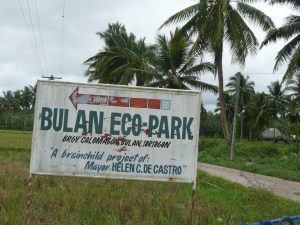
—–

*LGU-Bulan Mayor Helen De Castro and Tony Boy Gilana

ANSWERS TO OTHER QUERIES OF MR. ASUNCION:

1. SPECIES OF FOREST TREES PLANTED AT THE ECOPARK:

Gmelina arborea (Gmelina) – exotic

Acacia mangium (Mangium) – exotic

Acacia auriculiformis (Acacia auri) – exotic

Swietenia Macrophylla (Big Leaf Mahogany) – exotic


Tinanom tabi ini na species maski aram ta na exotic tabi ini sa dahilan na ini tabi, fast growing kaya sa panahon tabi na nagbabatog pa lang an pag-develop san Ecopark, kaipuhan tabi shade. Although exotic tabi, widely distributed naman na tabi siya sa Pilipinas for how many years.

Pterocarpus indicus (Narra)

Albizia saman (Acacia, Rain Tree)

Leucaena leucocephala (Ipil-ipil)

Fruit trees:

Artocarpus heterophyllus (Langka)

Mangifera indica (Mango)

Carica papaya (Papaya)

Annona squamosa (Atemoya)

Canarium ovatum (Pili)

Cocos nucifera (Coconut)

Theobroma cacao (Cacao)

Ornamentals:

Gumamela

Mac Arthur Palm

Yellow Bell

Bougainvillea

Senyas

Santan

2. SOURCE OF DRINKING WATER / FAUCET / WELL / WATER PUMP /

GRILLING AREA

None yet, pero may plano na.

3. MULTI-FUNCTIONAL PAVILION SA ECOPARK

Sa niyan, an ginagamit lang tabi na area para sa mga activities, an kahiwasan san lugar na kahampang san vermiculture nan vermicomposting facility. Nagbubutang tabi stage nan big tents kun may mga lecture, demonstrations, programs, etc.

4. Garbage cans

Dire tabi kami nagbubutang san basurahan sa mga rest areas o cottages dahilan sa ini-encourage namo na paghale san mga park goers sa cottages, dara tabi nira an basura nira para ibutang sa garbage receptacles na naka-locate sa gilid san tinampo.

5. Toilet

Dire lang tabi siguro nakuwaan letrato an mga toilet rooms. May 3 sets (one cubicle for men, one cubicle for women) tabi na toilet strategically located tabi sa Ecopark. Pa-triangle tabi an location san mga toilet since masyadong malaki ang lugar. An sayo sa may campsite banda, an sayo sa may durho na cottage, an sayo sa may centro san Ecopark.


 BULAN SOLID WASTE MANAGEMENT PROGRAM

The “Bulaneño Ako, Basura Ko, Sini-segregate Ko!” Program is one of the priority thrusts of the Local Government Unit of Bulan. It was first conceptualized in 2004, launched in 2005 and strictly implemented in 2008. The program encompasses the whole solid waste management program of the LGUandwas designed for: a.) sanitation and environmental protection, b.) sound solid waste management systems, c.) provision and enhancement of livelihood opportunities through intensive resource recovery and recycling, and d.) minimization of public expenditures.

Prior to the program implementation, there were clear violations of RA 9003 which were really detrimental to the environment and lives of the people. Rampant burning of solid wastes in the household and in the municipal dumpsitewas prevalent. Throwing garbage at the different waterways seemed to be a normal scenario. Moreover, dumping of unsegregated wastes at the municipal dumpsite posed hazards not only to the environment but also to more than thirty (30) scavengers in the dumpsite seekingfor possible resources. Although Republic Act 9003 mandating all LGUstoimplement waste segregation and close all the existing open dumpsites was passed into law in 2001, implementation was difficult to materialize.

In 2004, the call for the execution of the mandates of the Act was very intense. It is the time when incumbent Mayor Helen C. De Castro decided to include Solid Waste Management (SWM) as one of her priority thrusts. To immediately act and address the existingsituation, Mayor De Castro formed a Technical Working Group (TWG). A plan of action was made and a series of multi-sectoral meetings, orientations and seminars for LGU key implementers and other stakeholders followed.

On June 30, 2005, the “Bulaneño Ako, Basura Ko, Sini-segregate Ko!” Program was officially launched. A month after, Mayor De Castro spearheaded the launching also of the Bulan Ecopark, with an aim of transformingthe existing open dumpsiteinto an ecological park. However, the first implementation of the program had not been successful. The problems were eventually traced to lack of regular monitoring and evaluation coupled with some operational deficiencies on the part of the LGU. Mayor De Castro realized the problem and tried to address it.

On November 2005, the Municipality of Bulan was enrolled to the DILGGO-FAR Project. In 2006, Mayor De Castro along with four (4) members of the TWG went to Linamon, Lanao Del Norte to attend the Replication Inception Workshop (RIW) on SWM. The good practices to be replicated then were the operation of Materials Recovery Facility (MRF) and the preparation of two (2) compost activators. On the same year, Mayor De Castro spearheaded the replication process. Relevant facilities were established and more intensive IECs on RA 9003 and Municipal Ordinance on SWMwerere-packaged. Finally, on March 24, 2008, the program was strictly enforced givingemphasis on the following; a.) strict implementation of waste segregation-at-source, b.) collection of segregated wastes-at-source, c.) application of waste treatment (4Rs) / alternative technologies, d.) implementation of segregated waste disposal system, and e.) conversion of waste disposal facility into an Ecological Park.

With the efforts of the LGU and the massive participation of the community, the program earned various awards and recognitions both from the local and national levels. In 2007, the municipality was an awardee of the prestigious DENR Saringaya Awards, LGU Category for excellence in Local Governance and Environmental Protection on the field of SWM. In 2008, the DILG through its Secretary, Hon. Ronaldo Puno declared the Municipality of Bulan as Model Town on SWM. In view of being a Model Town, Bulan was expected to host RIWsfor interested replicating LGUs all throughout the country. At present, four (4) LGUsfromfour (4) provinces and two (2) schools including the U.P. Diliman – National College of Public Administration and Governance (UP-NCPAG) have already visited Bulan for its SWM Program. In 2008 also, Mayor De Castro reaped the Punong BayanAward of Excellence for championing the program. No less than the Vice President of the Republic of the Philippines, Hon. Noli De Castro and LMP National President Hon. Ramon Guicogavethe award at the Manila Hotel during the LMP General Assembly.

At present, the program is workingand regular monitoringand evaluation is being observed. The Bulan Ecopark, a brainchild project of Mayor De Castro is continuously building a big space of hope in the big wide face of Mother Earth.


The program since has been enrolled and awarded by the DILG as Model Town on Solid Waste Management on October 2008 caters LGUs, barangays, schools, and other groups interested to visit, observe and replicate the program. Some of the LGUs and groups who have already visited Bulan for its SWMProgram are the following:

a. Personnel from Cataingan, Masbate

August 2008

b. Students from U.P. National College of Public Administration and

Governance (NCPAG), Diliman Campus

September 19-20, 2008

c. Youth for Environment in Schools Organization (YES-O)

Division of Sorsogon

October 28, 2008

d. Sorsogon National High School Students

November 20-21, 2008

e. Liga ng mga Barangay, Tigaon, Camarines Sur

December 15,. 2008

f. Barangay Officials of Poblacion, Sta. Elena, Camarines Norte

December 22, 2008

g. LGU Officials of Prieto Diaz, Sorsogon

January 9, 2009

h. South East Asia – Urban Environmental Management Application Project Executives

March 2, 2009

i. Members of Provincial Solid Waste Management Board (PSWMB), Sorsogon

March 20, 2009

———————-

Video Of BulanEco-Park coming soon.

—————————————————end——————————————

Sta. Remedios Charity Medical Clinic

 By: Angelita de Guzman Kowalewsky

(click photo to enlarge)

P1080918

COMPASSION, yes, it was compassion for the sick, the helpless and the vulnerable, that made all of these happen. Sta. Remedios is a small village located in the town of Bulan, Sorsogon, the southern province of Luzon islands in the Philippines. This is the village where I grew up and saw the existing poverty that affects so many lives. It is COMPASSION for the people that drove me to help and make a difference in the lives of the sick and vulnerable, the hungry, the poor children who need education and food. And because of COMPASSION, and through hard work, sacrifice and strong belief that it can be done, Sta. Remedios Charity Clinic was founded. And this is …

HOW IT ALL BEGAN…

My name is Angelita de Guzman Kowalewsky and I have been a registered nurse for twenty five years. Three years ago, I went home to see my ailing mother confined in the local hospital. I brought with me precious medicines, antibiotics that were desperately needed. I went straight to the hospital from Ninoy Aquino International Airport which took fourteen hours by bus. I found my mother feeling better and getting ready to go home. While I was waiting for her, I had the chance to look around. I saw poor emaciated patients with sad look in their eyes, waiting for the family to bring back the much needed medicines from outside pharmacy. Apparently, the system in the hospital is for the physician to asses the condition of the patient, write prescription, and ask the family to buy the necessary medicine and medical supplies like IV tubing, IV fluids, etc. If the family has no money to buy the prescribed medicine and supplies, the patient will have to go home. I noticed some old gloves hanging by the window sill. The nurse told me that they had to wash the used gloves so that they can reuse it. I left the hospital with a heavy heart and feeling helpless. I wished I could do something to alleviate the suffering of those patients. I know in my heart that if they do not get the much needed medicine, they will die one by one.

While I was at home, I noticed one of the carpenters looking very sad. My sister told me that the carpenter’s son, Aldo, and eighteen year old boy, was dying. He had an infected abscess at the right side of his back as big as a grapefruit. Apparently, out of desperation, the parents sold their only carabao (the animal which the family uses for plowing the field) and a pig to take their son to the provincial hospital. When the family could no longer afford the cost of the hospitalization and medicine, they brought him back home to die or wait for a miracle to happen. I asked the carpenter to take me to his house to see the boy. He was very emaciated and barely able to raise his hand to greet me. He was lying on a makeshift bamboo bed. He weighed between 85 to 90 lbs. I offered my help to the family. I told them that I brought with me the best antibiotics and medicines from America which my mother did not use. They brought Aldo to my house in a hammock. I called the local physician in town to help me. We started him an intravenous hydration, gave him antibiotics, multivitamins and nutritious food. After two days of treatment, Aldo was able to sit up and walk with the help of his mother. On the tenth day, he was well enough to go home. His abscess was completely healed except for a little hole where the pus material drained out. I gave him a three month supply of multivitamins. His parents were crying and very grateful. I told them to thank the Lord for I was just His instrument. My mother got well without using the medicines. Those medicines were actually intended for their son so that he may live. God had answered their prayer for a miracle.

The story of Aldo spread around like a wildfire in the village. People various ailments started to come to my house. The cases ranged from simple headaches to urinary tract infection, influenza, to children with fever and cough. There was this young woman who came to me and was crying. She had been sick for several months. She appeared to have the classic symptoms of UTI. I called the physician whom I befriended when we treated Aldo. She was treated for UTI and instructed to come back after a week. When she returned, her eyes were bright and happy. She is clutching a chicken with her husband behind. She told me that for the first time in months she was not in pain. She had no money but she wanted to give me the chicken as payment. I told her that she didn’t have to give me anything. The fact that she felt better was good enough for me. Her husband was smiling in the background and I knew that chicken (a rooster) was his pet.

These are a few of the examples why I want to build a clinic. It is for the people who need medical help. I promised the people in the village that I would come back and build them a clinic with free medicine and free consultation. I came back to the United States, worked hard, worked extra hours, saved money and prayed to God to help and guide me for the task that I was about to embark on was a tremendously great task.

May 25, 2005, the grand opening of:

STA. REMEDIOS CHARITY MEDICAL CLINIC

P1080917This charity clinic is dedicated to the people of Sta. Remedios Village especially those who cannot afford basic medical services so that the poorest man, woman and child can get the care they need. The clinic has a consultation room, a holding bed, 2 medicine cabinets, thermometer, and sphygmomanometer. It is a multipurpose clinic. It provides free medical check-ups, free medicine, milk for the children, nutritional supplements for the very old and malnourished, and education on sanitation, diabetes, environmental protection, ecology, and pregnancy and infant care. It also serves as a children’s library after clinic hours. The clinic is staffed by one physician and four helpers. Word spread that there is a clinic where poor people can avail of free medical check-up and treatment.

 Here are some photos of the Clinic:

P1070821

P1070825

P1070827

P1070826

 P1070829                                                                                                       P1070824


The following were some 0f the medical cases we have already encountered:

1. A man with a large cut on his leg- We did not have sutures so we had to send him to the provincial hospital which was a three-hour ride by tricycle.

2. A patient with pneumonia.

3. Several diabetic patients with problems of hypertension and hyperglycemia, renal failure, edema.

4. A five year old girl carried by her mother to the clinic (see picture in the brochure) She was severely malnourished and at risk of dying.

5. Several malnourished elderly patients suffering from abdominal pain (most probably from gastric ulcer) need nutritional supplements like Ensure plus, etc.

6. Several cases of influenza, gastroenteritis, typhoid, dengue, anemia

We are now serving many villages, patients from as far as the Island of Masbate which is across the San Juanico Strait. Very sick people accompanied by their families are crossing the sea by motorized canoe to seek medical help. This is the situation. We are running out of medicine and medical supplies. I had been supporting this clinic for over four years now. I need your help desperately. Please help save one more life. Let us all get together and continue these humanitarian services.

We need the following:

1. Over the counter medicines for cough, fever, pain, gastric ulcer, headache, hypertension, etc. We accept any medicine you can give.

2. Medicine samples: Don’t throw it away. We can use it.

3. Canned foods for malnourished old people and powdered milk for the children or anything you can give is very well appreciated

4. Multivitamins for children/infant, prenatal vitamins for women, vitamin supplements for men, women. Vit.b-12, B-6, Iron supplement, Vit. C, etc.

5. We need disposable thermometer to prevent cross-infection, Sphygmomanometer(blood pressure apparatus)

6. Old or new EKG machine and supplies

7. Surgical instruments for simple surgical procedures, sutures, scalpels lidocaine 1% or 2%

8. Infant warmer for newly born, forceps, stainless steel basins for durability

9. Medical supplies

Thank you very much for any help you can give. Every donation you give counts. All donations are tax deductible.

——————

Photos by jun and mila asuncion April 29, 2009

Bulan Observer

On this day we went to Sta. Remedios to visit the Clinic founded by Angelita de Guzman Kowalevsky. We have been wanting to see this Clinic for quite a time already and so we made use of this opportunity last month when we went home.

But when we came it was off the clinic hours so we haven’t seen any patient and medical workers but we were greeted by Angelita’s niece who toured us around the clinic.

The Clinic is small but it symbolizes something very big which is the love for one’s own people and the hope for brighter Bulan’s future. Love moves each of us to sacrifice ourselves to  help improve the situation; in the case of Angelita she used her profession to give something back to her humble beginning.

The hope lies in reaching out other people who would offer their help  to the Sta. Remedios Charity Medical Clinic in any form- for any help counts, as Angelita says.

For now Bulan Observer helps spread this hope  to all its readers from many different places. May we indeed get some positive reactions from the people and other  institutions who are in a better situation to help what has been started.

We  thank Angelita for her great efforts in realizing her vision to help. It is now for all of us to help her keep this vision alive.

For A Brighter Bulan!

jun asuncion

Part II: The MDCC And The Bulan Rescue Team

The Municipal Disaster Coordinating Council or  MDCC and the Bulan Rescue Team deserve once again the highest respect for their selfless efforts and efficient performance in saving the lives of many Bulaneños and of coordinating the whole disaster management at the height of  typhoon Dante last May 1 and 2.

Under the leadership of  Vice-mayor Gogola and the young  and competent Municipal Administrator Luis De Castro, Jr., the dangerous risks  to the lives of our town people had been maintained to the minimum. I’ve observed these men at work in a situation where I know would also have triggered the highest emergency alarm and stress even among most advanced cities in the world. Our men worked with the serenity of spirit, bravery and heroism of a real Bulaneño amidst the chaos in the whole of  Bulan and the limited technical resources they have at their disposal. And I approached them and talked with them to know more about the disaster from their own perspective-  with Vice-Mayor Gogola as he inspects the evacuees in Bulan South Central School and with Mr. Luis De Castro in the MDCC office which is  housed in the old Municipal vicinity as he instructs the men of the rescue Team.

Mr. Luis De Castro has retained this  attitude of thankfulness in the midst of a disaster for the very little effort our Canipaan Team has done to the very first wave of evacuees that occupied the Bulan North Central School in the early hours of May2. I sensed also a deep sincerity in him when he told me ” sana walang maging casualty” (we pray that there will be no casualty).

These words had warmed my wet body and wearied soul for actually I came to bury my sister this very day- and not to roam around in the flooded streets of Bulan, an experience I never had for the last decades. Bulaneños still care for Bulaneños is the insight I have learned in my short exchange of words with Mr. Luis De Castro, Jr. I also somehow felt rewarded in return for the indignation and caring that I felt when as a young boy our then mayor Mr. Luis de Castro, Sr. met his tragic end. I think this inter-connectedness-in some-ways- in -a -deeper -level is the essence of being one people.

Our Kudos then to our competent young leaders who can practically manage the town on their own and who are present not only in peaceful and joyful times but in times of great calamities that even reached international news reports. Born good leaders seem to be always  at the right place and time and are there when the whole town is in distress and when  the padabas need them the most.

I violated my argument that if pictures speak louder than words, then let them be, which means words are unnecessary. My defense is that I cannot photograph my thoughts and feelings so again, I used words to convey them in this short tribute to our leaders.

For now let these following images speak louder than me:


P1080058


Municipal Adninistrator Luis De Castro, jr.  instructing his men.

P1080059


P1080046


 The silhoutte of Vice -mayor Gogola (middle figure) as he inspects the evacuees in Bulan South Central School.


P1080065


Some of the rescue men having their briefing.

P1080066


Getting set…

P1080067


One of the rubber rescue boats.

P1080117


Rescue men in action.

P1080098


P1080106


Hold on tight, children! The water is wall-high.

P1080125


A race against time.

P1080103


Clearing the waters from dangerous objects.

P1080099


Push…..

P1080127


and pull…

P1080120


Young boys on the look out,  ready to help.


These are some of images of Bulaneños’  fight for survival on that stormy days.


jun asuncion

Bulan Observer                                 (photos by jun and mila asuncion)

Part I: The Storm Dante: Images Of Survival


Tuloy Po or Please Come In  is unmistakably Bulaneño hospitality…

 Tuloy Po

 Even when Bulan is  under water brought about by the devastating typhoon Dante last May 1-2.

 P1080016

 But who will come in, what kind of guests when pupils are on vacation and  who will dare when it is flooded?


P1070925

 They are the guests- evacuees; children from Managanaga fleeing from high waters that swallowed their bamboo huts,

spending the night of heavy rains awake,  fearful and anxious about their situation.

Storm Dante shows no mercy as it pounded Bulan with strong winds and heavy rains overnight.

P1070923

The classrooms are  still closed and so they find their first refuge under the staircase;

children and even a baby are wet, shivering from cold- and hunger.

 P1070929

Young Bulaneños- pretty girls and handsome boys- soaked in water, sleepless and hungry.

P1070921

We come to their rescue during the first hours in the morning of May 2; nursing and comforting them.

P1070939

 As some fathers are  in great stress running and swimming back and forth

 to Managanaga to rescue their other children who are left behind.

 P1070945


 And this is how it looks by now outside the Bulan North Central School;

more families coming,  taking with them  their most important belongings as the waters continue to rise.

P1070948

 Women….

P1070953

 whole family…

P1070991

 And an old man escorted by his young ones.

P1070916

 A pig is precious, too.

P1080015

 I am astonished by the gracefulness in their bearing; they retain their dignity and calmness,

as many walk through waters in a meditative posture- which shows that experience

with floods is not extraordinary in the town of Bulan.

P1080013

 A boy joining his family somewhere, behind him the man

 in a meditative rhythm opposing the currents.

P1080018

 The day when boats are in the streets of Canipaan…

P1080136

 and a raft made of banana trunks, in place of cars and tricycles.

P1080001

 Meanwhile, these families are now inside a classroom, given towels, hot drinks and biscuits. etc.

P1080009

 Children now dry, visibly feeling better -at least for the time being-,

and mothers continue watching over them.


P1070979(click this photo to view Part II, or  the whole album)

A shy boy with sadness in his eyes in this dark room

with no electricity and drinking water.

If pictures speak louder than words, then let them be.


jun asuncion        

Bulan Observer                                                          ( photos by jun asuncion)


   —-end—-

My Dogs Georgie Boy And Lucie


By: Dora the Mouse

It was unusually cold in this particular winter night. The temperature tonight dropped down to – 17 degrees. I went out to get some firewood at the backyard and it was freezing cold. I live alone and no one is there to help me haul a few logs of firewood for the fireplace. My little Chihuahua dog was shivering from cold and stayed inside the house. I was a little bit scared going outside in the dark by myself getting the firewood. It was in this situation that I thought of getting a big dog for companion and as a guard dog.

Today I went to the dog pound and look for a big dog that I can adopt. I want to adopt a German shepherd but this German shepherd I was looking at was noisy and continuously barking and wants to bite me, on the other hand, there was this Samoyed white dog looking at me and was very quiet. He was looking at me with a sad look in his eyes as if telling me to adopt him. I went ahead and adopted this gentle white dog and took him home after paying a fee and getting his shots. I named him George.

George and I had been inseparable since then. When I watch TV, George watch the TV too. Everywhere I go, George went with me. One day, I decided to go to see my little (Ranchito) orchards up in the mountain. I planted a lot of fruit trees like peaches, nectarines, plums, cherries and pears. The trees started to have tiny buds of fruit and need some clearing of grass around the trees. I was so engrossed with what I was doing that it was already dark. George, my dog, sat right in front of me to protect me from anybody who was foolish enough to approach us. When my son finally arrived to pick me up, George gave a big growl and was ready to attack my son  and if he didn’t identify himself early enough, he could have been bitten. Samoyed dog are normally gentle, happy- go-lucky dog. That’s how protective this dog is.

I did a research about my Samoyed dog and this is what I found. The Samoyed derives its name from the Samoyedic people from Siberia. Samoyed dog is an all-white dog with a fluffy coat, upturned tail, and a characteristic smile. They were breed by a group of nomadic Samoyed people for herding and hunting deer. They were also use for pulling heavy carts and sleds. It is rare to find a Samoyed dog, aggressive, angry, and irritable. In 1889, they were brought to Europe for breeding but they mostly use for sole companion. They are very loyal and very friendly breed of dogs. I am very lucky to have my dog George with me.

One summer morning, I woke up feeling very sick and unable to get up. I was so sick that I can not even stand up. I called my son to come and see me. He lives about 30 miles from my house. Meanwhile, my little Chihuahua Lucie and George suddenly got on top of my bed and surrounded me. They normally don’t do this. I never allowed them on my bed, but this time, I think they can sense that there is something wrong with me. My son and the paramedics arrived and were trying to get me into the gurney, my two dogs were growling and refused to leave me. My son literally has to bodily take George and Lucie from me. I can sense that George was panicking and don’t want to leave me until I assured him that everything will be alright. I was confined in the hospital for five days. My son went back to my house to put some dog food and water for my dogs. Three days later, when my son went back to check my dogs and my house, the dog food was not touch. My dogs were very depressed and were not eating. I never realized how much dogs can love their master. I talked to my dog’s veterinarian and I was told that dogs can get depressed. I finally got better and went home after a few days. My dogs were very happy and I was very happy too. They started to eat and play again. Our lives went back to normal. I go to work early in the morning somehow, my dogs know exactly my time of arrival. They were all waiting and looking out the window. I can hear their happy barking. It’s a wonderful feeling to see these two dogs eagerly waiting for me.

I had been working for the past many, many years and had been supporting my relatives in the Philippines and my other charitable projects. I thought, I will spend a part of my life for myself and my dogs. It’s been my dream to travel and explore the 50 states of USA but never had the time or money to do it. I was busy raising my three children, helping my folks in the Philippines and my other projects. My children are now grown-ups and on their own. I have this charity project that I am happy to maintain and support that keeps me going too. I finally got the courage to realize my dream. I bought this 30 ft. motorhome big enough for my dogs and me. It has two separate beds in the back room, one for me and one for George and lucie. It has dining room with adjacent kitchen complete with microwave, oven, stove and a nice double sink, plenty of storage cupboard and it also has a refrigerator, a separate shower and a bathroom. It is like a self-contained home away from home. I gathered all the fishing gears, my late husband had accumulated for many years, cleaned them, bought some more baits and a big tackle box. Now I’m ready to go fishing. I went to the grocery to shop for non-perishable food and dog food. My children gave me a GPS system to help me find my way around. I am very poor in directions, it is pathetic. My children were worried for me to be traveling alone in this motorhome. Well, to relieved their worry, I bought this life size used manikin ,dressed it with a man’s clothes and put on an old man’s boots, complete with cowboy hat and sat it on the passenger side of the motorhome. See, I have a companion! They were all laughing. But you know what, it looks so real.

We went out on our first fishing trip in the motorhome. My dogs and I went to Gaviota, a seaside city park where they allow fishing where we stayed overnight. My dogs were restless and were vigilant. Every little noise, they bark and go to my bed and try to wake me up. It was an all night activity. I didn’t get enough sleep neither my dogs. But, after I had my first cup of freshly brewed black coffee, I realized that my dogs did a very good job of guarding the motorhome and me.

Well, this is what I can say about dogs in general. Whether the dog is pure breed, half mixed, native, or any kind of breed, dogs are generally very loyal animals. If properly trained and given a loving care, these dogs can give you back a thousand times more of love, loyalty and ready to be on the frontline for you. There were some instances that when a person was angry, he/she goes home and kick the dog instead. Please don’t do that. Kick the brick wall or a trunk of a tree to express you anger or frustration, not the dog. Dogs are precious like my dogs, Georgie Boy and Lucie. That is why there is this saying “Dogs are Man’s Best Friend” and it proved to be very true. Maybe, some of you can share wonderful dog stories, too.

—————————————————-end————————————————-

BULAN RESCUE TEAM ASSISTS MAGALLANES LANDSLIDE VICTIMS

Bulan, Sorsogon, May 8, 2009-

As a show of solidarity with the People of Magallanes Town, Bulan Town Mayor dispatched on May 6 & 7, the Bulan Rescue Team headed by Councilor Simmy Gerona to assist the residents of the landslide-ravaged barangays of Magallanes Town.

The team headed by Councilor Gerona also included Team Members Darius Razo & Antonio Amilano. They stayed in Magallanes where they helped and assisted in the transfer, by the use of the Bulan MDCC Rubberboat, of relief goods and people to areas which are in accessible by land transportation.

Magallanes Mayor Abelardo Arambulo immediately conveyed his gratitude to the people of Bulan, through Mayor De Castro’s office.

It can be recalled that the People of Bulan also pooled in their assistance to the People of Albay during the typhoon Reming and Mayon Volcano landslides where thousand were killed years back. Mayor De Castro sent a rescue and retrieval team to the devastated area. Several truckloads of relief goods and clean water were also dispatched by LGU-Bulan with the help of various volunteer groups and the whole community.

Meanwhile, Municipal Administrator Luis G. De Catsro, Jr., PIO Antonio G. Gilana and Ryan Cantre attended in Sorsogon City on May 6-7, a seminar workshop on Disaster Management and Risk Reduction sponsored by the Provincial Government, World Vision and Green Valley Development Foundation. They also trained on Rain Recording as part of the Disaster Preparedness Program of the Municipality.

 (PIO-Bulan)

BULAN TOWN BEARS BRUNT OF TYPHOON DANTE FLOODING; HEROISM DISPLAYED BY MANY BULANENOS

( LGU-PIO ) Bulan, Sorsogon, May 4, 2009 –

 Once more, the spirit of Bayanihan and volunteerism was displayed by many Bulanenos at the height of the massive rains and flooding brought about by Typhoon Dante on May 1-2, 2009. The Municipal Disaster Coordinating Council headed by Mayor Helen De Castro and Municipal Administrator Luis De Castro, provided the impetus in inspiring various groups to volunteer in evacuating families , saving lives and providing for relief operations at the height of one of the worst floods ever to hit Bulan Town in decades.

 Based on partial reports from 26 out of 63 barangays, 2,065 families comprising 10,233 persons were displaced by the floods. 85 houses were partially destroyed, 63 were totally damaged. The Rural Health Unit in Barangay Obrero was partially damaged, together with several schools reporting to be underwater causing destruction to various school facilities and documents. Damage to agriculture, livestock and fisheries was estimated to be around 13 million pesos. Infrastructure was severely affected amounting to 38 million pesos, mostly farm-to-market roads.

 The estimates can go higher with the reports coming in. Fortunately, due to the timely warning system of the Bulan Municipal Government, through the MDCC, majority of the Bulanenos were able to prepare. No casualty was recorded. It can be noted that Bulan people are very much aware of these alarm systems due to the consistent disaster management program of the Local Government Unit.

 The volunteerism of the Bulan organizations were once more brought to the fore with the participation of several responders like the PNP Municipal Station and 509th PPMG, The Philippine Army Scout Rangers based in San Isidro, Kabalikat Civicom 426, USWAG Bulan, TOFY, a youth group, DepED, and the various BDCCs of almost all barangays in Bulan. During the the height of the floods, barangay officials were busy, together with civic-hearted residents in evacuating and helping their community-members. Various areas of the National Highway all the way from Sta. Teresita to Zone 8 were submerged under water preventing all forms of land transportation. The floods started around 3 o’clock in the morning of May 2 and did not easily recede until around 5o’clock in the afternoon. Some areas in Bulan experienced up to 10 feet of floodwater.

 ( Bulan PIO ) PIO-LGU-Bulan 1

BULAN RESCUE TEAM SAVES FOUR FISHERMEN

Bulan PIO-LGU-Bulan 1

Bulan, Sorsogon, May 5, 2009 —

Four fishermen from Barangay Zone 7, Bulan, Sorsogon were rescued by the Bulan Rescue Team headed by Municipal Councilor Simmy Gerona on May 3, a day after Typhoon Dante hit the Bicol Region. These four fishermen, in an attempt to provide for their livelihood, braved the rough waters but unluckily their boat capsized off the Bulan shorelines. Fortunately, it was very timely that the Bulan Rescue Team was immediately informed of the incident and they responded to save the fishermen’s lives. The Bulan Rescue Team was organized by Mayor Helen C. De Castro in 2006 as a component of the Municipal Disaster Coordinating Council to respond to evacuation and rescue efforts during calamities and emergencies. It is headed by Administrator Luis De Castro and SB Member Simmy Gerona. Its members include Ryan Cantre, Antonio”Daday Amilano, and Victor Gubat, who were all involved in the rescue. The Bulan Rescue Team was also involved in the retrieval operations of several corpses involved in the Sulpicio Lines Princess of the Stars accident sometime last year. A day before, at the height of the massive flooding brought about by Typhoon Dante on May 1 and 2, the Bulan Rescue Team has its hands full in providing evacuation efforts to the residents of Barangays San Isidro and San Ramon.

We’ll Remember You Always, Manay Edna!(1950-2009)

p10701353

Yesterday, the 22nd of April 2009, Wednesday morning, our eldest and beloved sister Edna Asuncion Penos passed away totally unexpected.

We greatly mourn the loss of a loving and caring sister who dedicated her entire life to her family and to teaching our young Tagabulans. These children above were once her pupils in Bulan North Central School. She herself was the most loyal Tagabulan among us for she never left Bulan except during her college years in Legazpi city. She passed away a few days after her arrival in Cubao, Quezon City on her regular visit to her own family- husband Danny Penos and two grown up sons Bonbon and Jay who are all working in Manila.

I cannot describe in words the importance of Manay Edna in my own life and how this sudden not-being-with us-anymore pains us  all. Again, I rebel inwardly, will not accept that death is such a harsh reality. We would have loved that she stayed with us for many years more…

p10701321

Manay Edna will be brought back to our town Bulan for her final rest. Bulan, you are just too near for us…

We’ll remember you always, Manay Edna!

jun,  with menchu, jerry, malou, dennis, judy- and families, and mama with our youngest brother roy.

————– 

The melody that reminds me  always of Manay Edna:

BULAN-MASBATE RORO OPERATION TO START MAY 1

PIO-LGU-Bulan

Bulan, Sorsogon, April 23, 2009.

A big new development in the maritime transportation between Bulan Town and the mainland of Masbate Province was announced today by Sta. Clara Shipping Lines, thru its General Manager Antonio Sugahid, that it will start operations of their roll on roll off ferry on May 1.

In a courtesy audience with Mayor Helen De Castro, Municipal Administrator Luis G. De Castro and PIO Antonio G. Gilana, Mr. Sugahid said that that one ferry boat will ply the Masbate-Bulan route. It will have a two-hundred passenger capacity and can accommodate about nine buses. Departure time from Bulan Pier will be at 8:00 in the morning, arrival at Masbate port around 11:30 AM. Then it will depart Masbate at around 1:30 and arrive in Bulan by 5:30 in the afternoon.

Mayor De Castro welcomed this development as will be another added investment in the municipality and can help boost the economic sector especially among those living in the Port Area of Bulan. She added that Bulan is an investor-friendly municipality, and thanked the shipping line executive for the trust given the municipal government.

It can be remembered that on April 28, 2008, President Gloria Macapagal Arroyo launched part of the Philippine Central Nautical Highway here in Bulan. This forms part of her economic agenda of linking the whole country through the nautical highways.

Historically, passengers from Masbate Island used to make Bulan as a connecting point for their travel to Manila and other Bicol Cities, but with the opening of the Pilar Port in Pilar Town, Sorsogon, many of the passengers were diverted to that area. Only those coming from the Dimasalang, Masbate area came to Bulan for their trips to Manila. But the M/V Kathleen sea tragedy in November last year and the closure by the DOTC of the Dimasalang Port once more prevented Dimasalang passengers from coming to and from Bulan.

With the start of the roro operations, it is projected that there will be a resurgence of maritime trips between Bulan and Masbate, since it will be more convenient on the part of the passengers plying the Masbate-Manila trips to utilize Bulan as connecting area.

In the meanwhile, at the Bulan Integrated Terminal there will be no change in the volume of transaction since most of the clientele served by it comes from Ticao Island towns and Bulan. It is even expected to increase services in view of the increase in the number of public convenience vehicles and private vehicles which will be coming in and out of Bulan.. (PIO-LGU-Bulan)

Hostage Update: The Swiss Andreas Notter Released By Captors

Bulan Observer Quick Press


We are happy for the positive turn of events that led to freedom for the Swiss Andreas Notter. We also hope for the best for the remaining hostage Eugenio Vagni.


jun asuncion

Bulan Observer

—————

News from Swissinfo:

April 18, 2009 – 1:16 PM  Swiss ICRC hostage is free

 Islamic rebels in the Philippines have freed Swiss aid worker Andreas Notter but continue to hold another European captive, security officials said on Saturday.
The circumstances surrounding the release of Notter, an employee of the International Committee of the Red Cross (ICRC) were unclear, and he himself said he was not sure how it came about.

“I walked out and am happy to be alive and safe,” Notter told a media conference at the house of the provincial governor on the southern island of Jolo, where he was brought early on Saturday.

The 38-year-old from canton Aargau spent 93 days in captivity.

“I am very glad to be here with you. It happened very quickly. I am still a bit confused how it happened. My concern for now is my companion, Mr Eugenio Vagni. You are all aware that he is injured.”

In a statement, Switzerland’s foreign ministry said it was “relieved and pleased” with Notter’s freedom. It has demanded Vagni be “immediately and unconditionally released”.

Bern remains in close contact with the ICRC and Philippines authorities, spokesman Andreas Stauffer said.

Notter, Italian national Vagni and Philippines national Mary Jean Lacaba, all with the Geneva-based ICRC, were abducted by Abu Sayyaf rebels on January 15 when they were on a field visit to a prison on Jolo, a guerrilla stronghold.

Lacaba was freed by the rebels earlier this month and newspapers have said ransom was paid. The ICRC denies the claim and says it did not pay to free Notter.

“We never received any ransom demand for his release and we therefore have not paid,” said Florian Westphal, a spokesman for the ICRC. Notter’s return to Switzerland was “not foreseen in the coming hours,” Westphal added.

Attempted escape
Philippines Interior Secretary Ronaldo Puno said a group of men holding Notter was attempting to slip out of the security cordon around the guerrilla camp in the interior of Jolo when they were spotted by security forces who gave pursuit.

“The kidnappers left behind Mr Notter because they were not able to drag him with them anymore,” Puno told reporters, adding military pressure forced the rebels to free the hostage.

“We are fortunate that this incident ended without injury to Mr Notter.”

Earlier, a military spokesman had said Notter was found by troops. Richard Gordon, a Philippines senator and head of that country’s Red Cross, said that Notter was found walking near Indanan town, in the interior of Jolo, early on Saturday morning.

“He is relieved and he is glad to be alive,” Gordon said. “I told him the whole country prayed for him. He expressed concern for Eugenio. He said ‘Thank you for all your efforts.”‘

« We are fortunate that this incident ended without injury to Mr Notter. »

Philippines Interior Secretary Ronaldo Puno Notter, unshaven and with long hair, was smiling when he faced journalists after doctors gave him a clean bill of health, although he looked to have lost weight during his captivity.

The former history professor was given time to rest after a glass of milk and a soft meal, Puno said, adding Notter had already contacted family, friends and Red Cross colleagues.

“He is suffering from fatigue and may be a little bit disoriented for the moment,” Puno said.

“In good health”
“When we first heard reports of his extrication from the kidnappers, we were afraid because he was seen walking around with a cane. But he looks in good health. The doctors did not find any serious health problem.”

The Abu Sayyaf, a small but violent militant group based on Jolo and nearby Basilan, had earlier demanded that troops relax the tight cordon they were keeping around the rebel hideout before talks for the hostages’ release could start.
Provincial governor Tan sent a team of Muslim clerics to the rebel camp earlier this week to seek the release of Vagni, a 62-year-old who is reportedly suffering from hernia.

General Alexander Yano, the Philippines military chief said in a statement that disclosing the details of Notter’s rescue “may derail current efforts to ensure the safe release of the remaining victim”.

There was no word on any progress.
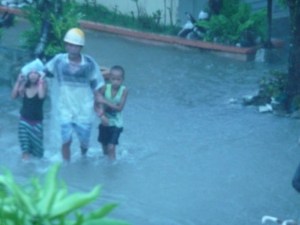
The Abu Sayyaf, with links to the Southeast Asian regional militant network Jemaah Islamiah and to al Qaeda, has been blamed for the worst militant attack in the Philippines, the bombing of a ferry in Manila Bay in 2004 that killed 100 people.

It is also notorious for high-profile kidnappings and large ransoms and has a history of beheading captives.

swissinfo with agencies

————————————end—————-