President Noynoy Aquino’s State of the Nation Address (SONA) 2011 (English translation)

Senate President Juan Ponce Enrile; Speaker Feliciano Belmonte Jr.; Vice President Jejomar Binay; former Presidents Fidel Valdez Ramos and Joseph Ejercito Estrada; Chief Justice Renato Corona and the honorable Justices of the Supreme Court; honorable members of the diplomatic corps; members of the House of Representatives and the Senate; Local Government Officials; members of our Cabinet; members of the Armed Forces and the Philippine National Police; to my fellow servants of the Filipino people;

And to my beloved countrymen, my Bosses:

I stood before you during my inauguration and promised: we would do away with the use of the wang-wang. This one gesture has become the symbol of change, not just in our streets, but even in our collective attitude.

Over the years, the wang-wang had come to symbolize abuse of authority. It was routinely used by public officials to violate traffic laws, inconveniencing ordinary motorists—as if only the time of the powerful few, and no one else’s, mattered. Instead of behaving like public servants, they acted like kings. This privilege was extended to their cronies and patrons, who moved along the streets as if they were aristocracy, indifferent to those who were forced to give way and were left behind. Abusing privilege despite promising to serve—this is the wang-wang mindset; this is the mindset of entitlement.

They had no right to do this. The law authorizes only the President, the Vice President, the Senate President, the Speaker, the Chief Justice, and police vehicles, fire trucks, and ambulances to use sirens in the fulfillment of their official duties—no one else. Yet the flagrant abuse we bore witness to prompts us to ask: if they felt it their privilege to flout the simplest traffic laws, how could we expect them not to help themselves to a share of projects funded by the Filipino people?

Do you want the corrupt held accountable? So do I. Do you want to see the end of wang-wang, both on the streets and in the sense of entitlement that has led to the abuse that we have lived with for so long? So do I. Do you want to give everyone a fair chance to improve their lot in life? So do I.

We have fought against the wang-wang, and our efforts have yielded results. Just this year, the number of Filipinos who experienced hunger has come down. Self-rated hunger has gone down from 20.5% in March to 15.1% this June—equivalent to a million Filipino families who used to go hungry, but who now say they eat properly every day.

As for business, who would have thought that the stock market would reach seven record highs in the past year? At one time, we thought that for the PSE Index to reach 4,000 points would be, at best, a fluke. We now routinely exceed this threshold.

Our once low credit ratings have now been upgraded by Moody’s, Standard and Poors, Fitch, and Japan Credit Ratings Agency—in recognition of our prudent use of funds and creative financial management. These improved credit ratings mean lower interest on our debts. Our innovative fiscal approach has saved taxpayers 23 billion pesos in the first four months of this year. This is enough to cover the 2.3 million conditional cash transfer beneficiaries for the entire year.

Let me remind you: in the nine and a half years before we were elected into office, our credit ratings were upgraded once, and downgraded six times by the different credit ratings agencies. Compare this to the four upgrades we have achieved in the single year we have been in office. This was no small feat, considering that the upgrades came after ratings agencies have grown considerably more conservative in their assessments, especially in the wake of criticism they received after the recent American financial crisis. But while they have downgraded the ratings of other countries, they have upgraded ours, so that we are now just one notch below investment grade. Our economic team is hard at work to sustain the momentum.

And allow me to share more good news from the Department of Energy: having rid the DOE of wang-wang, we have revived the confidence of investors in our energy sector. 140 companies, all ready to participate in the exploration and strengthening of our oil and natural gas resources, can attest to this. Compare this to the last energy contracting round in 2006, which saw the participation of only 35 companies. Just last Friday, a new contract was signed for a power plant to be constructed in the Luzon grid, so that by 2014, our country will have a cheaper, more reliable source of energy.

There is confidence and there is hope; the government is now fulfilling its promises. And I cannot help but remember a woman I spoke with during one of my first house-to-house campaigns. She lamented: “It won’t matter who wins these elections. Nothing will change. I was poor when our leaders campaigned, I am poor now that they are in office, and I will still be poor when they step down.” This is a grievance echoed by many: “Our leaders didn’t care about us then, our leaders don’t care about us now, and our leaders will not care about us tomorrow.”

Given the persistence of the wang-wang attitude, wasn’t their sentiment justified? This was the attitude that allowed helicopters to be bought as if they were brand new, but had in fact already been extensively used. This was the attitude that allowed GOCC officials, like those in the Philippine National Construction Corporation, to pay themselves millions of pesos in bonuses, even as they failed to render decent service and plunged their respective agencies deeper into debt. Before they stepped down from their positions, the former heads of the PNCC gifted themselves with two hundred and thirty-two million pesos. Their franchise had lapsed in 2007; their collections should have been remitted to the national government. They did not do this, and in fact even took advantage of their positions: the bonuses they allotted to themselves in the first 6 months of 2010 was double the amount of their bonuses from 2005-2009. Yet they had the audacity to award themselves midnight bonuses, when they had already drowned their agencies in debt.

To end the wang-wang culture in government, we employed zero-based budgeting to review programs. For this year and the last, zero-based budgeting has allowed us to end many wasteful programs.

For example, we uncovered and stopped an ill-advised plan to dredge Laguna Lake. We would have borrowed 18.7 billion pesos to remove 12 million cubic meters of silt—which would have re-accumulated within three years, even before the debt could be fully paid. We also uncovered a food-for-school program with no proper targeting of beneficiaries, and other initiatives that were funded without apparent results. All of these were discontinued, and the funds rechanneled to more effective programs.

The budget is the clearest manifestation of the straight path upon which we tread. I say to those who would lead us astray: if you will further disadvantage the poor, do not even think about it. If all you would do is to fill your own pockets, do not even think about it. If it is not for the benefit of the Filipino people, do not even think about it.

I wish we could say that we had completely eliminated the wang-wang attitude, but in some parts of our consciousness, it still persists.

It still exists in the private sector. According to the BIR, we have around 1.7 million self-employed and professional taxpayers: lawyers, doctors, businessmen who paid a total of 9.8 billion pesos in 2010. This means that each of them paid only an average of 5,783 pesos in income tax—and if this is true, then they each must have earned only 8,500 pesos a month, which is below the minimum wage. I find this hard to believe.

Today we can see that our taxes are going where they should, and therefore there is no reason not to pay the proper taxes. I say to you: it’s not just the government, but our fellow citizens, who are cheated out of the benefits that these taxes would have provided.

We are holding accountable—and we will continue to hold accountable—those who practice this culture of entitlement in all government offices, as there are still some who think they can get away with it. A district in Region 4B, for example, began a project worth 300 million pesos, well beyond the 50 million pesos that district engineers can sign off on their own. But they could not leave such a potentially large payday alone.

So they cut the project up into components that would not breach the 50 million peso limit that would have required them to seek clearance from the regional and central offices. They tried to keep this system going. And often, since lump-sum funding was being used for the projects, no questions were asked about the plans or project details. They could have been spinning webs and they would have still been given the funds, so long as they knew someone in power.

Secretary Babes Singson did not let them get away with this. He removed the district engineer from his post, and suspended the awarding of the project in an effort to uncover other anomalies that may have happened. A thorough investigation of all those involved in the case is underway; we will blacklist all contractors proven to have engaged in foul play.

Because the project had to be delayed, Filipinos who would have otherwise benefited from them are still made to face unnecessary inconveniences.

These anomalies are not limited to Region 4B. We are putting an end to them. We are eliminating the patronage politics that had been prevalent in DPWH, and replacing it with a culture in which merit prevails. All projects must have work programs; we will require those involved in projects to submit well thought out plans for consideration, so that each project complements the other. We have also instituted an honest and transparent bidding process to provide equal opportunity to interested contractors.

Because of this, we have already saved 2.5 billion pesos, and expect to save 6 to 7 billion by the end of this year. The most important thing, however, is that now, we can count on well-paved roads—as opposed to the fragile pothole-ridden paths that our people had grown used to. Once, we believed that the system in the DPWH was impossible to fix; but look—it’s possible, and we’re fixing it.

Even in agriculture, the culture of wang-wang once persisted. Before we came into office in 2010, the Philippines imported 2.3 million metric tons of rice, which was already a million metric tons more than the 1.3 million that we needed. We even had to pay extra for warehouses to store the rice acquired through excessive importation.

How many years have we been over-importing rice? Many Filipinos thought that there was nothing we could do about it.

We proved them wrong in the span of a year. What was once an estimated yearly shortage of 1.3 million metric tons is down to 660,000—that’s almost half of the original amount. Even with our buffer of 200,000 metric tons as contingency against natural calamities, it is still significantly less than what was once the norm.

Our success in this sector was not brought about by mere luck. This is simply the result of doing things right: using the most effective types of seedlings, and careful and efficient spending on irrigation. In the past year, we irrigated an additional 11,611 hectares of fields, not to mention the near 212,000 hectares of land we were able to rehabilitate. The result: a 15.6 percent increase in rice production.

We envision two things: first, an end to over-importation that only serves to benefit the selfish few. Second: we want rice self-sufficiency—that the rice served on every Filipino’s dinner table is planted here, harvested here, and purchased here.

Let us look back on the situations of many of our policemen a year ago. The average salary of a common PO1 in Metro Manila is around 13,000 pesos. Around 4,000 pesos or about a third of their salaries goes directly to paying the rent. Another third goes to food, and the final third is all that is left for electricity and water bills, commuting, tuition fees, medicine, and everything else. Ideally, their salaries match their expenses—but this is not always the case. Those whose salaries are not enough would probably resort to taking out some loans. What happens when the interest piles up and they end up having to spend even more of their salaries? Will they still be able to do the right thing when tempted with an opportunity to make a quick buck?

This is why, this July, we have followed through on the housing promise we made in February. We were able to award 4,000 Certificates of Entitlement to Lot Allocation. This is only the first batch of the 21,800 houses we will have constructed by the end of the year. Awarding our men in uniform these houses will turn their 4,000 peso rent expense into an initial 200 peso per month payment for a house that is all theirs. The cash they once paid for rent can now be used for other needs.

I hear that there are still more than a thousand houses left, so for our policemen and our soldiers who have not yet submitted their papers, this is the last call for this batch of houses. But do not worry, because this housing program will continue next year, covering even more people and more regions. The NHA is already preparing the sites for housing projects in Visayas and Mindanao, with an expanded list of beneficiaries that will also include employees of the Bureau of Jail Management and Penology and of the Bureau of Fire Protection.

Speaking of security, does enhanced security not also enhance our national pride? There was a time when we couldn’t appropriately respond to threats in our own backyard. Now, our message to the world is clear: What is ours is ours; setting foot on Recto Bank is no different from setting foot on Recto Avenue.

At times I wonder if the stories about some of our past stand-offs are true—that when cannons were aimed at our marines, they could only reciprocate by cutting down a coconut tree, painting it black, and aiming it back. True or not, that time is over. Soon, we will be seeing capability upgrades and the modernization of the equipment of our armed forces. At this very moment, our very first Hamilton Class Cutter is on its way to our shores. We may acquire more vessels in the future—these, in addition to helicopters and patrol crafts, and the weapons that the AFP, PNP, and DOJ will buy in bulk to get a significant discount. This goes to show how far we can go with good governance; we can buy equipment at good prices, without having to place envelopes in anyone’s pockets.

We do not wish to increase tensions with anyone, but we must let the world know that we are ready to protect what is ours. We are also studying the possibility of elevating the case on the West Philippine Sea to the International Tribunal for the Law of the Sea, to make certain that all involved nations approach the dispute with calm and forbearance.

Our efforts to enhance the capabilities of our men and women in uniform are already succeeding. In the first six months of 2010, we had 1,010 cases of car and motorcycle theft. Compare that to the 460 cases in the first six months of 2011. Unfortunately, it is the one or two high-profile cases that make the headlines, and not the bigger picture—the fact that there is a large drop in car and motorcycle thefts, and that we have returned a higher percentage of stolen cars to their rightful owners.

And here is another example of positive change in law enforcement. The Anti-Trafficking in Persons Act was signed in 2003. Unfortunately, because the government did not properly implement it, only 29 individuals were convicted in a period of seven years. In just one year, we have breached that amount, convicting 31 human traffickers. Perhaps, this is the “sea change” that US Secretary of State Hillary Clinton was referring to; and because of this change, the Philippines has been taken off the Tier 2 Watchlist of their Trafficking in Persons Report. If we had not been removed from this watchlist, the assistance we have been receiving from the Millennium Challenge Corporation, among others, would have been jeopardized.

Allow me to talk about jobs now. Our foremost pledge to the Filipino people was to create more jobs, and we have delivered. In April 2010, the unemployment rate was at 8%; in April 2011, it was at 7.2%.

To put things into perspective: We must all remember that the ranks of the unemployed represent a moving target. Every year, thousands of fresh graduates join the ranks of job hunters. Last year, the number of unemployed Filipinos in our labor force grew after many of our countrymen who earned a temporary living from election-related jobs—the people assigned to hanging buntings, the people tasked with clearing a path for politicians in crowds of people, the drivers, and other campaign staff—were laid off. But, despite all this, our results make our success evident: one million and four hundred thousand jobs were created last year.

Before, our foremost ambition was to work in another country. Now, the Filipino can take his pick. As long as he pursues his dreams with determination and diligence, he can realize them.

The number of jobs generated in our country can only grow from here. According to the Philjobnet website, every month there are 50,000 jobs that are not filled because the knowledge and skills of job seekers do not match the needs of the companies. We will not allow this opportunity to go to waste; at this very moment, DOLE, CHED, TESDA, and DepEd are working together to address this issue. Curricula will be reviewed and analyzed to better direct them to industries that are in need of workers, and students will be guided so that they may choose courses that will arm them with the skills apt for vacant jobs.

Despite the demand for these jobs, there are still people who are being left behind. What do we do with them? First, we identified the poorest of the poor, and invested in them, because people are our greatest resource. Of the two million families registered with the Pantawid Pamilyang Pilipino Program, 1.6 million are already receiving their conditional cash transfers. Through the initiative and leadership of Secretary Dinky Soliman, we have been able to give much needed assistance to an average of more than 100,000 families per month. I am optimistic that we will reach our target of 1.3 million additional beneficiaries this year. With a compliance rate of 92%, millions of mothers are already getting regular check-ups at public health centers, millions of babies are being vaccinated against common diseases, and millions of school-aged children are now attending classes.

With these significant early results, I am counting on the support of the Filipino people and Congress to expand our Pantawid Pamilyang Pilipino Program. Before the end of 2012, we want to invest in the future of 3 million poor families.

We are giving these poor families a chance to improve their lives, because their progress will be the country’s progress. How can they buy products and services from businesses if they do not have a proper income? When a poor father turns to crime in order to feed his family, who would he victimize, if not us? When people cannot properly take care of themselves and fall ill, do we not run the risk of getting sick as well?

We are laying down the foundations for a brighter future for the poor. For example, in the health sector: PhilHealth beneficiaries increased during elections, as the agency was used as a tool for dispensing political patronage. Today, we identify beneficiaries through the National Household Targeting System, to make sure that the 5.2 million Filipino families who benefit from PhilHealth are those who really need it.
Let us turn our attention to the Autonomous Region of Muslim Mindanao. The politics there have been dominated by horse-trading and transactional politics. During national elections, whoever is in power in ARMM is free to manipulate the electoral machinery in his region, ensuring that non-allies do not get votes. That Mayor or Governor then demands payment for his services come the ARMM election, and it is the administration’s turn to manipulate the electoral machinery to secure the win of their candidate.

According to the Commission on Audit, in the office of the regional governor of ARMM, eighty percent of the funds disbursed were for cash advances that cannot be justified. If those funds had not gone to waste, a child could have gone to school. Instead, we built ghost bridges to reach ghost schools where only ghost teachers went to work.

We want ARMM to experience the benefits of good governance. And so, the solution: Synchronization—candidates in ARMM will run at the same time as candidates in other parts of the country. There would be less opportunity for them to employ command votes for political patrons. The result would be fairer elections. Thank you to Congress for passing the law synchronizing ARMM with the national elections.

And why do we need to postpone the elections? Because, in their desire to return to or retain power, many are prepared to engage in corrupt practices just to win again. Imagine if we had listened to the critics, and allowed the election to proceed under these circumstances. We would have perpetuated the endless cycle of electoral fraud and official abuse that has led ARMM to become one of the poorest regions in the country.

I do not doubt that the reforms we are putting in place will yield concrete results. When we talk about the straight and righteous path, we talk about that new road that was built in Barangay Bagumbayan in Sta. Maria, Laguna. When we say clean government, we are talking about the clean water that residents in Barangay Poblacion in Ferrol, Romblon now enjoy. When we refer to the light of change, we also refer to the electricity that now powers light bulbs in Barangay San Marcos in Bunawan, Agusan del Sur. This is happening in many other places, and we will make it happen everywhere in our country.

Government agencies are now focused on realizing this; they are working together to creatively solve the problems that have long plagued our country.

Have we not had flooding problems, which we know are caused by the incessant and illegal cutting down of trees? The old solution: A tree-planting photo opportunity, whose sole beneficiaries are politicians who want to look good. They plant trees, but they do not ensure that the trees would remain standing after they leave.

One of the possible solutions we are studying is to make the stewardship of these trees beneficial to communities. They will be given coffee and cacao seeds to plant. While they wait for harvest, they will receive stipends for safeguarding the trees planted to mitigate flooding. We are looking at informal settlers, who are currently crammed into our cities, as possible beneficiaries of this program. We will be investing in the people, even as we invest in the environment.

Who could have thought that little over a year ago, we could accomplish this? Today, we dream; one day soon, these dreams will be a reality.

This same creativity is in display with the innovations that are already being implemented. We have developed low-cost traps that kill mosquito larvae, probably contributing to the nearly fourteen percent decrease in dengue incidents; coconut coir fibers that are normally just disposed of have been used as a cost-effective way to strengthen our roads; we have landslide sensors that warn when soil erosion has reached dangerous levels; we have developed early flood warning systems for riverside communities. All of these are products of Filipino creativity.

DOST and UP have even teamed up to develop a prototype monorail system, which could potentially provide a home grown mass transport solution that would cost us as little as 100 million pesos per kilometer, much cheaper than the current cost of similar mass transit systems. The potential savings could result in more kilometers of cheap transport, decongesting our urban centers and allowing rural communities easier access to centers of commerce and industry.

Let me reiterate: These proposals were developed by Filipinos for Filipinos. Do you remember the time when we were unable to even dream of these kinds of projects? I am telling you now: We can dream about them, we are capable of achieving them, and we will achieve them. Isn’t it great to be a Filipino living in these times?

All of these things we are doing will be wasted if we do not do something to end the culture of corruption.

To my colleagues in public service, from those at the top and to every corner of the bureaucracy: Do we not feel the pride that working in government now brings? That, now, we are proud to be identified as workers in government? Will we waste this honor?

I call on our Local Government Units: Those of you who are in the best position to understand the needs of your constituents can expect greater freedom and empowerment. But we trust that in providing for your communities, you will remain committed to the straight path, and will not lose sight of the interest of the whole nation.

For instance, there are some municipalities that want to tax the electricity transmission lines that run through their jurisdictions. Although this will augment local coffers, the rest of the Filipino people will have to deal with higher electricity rates. Let us try to balance the interests of our constituencies with that of the nation as a whole.

It is imperative that our programs remain in sync, because the progress of the entire country will also redound to progress for your communities. Let us do away with forward planning that only looks as far as the next election, and think of the long-term national good.

Ultimately, we have to unite and work together towards this progress. I thank the Congress for passing laws regarding GOCC Governance, ARMM Synchronization, Lifeline Electricity Rates Extension, Joint Congressional Power Commission Extension, Children and Infants’ Mandatory Immunization, and Women Night Workers.

Last year, Congress demonstrated their support by approving the budget even before the year ended. The timely passage of the budget allowed projects to be implemented more quickly. Tomorrow we will deliver to Congress our budget proposal for 2012. I look forward once again to its early passage so that we can build on our current momentum.

We have already made progress, but we must remember: This is only the beginning, and there is much left for us to do. Allow me to present to Congress some of the measures that will bring us closer to the fulfillment of our pledge to the nation.

We aim to give due compensation to the victims of Martial Law; to grant our house help the salaries and benefits that they deserve; and to improve the system that awards pensions to our retired soldiers. We likewise support the expansion of the scope of scholarships granted by DOST to outstanding yet underprivileged students; the advancement of universal quality healthcare; the responsible management of the environment; and the formation of facilities that will ensure the safety of our citizens during times of great need and calamity.
Our agenda also includes the development of BuCor, NBI, NEA, and PTV 4, so that, instead of lagging behind the times, they will better fulfill their mandate of public service.
Not everything we want to do will be explained today, but I invite you to read the budget message, which contains a more comprehensive plan for the coming year.

Some of my critics say that I take this campaign against corruption personally. It’s true: doing what’s right is personal. Making people accountable—whoever they may be—is personal. It should be personal for all of us, because we have all been victimized by corruption.

What is wrong remains wrong, regardless of how long it has been allowed to persist. We cannot simply let it pass. If we ignore the crimes of the past, they will continue to haunt us. And if we do not hold people accountable, then they will do it again and again.

The truth is, we have uncovered so many anomalies. In PAGCOR, the previous management apparently spent one billion pesos on coffee alone. At one hundred pesos per cup, that would be ten million cups of coffee over the last several years. Where did all that coffee go? Who drank it? Perhaps we can find the people who consumed all that coffee and ask if they have been able to sleep in the last few years.

When the new Ombudsman, former Supreme Court Justice Conchita Carpio-Morales, takes office, we will have an honest-to-goodness anti-corruption office, not one that condones the corruption and abuses in government. I expect that this year, we will have filed our first major case against the corrupt and their accomplices. And these will be real cases, with strong evidence and clear testimonies, which will lead to the punishment of the guilty.

We are aware that the attainment of true justice does not end in the filing of cases, but in the conviction of criminals. I have utmost confidence that the DOJ is fulfilling its crucial role in jailing offenders, especially in cases regarding tax evasion, drug trafficking, human trafficking, smuggling, graft and corruption, and extrajudicial killings.

We are not leaving anything to chance; good governance yields positive results. Think about it: We have realized our promise of providing the public with the services that it needs and implementing programs to help the poor without having to raise our taxes.

This has always been the plan: to level the playing field; to stop the abuse of authority; and to ensure that the benefits of growth are available to the greatest number.

We have put an end to the culture of entitlement, to wang-wang: along our roads, in government, in our society as a whole. This will bring confidence that will attract business; this will also ensure that the people’s money is put in its rightful place: Funding for infrastructure that will secure the sustained growth of the economy, which will then give rise to jobs, and public service that guarantees that no one will be left behind. More opportunities for livelihood will be opened by tourism; the strengthening of our agriculture sector will ensure that every Filipino will have food on his table. We will invest on those who were once neglected. All this will create a cycle wherein all available jobs are filled, and where businesses flourish through the empowerment of their consumers.

I am aware that, until now, there are still a few who complain about our style of governance. But you have seen our style, and its ensuing results. You have seen their style, and, especially, where that took us. Anyone with their eyes open can clearly see which is right.

We are steering our government in a clear direction. A country where opportunity is available; where those in need are helped; where everyone’s sacrifices are rewarded; and where those who do wrong are held accountable.
I remember a woman warning me during the campaign: “Noy, be careful, you will be stepping on many toes.”

Sometimes, I do worry about what I am doing. But I am heartened because you are with me, and we stand on the side of what is right.

I thank the priests and bishops who have continued to dialogue with us, like Cardinals Rosales and Vidal. Cardinal Rosales and I may not be the closest of friends, but I believe that he did all that he could to reduce the tensions between the church and the government. The election of Archbishop Palma, defender of human rights and of the environment, as head of the CBCP only bolsters my confidence that the state and the clergy will be able to engage each other in a positive manner. I likewise thank my Cabinet, who have sacrificed their personal comfort to fulfill the national agenda. I give special mention to PAGASA, who now truly delivers reliable advice and warnings during times of calamity.

And to those who may resist the change we are trying to bring about, this I say to you: I know what I must do, and my personal interests are nothing when compared to the interests of the nation. There are many of us who want what is right for this country; and there are more of us than you. To those of you who would turn back the tide of reform: you will not succeed.

To those who have chosen to tread the straight and righteous path alongside us: it is you who created this change, and it is you who will bequeath our success to your children. To the jeepney driver plying his route; to the teachers and students coming home from class; to the artists whose work inspires our sense of nationhood; to our policemen, our soldiers, our street sweepers, and our firemen; to you who work with honor, in the Philippines, in the oceans, or in other countries; our colleagues in government who stand steadfast with us, whatever province you come from, whatever party you belong to; every Filipino listening to me now—you made this happen.

You created a government that truly works for you. We still have five years left to ensure that we will not return to what once was. We will not be derailed, especially now that what we have begun has yielded so many positive results.

If you see a loophole in the system, do not take advantage of it. Let us not acquire through patronage what we can acquire through hard work. No more cheating, no more taking advantage of others, no more one-upmanship—because in the end we will all realize our shared aspirations.
Let us end the culture of negativism; let us uplift our fellow Filipinos at every opportunity. Why are there people who enjoy finding fault in our country, who find it so hard—as though it were a sin—to say something nice? Can we even remember the last time we praised a fellow Filipino?
Let us stop pulling our fellow man down. Let us put an end to our crab mentality. Let us make the effort to recognize the good that is being done.

If you see something right, do not think twice—praise it. If you see a policeman directing traffic, coatless beneath the rain—go to him and say, “Thank you.”

If you fall sick, and you see your nurse caring for you, when she could easily be treating foreigners for a higher salary—say, “Thank you.”

Before you leave school for home, approach your teacher who chose to invest in your future—say, “Thank you.”
If you chance upon your local leader on a road that was once riddled with holes, but is now smooth and sturdy—go to him and say, “Thank you, for the change you have brought.”
And so, to the Filipino nation, my Bosses who have steered us toward this day: Thank you very much for the change that is now upon us.

The Philippines and the Filipino people are, finally, truly alive.

———————————————————————

To Correct History?

by jun asuncion

Brain drain is a fact.  That we still have brilliant brains  in the Philippines is also a fact.  Among such brains I have considered are Senator Escudero and Senator Legarda. But it seems that intelligence is something and motivation is another thing. That a personal motive – especially a political one – sometimes could override intelligence which results to a nearly stupid kind of logic coming out from such brilliant brains.

A case in point is Escuderos statement today in Philstar’s headlines  “DOJ ready to probe 2004, 2007 poll fraud ”
where he talked of correcting history:

“To correct history”

Escudero said he would file a joint resolution for the purpose of gathering representatives of the DOJ and the Comelec once the second regular session of the 15th Congress starts next week.

Escudero recommended a retired justice to head the fact-finding committee.

“The objective is not to establish that ex-President Arroyo indeed cheated in the past elections and not to jail her. The objective here is to establish who really won in the 2004 elections and give the person proper place in history,” Escudero said.

Escudero said the purpose of the committee is not to render void Arroyo’s term.

“This (proposed committee) is not to invalidate President Arroyo’s term. This is a rare opportunity for our country to correct history,” he said.

 So far, so good. But if you would look at it closer, something is wrong with his thinking. Hence, so near, so bad. And this prompted me to ask to myself this morning as I read these lines, for heaven’s sake, “what happened to this mind?”, “What is his motive that twisted his logic?” And where is his legislative and/or judicial  impartiality?

First, look at the term Fact-finding. To find a fact is to find all facts related to the case in point. The real case in point is the electoral fraud of 2004 and 2007 which involved Arroyo.

Therefore, what’s the use of creating  a fact-finding committee when at the onset you already exclude possible facts that might point to Arroyo having cheated in the past elections? You don’t need to read between the lines when he says that “The objective is not to establish that ex- President Arroyo indeed cheated in the past elections and not to jail her…” And how can a lawyer-senator utter such comforting words to a suspect before the trial and weighing of factual evidences before a legal court? Where is impartiality and professionalism here? What does he want to achieve by sweet-talking Arroyo?

Sweet talking continues: ” The objective here is to establish who really won in the 2004 elections and give the person proper place in history,” Escudero said.

Well, it’s proper to give credit to whom it is due – in this case either to Arroyo or Poe. But supposing Poe really won the election by votes, wouldn’t this fact automatically establish Arroyo as the cheater? The simple Bulaneño logic would say  “yes, it would”.

Correcting history or giving a person proper place in history includes both sides of the coin, the victim and the crime perpetrator. When we think for instance of the holocaust, we give honor to the victimized Jews and dishonor to Hitler. In our case, why emphasize Poe, the victim and let go the cheater Arroyo? Would this serve as a good example of criminal jurisprudence? Is election cheating on the presidential level  not covered by law?

Before the court has spoken its verdict, Arroy0  naturally still enjoy  her legal  right to presumption of innocence though the public knowledge speaks of Arroyo as the cheater. For Senator Legarda, it’s already clear that Arroyo was the cheater and Poe the cheated when, “reacting to Escudero’s proposal, Legarda suggested placing Poe’s photograph in Malacañang, which she said, would be an “unprecedented way of correcting history.” 

Is electoral fraud not a crime in the Philippines but just a matter of media entertainment and gossips? In the US it is a crime. Remember Watergate?

For us, It seems that it is not when we listen to Senator Legarda: ” There is the need to go after the people involved in the electoral fraud. It is also important to know what happened… but there is no longer a legal way to address the entire process. Will you invalidate the services of GMA (Arroyo) and (former Vice President) Noli (de Castro)? Can you declare FPJ (Poe), who died because of ill-feelings on this?” she asked.

This is another example of derailed logic. What happened to our brilliant brains in the Philippines? Why sound suddenly so forgiving and idiotic at the same time? Yes, no one can invalidate Arroyo’s services in the past but a crime done in the past (and even when proven of planning to do it sometime  in the future) is  punishable by law. A crime such as electoral fraud is not a public service but an insult to the public. It  is a crime against the people, the electorate and against the rules of the Comelec.

Correcting history is a  blurred concept. Correcting the criminals with appropriate punishment is much clearer. Today’s government officials like Escudero and Legarda should rather face their responsiblities.

 —————————————————————————-

Brain drain And Minority Leader Danilo Suarez

by jun asuncion


House Senior Deputy Minority Leader and Quezon Rep. Danilo Suarez said in Philstar today :

– Aquino has turned the entire government machinery into “one wrecking crew” just to get back at leaders of the previous administration.

My comment: Who will do that otherwise? The Philippines of today is the result of corrupt leadership of the past administrations. Now they have to pay for it.

– “If your marching order is to dig up dirt to use against your enemies, instead of finding ways to improve the lives of Filipinos, you will self-destruct,” …

My comment: Finding ways to improve the lives of Filipinos? The lives of the Filipinos have never been improved because of corrupt and plundering leaders in all levels, from president of the past administrations to the governors and mayors even of today. They destroyed not only the Philippine economy but her people and all of  her institutions, – and ultimately also destroyed themselves now that they have to face the charges for the crimes they have perpetuated when they were up there in their respected offices freely serving their selfish interests. The fight against corruption and plunder is the best way to improve the Philippines. For then the flow of government resources will finally reach its designated targets. No economy and institutions will function properly with corrupt employees and when the flow of government resources ends up in their own pockets.

So President Aquino is doing the right thing because corruption is the root of our poverty. He started this corruption-free political culture in the Philippines, a courageous undertaking which deserves national and international recognition. I think a corruption-free culture is the key to a better Philippines. At the moment that’s really the only way to start improving the lives of Filipinos. This is a big social change happening  in the Philippines.

– “Imagine all the time and public resources to be spent on that one objective alone. And the people’s attention is turned to these issues, so the national attention is on these issues, not the real urgent problems that we must address collectively,” …

My comment: Danilo Suarez has forgotten how much time, opportunities and public resources have been lost during the time of Macapagal-Arroyo, Estrada and Marcos- and how much more we will be losing today and in the future if we don’t end this corruption culture in the Philippines. Alone the loss of good brains due to emigration of intellectuals, imprisonment, extra – judicial killings of thinking Filipino leaders of different sectors is irreplaceable. The loss of  money, of  tax money that should have gone to education, research, health programs, etc., is unaccountable. How about the loss of image? If you live abroad, you will know how the rest look down on us. We have suffered collectively because of these things caused by these people. Hence, we must address this urgent problem of corruption and social injustice collectively and help bring these people to justice.

– “They know that if you hit GMA you will be on the headlines,”…

My comment: When GMA was still president, she was always on the headlines for hitting the country hard and placing it as the most corrupt and plundered nation in Asia and of using the OFWs to her political advantage.  Now the world knows that GMA will soon be facing these criminal charges against her and her old machineries of corruption. Her Ombudsman Gutierrez – a woman who was supposed to fight corruption –  had to go because of  favoring corruption. Already a win for Philippine  justice. “Talk to my lawyers”, was GMA’s response to the inquiring journalists at the airport. Lawyers are professionals and are paid to create good defense argumentation out of  GMA’s miserable situation. But justice doesn’t end there.

To sum up, I think Minority leader Danilo Suarez is a living proof of brain drain in the Philippines.

—————-

THIS BACMAN IS NO HERO

JGL Eye

By JOSEPH G. LARIOSA


CHICAGO (jGLi) – In his diary, Philippine national hero Jose Rizal described Missouri River as twice the size of Pasig River in its widest part. Missouri is just the second largest tributary of the Mississippi, the largest river system in North America.

In my youth, I considered Kawayan (spelled with a “k” since there is no “c” in Tagalog nor Bikol alphabets) River in Basud, Sorsogon in the Philippines just as big as the Pasig River if not half as big in its narrowest part.

When I was in grade school, I always cherished the days when we visited our relatives living near Kawayan River so we could swim in the white water the whole day.

If we could leave early in the day, we would even walk upstream of Kawayan River called “Rangas” for a picnic to visit one of my uncles, Felipe Lariosa, who would guide us to a pool of water which was so clean it was safe to drink. We did not care if we took on water while we bathed.

Today, Kawayan River is like a swamp that may soon become a dry and barren land.

Thanks to what Los Angeles, California activist and former Sorsogon resident Bobby Reyes describes as an “ecological rape” of Kawayan River perpetrated formerly by the Philippine government when it was operating the Philippine National Oil Company, which later became National Power Corporation. The NPC ceded its interest to Energy Development Corporation after submitting the complying bid for the 150-MW Bacman (Bacon-Manito) geothermal plants last year for 1.2-billion pesos (US$26-million) during an auction hosted by PSALM (Power Sector Assets and Liabilities Management Corp).

While geothermal is considered “cleaner energy” than coal- or oil-fired power plant because each kilowatt-hour of electricity it generates only emits about 5 percent of carbon dioxide, along with the area’s “rotten-egg” smell as well as ammonia and methane that it emits, geothermal still raises environmental issues such as air and water pollutions along with safe disposal of hazardous waste, silting, and land subsidence.

 FACEBOOK REVOLUTION

One of the residents near Kawayan River, Sonia Lariosa, a cousin of mine, informed Mr. Reyes that in her Facebook, http://www.facebook.com/media/set/?set=a.10150294889948968.379581.720778967, everyone can see the effects of how huge power companies bring ecological nightmare to the rivers like Kawayan and nearby farm lands when these powerful companies disregard environmental safeguards as they go about with their business.

Sonia complains that Kawayan River is now a very small tributary and from the photos, it seems it is no longer empties into the Sorsogon Bay.

She said her small rice fields are no longer irrigated with water from up streams but with muds “with cement” that can only come from nearby “Bacman II, a geothermal facility that operates two 20-Megawatt-unit turbines “commissioned in 1994.”

The word “Bacman” was taken from the towns of Bacon, Sorsogon and Manito Albay in the Bikol region. It has a steam plant (BacMan I) located in the boundary of Bacon and Manito.

“When my father was alive (Cerelo Lariosa, a World War II veteran), these PNOC people had been bulldozing our small patch of land. My father protested but because nobody can sue the government without its consent, my father gave up and let them do what they wanted,” Sonia recalls.

While the PNOC was building their facility, quarrying of the river went into high gear. Today, when there is rain, there are no more stones to hold the soil and there are mudslides all over the place.

Sonia is not the only one affected. Her neighbors about 200 of them have signed up a petition to put into stop to the unmitigated exploitation of their natural resources that used to irrigate their rice fields, which are the main sources of their livelihood. “We can no longer grow palay in our rice fields,” she wailed.

BANTAY SALAKAY (PROTECTOR-PREDATOR)?

She said she could not get the cooperation of her Barangay Captain so their complaints will reach the higher government authorities (the local “representathieves” of the Department of Environment and Natural Resources), who are conniving with the Energy Development Company people.

They are now enlisting the help of senior law students from Aquinas University in Legazpi City so they can file complaints.

They have formed a group called “Bacman Geothermal Multi Monitoring Task Force,” which will file a complaint against EDC before the United Nations for violating the KYOTO PROTOCOL, an environmental treaty, of which the Philippines is a signatory.

The Task Force realizes that they are up against a behemoth in the industry in EDC, a geothermal leader whose Chair Emeritus is Oscar Lopez of the powerful ABS-CBN international conglomerate. Last May 15, EDC reported a net income of 1.45 billion pesos (US$31-Million) for the first quarter of the year alone. Thru its subsidiaries Green Core Geothermal, Inc. (GCGI) and Bacman Geothermal, Inc. (BGI), EDC acquired the geothermal power plants owned by National Power Corporation, which sources steam from Company’s steam field assets.

Oscar Lopez is a sister of Gina Paz L. Lopez, the managing director of ABS- CBN’s Foundation, Inc.’s Bantay Kalikasan (nature protector) that “envisions a responsibly protected and preserved Philippine environment where children can live safer, healthier and more bountiful lives.”
Sonia said she wrote Gina about her complaints against EDC. But Sonia is afraid Gina is going to be placed in a “conflicting role.”

EDC remains the largest producer of geothermal energy in the Philippines, accounting for 62 percent of the total country, the largest integrated geothermal power company in the world.

Last year, Bacman plants generated 1,199 MW. To appreciate better the power of an MW, a 3-MW plant can supply electricity to Ormoc City, which has a population of 177,524 people and Ormoc’s nearby towns. (lariosa_jos@sbcglobal.net)

 —–end—–

THE SECRETS OF POLITICIANS’ STAYING POWER


JGL Eye

By JOSEPH G. LARIOSA


CHICAGO (jGLi) – When I was covering the mayor’s offices of Rizal province in the Philippines in the seventies, I was pleasantly surprised to see a mayor of Antipolo in near tears when I told him politicians should pave the way for other aspirants when they had grown tired of their jobs or had run out of ideas to improve other peoples’ lives.

“Joseph,” the mayor told me, “what will happen to me when I leave the town hall? Running for mayor and winning the job is the be-all and end-all for me. I don’t have any other marketable skills to boot.”

If you get a similar response from politicians in your neighborhood, you should be ready to stick by him for a long haul.

These kinds of politicians might not have heard of the Peter Principle propounded in 1968 by educator Dr. Laurence J. Peter, who said that: “In a hierarchy, every employee tends to rise to his level of incompetence … in time every post tends to be occupied by an employee who is incompetent to carry out its duties … Work is accomplished by those employees who have not yet reached their level of incompetence.”

This theory met its match when the United States Military has required that certain ranks should be held for no longer than a set amount of time, a lack of compliance of which could render grounds for dismissal.

We can just imagine if the Philippine military will ignore the Peter Principle. What would have happened to the Philippines if thefts of comptrollers of the Philippine Armed Forces like Generals Carlos Garcia and Jacinto Ligot or AFP Chiefs of Staff like the suicide-driven Angelo Reyes, Diomedio Villanueva and Roy Cimatu were not exposed? Don’t you think they would ever leave their posts if they were not detected?

And if these kinds of generals were given the option to retire from office like a United States Supreme Court justice who has lifetime tenure, where will the Philippine government get its depleted funds?

LESSONS FROM GENERALS

Look at what happened to other generals abroad, whose rise to power had remained unchecked. There were Adolf Hitler, Joseph Stalin, Augusto Pinochet or Col. Muammar Muhammad al-Gaddafi to name few, who are shoo-in for entries into the Hall of Shame.

And this takes us back to our local politicians, like my favorite provincial governor in Sorsogon, Atty. Raul Lee.

Governor Lee is your typical Filipino politician, who believes that, like the mayor of Antipolo, Rizal, or the Hall-of-Shame generals that they are the only competent people who can improve other peoples’ lives.

If Governor Lee will be voted off, he can no longer game the system. His position will be a fare game to all comers, who believe that he no longer have an iota of competence.

Ever since his political rival in Governor Juan Frivaldo died after becoming the longest-serving Sorsogon provincial governor, Governor Lee seemed to have carried a chip on his shoulder because he could no longer break Mr. Frivaldo’s winning streak.

With term limits now in place, like any other politician protecting his turf, when Gov. Lee will just about to be termed out, he will let his wife, Sally, run for his position so he will not lose his touch of power. And he can run again for the same position in case his wife is also about to be termed out.

But if they have outlived their competence, as they never age like wine, I believe, Governor Lee should just cede his position to his vice governor and “cut his losses.”

POLITICAL DYNASTY IN THE MAKING

Instead of enjoying his retirement, the 69-year-old Mr. Lee is now re-enforcing his mini-dynasty that he would only be dreaming if the aging “Tata Juan” were still alive. He is now grooming his son, the incumbent Sorsogon City Vice Mayor, and his grandson, the incumbent SK Federation President, for his position.

I don’t mind if his dynasty takes root for as long as can improve the peoples’ lives till Kingdom Come.

But why is he now so insecure like Marcos? Governor Lee has also now usurped the power of the provincial legislature called Sangguniang Panlalawigan by reducing its budget?

The last I heard, in order to silence his critics, Governor Lee has also taken over the appointing power of his vice governor (Antonio H. Escudero) and suddenly became a micro-manager.

After being named to answer for the fertilizer scam, Mr. Lee turned the table on his opponents in the Sangguniang Panlalawigan by hitting them where it hurts most: deprive the SP the ability to hire and keep their own staff.

All appointments by the SP will now have to go thru the eye of his needle so he can buy their loyalties.

His vocal critique, SP member Vladimir Frivaldo, the grandson of “Tata Juan,” was deprived of his “proposed staff complement” after Governor Lee learned that the grandson of his former foe was opposing Lee’s support for STL (small town lottery) operation, the controversial operation of mining in Barangays Balocaue and Cabagahan both in Matnog, Sorsogon and demand for liquidation of the loan obtained by his wife, Sally Lee, in the amount of 260-M pesos (U.S.$ 5.7-Millions) before Lee can obtain a new 350-million pesos (U.S $8.75-M), the biggest loan in the history of the province.

Mr. Vladimir Frivaldo reminded Gov Lee that it is the duty of the SP to approve the annual budgets, the request by the office of the Governor to obtain loan, to oversee that programs and projects are implemented properly within existing laws, guidelines and procedures and make implementors accountable, and not the governor’s.

I don’t know how Gov. Lee can circumvent the fertilizer scam filed against him before the Office of the Ombudsman. If he can steer clear of the charges, the people of Sorsogon can always gather enough signatures to start the ball rolling for his unprecedented recall. (lariosa_jos@sbcglobal.net)


———————————end—————————


Aries Caces And The Beauty Of Piano Music

by jun asuncion

If  you understand that music is a craft,  then you would also appreciate watching how musicians work offstage in full concentration as they give form to a printed music and refine the details. It is hard work. Personally, I enjoy more watching rehearsals or musical workshops for that matter than concerts for the simple reason that I learn more about music. In a concert situation you’ll only find yourself adoring the artist after a virtuosic or in your own opinion a perfect piano playing and interpretation. But if you ever learned something about the music and techniques, that’s another question.

I have seen two years ago how Aries Cases rehearsed his pieces in the morning before his evening concert, and how he was completely absorbed in his playing amidst the noises around him as chairs were being pushed and pulled, mics and mixer being tested, stage screen rolled up and down, tables set, etc. Aries just went on undisturbed, hovering his fingers on the Steinway keys, playing a barrage of perfect glissandos  of Liszt’s Mephistopheles Waltz, Beethoven’s Appassionata, to name just a few of his very heavy playlist that evening of 2009. After his rehearsal, I helped him re-position the piano in search of the point on the stage with the best acoustic return for the pianist. And then we talked about music.

Now, as my mind is full with classical music again in anticipation of  Aries’ concert  in Zürich next month, I was fortunate enough to have found uploaded video materials with Aries and his student during a master class on Beethoven’s piano works held in Manila. Here you can see how a master shows the student the finesse of piano playing and musical interpretation.

I look forward to meeting Aries next month with Franz Liszt in his luggage, I mean in his head, for I know he will be playing Liszt’s piano works wholly  from memory. I’m over the moon as I imagine  to hear live Liszt’s Liebestraum, Hungarian Rhapsodies, Trancendental Etudes and perhaps Nuages gris.  This year marks the 200th birth anniversary of Franz Liszt, the enfant terrible of piano in his time who, in 1848 in his mid-age, had left the concert stage and retired into seclusion in search of new musical forms and harmonies which resulted in his symphonic poem – a one movement orchestral music-  and  in works containing whole tone scale, parallel fifths, diminished and augmented triads and dissonances, thus breaking the walls  of classical constraints and laying  the foundation for 20th century composers like Ravel, Bartok and Debussy and anticipating to a great extent modern musical forms as rock and jazz.

My acknowledgement to Aries’ student for his uploaded video clips.

———–

The Pianist

Vienna based pianist Aries Caces is one of the most versatile Filipino concert pianists. Aside from being a chamber musician and repetiteur, he is also a conductor. The late Manila critic Vilma Santiago-Felipe described him as “another gem in the Philippine music scene.” At the age of seven, he enrolled at the University of Santo Tomas (UST) Conservatory of Music as a personal scholar of Prof. Feliza Custodio. From 1980 to 1985, he attended the Philippine High School for the Arts and the UST Conservatory of Music under the tutelage of Prof. Ernestina Crisologo and Prof. Bernardino Custodio. In 1982 he won First Prize in the National Music Competitions for Young Artists (Piano Category). Two years later, he was runner – up in the Manila Symphony Orchestra Concerto Competitions. Caces came to Graz, Austria in 1985 upon the invitation and arrangement of then Austrian Ambassador to the Philippines, Dr. Friedrich Posch. He studied with Prof. Walter Kamper at the Hochschule für Musik und darstellende Kunst in Graz. From 1986 to 1993, he was under the tutelage of world-renowned pianist Prof. Paul Badura-Skoda at the Hochschule für Musik und darstellende Kunst in Vienna. He finished his “Diplom” in 1989 and obtained his Master’s Degree (Magister Artium) in Piano Performance in 1994 under Prof. Roland Keller. He also studied Piano Chamber Music with Prof. Georg Ebert. In 1999, he finished his “Diplom” in Conducting at the Hochschule für Musik in Vienna under the tutelage of Prof. Uros Lajovic. Caces has performed several solo recitals and various concerts in the Philippines, Austria, Canada, Czech Republic, France, Germany, Spain, Switzerland, and the U.S.A. In 1989, he was soloist of the Hochschulsymphonieorchester in a concert performed at the Golden Hall of the Musikverein in Vienna. He was awarded the “Prix Decouverte” during the Festival International de Musique in Le Touquet, France in 1991. He has also played as soloist of the Philippine Philharmonic Orchestra, UST Symphony Orchestra and the Hannover Kammersymphonieorchester. In 2001, he was a featured soloist of the Philippine Philharmonic Orchestra during its first European tour. He was a recipient of several scholarships, including the Makiling Academy and Research Institute for the Arts (MARIA), UST Conservatory of Music Alumni Association, Music Promotion Foundation of the Philippines, Cultural Center of the Philippines Young Artist’s Fund and the Austrian Federal Ministry of Science and Research.

——–end——-

Justiniano Asuncion’s Album Of Watercolors Mirrors 19th Century Filipino Life

 A reprint of Mrs. Florina Capistrano -Baker’s article in Philstar in connection with our search for the artist Justiniano Asuncion. junasun


 By Florina H. Capistrano-Baker


Not a few art enthusiasts are under the mistaken notion that the 19th century album of watercolors depicting various peoples and costumes of the Philippines in a special collection at the New York Public Library is yet another version of the Damian Domingo album at the Newberry Library in Chicago, a misconception apparently stemming at least in part from a typed commentary on a small slip of paper appended to the album stating thus: “Artists: Damian Domingo and Justiniano Asuncion, according to Mr. A. Roces, July 8, 1980.”Further, an earlier notation presumably handwritten shortly after the album was completed, indicates that: “These figures were painted for the sake of the costumes by a native artist of Manila [sic] for M. Soden Esq. of Bath — in the year 1841 or 2 (9 in number). The other four by an inferior artist the former being ill. [signed M.M.S.]”If we were to believe the 1980 notation that the artists were indeed Damian Domingo and Justiniano Asuncion, the logical assumption of most would be that the nine superior paintings were by Domingo, and the other four by Asuncion, who was the more junior of the two. Closer scrutiny, however, disputes the attribution to Damian Domingo, for the rendering of the figures is distinct from that of the signed Domingo album in the Edward Ayer collection at the Newberry Library.
 
 Moreover, it is the opinion of many that Justiniano Asuncion surpassed his erstwhile mentor in artistic skill and virtuosity. It is therefore unlikely that the “other four by an inferior artist the former being ill” could refer to the talented Asuncion. Rather, the nine superior works are clearly those of Asuncion himself, and the four inferior works by another, unidentified artist.The handwritten notation placing the year of manufacture to the early 1840s similarly refutes authorship by Damian Domingo, who is said to have died a decade earlier in the early 1830s. A careful reading of the images, in fact, brings to mind the many unsigned 19th-century prints attributed to Justiniano Asuncion that are still seen occasionally offered for sale in various art shops today.Belonging to the genre popularly called tipos del pais, this album labeled simply as Philippine costumes consists of 13 gouache images of individual types and costumes of the Philippines on European wove paper, with three additional images that do not seem to belong to the set, namely fragments of an image of a Chinese lady, an illustration of different types of butterflies, and a print of a European hunting scene.
 
The album was formally accessioned by the New York Public Library in 1927, although, even before this date, it was most likely in the collection of one of the three philanthropic institutions that were consolidated to create the core collections of the New York Public Library – namely, the Astor, Lenox and Tilden foundations.Ironically but most appropriately, I first experienced the Justiniano Asuncion album at the New York Public Library two years ago, on the afternoon of July 3, while in pursuit of Damian Domingo albums overseas. As with my first encounter with Damian Domingo at the Newberry Library in Chicago, I sat transfixed as the album was placed before me, prolonging the chase a bit longer, relishing the anticipation, savoring the warmth of the lustrous wood around me – the rhythmic rows of reading tables embraced by luxuriously paneled walls, the hushed readers consumed by their particular passions and obsessions.

Subjecting the exquisite images to my trustworthy magnifying loupe, Asuncion’s distinctive rendering of facial features was magnificently revealed in consistent details otherwise invisible to the naked eye – a dab of red here, a bit of gray there, a dot of white strategically situated to simulate those vibrant, luminous eyes. Painted in a different style from that of Domingo, the Asuncion images appear more European in both features and skin coloring, in stark contrast to the Domingo images which are more Southeast Asian. Despite the marked stylistic differences between Domingo and Asuncion, it is clear upon careful comparison of the images of the Newberry and the New York Public Library that the types and costumes portrayed in the Asuncion album were inspired by, if not directly derived from, the Domingo album.

Besides its artistic virtuosity, the Asuncion album is particularly valuable because of the copious handwritten notes accompanying the images. Thwarted by the Fourth of July celebrations during my first visit, I successfully completed my own transcription of all the notes during my second, longer visit last year.

This revealing essay, for example, accompanies an image of a man with his fighting cock:

“No. IX. This is one of the best. The color, the dress, and the character altogether is exactly that of a Manila man. The fighting cock under his arm is very characteristic; for the two are inseparable — quite! They are constantly training their cocks to fight, and as they meet in the streets they always let their cocks have a little sparring. The peg attached to their leg is stuck in the ground when their owner is tired of carrying them, and they are allowed the range of the string. The natives like gambling better than work, and the Spanish government instead of discouraging, do all they can to encourage them to gamble. In every town or village is a theater built by the government for the sole purpose of cock-fighting; and upon every bird that enters they impose a tax which yields to government 100,000 or 200,0000 sterling.”

How little has changed today, from the lowly jueteng and small-town cockfights, to world-class government-sponsored gambling casinos similarly entrenched, siphoning hand-earned monies to line the pockets of some morally decrepit few!

A chatty commentary describes the customary way of wearing tresses of Rapunzelian proportions:

“No. VII. This is by the same artist as the two first – A Spanish mestiza of Manila. – The most striking part of this figure is the manner of wearing the hair, which gives a most fascinating appearance to the tout ensemble, but unfortunately this is not correctly painted; the hair when worn in this fashion is parted in the center of the head and allowed to fall gracefully and naturally from each side of the forehead over the shoulders and down the back: The comb has no business here; it being quite unnecessary. The hair is so abundant as nearly to obscure the whole figure if not thrown off the face. When bathing it has the strangest effect to see such a quantity of hair floating over the surface of the water and extending such a distance.”

Another detailed account describes the well-dressed damsel’s complete ensemble:

“No. II. Is a Mestiza. This gives a very good idea of the female costume. The blue stripe is a little jacket made of the same material as the man’s shirt; it has not so much work upon it, the cuffs only being embroidered. It reaches to the waist, and is made very loose: Under it is tied the red and yellow plaid petticoat; over which is the cabaya, a long piece made either of silk or cotton, as the wearer can afford; which is wrapped tightly around the body and the end tucked in; which if properly done never comes loose; this is so tight over the hips as to appear to impede the free motion of the limbs… Their slippers, which are very small, only just sufficient to cover the foot, are very prettily embroidered in gold, generally done by themselves. They are so small that the little toe is always outside, which helps to keep them on. They are never worn out of doors in dirty weather, but carried in the hand, and when the señorita arrives at her destination, she finds at the door a pan of water into which she immerses her feet before putting on the slippers. The handkerchief over her shoulders is made of piña cloth, or cloth made of the pineapple fiber, this is peculiar to Manila; in no other part of the world has it ever been made. It is as fine or finer than the finest cambric, and beautifully embroidered; all the señoritas excelling in that kind of work, and in doing which they spend a great portion of their time. The fair sex… pride themselves much in their hair, with which their heads are most luxuriously covered; if they were seen in this country, it would excite much envy… It is all combed to the back of the head where it is dressed; plaited or otherwise according to fancy; but it is always particularly neat.”

While clearly impressed with the mestiza’s charms, the author did not seem to think too highly of her male counterpart:

“No. 1. An exact representation of a rich Mestizo. The complexion is admirably painted and likewise the dress. He is a great dandy and fond of imitating the Europeans, as you may see by his hat and umbrella… The umbrella is to preserve his complexion from the sun. Most people use them when walking in the heat of the day… This man leads a most idle dissipated life; he spends his day in gambling and cockfighting; his evenings in playing and singing the guitar; the songs are limited to very few in number.”

Certainly not a very inspiring image of the ideal Romeo, but most likely gifted with such charisma as to render hapless ladies oblivious to such deficiencies. Nonetheless, one must keep in mind that these commentaries are from a western, presumably male, perspective – male colonial gave undoubtedly swayed by the legendary charms of the winsome Filipina. How much or how little out world has changed since the 1840s!

About the author:

Florina H. Capistrano-Baker
Director, International Exhibitions, Ayala Museum
Born in Manila, the Philippines. Ph.D. from Columbia University. Visiting lecturer at Skidmore College, Saratoga Springs, New York. Specializes in Pacific and Island Southeast Asian art history. Publications include Art of Island Southeast Asia: The Fred and Rita Richman Collection in the Metropolitan Museum of Art (MMA, 1994), “Containing Life: Basketry Traditions on the Cordillera” (Basketry of the Luzon Cordillera, Philippines, Roy Hamilton, ed., UCLA Fowler Museum of Cultural History, 1999), and Multiple Originals, Original Multiples: 19th-century Images of Philippine Costumes (Ayala Foundation, 2004). Works in New York and Manila.

 
                                                                               —–end——

A Visit To Sta. Remedios Charity Medical Clinic

 by jun asuncion

Last 2009, 2010 and early this year, we were in the Philippines for various reasons.

In some occasions, we went as far as Bulan, visited relatives and nice places in the region

and, of course, Sta. Remedios and took some photos of people and of these  places.

This year, we shall be continuing with the projects we have in mind for the medical mission

and for the Bulan Observer Foundation that we are trying to set up.

The  Bulan Lions Club Medical Mission

 (photos courtesy of the Bulan Lions Club)

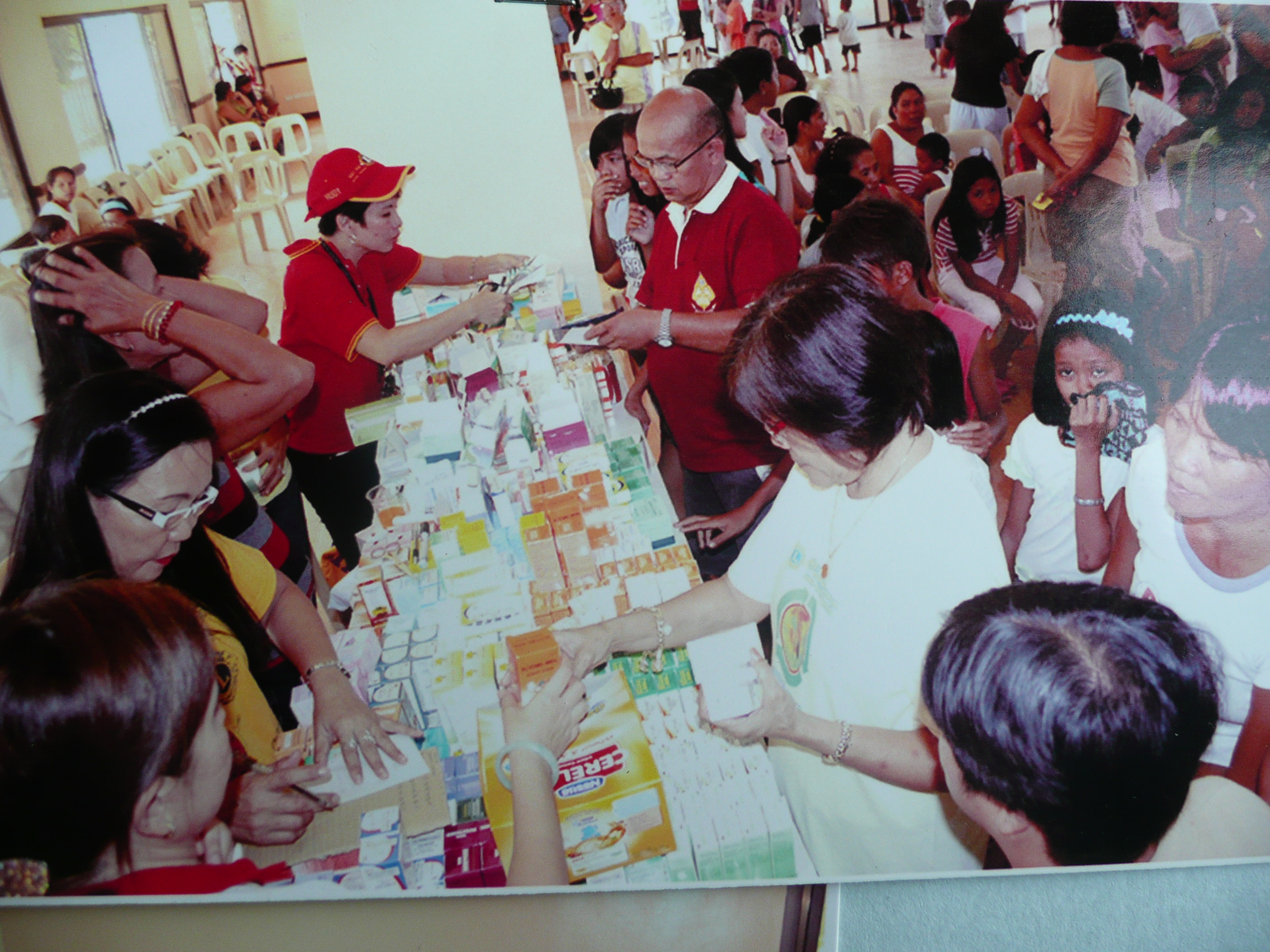
On Mission: Mr. Antonio Vytiaco, Sr. of Bulan Lions Club.
 A photo of Mr. Antonio Vytiaco, Sr. of Bulan Lions Club,
the person who organized the distribution of the medicines
sent by Bulan Observer and Team to the people in need.
 
Special thanks to Dr. Maria Belen Gordola, the president of
the Lions Club International, Bulan Sorsogon Chapter and
all the helpers behind for making their medical missions a success.
 
 
Bulan Observer, together with Franklin Patricio, Elizabeth Patricio,
 Mila Asuncion (all professional medical staff working in
 Clinic Hirslanden, Zürich, Switzerland)
 and our artist, the pianist/conductor Aries Caces are doing
their share (although they are not from Bulan themselves)  in helping the
Sta. Remedios Charity Medical Clinic and the Bulan Lions Club
 sustain their important medical missions.
 
Our involvement in Bulan is purely humanitarian in nature,
 nothing political as we do not have the ambition, the need,
the proximity or the time to engage in politics.
 
 However, to have compassion for the poor people
is something that transcends borders, colors and cultures.
 
 We just respond to this call of compassion, do something with it,
 help and expect nothing in return.
 
This year 2011, our pianist will be performing another
 concert in Zürich for the Sta. Remedios Charity Clinic
 and Bulan Lions Club and will be playing the works of Franz Liszt
in commemoration of  the 200th birth anniversary of this
 great composer. This will be on June 17, 20011 at 7.oo pm.,
 Gemeindesaal Zollikon.
 
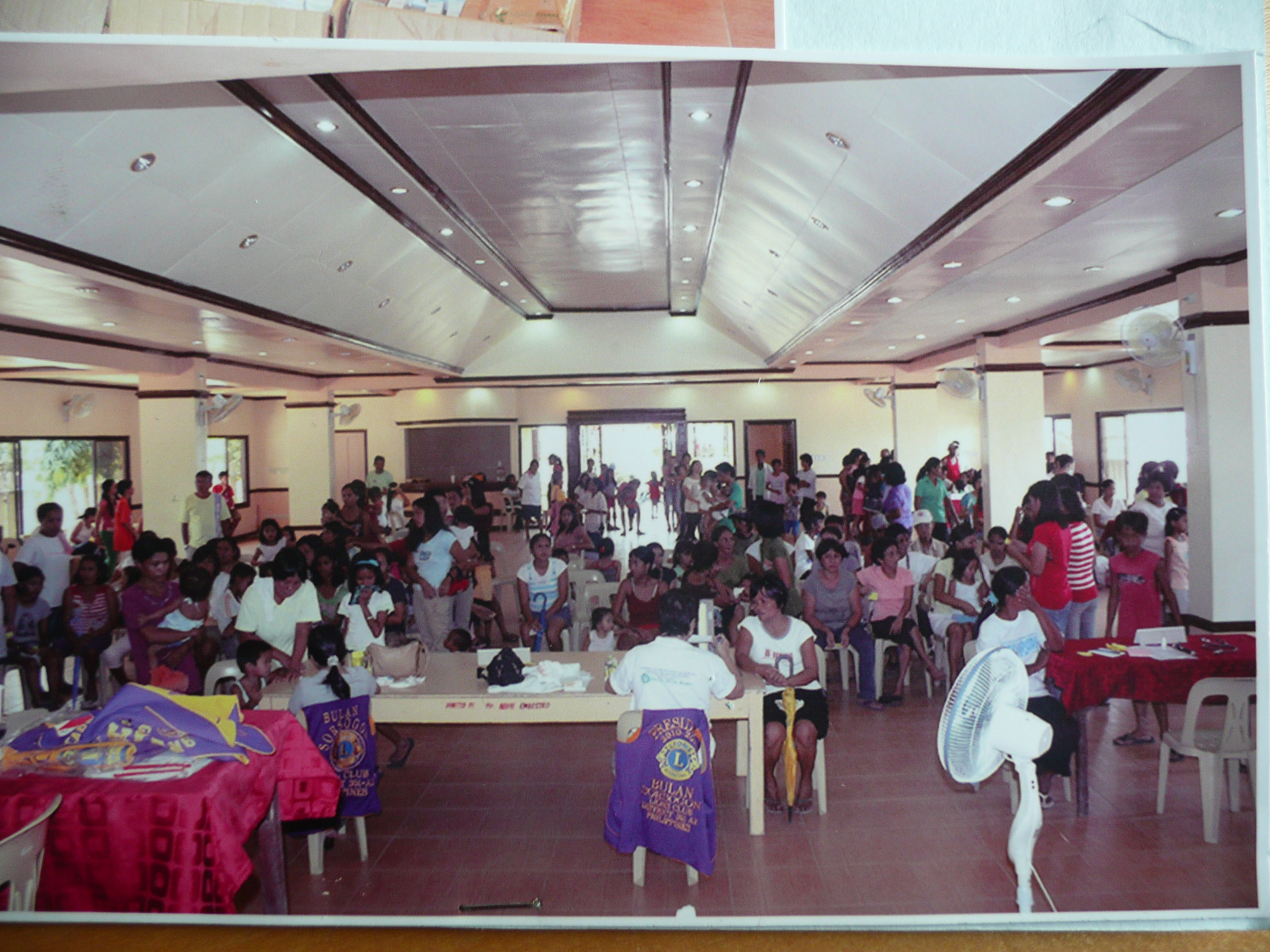
Shown here are some photos of the Bulan Lions Club
medical mission held at Sabang Park in Bulan Sorsogon last year.
2010 Medical Mission at Sabang Park Pavilion


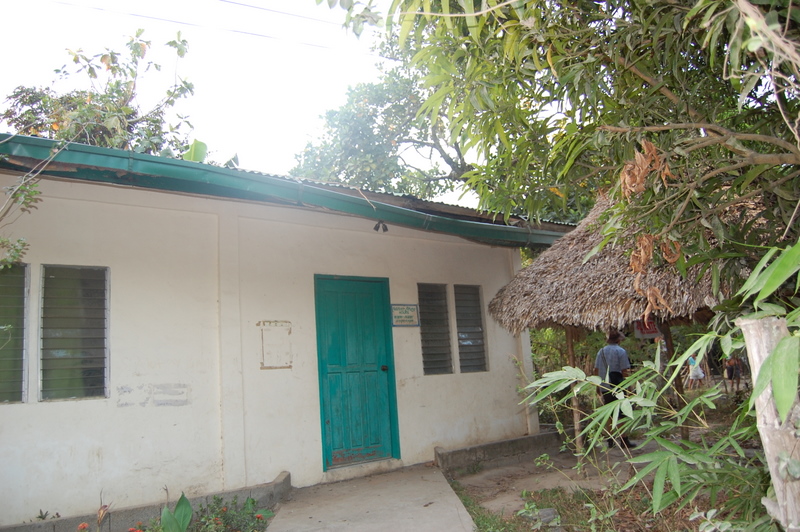
The Sta. Remedios Charity Medical Clinic
 (photos taken by Mila Asuncion)
 
Here is the  Sta. Remedios Charity Clinic.
 
The need for repair is very visible.
The Sta. Remedios Charity Medical Clinic


  Part of the interior of the Clinic.


 The children who live around the clinic area.
 
 .


Faces of hope.


Signs of peace.


L is for love, not for Laban or political fight (opposition).


 A talk with an older inhabitant as he informs
 about the U.S.- based nurse Angelita Kowalewsky,
 the founder of the Clinic.


And the time to say goodbye has come.
A quick visit yet we took time to take photos of these children.
Their laughter and vitality is a good sign and their needs are
as small as they are.


Though their needs are small, help them to have medicines
 and medical care when pains and sickness rob them
of their vitality and laughter.
With these images and thought, we left Sta. Remedios and
were happy to be in Bulan again,
 a charming town between its hills and the waters of China sea.
 
 
                                                                                                     ——end——

Two Murder Survivors Part Ways on Death Penalty

By JOSEPH G. LARIOSA

Joseph Lariosa
CHICAGO (jGLi) – Two surviving Filipino Americans whose members of their families were victims of murders in Illinois share opposite views on death penalty.

I sought out their views following the signing Wednesday (March 9) by Illinois Gov. Pat Quinn of the ban of death penalty, making Illinois the 16th state to end capital punishment.

As you know, the Philippines is one of the 95 out of the 193 members of the United Nations or members with UN observer status, which abolished death penalty. The Philippines is only one of eight out of 41 countries in Asia, which abolished capital punishment.

Of course, the People’s Republic of China is one of the countries, which is keeping death penalty in its books. And if it stays that way, it is going to be a frequent travel destination for Filipino diplomats, who would be appealing the stays of execution of 79 Filipinos in Death Row for “large scale drug trafficking.” 

NOT THRILLED BY ABOLITION OF DEATH PENALTY 

For Reyle V. Cardino, 53, whose parents were murdered on July 8, 2009 in their home in the outlying Chicago suburb of Rockford, Illinois, said he is not thrilled by the decision of the Democratic governor.

In an email to this reporter, Reyle (pronounced reel) said, “Let me start by saying that I was completely against the abolishment of the death penalty in Illinois. I have sent an email to the Governor myself, telling him my feelings towards this issue.”

He added, “I was assured by the Winnebago County State Attorney Joe Bruscato that if (the bill is) signed, there will be initiatives to put a bill together to re-instate the death penalty in Illinois. And so far, there is already movement. I just hope that this issue will be put before the people of Illinois to vote. We might find (out how) the people of Illinois (stand on) the death penalty.”

Because the case of the double murder of his father, Reynato “Rey” V. Cardino, 77, and his mother, Leticia Villanueva Cardino, 75, is still pending, Reyle anticipates “a delay (of the case) until the issue of the death penalty is settled.”

With the case still very fresh in his mind, Reyle believes, “life in prison (for the killer of his parents) alternative is not enough.”
He said, “This is not the Middle Age anymore where, life in prison means being hang up against a wall with chains until (the prisoner is) dead.”

Reyle added, “Having to spend the rest of his natural life in prison, where he can start a whole new way of life, have friends and family come visit, is not penalty enough (for the killer of his parents). 
“Have TV, food to eat, a roof over his head, a library, a gym and maybe a movie once a week, is not penalty enough. He will put what he had done in the back of his memories and live his new life. He will not forget us, but he will not think of us, is not penalty enough.”

“He brutally attacked me and left me for dead, brutally attacked and caused the death of my mother and father. (With t)he trauma that he had inflected on my family, does he deserve to die? (In t)his case I say yes overwhelmingly.”

Like State Attorney Bruscato, other Illinois state prosecutors, among them, Illinois State Attorney General Lisa Madigan, had asked Quinn to veto the bill, saying videotaped interrogations and advancements in DNA technology had left no room for wrongful executions of innocent people. Taped interrogations were one of the features of a bill filed by President Barack Obama when he was an Illinois state senator.

 “I LOVE BAN OF DEATH PENALTY”

For his part, Emmanuel S. Castro, 69, told me “I love it that there is no more death penalty in Illinois.”

Castro, a Filipino American native of Bulacan in the Philippines, is the father of Michael Castro, one of the two Filipinos and five others, who were massacred in 1993 in suburban Palatine, Illinois.

“I have since changed my mind regarding death penalty. Papatayin natin ang mga murderer, paano kung wala naman palang life after death? Di hindi na sila mapaparusahan ng Diyos.” (Okay, if we hang the murderers, what if there is no life after death? They will be spared from the punishment of God.”

“Kung nasa kulungan sila, paglalaruan lang sila ng mga inmates. (If they in prison, they will be pestered by other inmates). Their human bodies will suffer,” Mr. Castro said.

When I told him that hanging two inmates would be two mouths less to feed and saving from additional expenses, Mr. Castro countered, “You are talking about expenses not my feelings.”

“Besides,” Mr. Castro said, “because Death Row inmates are not granted parole, they will be forever suffering in isolation. They will miss birthdays of their children, the Christmas and other holidays while they are alive. No television. They only have one-hour-a day of recreation and no comfort in life at all. Only full of miseries.”

Mr. Castro said he did not get any civil damages from the owners of the fast food chain, Brown Chicken’s restaurant, because it was proven in court that the owners were not negligent – as the husband-and-wife restaurant owners Richard Ehlenfeldt and his wife, Lynn, were among those who were murdered along with his son.

“Even if I benefited from the death of my son, they can no longer have my Michael back.”

It was a rare interview granted to this reporter by Mr. Castro, who declined to be interviewed by Discovery Channel some time ago, saying, “I did not want to relive the nightmare that we suffered as a result of the death of my son.”

The killers of his son, Juan Luna and James Degorski, were both spared from Death Row and are now living a life in prison. (lariosa_jos@sbcglobal.net)

 —————end—————

Genealogy of the Asuncion

These documents were sent to me by various cousins. It took me a long time to release them because of technical problems. Now that they’re out, I hope that these will inspire the young Asuncions of today and move the older ones in possession of some relevant documents to share them to these younger ones. jun asuncion


The Sketch

(Justiniano Asuncion’s sketch of his parents Don Mariano Asuncion and Doña Maria de la Paz Molo)

A family that recognizes the remote origin of spouses

Don Mariano Asumpcion and Dona Maria de la Paz Molo San Agustin.

In Memory of Mariano Asumpcion

(by Macario Carillo, written June 12, 1926)

Of these spouses, we were able to preserve their photo drawn only in crayon by one of their children who was a celebrated painter in the mid 1900’s. He was Don Justiniano better known as Capitan Ting. The photo measures nearly one foot high, and for the first time was reproduced and published in the No. 4 Vol. 1 of the Revista Historia de Filipinas (page 60). The frontal sketch of this remembrance is a reproduction of the same by Corazon, the third grandchild of the photographed.

We do not have personal details of the family’s parents. We only know that they were principal neighbors of the town of Santa Cruz in Manila. It is possible that Captain Ting who was naturally artistic in detailing and untiringly compiling data, wrote memorable events about his parents, but his writings could have gotten lost or destroyed during the revolution, or acquired

by some members of the family that we now ignore. To him we owe the list of succession of Governors that went to the union of “meztizos” in the town of Santa Cruz, Manila. Since its foundation in the year 1741 until 1889, the list became public in the No. 4 and 5 of the Revista Historica de Filipinas.

In this list ( of which the original has disappeared ) we found out that this great head of the family, Mariano Asuncion Cagalitan, was Governor in the year 1805. And because the author of the list was also one of them, it now appears an opportunity to enclose what he refers as follows: “Justiniano Asuncion took possession on the 25th of January, 1853 and was revealed on the 27th of June,1854, opened the second street of San Lazaro, now, Oroquieta Street, in the entrance of General Novaliches.” As it is seen in the said list, it has found more notable inserted events that took place during the term of the Governor.

– CHILDREN –

1. MANUEL ASUMPCION – Born on the 24th of December, 1792, Sunday at 6:00 a.m. and baptized on the 10th of January, 1793 by Bro. Vergara, Canon Magistrate and Licensed in Law, making interim priest Br. D. Mariano de los Santos. His godfather D. Juan Morat.

2. ANTONIO ROXAS ASUMPCION – Born the 10th of May, 1794, Saturday at 2:00 p.m. and was baptized on the 15th day of May by Bro. D. Buenaventura Ubaldo. His godfather was the Head Priest and Secretary of the Archbishop of Manila, Br. D. Raymundo Roxas.

3. VICTORIA PAZ ASUMPCION – Born the 23rd of December, 1796, Wednesday 6:00 p.m. and was baptized the 25th of December by the Priest, Br. D Ramundo Roxas. Her godmother was Dona Josefa Bogan.

4. MAMERTA PAZ ASUMPCION – Born the 11th of May, 1798, Friday 7:00 a.m. and was baptized the 13th of May by Br. D. Baltazar de Ventura. Her godmother was Dona Marcelina Bonifacio.

5. JUSTO ASUMPCION – Born the 9th of August, 1800, Saturday, 6:00 p.m. Was baptized on the 15th day of August by Br. D. Joseph. His godparents were Br. D.Mateo Ramos and Dona Maria Magdalena. Died the 15th day of December, 1803.

6. MARIANO ASUMPCION – Born the 15th of August, 1802, Sunday at 9:00 a.m. Was baptized on the same day by Br. D. Pablo de Mendoza. His godfather was D. Mariano Estanislao de Borja.

7. EPIFANIO ASUMPCION – Born the 7th day of April, 1806, Monday, at 7:00 a.m. Was baptized on the same day by Br. D. Bonifacio. His godfather was D. Juan Gualberto Antonio. Died in the year 1837.

8. AMBROSIO ASUMPCION – Born the 7th of December, 1808, Wednesday at 11:00 a.m. and was baptized the next day by Bro. D. Menandro Obispo. His godparents were D. Manuel Bonifacio Pitex and Dona Maria Eloriaga.

9. PASCUALA PAZ ASUNCION – Born the 17th of May, 1811, Friday, at 2:00 p.m. and was baptized by Br. D. Cristobal de los Angeles. Her godmother was Dona Potenciana de San Agustin.

10. LEONCIO ASUMPCION – Born the 12th of September, 1813, Sunday, at 7:00 p.m. and baptized by Br. Raymundo Roxas. His godfather was Br. D. Juan Nepumoceno Mijares priest of the town of Binondo.

11. JUSTINIANO ASUMPCION – Born on the 26th of September, 1816, Thursday, at 8:04 p.m. and was baptized by Bro. D. Ramon Pineda. His godfather was D. Benito de los Reyes and for confirmation by his own brother, D. Epifanio Asumpcion.

12. CANUTA PAZ ASUMPCION – Born on the 19th of January, 1819, Tuesday, at 4:30 a.m. and was baptized by Bro. D. Gregorio de Jesus. her godmother was her own sister, Dona Mamerta Asumpcion.

D. Mariano had as a cradle, the town of Santa Cruz, Manila, which was also the same for all his children, where he lived for the rest of his life. He was born from a modest family. His complexion was white and his nose was pointed like his mother of Latin blood who came from a family that was traditionally Portuguese or half Portuguese. A bit more noticeable on the picture was the observer’s being notorious for remembering faces. His Caucasian origin of which he appears, is coordinately in contrast to his attire and the pigtail that he carries on his well formed head. This pigtail, according to D. Jose Ma. Asuncion great grandchild of the person we refer here as the biographer, ” was of importance in these towns where French fashion was in vogue and therefore had to be a prototype of elegance and good taste” (Revista Historica de Filipinos page 61, No. 4 Vol.1). We also believe that its use was made influenced by our neighbor, Imperial China.

We know nothing of the level of instruction, undoubtably, it was most instructed in its local ambiance.

His wife, Dona Maria, was the only one with whom he united his fortune. She was the niece of Dr. Molo, father of Captain Paterno Molo, ascendants of those that now constitute the distinguished family of the Paternos of this city. She was a mestiza by blood and was very fond of her children. She outlived her husband by 15 years, of which he passed away when the one who was to be Captain Ting was only 12 years old, according to the daughter of the latter, and also as told by the same. This daughter, Doña Benita has already surpassed her 71st year dedicated to the_________________of virtue.

(Note: The foregoing is the English translation of a friend of Ms Lourdes (Nelly) I. Jhocson, daughter of Consuelo Asuncion and Dr. Gabriel Intengan, of the original Spanish text writen by Macario Carrillo, husband of Guia Asuncion. The blank space in the last sentence of the account referred to an apparently illegible word. On closer scrutiny in a computer scan, the word appears to me as “rezo” which in English means prayer. The Spanish text would therefore read as “… sus 71 anos dedicados al rezo y a la virtud.”. In English, ‘…her 71 years dedicated to prayer and to virtue.”. (Eduardo C. R ojas, Jr. )

………………….

Original Spanish text  of Macario Carillo

The MEAO Heard ‘Round The World

By JOSEPH G. LARIOSA


CHICAGO (jGLi) – The Matnog Environmental Advocates Organization (MEAO) is a very tiny group named after the obscure municipality of my mother in Sorsogon province in the Philippines but its advocacy is getting notice in this part of the world.
MEAO’s advocacy is to be more conscientious with environmental disaster waiting to happen. It got a boost last week when an indigenous villager Maria Aguinda in Rumipamba, Ecuador won a blockbuster $9.5-billion judgment and brought to its knees U.S. giant Chevron for leaving behind an environmental damage for polluting the villager’s rain forest.
The multi-billion dollar judgment should send shockwaves to upstart mining companies in the Philippines, which ventured into this labor-intensive business fraught with environmental pitfalls.
One such debacle in the Philippines that escaped notice was the massive environmental hazards left behind by the United States in the early nineties when the Philippine Senate shut down the bases without first requiring the US to rid the bases of their hazardous materials.
Recently, the multi-national joint $45-Million investment from Lafayette, Philippines, Inc. (LPI) of Australia and the LG Group of South Korea whose contract to mine 18 out of 180 hectares, (not 5,218 hectares that I inadvertently wrote in my previous column), that straddle within Barangays Malobago, Pagcolbon and Binosawan in Rapu-Rapu, Albay province, north of Sorsogon province, was unceremoniously scrapped four months into the six- to seven-year operation following cyanide poisoning that triggered massive fish kills in the adjoining Pacific Ocean.

GRAVEL-AND-SAND MINERS

Now comes a little-known venture capitalist named Antonio Ocampo and/or Antonio Comersiase Jr. who appear to be backed up by a gravel-and-sand delivery truck company euphemistically named Alexandra Mining & Oil Ventures, Inc. based in Quezon City in the Philippines advertising Matnog Ore Project as one of its “on-going mining projects.” The Matnog Ore Project covers 19.840 hectares (not 19,840 hectares that I earlier mentioned in my column).
May I ask these venture capitalists if they have capitalization that comes close to the $45-million put up by the LPI and LG Group and be ready to lose that kind of money when disaster strikes?
Are they ready to operate without PEZA (Philippine Economic Zone Authority) so that they will be paying 54 percent national and local taxes and they get only 46 percent of their ROI (return of investment)?
Do they have money held in a screw so that authorities can draw from it to be given away to victims of calamities and disasters that could be caused by mining operation in Balocawe in Matnog?
Do they have money that will be sourced from fine against them “for pollution” to solve among others the “Acid Mine Drainage (AMD) problem” and for “decommissioning” expenses after the mining operation and replanting of trees that were cleared prior to the mining operation?
“Rehabilitation and environmental mitigation measures” are expensive propositions.

DISASTER INSURANCE, ANY ONE?

Without escrow account, do they have a surety bond or disaster insurance to cover future victims of disaster that may result in the mining operation?
Do they have an ownership structure that will publicly show that the incorporators of the mining permit holder have capability to pay in case of damages by showing their previous statements of assets and liabilities? Are they ready to follow the recommendations of the Presidential Rapu Rapu Fact Finding Commission Report (PRRFFCR) and/or the DENR (Department of Environment and Natural Resources) Assessment of the Rapu Rapu Polymetallic Project (DARRPP) issued in 2006?
To avoid the multi-billion dollar fine in Ecuador against Chevron, are these mining permit holders ready to establish “baseline average health condition” by conducting medical tests and “blood work” of the population around the mining area free of charge so that they can show that the population has pre-existing medical health condition prior to and after the mining operation?
Can DENR Secretary Ramon J. P. Paje certify that it has now re-trained its personnel following the 2006 Rapu-Rapu debacle, which according to PRRFFCR exposed its personnel as having “dysfunctional monitoring system”?
And is there now an oversight mechanism that can oversee the operation before, during and after the mining operation?
If the answers to all of the above questions are “yes,” then, by all means, this mining permit holder should be allowed to mine the Matnog Ore Project.
Its approval should stop Governor Raul R. Lee from “politicizing” this project to harass the members of the Sorsogon provincial board, who are opposing the mining operation in Matnog.
Provincial board member Vladimir Frivaldo has complained that ever since he opposed the mining project of Matnog and the STL (small town lottery, the legalized jueteng), Governor Lee has been giving him a hard time.

LEE SHOULD BE RECALLED?

The governor refused to give him detailed information where the previous and existing loans of the province went before he could support another request of the governor to obtain 350-million pesos loan (US$8.1-Million).
If the new loan is approved by the rubber-stamp provincial board, the loan of the province will balloon to 1-billion pesos (US$23-M) if the previous loan obtained by his predecessor, his wife, Gov. Sally Lee, is added to it. He said a new slogan “Utang Sorsogon” will be added to “Bangon Sorsogon.”
Frivaldo also questioned the poor judgment of Gov. Lee for appropriating his office with the third highest budget at more than 65-million pesos (US$1.5-M) when the most important offices like the Provincial Agriculture Office, Provincial Cooperative Office, Provincial Nutrition Council, Provincial Social Welfare and Development are only getting P22.0 million (US$.5-M), P700,000.00 (US$16,279), P500,000.00 (US$11,627) and P2.7 million (US$72,790), respectively. Support to education and social services is only P1.9 million (US$44,186).
Frivaldo also urged Governor Lee to build a new three-story Sangguniang Panlalawigan building because in the existing SP building when it rains outside, it also rains inside, soaking the Vice Governor, SP Members and secretariat staff.
Another complaint of Mr. Frivaldo is Governor Lee’s disapproval of the six staff appointments in his office that is required under the Department of Interior and Local Government Code while Lee’s wife, Lee’s son, then incumbent Sorsogon City Vice Mayor and Lee’s grandson, SK Federation President are “suppressing opponents/critics of your administration policy.”
If Mr. Frivaldo cannot charge Governor Lee with administrative violation of DILG Code before the Office of the President for grave abuse of discretion, he should initiate a preparatory recall assembly or by registered voters to recall Governor Lee as provided for by the Philippine Constitution.  (lariosa_jos@sbcglobal.net)    /

———-end———

The Asuncion and Gerona Connection


Dear fellow Asuncion relatives,

Had breakfast with neighbor Horace Gillego and he supplied me a copy of their family tree. In our previous emails last year, we mentioned that Horace pointed us to the Bulan Observer website of Jun Asuncion (Horace’s roots come from Bulan). Lately, Horace discovered in their late dad’s house an old folder which contained the family tree of Rafael Espiritu Gerona (died April 14, 1871) and Ma. Justaquia Gray (died Jan 1, 1873).

The family tree traces the line from the Gerona & Gray union (they were married July 30, 1821). One of their seven children was Casimiro Gerona (married Zenona Antiado). Their union brought forth four children, the youngest Salvador Gerona (married Rita Gimpaya). And the latter couple produced ten children, one of them was Monica Gerona.

Monica Gerona married Rodolfo Asuncion. Rodolfo Asuncion was one of the children of Zacharias Asuncion. Rodolfo’s mom is Zacharias’ third wife – Remedios Ramirez. Zacharias’ dad is Justinano. Zacharias’ grandpa is Mariano “Kagalitan” Asuncion.

From Rodolfo Asuncion and Monica Gerona came papa Ronnie Asuncion.

From Rodolfo’s brother Adonis came Andres Asuncion (dad of Andres “Jun” Asuncion & Malou Asuncion Lao).

From Rodolfo’s brother Jacobo came Sor Marissa Asuncion’s line./

Ed Rojas- Asuncion

Stop Mining In Palawan

By GINA LOPEZ

Managing Director

ABS-CBN Foundation, Inc.

My dear friends,

On January 24 a very dear friend and colleague Gerry Ortega was shot in the head dead. I was just with him that weekend – and a few minutes before he died what we were discussing over the phone was an anti-mining campaign in Palawan – given that on December two huge mining applications were railroaded – and they were to be near protected sites.

Gerry is dead but we will not let go of his dreams – and mine – and probably yours too.

Palawan has 17 key bio diversity sites – which means it is part of the 70% bio diversity sites which are essential for sustaining life in the planet. It has 2 world heritage sites, 8 protected sites. Yet if you see Palawan on the map you will note that it is a very thin island – which is 82% mountain. It means that if the forest gets denuded and the minerals excavated – the tailings seep directly into the sea affecting the coral reefs. The top soil is thin – and the island eco system is fragile.

Mining is not the way to go for Palawan. I have five eco tourism sites wherein the communities involved can now send their children to school, can dream bigger dreams. Mayor Hagedorn in Puerto Princesa has banned mining and logging – and focused on tourism and agriculture. From 2 flights a week, Puerto Princesa now boasts 10 flights a day. His revenues have gone up from several million to several billion.

Mining as an economic path in a magnificent “Last Frontier” is based on a paradigm of economic growth that is myopic and archaic . In this age of climate change and global warming any economic development that does not recognize and revere the web of life should be thrown in the dustbin.

Please please support the ten million signature campaign to Stop Mining in Palawan. The richness of Palawan is the wealth and pride of the country, it is the wealth of the world. Log in to www.no2mininginpalawan.com  .. register your vote and please please send it to thousands others. You can also include your household by downloading the form printing it – and faxing it t 4152227 or you can scan it and send it to signatures@no2mininginpalawan.com. Questions can be sent to signatures@no2mininginpalawan.com.

Palawan

 Palawan contains part of the 70% biodiversity in the planet. It has 17 key biodiversity areas, 2 world heritage sites and 8 protected sites.

Its topsoil is thin and island eco system is fragile.

There are currently 354 mining applications in Palawan. Mining in Palawan is a myopic, archaic view of economic development.

We need to respect the web of life.

Please, please help me gather 10 million signatures now. We need laws enacted to save our VIP diversity.

Register at http://www.no2mininginpalawan.com / and vote NO TO MINING.

This is for our country, this is for the future.

  Gina Lopez                                                              

                                                                      —–end—–

Bulan Lion’s Club Medical Missions 2011


by Maria Belen C. Gordola, M.D.

Greetings of Peace! In behalf of the Bulan Lions Club, I would like to thank you  (Bulan Observer and Team)  for your generosity. The medicines you donated were distributed during our Medical Mission at Sabang Pavilion Zone 2, last August 2010.

The following are our 2011 activities discussed during our Club meeting:

 Feb. 26 Medical Mission at San Francisco, Bulan.

 March 19, Vision Screening Catanusan Elementary School and Gubat Elementary School.

 April 16 Medical Mission at Barangay Beguin,

 and for the month of May, a medical mission for coastal Barangays to be identified during our monthly meeting this Feb. 2011.

We hope for your continued support for our future Medical Mission activities. Again, our sincerest appreciation for  your assistance.

—————–end——————

An Asuncion at Mensa- Switzerland

A personal note, written primarily for my relatives and for those interested in child psychology.


Way back in the 1980’s, during my college years in Manila, my favorite psychology subjects were psychological testing (psychometrics), projective techniques, psychopathology, mental hygiene, theories of personality, experimental psychology and seminar on exceptional children. In projective techniques, the student learns the rudiments of administering and evaluating personality tests. Throughout these courses, the student begins to be confronted with the question of personalities, the reality of individual differences, inborn and acquired traits, the nature of intelligence in all its theoretical aspects.

A college freshman is faced with these basic questions: First, what is personality? Second, what is intelligence? And then you slide into the third: Is there a direct correlation between personality and intelligence? Do intelligent people have more pleasant personality than less intelligent ones or is there no direct correlation at all between these two factors? The next thing that confronts the student is the relationship between high intelligence or genius and insanity? Is this true that geniuses are prone to mental illness and personality disorders whereas the normal ones not? Or is this just a myth or a hollywood invention? And then comes this simple issue: Are intelligent people practical and independent?

Well, four years of basic psychology studies will not give you instantly the answers to these questions and give you peace of mind. I have learned that my favorite subjects had only given me a good starting point to continue the inquiry. One thing that I have learned after all these years is that everything is a matter of definition and the context to which this definition is being applied. Or, even better, let the context offer the definition of such things as intelligence, normalcy, perfection, etc. The other thing that has taught me more is experience. Experience gives you a solid understanding or even doubt about the subject. My years of experience in observing psychiatric patients have no doubt taught me more than anything else to evaluate roughly a person almost at a glance: Is he/she a schizophrenic, a psychopath, a drug dependent, an alcoholic, a manic-depressive one, a borderline personality, suicidal person or a sexual deviate; or, to evaluate indirectly by way of any available product of that person: a written piece, a drawing or illustration, etc.

But intelligence is something else. It requires more to gauge it. A mere glance cannot tell me if one is an average, genius or retarded (except for genetic abnormalities as Down syndrome, etc.). But this time, through indirect way, i.e. by way of a written piece or work of art, etc., I could tell more about the intelligence of the person.

On the other side, my experience has shown me how tricky this aspect is: For example, relying on school performance alone does not give you the real intelligence of a child or a youth. Behind an average or even below average performing child could be a gifted one. It is in the extremes of appearances that we have to exercise caution and observe more. But in general, we can say that a child is intelligent if it grasps abstract relationships within a short time than other children and translates his ideas successfully into concretely observable results for the observers. But what if this translation doesn’t occur, or if the child consciously – or even unconsciously – distorts this translation? It follows that our picture of the child is also distorted.

Then it’s time that we observers, parents or educators must look at ourselves. Are we competent enough to make the right judgment(evaluation) and do we have the necessary experience in this area?

I always recommend observing the child who has problems at school  in the totality of his behavior and when needed to send the child to a recognized testing institution for aptitude and intelligence test. Ideally, school – pubic or private –  should have also a team of counsellors which includes one or more school psychologists to help troubled parents and children.

In my neighborhood, I have given advice to concerned and troubled parents this way and even offered my on – the – spot analysis of the child’s personality and general mental aptitude drawing out of my experience in this field. I admit, that though it’s really hard to determine the child’s intelligence, still I can say that experience gives me  a solid ground to base my guess or intuition. I was right in many cases because these grown-up children are now high achievers, out of the initially hopeless situation when they were in the elementary years.

But now, we come to my experience of this subject within the four walls of my home, an experience that has given me doubts about what I know and challenges that  almost went beyond our limit as parents. And that is when my second son, Samuel, came into our life. From birth, I already sensed that he is intelligent. As a child he rarely cried, was very quite, curious and independent in his ways. At age three, he was reading until three in the morning that at times I had to switch off his bed lamp so he would sleep. At this age he had memorized the books he had in his room, performed weird chemistry experiments, etc. He protested by crying when we brought him to a play group but showed great joy when we brought him to a painting group for children.

 His week, together with his older brother Cyril, was full of activities already before the age of five: music group for pre-school children and,  a few months after, violin lessons where he always astonished his teacher for his excellent hearing, private English, French and cooking courses every Saturday for several years and swimming where he also excelled. Later on he switched to piano and about the same time he started with hip-hop dancing course from a known dancer and teacher and won second place in the Swiss dance team competition. With 16, he started teaching this dance style, now with 18, he resumed his Thai boxing lessons and intends after graduation this summer to go to Thailand for Muay Thai boxing teacher course.

Before entering primary class, he underwent a thorough intelligence and aptitude tests in a private human potential evaluation clinic that took the whole morning with a short break in between. The results showed  him belonging to the top 2% of the population of  children of his age group. The effect was that he jumped directly from kindergarten to Grade 2 and parallel to normal schooling, he had to attend special courses for gifted children organized and supported by the city of Zürich where they learned other supplementary subjects as chemistry, mathematics, physics, philosophy, etc. This satisfied all of his “mental needs”. During this time, at age 9, he was admitted to Mensa-Switzerland whose only criterion for membership is an IQ score in the top 2% of the general population on a battery of standardized intelligence tests (“normally” from above 130 IQ scores). But this too went not without a little problem because he was “under age”, which means below 15. But they readily made an exception to the rule. And so it went that he became the youngest member in the history of Mensa-Switzerland.

Parents can only be proud of this story but we had our own worries. His normal schooling went on not without problems for he showed little interest in his homework and in most of his teachers in the public school who were not trained for such a child with a different quality of perception. In fact, some of his new teachers in the primary school considered him below average. He was –  and is even now – behaving like that so that, at age 12, I let him undergo another intelligence and aptitude test, this time administered by the school psychologist in that private school we found for him after we pulled him out from the Volksschule. I was there again to observe as he made his written and oral examination for hours. From the answers to the oral tests I heard and the awed facial expressions of the psychologist , I knew already that he was still in his “old” intellectual status. Hence, nothing was changed only that he needed the right environment that suits his needs.

But he remained an ordinary boy before the eyes of our  friends and relatives and with time we got used to this fact. Only a handful of his friends (who are gifted themselves) realize and appreciate the gift that is in him. Same feathers flock together? Intuitively, I observed, they do.

With 15, he was turned down by many firms as he applied for apprenticeship because of his not-so-shining secondary school grades. Again, another problem for all of us. Until he was admitted to a  Swiss Federal Institute of Technology or ETH (Einstein’s alma mater) spin-off  IT firm. There his mentor, an ETH IT lecturer, himself  a very intelligent man, has told us that “no doubt, your son is very intelligent”.

So, what’s the problem? Samuel will graduate this summer at age 19 as IT specialist. /

jun asuncion

                                                       —–end–

Carpetbaggers Back Off My Boyhood Town!


By JOSEPH G. LARIOSA

Joseph Lariosa

(© Journal Group Link International)

C HICAGO (jGLi) – When I was a young boy vacationing in the native town of my mother, Consolacion G. Garra, in Matnog, Sorsogon, Luzon’s gateway to Southern Philippines, I always wondered why its white beaches had sprinklings of black sands.

It turned out those black sands are called “margahas,” which I later came to know as magnetite sands.

With no money to buy toys, we used these margahas to entertain us. We would put a trickle of these black sands on top of a small piece of grade school pad paper and put a magnet or magnetite stone (bato balani) below the paper and we would run the magnet in different directions.

Because the margahas is attracted to the magnets, these black sands would stand up on end, like soldiers, if we moved the magnet or bato balani below the paper. The margahas would follow the magnet like dutiful soldiers.

And it gave us a kick because it put matters under our control.

I had no idea that these margahas and bato balani abundant in Matnog and the whole of the Bicol region were iron oxide minerals that are often mined as an ore or iron. It is commonly used as abrasive in water jet cutting, as toner in electrophotography and as micronutrient in fertilizers, as pigments in paint, etc.

These magnetic minerals attracted nationwide attention in November 2005 when two sacks of dead fishes were allegedly buried in Barangay Binosawan in Rapu-Rapu, an island town of Sorsogon’s neighboring province of Albay to the north.

For these margahas and bato balani to be of commercial use, they have to be mined. During their mining, they would give off toxic discharges, like cyanide, that emptied into Albay Gulf and into the Pacific Ocean that flowed south to neighboring towns of Prieto Diaz, Gubat, Barcelona, Bulusan and Bacon (now part of the capitol town of Sorsogon City), all in Sorsogon province.

GLORIA ARROYO’S SHINING MOMENT

The cyanide poisoning caused massive fish kills in the area prompting President Gloria Macapagal Arroyo to create the Presidential Rapu Rapu Fact Finding Commission Report, and a separate DENR (Department of Environment and Natural Resources) Assessment of the Rapu Rapu Polymetallic Project, both in 2006.

In one of then-President Arroyo’s rare shining moments, she approved the Commission’s report to junk the “$45-million in capital investments from Lafayette, Philippines, Inc. (LPI) of Australia, as well as $10-million investments from LG Group of Korea” that were jointly mining in Rapu Rapu. Ms. Arroyo learned that LPI’s Country Manager Mr. Roderick Watt “inadvertently stated in his letter” to her that LPI’s PEZA (Philippine Economic Zone Authority) application did not need the Mayor’s (Rapu Rapu’s) concurrence.

More damaging, however, was the forgery of Rapu Rapu Sangguniang Bayan Secretary’s signature in the SB resolution that granted “ecozone” permit to LPI for tax-exemption.

As a PEZA registrant, LPI certified that it would not endanger public safety or public health or violate anti-pollution requirements by installing pollution-control devices.

As a result of the fish kills, the National Economic Development Authority recommended the LPI’s “tax-free status” revoked. While the DENR ordered the Bureau of Internal Revenue to investigate possible tax fraud as a mere two percent was paid in excise tax for the year 2005 for PhP 2,065,511.54, out of the $2.4-million ore exported.

But the most damning information issued by the Commission is the finding that the “DENR, its bureaus, i.e., MGB (Mines and Geo-Sciences Bureau) and EMB (Environmental Management Bureau), its regional offices, including its monitoring team, (are) to be so dysfunctional as to be unable to prevent the occurrence of the October (fish kills) incidents. They simply did not have the sufficient capability of monitoring mining operations in Rapu-Rapu. Worse, though, is that if they had the capability, then, they utterly lacked will.”

“UNWARRANTED AND UNTOLD SUFFERINGS”

I wonder if my friend, Sorsogon Gov. Raul R. Lee, ever read these reports. He was quoted in the report as saying that in Sorsogon, the fish scare caused “unwarranted and untold sufferings” to fisher folk families, fish traders and the fish consuming public. Did the good governor ever sue the LPI for damages to assuage the “unwarranted and untold sufferings” of his constituents?

A registered mail sent me by Gov. Lee justifies the approval of a similar small-scale mining operation, like Rapu-Rapu’s, in a small barangay of Balocawe in Matnog consisting of 19,848 hectares.

The lucky mining permit holder is one Antonio Ocampo and/or Antonio Comerciase, Jr. of No. 3 Barangay Tomolin, Ligao, Albay. He was given a permit on “Sept. 23, 2009, to extract 25,000 metric tons of iron ore from Sept. 23, 2009, to Sept. 22, 2010, with an option to renew for the same length of period.”

Writer’s Note: Rapu-Rapu’s mining operation covers only 5,218 hectares and was able to extract 67,693 metric tons of gold ore mined in 2005 and exported $2.4-million worth of ore.

Governor Lee was prodded to send me a letter after I e-mailed DENR Secretary Ramon J. Paje that he should listen to the petition of “Save Matnog, Stop The Iron Project.” Secretary Paje, in turn, forwarded my e-mail to Regional Director Reynulfo A. Juan of Mines and Geo-Sciences Bureau in Bicol. Mr. Juan sent me a registered mail, informing Governor Lee about my complaint.

In his letter to the Governor, Director Juan said, “(M)ay we recommend that the Provincial Government conduct the necessary validation on the issues being raised and to inform Mr. Lariosa directly on the actions taken by your office”?

 THIS CABINET SECRETARY IS E-MAIL-FRIENDLY

 Governor Lee told me, the “Permit Holder (on Balocawe mining) was issued with an Environmental Compliance Certificate (ECC) dated Aug. 13, 2009, by the DENR Environment Management Bureau (EMB V) on the basis of the submitted Project Study and Initial Environmental Examination Report after thorough evaluation of that Office who (sic) has the authority and capacity to undertake environmental assessment of projects within their area of jurisdiction.”

Mr. Governor, the permit was issued in August 2009, three years after the scathing Commission Report. My question to you is this: Did you get an assurance that remedial measures have now been undertaken since the Commission’s report in 2006 that indicted the “DENR, its bureaus (i.e. MGB (Mines and Geo-Sciences) and EMB (Environmental Management Bureau), its regional offices, including its monitoring team, (as) to be so dysfunctional as to be unable to prevent the occurrence of the October (fish-kill) incidents? They simply did not have the sufficient capability of monitoring mining operations in Rapu-Rapu. Worse, though, is that if they had the capability, then they utterly lacked (the) will”?

Does the mining permit holder have the LFI’s and LG’s of Korea combined resources in capital investment of $55-million to operate a much-bigger “small mining” operation that will ensure the public safety or ensure public health and not violate anti-pollution requirements by installing “control devices”? If so, who are his business partners?

In the event of a disaster, like a massive fish kills, or loss of the threatened Philippine Eagle owl (Bubo, Philippines), whose nest will be displaced by the clearing of the biodiversity area and occurrence of mudslides, is the permit holder capable of buying disaster insurance from Lloyds of London to appropriately compensate future victims, who in your words, may run into “unwarranted and untold sufferings”?

If you can answer, “yes” to all these questions, I will be behind this permit holder.

Meanwhile, I am appealing to President Noynoy Aquino and the Commission on Appointments to keep and confirm Mr. Paje as DENR Secretary and keep or promote Director Juan just for responding to my e-mail. Any other Cabinet Secretary or Bureau Director would have just deleted my e-mail complaint from their junk e-mails. 


Happy New Year to all! # # #

Editor’s Note: To contact the author, please e-mail him at: (lariosa_jos@sbcglobal.net)

                                                               ————-end————–

Disclaimer

jun asuncion


Just a few days before the end of 2010, a sister of mine asked me why I did not respond to her Facebook invitation. I told her I’m not a Facebook fan and that blogging is more interesting and is more than enough to consume the remaining time of my otherwise very busy life. “But you’ve  got a Facebook account that I discovered and with your Bulan Observer photo on it!”, my sister exclaimed.
“No, I don’t have one” I repeated and thought she was just joking.
To prove her point, she opened her Facebook and there I saw it crystal clear –  the Facebook supposed to be mine!

Dear friends, that Facebook account bearing my photo is not mine and has nothing to do with me.

It is, I think, a work of a lost soul who has no face of its own to attach to its own Facebook; a person who has not the courage to discuss with me in Bulan Observer the corruption issues that hurt him.

We have discussed this in the past that a man without a valid and decent argument to present resorts to such primitive form of language – and I pity such a primitive and faceless being who roams around the net without a concept of civilization.

Again, as a netizen my home is Bulan Observer and nowhere else.

Thank you and have a fruitful and blessed 2011.

jun asuncion

                                                             ——————————————————

2010 in review

The stats helper monkeys at WordPress.com mulled over how this blog did in 2010, and here’s a high level summary of its overall blog health:

Healthy blog!

The Blog-Health-o-Meter™ reads Wow.

Crunchy numbers


Madison Square Garden can seat 20,000 people for a concert. This blog was viewed about 62,000 times in 2010. If it were a concert at Madison Square Garden, it would have performed about 3 times.

In 2010, there were 39 new posts, growing the total archive of this blog to 255 posts. There were 25 pictures uploaded, taking up a total of 87mb. That’s about 2 pictures per month.

The busiest day of the year was May 11th with 634 views. The most popular post that day was Update: SORSOGON PROVINCIAL CANDIDATES FOR 2010 ELECTION.

Where did they come from?

The top referring sites in 2010 were search.incredimail.com, facebook.com, search.conduit.com, bulan.com, and google.com.ph.

Some visitors came searching, mostly for impormasyong pang-turista ng bern, bulan observer, cactus, loren legarda, and business and politics family dynasties.

Attractions in 2010

These are the posts and pages that got the most views in 2010.

1

Update: SORSOGON PROVINCIAL CANDIDATES FOR 2010 ELECTION December 2009
14 comments

2

Strengths And Weaknesses Of The Filipino Political Character February 2009
11 comments

3

The CRIMINAL JUSTICE SYSTEM in the Country: April 2008
13 comments

4

Local Archive December 2009
3 comments

5

About Bulan Observer December 2007
35 comments

                                                                                                         ……………………………………………

Lawmaker seeks tax deduction for families with children with disability


OFFICE OF REP. DEOGRACIAS B. RAMOS, JR


NEWS RELEASE


Government should help ease the financial burden on families caring for children with special needs by allowing a deduction on a parent or legal guardian’s taxable income.

Rep. Deogracias Ramos, Jr. (Sorsogon, Second District) said families with special needs children have different out-of-pocket expenditures than those with regular children.

“We should help children, regardless of any difficulties or differences they may have, to fully realize their potential for development. By allowing a tax deduction on a legal guardian’s taxable income, we help families reduce their expenses and hopefully provide better care,” he remarked.

Under House Bill 3765, a taxpayer caring for a child with a disability will be able to get a tax deduction of P50,000. Expenses that qualify for a deduction are:

• Tuition for a private school

• Therapy

• Diagnostic evaluations by a medical professional

• Tutoring

• Transportation expenses to school or a medical facility

• Specialized instructional materials

The Department of Education’s Special Education Division estimates the cost for taking care of a child with a disability is at least double compared to regular children.

Based on the 2009 Family Income and Expenditure Survey, Filipino families earned an average of P206,000 and spent P176,000 on the average. This translates to an average annual family savings of P31,000 in 2009. On a monthly basis, the reported average income was P17,200 and average expenditure was P14,700.

Families in the bottom 30% income group reported an average annual family income of P62,000. Families in the upper 70% income group earned an average annual income of P268,000. On a monthly basis, the average income of the families in the bottom 30% was P5,200 while the upper 70% earned an average of P22,300.

A child with a disability is understood to be one who is intellectually disabled, has hearing impairments (including deafness), speech or language impairments, visual impairments, serious emotional disturbance, orthopedic impairments, autism and traumatic brain injury.

Rep. Ramos pointed out that families living in the provinces have a harder time getting an educational program and medical assistance suitable to the child’s needs.

He said children with different disabilities are often grouped together rather than have separate classes for each condition.

Children with a learning disability topped the list of special needs children enrolled in a public elementary school as of 2009. A total of 51,296 children were assessed as learning disabled, while the number of mentally retarded/intellectually disabled children stood at 13,119. Children who are hard of hearing ranked third with 12,039.

For School Year 2007 to 2008, the number of enrolled children with special needs in public and private elementary schools stood at 92,429. This translates to a 27.6% increase compared to School Year 2004 to 2005’s total of 79,118. Many children no longer pursue secondary education or stay in elementary schools for an extended period of time.

About Rep. Deogracias B. Ramos Jr.

Liberal Party – Sorsogon, 2nd District

Rep. Deogracias B. Ramos, Jr. represents the Second District of Sorsogon in the House of Representatives. The district covers Bacon, Gubat, Barcelona, Bulan, Irosin, Santa Magdalena, Matnog, Juban and Prieto Diaz.

He currently serves as vice-chairman of the Committee on Natural Resources, Committee on Rural Development and Committee on Bicol Recovery and Economic Development.

Rep. Ramos received numerous national awards during his time as Mayor of Gubat, a second-class municipality in Sorsogon. These include:

• 1994 National Population Development Award

• 2002 TESDA Kabalikat Award

• 2004 Department of Agriculture Gawad Saka Award

• 2009 National Nutrition CROWN Award

• 2009 Punong Bayan Award of Excellence from the League of Municipalities of the Philippines.

The Congressman played a pivotal role in the establishment of the Bicol University – Gubat Campus.

The awards and the creation of the BU – Gubat Campus reflects the Congressman’s commitment to Agriculture, Education, Health, Nutrition and Public Service.

CONTACT:

T: (02)9315001 local 7210.

                                                                                                                                          —-end—-

Whistling in the Dark


By Oliver Geronilla


From where I am, I can sense that Bulan politics is so still you could hear a pin drop. The pledge to be transparent, the enthusiasm to inform and be informed have all vanished into thin air–perhaps corked in the trapos’ bottles of potions only to be reopened when it’s time to bewitch the electorate again.

Something’s wrong. This silence needs to be broken lest we be accused of being privy to whatever plot is being brewed by these political wizards and witches. This is the point when silence is no longer golden. It reeks of many things that you and I are both wary of—secrecy, muted whimpers, and God forbid… a whole new world of shenanigans!

Just a few more weeks, the year will be over. And yet, nothing significant has transpired in the way hits and misses in local governance are regularly reported to the people of Bulan. Well, fair do’s, at least its official website has been recently tweaked making it technically no longer dormant. Thanks to Tinker Bell! But, by golly, it still bears the same news items that netizens have probably read and reread to their boredom. To make things worse, count how many times the mayor’s picture “graced” the welcome page. Has the moon’s gravity paralyzed the mighty brains and hands of our local heralds? Or have they been gagged by the powers that be?

Whatever the case may be, it still puzzles me why this is happening when I suppose there’s enough manpower to do this job. It doesn’t take a genius to write what we see, hear, and feel. We’re not asking for brilliantly written pieces; we’re asking for reports, for observations, for stories decently written that can fill the vacuum of emptiness that make one stop thinking the world has come to a halt—in Bulan.

Personally, I want to go home, go around the town, and gather some news just for me to have a springboard. But do I really have to do them? For sure, columnists don’t go to Iraq or to North Korea just to get some juicy pieces of information for their articles. For sure, they can have the needed information to put substance into what they write without hopping from one place to another.

Hence, it bothers me that I can write commentaries about Southeast Asian affairs at a drop of a hat, but I can never write a piece about my own hometown. I can’t … because I rely mostly on cyber news. And there’s nothing much and there’s nothing new that we can read about our town through the world wide web. That’s for sure.

So, let me propose one thing: let’s all write. It might be daunting at first, but when we get the hang of it—perhaps through trial and error or dedicated mentoring—everything will just go smoothly.

By writing down our “observations,” we can subtly change the course of events in our town. It’s not tilting at windmills. In fact, it’s doing our share.

Silence is not what we need now. Make noise. Let’s write.

                                                                       ———end———

To Bulan Lion’s Club


We are interested in your medical missions that you do from time to time for the less-fortunate people of Bulan and we would like to know more about it in terms of your experiences with it, the mechanics of how you conduct it, problems met, support and feedback from other sectors and of course your plans and sustainability concepts.

My group is working again on the next fund-raising project and a part of its proceeds will be alloted again to your medical mission. Should you be interested in it, please let us know.

We  also ask you about the present status of the Sta. Remedios  Charity Medical Clinic and,if possible, please send us photos of it.

Hoping to hear from you soon.

jun asuncion

                                                            —————————————

If You Would Ask Me

 by jun asuncion


 Or let me say, if I may ask you.

 By chance, I read yesterday that the 18-year-old,  fresh high-school graduate Alexandra Mills of Lousville, USA, won the Miss World beauty pageant. This reminded me of our Bicolana beauty queen Venus Raj- and most of all to the question: “What was the major mistake in your life and what did you do to correct it?”…it goes something like that. What would have been Miss Mill’s answer if asked the same question, I thought…

 Although I never watch beauty contests, the “Major, Major” controversy, however, had caught my attention after that Miss Universe contest. And weeks after that, it was followed by the hostage crisis at the Querino grandstand, an event which I monitored from the beginning.

I was also a bit disappointed by Venus’ handling of the question and very much disgusted by the  handling of that hostage crisis by our government and police officers. At one point we became the laughingstock for the whole world. I was sure  that  at that very moment, élite rescue teams from different countries were monitoring how we would handle the crisis in the hope of learning something. But what we showed them deserved no respect.

I did not lose my respect to Venus, though the Miss Universe beauty pageant did not interest me at all. My interest came when I read from yahoo news about the only gaffe in the pageant which was Miss Raj’s answer to the question from a hollywood panelist. Indeed, ” Major, Major” echoing from a stage carrying the most beautiful women in the world in a given moment to be followed afterwards with “Minor, Minor”  performance at the Querino grandstand where some innocent Hong kong Chinese tourists were butchered and where weeks before a major positive change in our national leadership was proclaimed.

Personally, I love majors and minors. For jazz musicians, major and minor chords account much in the improvisation. For beside the dominant, diminished and augmented chords, it is from the sound qualities of majors and minors where musical landscapes made up of improvised lines are created. There are excellent and mediocre players but it’s alright,  the main thing is that it doesn’t cost the lives of the musicians and of the listeners.

However, improvisation has no place in a rescue operation involving real people in danger. Here, the minutest detail must be planned and the whole operation exactly orchestrated. There is no need to go into the details for everybody has seen in TV’s and YouTube how the whole improvisation became so fatal. It couldn’t be blamed to the policemen on the front but to those who were giving the commands – the police directors and the politicians behind. If it were a musical catastrophe, the conductor would have been out of his mind and been divested of his prestigious function for his failure to differentiate a minor from a major chord.

But what happened is past. The only thing good is to learn lessons from it. The PNP has always been a problem child in our country and that without a valid cause: Political corruption in the past. Hence, we can point to it being the problem parent of the problem child. Corrupt politicians till the recent past have maltreated the PNP, used it for their own political survival. Therefore, the PNP and its entire command channels did not develop to the desired professional status. It remained primitive and  incapable of complex and planned operation. The whole proof to it is still to be seen in YouTube so to deny it would be a spinal reflex again  than a cortical reflection.

How about Miss Venus Raj’s controversial answer, was it a slip of the tongue, a  spinal reflex or a poor cortical reflection? Or a poor improvisational talent? It must have cost her the crown but still she somewhat queenly tackles the whole controversy around that answer. That’s the main point there, of being able to stay beautiful, decent and somewhat pure after  a painful mistake. Well, who among us doesn’t commit a mistake? And many are uglier after committing a mistake but I guess not so with Venus. Venus remained beautiful after that answer,  a major issue that made her even more popular, a major reason for those green-eyed monsters who are jealous with her looks. Yes, Major, Major, she being true to her name Venus, the Greek God of beauty.

Well, seriously if the PNP commits a major mistake, how much more a beauty queen? The only difference was that her mistake did not cost more than eight lives and had caused no damage to our tourist industry. So, are you not ready to forgive such a blunder by Venus? I am, for it was not a crime.  And Venus did no finger-pointing after that, a gesture that for me would have cost more her crown.

But now back to you, what  would you answer to such a question? How would the PNP had answered such a question?? Away from that bloody Querino grandstand and back to that beauty-packed stage, the question posed to Venus would have sounded so simple yet, seen in the right context, it was a complex and catchy one.

The question automatically puts one in a position of either telling the truth or not. To invent a scenario would be a case of lying which would cost more the crown.  To tell the truth would always be the best. But what if really no  major mistake has happened yet to your young life like Venus’? What would you tell the whole world who is listening and not only expecting an honest answer but an intelligent talking?

It was not Venus’ answer itself that disturbed me but the psychology behind her attitude which this time did not work -as expected- in that Western context. Sensing that her answer was not very convincing, she attempted an emotional coup d’ etat by an overly show of gratitude or thankfulness, hoping intuitively to defuse the jury’s cerebral mechanism. I mean she was not asked to show a sample of the Filipino trait of Utang Na Loob! That’s why it failed because it was not the right place for it, prompting the Western media to call it  a “social” gaffe.

I’m not a beauty queen, but if you would ask me, Venus should have argued this way: ” The major mistake that I made in my life was that of allowing myself for a time to be a helpless victim of poverty and feeling marginalized and inferior due to our social status and to my growing up without a father…I realized too soon that I must be positive in my outlook to have a brighter future for me and my family…this was I think my way of correcting that mistake and which has brought me to where I am now…”

Well, who could prove such argument as a lie or not? In fact, seen against Venus’ biography, one can easily take it as an honest answer; not perhaps for a psychologist, but we don’t want to dig  that far.

I think the Filipino emotionality and traits are still contained in these lines without however sacrificing the cerebral aspect. I’m sure it should have appealed to the Western mind (the jury and the media most of all).

A balance of emotion and thinking-I guess- has a  more deeper and beautiful impact to the society.

What do you say to that if I may ask you?

                                                                      —-end—-

Turning Weaknesses into Strengths


By W. Scott Thompson and Oliver Geronilla


 We have always hated people giving advice.  It usually stems from their own insecurities or their desire to look stronger and wiser than we are.  But what if you ask for it? Sartre, on one occasion, said: “Once you choose your adviser, you’ve chosen your advice.”  So much for the impartiality of advice.

Now when a bright new president comes on the scene, Dutch Uncles are just full of advice especially if that “advice” might give them an entrée to Malacanang. There are also the doubting Thomases-cum-analysts who sometimes play politics. The question is:  Is it wrong for analysts or the general public to think about all the qualifications—and disqualifications—of a new leader—and how to play to these?  We don’t think so. After all, no one is perfect. 

There are five things that people say about the new president that might be negative but can be positive.

First, he isn’t an economist—though he, in fact, studied economics at Ateneo.  Well, Barack Obama isn’t an economist either. Nor Winston Churchill. Nor Franklin Roosevelt. Nor is any major leader in the world to our knowledge.  Oh,  there was GMA—an economist.  What a marvelous reason to be grateful that P-Noy isn’t an economist.

Second, P-Noy isn’t peripatetic,  isn’t instant-energetic, likes to sleep late, and doesn’t get excited.  That’s a disadvantage?  Well, there are lots of things to be done when you are president, and we assume that P-Noy isn’t like Erap, sleeping late because he’s hung over and wants to start the new day (as we once saw him) with brandy and roast beef. All hail to saying ‘Chill’ when everyone else is running around.  Remember Kipling’s poem ‘If’?  ‘

If you can keep your head when all about you
Are losing theirs and blaming it on you,
….

If you can dream – and not make dreams your master;

If you can think – and not make thoughts your aim;

If you can meet with Triumph and Disaster

And treat those two impostors just the same;

  …you’ll be a Man, my son!

 Third, he is sometimes faulted for not having a wife.  But he was overwhelmingly elected with that in full view.  In these days, is this anybody’s business?  Maybe it’s strength.  Every eligible woman in the country will hope to become first lady.  The position is not foreclosed though we presume that the new president is comfortable with his life as it is, and we shouldn’t expect any changes.

There is only one ‘weakness’ that might be scary—the fourth. P-Noy hasn’t been to Europe.  In this he echoes ‘W’ Bush, who through his father’s headship of the CIA, ambassadorship to China, etc., never traveled beyond the Rio Grande. P-Noy could have accompanied his mother on her trips as head of state—and chose not to.  We don’t however think his reasons are the bad ones that ‘W’ had (‘W’ was drugging and drinking in those years).  And we recall our own shock that Ronald Reagan went to Venice for a G-8 summit, revealed he’d never been there, and even then avoided St. Marks Cathedral and the great plaza.  But Reagan was a great president. In fact P-Noy’s tendency to stay at home might mean a lack of braggadocio, a contentedness with his huge responsibilities here in the archipelago.  Let’s hope so.

Now the last weakness: P-Noy smokes.  Maybe that’s his biggest strength, but it makes him an instant friend of Barack Obama. At the dreamy level of heads of state, the highest club of any, all you need is a connection to the king-of-kings.  They have it; they’ve already had a long chat about it.  Obama we think a bit hypocritically is reported as saying that he’s quit, but his annual physical contradicts that. So they’ve got plenty to joke about.  And no doubt on his state visit, President Noy and Barack will find a room deep down in the nuclear-secure area of the White House to have some smoke and jokes.

A leader usually emerges because he ‘fits’ the needs of his electorate.  In this case, President Noy fits the desperate need of the Filipino electorate for someone whom they can trust after nine years of scalawags; Benigno Aquino III was elected because he fits a huge requirement for the job—the nation’s desire for someone in the mold of his mother, more a saint than a devil.

Don’t worry about critics, and don’t worry about all the advice, P-Noy. Remember what Franklin Roosevelt said, when the carping got intense? “I welcome their hatred,” sublimely—and with his cigarette flashing from its iconic holder. //


Oliver Geronilla is a language instructor based in Dasmariñas City. W. Scott Thompson, Dr. Phil. served four presidents in the United States and is professor emeritus of international politics at the Fletcher School of Law and Diplomacy in Boston.

   ……..end…….


The Loving Eye For Detail


A 19th-century burgher records the faces of his people (originally published in the 1975 edition of the Archipelago magazine) 

by Santiago A. Pilar
 
Portrait of Romana Asuncion (cover Archipelago Magazine 1975)


Perhaps the most satirical of witticisms expressed about the Philippines during the Spanish times was made by a visiting French nobleman in a report to his country in 1766. « I am writing you from the other side of the globe, and may I even add from the 14th century ! » declared M. Le Gentil de la Galasiere who, steeped in the ideas of the then modern French Enlightenment, must have been intensely shocked about the medieval lifeways of Spain’s territory in Asia. 

The erudite Seigneur’s caustic esprit was only one of the volley of similar pointed comments hurled at the quality of the Spanish rule in the islands, criticisms which eventually stirred up some enlightened Spanish hearts into taking steps toward a better administration. Out of these attempts at reforms aimed primarily at improving the country’s unpredictable economy, one move was the institution of government-subsidized agricultural projects and incentives. 

Whereas years of economic dependence on the Chinese silk trade with Mexico neglected the natural potentials of the islands, the colonial government now turned its attention to the development of natural resources and the stimulation of agricultural activities. 

The much sought- after spices of yore no longer commanded a monopoly of interest; crops like sugar, tobacco, indigo and hemp began to be in demand. In 1834, when Spain at last officially opened Manila to international commerce, progress began to be seen in manifold manifestations, among which was art patronage. 

Perhaps no other painter’s life was more intimately interwoven with the course of newly prosperous 19th-century Manila than that of the early master, Justiniano Asuncion. Gifted with a durable life of 80 years, he witnessed prosperity coming upon the once languid city and bringing new turns in the destinies of its awakened inhabitants. As a consequence of this long life, his painting career reflected the artistic preferences of his flourishing milieu perhaps more faithfully than any of his contemporaries. 

Justiniano Asuncion was elected cabeza de barangay in the community of mestizos in Sta. Cruz, Manila. For this reason, he was ever after fondly called Capitan Ting. The biographer Manuel Artigas y Cuerva jotted a 14-sentence sketch of his life and called him modelo de honradez, an exemplar of tacto y prudencia

The Sta. Cruz of 1816, when Capitan Ting was born still carried the features of what Le Gentil de la Galaisiere, 50 years earlier, referred to as the “fourteenth century”. As any other Christianized spot in the islands, the district reminded the monsieur of some medieval European faubourg: a self-complacent artisan’s village that only trembled when threatened with the fires of hell. Little surprise it is, therefore, that the quiet nest of sculptors, smiths, embroiderers and jewelry setters was noted for spectacular church processions, activities which must have absorbed the year-round material profits and efforts of its dexterous denizens. 

According to the medieval scheme of things, the fine arts were crouched within the level of the crafts. The painter, however much praised, was seated between the tailor and the carpenter. In fact, he had to enlist himself in a guild encompassing all citizens who practiced his profession. This guild system was a mechanism of the colonial government to facilitate the collection of tributes. 

Another medieval aspect of Sta. Cruz’ lifeways was the classification of its citizens into communities according to race- Chinese, mestizo or native. Each community elected its own officials and competed with each other in the civic and religious affairs of the district. The Gremio de Mestizos, to which the Asuncions belonged, since 1741 surpassed in prestige its father guild, the Gremio de Chinos.and continued to be the most influential group in the arrabal until the end of the 19th century. 

It is often said that artistic genius runs in the family. Justiniano’s lineage is a shining example. His elder brothers, Antonio, Ambrosio and Mariano, were all recognized by religious organizations for their talents as painters. Antonio even earned a flattering epithet, Fra Angelico Filipino! Manuel and Leoncio- Justiniano was the youngest son in a family of 12-  maintained a sculptors’ shop and executed many life-size figures, like the Tercera Caida which was carried during Holy Week processions in their home district. 

Neither were the Asuncions an ordinary mestizo family. Their father, Don Mariano, assumed the coveted position of cabeza de barangay in 1805. An engraving of his ancestor, copied from a paste original by Justiniano, depicts him in the powerful pose of a grand patriarch. Of interest is his costume. Typical of his mestizo class, he wears loose pantaloons, an equally loose camiza, intricately embroidered at the hems, and a collar kerchief to simulate the European cravat. His hair is gathered at the back of his head into a Chinese pigtail. Curiously, he wears a pair of slippers with curled toes. 

Perhaps it is important to mention that the family name was recently acquired. Don Mariano was originally surnamed Kagalitan. Perhaps the old man adopted a Spanish surname as he rose in position in society. The spirit of change was beginning to dominate the times. 

Neither did the ambiance of progress leave the artistic world untouched. When Justiniano was about six years of age, the painter’s lot as a craftsman was elevated to better status with the establishment of Escuela de Dibujo, the first public art school in the community. Since the painter now went to school, the respectability of his position became fairly assured. Thus when young Ting reached schooling age, he had not only exposed himself to the artistic influences of his brothers, he must have also attended the Escuela wherein Don Damian seems to have been the sole professor. 

When the school closed in 1834- “for lack of funds”- aspiring painters had to seek private tutorship from recognized masters. Both the lessons under Don Damian and those under private tutelage seem to have consisted of the same rigorous training designed to acquaint their pupils with the nuances of realistic painting, with the fastidious emphasis on details, as the standard of times dictated. The supreme test of this sensitivity to details was the limning of miniatures, religious portraits on a golden or ivory or cloth surface, usually the size of a thumb and later on framed on chains or rosary beads. Justiniano made many of these locket paintings but it is difficult to make infallible attributions of extant examples to his name. 

One authenticated early work establishes his affiliation to Don Damian and his contemporaries. This religious painting, wrought on copper sheet, is entitled “The Coronation of the Virgin”. A favorite subject of religious paintings, the original picture may have been a polychromatic estampa. The subject, as further interpreted by local painters, has acquired an Oriental grace, a visual flatness or lightness as done in very fine polish with the Chinese brush. The young Justiniano’ painting of the Virgin had a cool sweetness that emanated from cautious hands. 

Filomena Asuncion (Oil portrait, miniature, c. 1875)


Little drawings of native costumes and scenery such as those trajes painted by Don Damian in the 1820s grew in popularity as more foreign ships docked in the country. What today would be called picture post cards, these little mementos attracted foreign travelers no end. A recently discovered collection of these so- called tipos del pais was done by Justiniano to depict the attire of his times in the 1840s. This album attests to his mastery of water color in drawing the minutest details. A matter of interest is the fact that his album had both Spanish and English captions which hint that they were aimed at some English patrons. 

A thriving contemporary, Juan Transfiguration Nepomuceno, also drew similarly costumed figures to illustrate the French scholar Jean Mallat’s Les Philippines. In comparing the two albums, an ineffable difference is at once apparent. While Nepomuceno’s models looked like garbed mannequins, cold and poised, Asuncion’s are breathing humans, pulsating and alive. The characterization of these figures indicate his realistic capturing of the particular personality of his portrait sitters. 

Justiniano’s album de trajes was to become the standard to be copied, both in subject and configuration, by future magazine illustrations in his century. His influence is clearly evident beginning with the drawings of C.W. Andrews, the British illustrator of La Illustracion Filipina, a magazine which ran for publication between 1859 and 1860. 

Toward the end of the 1840s, Justiniano’s name as a painter had grown in importance. In 1850, Rafael Diaz Arenas, a Spaniard who contributed articles to Diario de Manila, published his memoirs and in it made allusions to Justiniano’s fame. He wrote: “After Damian, Arceo excelled in portraiture…now it is said that there is one in Santa Cruz who paints very well but I do not know him” 

By this time, Justiniano had married Justina Parafina. In February 25, 1853, he was elected cabeza de barangay de mestizos in his district like his father before him. During his term, he inaugurated a new street along the San Lazaro Hospital area which is known today as Oroquieta. 

By the 1850s, a considerable number of truly affluent Filipino families began to emerge as a result of the flourishing trade with British and American firms. With more money to spend on the amenities of life, tastes for leisure, entertainment and material acquisition began to change accordingly. In the arts, for instance, a marked shift in interest from religious to secular paintings arose not out of sheer irreverence on th clientele’s part, but because it was almost mandatory to equate one’s wealth with more mundane signs. Moreover, the new bourgeoisie’s success in business and agriculture and their eventual ascent to society had precipitated their growing importance as individuals. Understandably, in posing for a portrait, one invariably underscored one’s position or consequence. 

Understandably then the earliest known portrait painted by Capitan Ting was dated in the 1850s. The sitter was probably the most influential señor of his district, Don Paterno Molo y Agustin, businessman-proprietor of a chain of merchant boats that brought divers goods as far as Aparri. It was actually Don Paterno’s first name which was later adopted by his socially prominent and affluent descendants as their family name. When he posed for this portrait Don Paterno was in the twilight of his life and his son, the equally prestigious Don Maximo or Capitan Memo was already overseeing his business for him. 

Another early portrait executed by Capitan Ting is a half-body close up of his niece, Filomena, eldest daughter of his brother, Leoncio. This retrato is dated to the late 1850s by inference of the style of the model’s costume. Interestingly, this is the only extant portrait depicting a Maria Clara of that period-  the panuelo over a non-transparent blouse with striped and relatively tapered long sleeves. One can easily pick out Filomena’s costume among the female figures painted by the German Karuth in 1858. 

By the early 1860s, the affluent in the provinces caught the fever for portraits. The portrait painters of Manila now traveled to the provinces to seek the patronage of the town principalia. In Candaba today, in what was once a great house there used to hang the magnificent life-size portrait of Don Norberto Castor, a wealthy landlord of that feudal town. Don Berto’s importance is more than suggested by Capitan Ting in the portrait he painted in 1861. Togged in the fine European fashion of his days, the retrato speaks of a bygone era now romanticized in the movies. 

In the late 1870s, Justiniano went back to the Paterno mansion to paint Capitan Memo’s third wife, Doña Teodora, and his daughter, Dolores, composer of the ballad La Flor de Manila, now popularly known as Sampaguita.The three portraits executed by Capitan Ting for the Paternos- Don Paterno  included- are of equal artistic merits all attest to the painters unsurpassed forte of capturing his sister’s individual personalities. 

Comparatively speaking, however, Don Paterno’s portrait would perhaps draw the interest of the more analytic viewers. Here, the subject is the venerability of old age rather than the relatively common place topic of Filipina femininity or the intricate embroideries of the Maria Clara. Capitan Ting seems to be playing homage to senility rather than to the worldly prominence of his sitter. His interest is in the steady gaze, the heavily drawn lips and the highly domed forehead. The conscious stiffness of his model’s carriage seems to be the wisdom of one who has had battles with life and emerges with more resolute views about it. The infirmity of age is however lightened by the rich designs of his embroidered cuffs and collar. The bold vertical line of the barong gives the old man one last tenacious display of strength and power. 

In contrast to the tone and temper of Don Paterno’s retrato, the one of Dolores is a visceral display of bourgeois ostentation. Justiniano justifiably eschews in this masterpiece the element of character- he is primarily concerned with what the eyes can behold rather than what the mind can analyze. The subject is a handsome young woman of the gentry class, and perhaps it should be so. Here, the actual and symbolic nuances of mundane prosperity is at once the order; the rich embroideries of the pañuelo and skirt, the rings on seven fingers, the bejeweled hairpin brooch, the matching fan and kerchief she clasps in one hand, the limpid eyes of one who has not seen much hardship in life, and the fine lips set in an aristocratic smile. The viewer is held back however of begrudging Dolores all her well-appointed fineries because Justiniano imbues her with a kind of inner warmth emanating from an Arcadian purity of mind and spirit. The eyes and the suppressed smile definitely conveys Dolores’ genial nature. 

Capitan Ting devotes equally meticulous attention to the exquisite embroidery of the pañuelo in the portrait of Doña Teodora. Yet still, the gracious-but-firm character, which a woman so young had to evolve as matriarch of Capitan Memo’s brood by two previous marriages and as manager of a complex joyeria, or jewelry store and workshop could not but illumine the smooth wood of the picture. 

The portraits executed by Capitan Ting, each a unique statement on the nature of a particular individual, always draw out fresh and varying experiences from their viewers. The opposite effect is what is rather felt in portraits done by his contemporaries who almost never went beyond idealizing their sitter’s physical appearance and whose work therefore when seen as a body, despite the variety of subjects, rather leave their viewers with a sense of the monotonous: that you’ve-seen-all-if-you’ve-seen-one-effect. 

The impression does not hold with the works of Capitan Ting. An admirer would, on the contrary, be even more amazed upon seeing his portrait of his niece Romana, daughter of his brother Antonio, married to a Carillo from Biñan. This, he painted in 1875. Here, the Master, can no longer be held back by the rigid artistic convention of his setting. The strict surveillance made upon the painter in the previous century conditioned the artist to merely copying engravings or actual objects and forbade him to express any personal interpretation of his subject. Now, the highly individualistic artist that Capitan Ting was, breaks away from the professional distance that he is expected to keep to his work and unabashedly suffuses it with his own presence, his own fine madness. His painting therefore reaches the level of a poet-artist’s manifesto. 

Unless other works of similar temperament come to the fore in order that a stylistic lyrical period among Manila’s painters of that time could be established, the portrait of Roman Carillio remains a phenomenon of expression in the entire history of painting in the Philippines. The presently known paintings dated to that decade are likeness-portraits by Antonio Malantik, Lorenzo Rocha, and Simon Flores. 

In 1875, neither Juan Luna nor Felix Resurrection Hidalgo had yet reached Europe to experience artistic emancipation. It could only have been through the spark of some book of artistic reproductions or the temperament of some circulating foreign novels that led the highly sensitive Capitan to the possible heights of freedom of spirit that the artist could enjoy in places outside of his environment. 

The decade during which Capitan Ting lived, the 1870s, was the decade of Cavite mutiny, a period of witchhunting and, as a whole, was stiflingly repressive. Perhaps such atmosphere was what precisely sent the Maestro to soar into some Elysian sphere. Indeed, the sublime aspiration to transcend the harsh, the bitter or the cruel is the one and only theme of the portrait of Romana Carillo. Just as Romana clasps a book, Capitan Ting’s oeuvre is an appeal to Reason, to Knowledge, to the Order that sometimes only art is capable of. Perhaps it is necessary to mention here that Justiniano went through a very bitter experience when in 1863, the calamitous earthquake that wrecked Manila, ruined his home and killed his bachelor brother, Ambrosio. 

There is much more to the merits of “The Woman with a Book” as a phenomenal milestone in the stylistic evolution of Philippine painting. In this work, Justiniano rises above the ground on which he and his artistic predecessors have hitherto worked. In painting the sunset behind Romana Carillo, he advanced the possibilities of the local realistic style, shifting it from its mere use as a technique to render life-likeness to its possible virtue as an idiom of temperament, a mode of self-expression. The landscape, not as a scene per se, but as an instrument to create atmosphere, was itself a novelty and the use of the colors of the sunset could have been a point of departure from the extremely linear predisposition of the current realism. 

Indeed, a highly creative person like the Capitan was now bored with the miniaturistic style and wanted to move to another direction in his art.His milieu, however, the entire powerful force actually lagging behind him compelled him to work with it. Hence the detailed workmanship of the portraits of the Paterno ladies. The spirit of the 1880s all the more called for the artist to record his setting in the graphic detail. The decade that cried for reforms- for material, specific changes- obliged the artist to graphically immortalize whatever was gained. 

After the earthquake of 1863, there was a rebuilding and renovating of church buildings and the most ornate of ornamentation possible, present evidences seem to say, was the natural defensive reaction toward the witnessed perishability of things. 

Four life- size oval frames painted by Capitan Ting, which used to hang on the predentives of Sta. Cruz Church depicting the figures of Saint Augustine, Jerome, Ambrose and Gregory the Grant were typical of the taste of the period. These works were done in the trompe l’oeil tradition, offering occasional distractions upon devotees who would look up now and then to wonder whether the adornment of the Saints’ robes were real or painted. An extant example he did in this phase of realism is the painting, “Virgen de Antipolo.” As in paintings of a truly realistic nature, the Capitan was able to capture the natural light that, translated to the canvas, projected the holy image’s priceless jewels to very high relief. Here is realism at its full development, and here was Capitan Ting, bored with it but desperately tied to it whenever commissioned by his powerful patrons. 

In the state of boredom, he often used his skills to amuse and confuse his guests and admirers alike. He is remembered to have painted on the downstairs wall of his newly built house, right under the window balustrade, a life-size infant falling in midair. The picture never failed to startle or evoke shrieks from passersby who at first glance thought the child was real. Once he also painted on the top of the chest, a scattering of very realistic coins, causing embarrassment to guests who stopped to pick them up. 

It was indeed time for Capitan Ting to amuse not only others but himself. The spirit of change seemed to be no longer working on his side. In 1884, Luna and Hidalgo become a sensational dou when they won major medals at the Exposition de Bellas Artes in Madrid. This achievement created a completely new turn in the artistic tastes of the time, for now artists who were educated abroad were lionized over those who stayed home and did not have the benefits of a European training. The wily ones began to copy Luna’s or Hidalgo’s techniques and concepts. Others who chose to remain as they were risked the danger of vanishing from the success scene. 

Capitan Ting who was in his 70s probably considered himself too old to compete with the young and trendy painters. In Manila’s art circles and to Capitan, it was clear that the miniaturistic style of realism had passed. 

Gray times too fell on the mestizo businessmen of Manila. The many foreign firms that had branches in Manila found faster market for their goods in the retail store of Chinese merchants. The Chinese, in turn, by virtue of their business connections with these big foreign firms, began to move steadily toward gaining control of the retail trade, once the domain of the mestizo businessmen. 

In the ambiance of this redoubtable financial losses, Capitan Ting’s adventurous son, Zacarias, set out for the province of Sorsogon about 1886, there to find better business opportunities where the Chinese had not yet gained foothold. It is said that his was the first “supermarket of Abueg town. With his marriage to a girl from nearby Masbate, Remedios Ramires, Zacarias so firmly established himself in that province that Capitan Ting felt sufficiently called upon to make the long and arduous trip to visit him. 

While in faraway Sorsogon, Capitan Ting learned of a new reform introduced in Manila. In a decree signed by the Overseas Minister of Spain, the guild system was abolished and replaced by a more systematized structurazation of the municipal government itself. By a stroke of the pen, the world of the Gremio de Mestizo, in which Capitan Ting figured most prominently, was cancelled. Capitan Ting never returned to Manila. In 1896 at the age of 80, Capitan Ting died in Abueg, Sorsogon, far removed from the middle class milieu that nurtured him and gave him fame. 

Rather ironically for such a meticulous portraitist, Capitan Ting’s own self-portrait does not exist today. It was kept in the house of one of his descendants in Malate, a southern district of Manila, which saw heavy damage not only during the battle for the liberation of the city in 1942, but also during two subsequent fires that leveled many houses to the ground. Yet more works of Capitan Ting, however, may surface. The Paterno family is supposed to have a representative collection. There has also been word that there are several works of Don Justiniano in Spain. When all his works are accounted for, another chapter in the life of Capitan Ting and his generation will reveal yet more delights. 

————– 

The Archipelago Magazine 1975


To see the scanned fotos of the  original1975 publication of the Archipelago magazine, please click here

About the author: Santiago Albano Pilar is a professor of art history at the University of the Philippines College of Fine Arts. He teaches advanced courses in art history and connoisseurship in both the undergraduate and graduate programs. Pilar has authored several art books which include Juan Luna: the Filipino as a Painter, Pamana: The Jorge B. Vargas Art Collection and Domingo Celis: Inspired Calm and Harvest of Saints. He is associate editor of the Cultural Center of the Philippines‘ Encyclopedia of Philippine Art Volume IV: The Visual Arts. He was the 1980 TOYM (Ten Outstanding Young Men) Awardee for Art History and won the Araw ng Maynila Award: Tagapag-alaga ng Sining in 1996. He is also a consultant of exhibition projects for the Ayala Museum, Metropolitan Museum of Manila and Cultural Center of the Philippines. 

—–end—– 


The Roughness Of Times


by jun asuncion


The search for the roots can never be a one-man undertaking even if  given the time and the means to pursue it.  It is a teamwork. For unlike writing an article on  a particular theme, for instance, where one has an infinite resources available on the web or libraries, the search for one’s lineage is like an archeological adventure: the material is scarce and one is dependent on that factor that we call luck. Luck in finding the right spot on a vast space to start digging and luck if you meet the people who are working with you, not against you. You may have the complete tools that you need for this kind of work but without luck and this teamwork, you wouldn’t bump on the materials you are searching for that will answer the questions you have posed at the start of your quest.

I’m for instance lucky and happy that the fundamental work on our family tree was  done already by other relatives who worked hard together in gathering the data they needed. That’s teamwork. Now, my search focusses primarily on biographical details of our ancestors and in the future perhaps more on my own reflections on these.

 Big thanks, of course, to today’s internet technology which has made many things a lot easier for us,  from transfer of ideas to transfer of digital documents. Indeed, a lot easier and faster.

But still, your progress for this kind of work is still very much dependent on the materials you find or get from different sources, of documents that are relevant and could probably link you to another, or give meaning to the seemingly irrelevant material or even idea that you already have for long.

So, as in any work in progress, your grasp of the whole subject is constantly adapting to the new materials that you are getting or even losing because of being  proven to be wrong. Here lies the excitement of the situation, here is the excitement when you find luck, here is the joy of teamwork.

One such excitements that occurred to me was when I got an E-mail with an attachment which I think the best E-mail attachment that I received so far in my yahoo career. The e-mail came from my cousin Sonny Rayos who lives in Texas and who has been very much ahead of me in his search for the Asuncion roots. He said that he also received this document from a cousin Gabriel Asuncion. 

The attachment is an article authored by the now Prof. Santiago A. Pilar about Justiniano Asuncion entitled The Loving Eye For Detail which is biographical sketch of the artist Justiniano Asuncion. I said authored by the now Prof. Santiago because the article was published 35 years ago  in now defunct international  magazine the Archipelago and that I don’t know if Santiago was already a professor at that time. I’ve tried to contact Professor Santiago to ask for his permission for the reprint of his article here in Bulan Observer but as of now I haven’t been successful. In any case. I consider it necessary not to let this article lay dormant for another decades before it will have its readers again. Indeed, for such a beautiful work, to risk being accused of copyright  infringement is justified. But to the best of my estimation, a scholar in the caliber of Prof. Santiago wouldn’t lay about me if his work is appreciated for such a purpose that we have and within such circumstances.

In this article, and in other documents I received from Sonny Rayos, a few but very important questions were answered or earlier concept disproven. Disproven was my original conception that our patriarch Mariano Asuncion wasn’t a mestizo. He was indeed a mestizo with caucasian features and a prominent one in the 19th century Sta. Cruz. One solid proof of this argument is the existence of a sketch of him rendered by his son Justiniano, the master painter himself.  And my question that was answered through Santiago’s article was whether Justiniano ever visited his son Zacarias in Bulan. Indeed, the ageing father visited his son in Bicol and remained there until his death.

But there is one big thrilling  question here because Prof. Santiago mentioned another name of the town in Sorsogon which is Abueg, not Bulan which I expected. I thought for a while that Abueg must have been an old 19th century name for Bulan but my intensive net surfing rendered negative results. I really don’t know of any place in Sorsogon that bears this name today and in the last centuries. For the meantime I leave this issue open and just hold on to my assumption that this was a mistake until proven otherwise. Indeed, this is a work in progress.

With more and more inputs coming from other relatives about who is who and from whose line and where, this time is opportune to start updating the Tree. Hence,  I urge whoever is in possession of valuable material related to this work, blood relative or not, to share it to us so we can move on. Information of this kind should be passed around for it is not about you and me but for the future family generations to come and of continuing what Justiniano had started to pass around: His portraits of the Asuncion women, his drawing of his father and his self-portrait which unfortunately was destroyed by the roughness of times.

—–

next: The Loving Eye for Detail by Santiago A. Pilar

                                                 —end—-