On Looking Back


by jun asuncion


I guess many of you have already noticed that over the last few weeks, comments that came in were mostly on my posts about the Asuncion History thus giving us the impression that we’re drifting away from our aim of keeping an eye on Bulan politics.

This maybe true but only if seen over a short-term. But talking about the families of Bulan is also part of our initial definitions for it is about local history.  I started with the history of the Asuncions of Bulan not because I’m an Asuncion but because the Asuncions are also part of our municipal history. I have always stressed in my past writings that local history is a subject of great importance. For how does it help our young Bulaneños’ identity if they only learn about Napoleon or Alexander the Great? Bulaneños should know first of all who died for them in the soils of Bulan fighting for their freedom. In this way, I welcome Mayor Helen  De Castro’s plan of starting a local museum of Bulan for then we can start paying our tribute to our past heroes and people from all walks of life who made a little difference in our town.

Looking back is advisable only if we have the intention of coming back to improve our present situation. This is also what I expect from our politics in Bulan. It should look back with the purpose of improving Bulan and of uniting its people. It should neither look back with the intention of revenge or destruction nor build a local heritage museum only to glorify one family or an exclusive group of Bulan citizens. A local heritage museum should glorify the whole town of Bulan by bridging it to its past and to its desired future and by giving its local identity a solid historical ground.

But above all these, it’s all about the attitude of thankfulness when we begin to treasure the past. Carried over to the present politics, we can only harvest good things from it. For a mayor and other elected municipal officials of Bulan to be sincerely thankful to the people who placed them to their positions is a good sign of cultivating that public trust.

Now, over the  long-range, my search for the Asuncion’s history is also one of the many ways I have in mind of connecting Bulan with other places in the Philippines and even abroad. This is my way of putting Bulan in the global map. With more and more Asuncions coming from different places- and so as Yatcos, Alzonas, Rayos, Paternos, etc.,- reading Bulan Observer we also increase indirectly observers of Bulan. In this way, we are actually fulfilling that definition of letting the whole world know about what’s happening in our town not ony politically but also culturally. Political vigilance should be spread out for it to be effective.

The other method of increasing our observers is that of inviting writers to publish some of their works here. We have  been graced lately by a Philstar columnist Michelle Dayrit-Soliven when she posted her articles here in Bulan Observer. We are humbled and honored by her gesture of recognition for the culture that we represent. Until now we have been successful with this method but it is clear to all contributors  that everything is on voluntary basis. So writers come and go and that’s good like that for we are all free to move around as we treat each other as good neighbors.

But lately this did not work with one contributor from Gubat for he had other expectations and couldn’t deal with criticism to the point that he literally ran amok and ordered me to go away and look for another master.  I’ve looked around for level-headed writers, not ego-inflated colonial masters.  And go away from what, from Bulan or Bulan Observer? Since I  don’t want that the youth should learn from such primitive language and arrogant attitude, I decided to exclude him from our round table where we treat one another as free beings, not as masters or slaves. In this way we remain true to our committment of preventing BO from becoming a hate site. Yes, we aim for a culture of freedom and  reason, not for a culture of slavery and hate.

Now, let it be made clear to our local officials that we have a broader and healthier concept of political vigilance. It is not about mistrust or paranoia but of appreciation of good things they do for Bulan. Though we still encourage every one not to hesitate to report observed unpleasant events  in Bulan that concern us all. It’s not personalities but  principles that interest us most of all. Indeed, nothing personal in the truest sense of the word, a motto which has cost me personally some good old friends but also left me with a few real good ones.

Back to writing about  family heritage, may this serve as motivation for others in n Bulan to do the same for it’s not only interesting but also full of surprises. It could for instance suddenly turn out that a neighbor you cannot stand is actually your relative. So writing about one’s family brings people closer together. This is one thing good about looking back.

                                                          —end—

Stitching Up Dreams


 by Michelle Dayrit-Soliven 


Her dreams are made of a thousand and one fabrics fashioned out of a thousand and one stitches. This I learned about Cora de Jesus Manimbo. 

Cora


One of the most meaningful events I was fortunate to attend recently was a store blessing of a newfound friend. More than just a dress shop, this blessed establishment represents a miracle borne from adversity, an answered prayer for Cora and her family. 

My scheduled time to meet her was quite unusual. “May I invite you for breakfast to celebrate this happy occasion,” read Cora’s SMS to me. Not wanting to miss it, my husband and I made sure we were at her shop in Greenhills at 7:30 a.m. on the dot. It was a Sunday, otherwise known as the Lord’s day. Truly we felt it was. Families gathered together as Fr. Fernando Suarez thanked a benevolent God who showered this gift unto Cora and her prayerful family. With gentle sprinkles of holy water, Fr. Suarez blessed each corner of the store, the lovely Filipiniana inspired dresses designed by Cora, exquisitely embroidered barongs, fabrics and accessories artistically displayed by her staff. His solemn prayer was, “Lord, please continue to bless the work of their hands and all those who enter here.” 

It was a joyful gathering of family, friends and loyal patrons who shared in her joys having witnessed firsthand the difficulties that Cora went through. Judging from the attendance, the Manimbo family is well loved by many. 

I spotted a lovely lady in a cloud of pink (my favorite color) fleeting around, warmly greeting her guests. It was Cora elegantly garbed in her own creation. 

“Thank you for being here, Michelle and Benny,” she said with a smile. 

Like an old friend, Cora continued to share with us her story. “This is a very special day for me. Now I know that God had a secret plan all along. What I considered the most challenging situation in my life turned out to be a blessing in disguise. That powerful typhoon Ondoy struck us full force in Marikina last September. We were overwhelmed by the challenges of rebuilding our home, our business, our lives. But thank God! After eight months, with everybody’s help, including my friends, staff and family, we have been able to relaunch this new and permanent shop for all of us to enjoy. This is a testament of our faith in the Almighty.” 

And really what a great address it is. Much more accessible, according to her clients, than the former Marikina location. Her new shop Cora D.J. Manimbo Fashion House is located on the upper ground floor of Swire Elan Suites, a condotel building on 49 Annapolis St., Greenhills in San Juan. 

Over a sumptuous breakfast buffet in the hotel café, we got to meet the dynamic couple behind Elan Suites. From architect Ramon Licup and his pretty wife Elena Murillo Licup, I learned that their condo hotel is very popular among balikbayans and foreign guests. Conveniently located right across the lively Greenhills shopping complex, it is a solid landmark in Greenhills. No wonder that this location is perfect for Cora’s balikbayan clients. After getting their wedding ensembles made at Cora’s they can stroll down the street in the company of their family and friends, catch up on the latest movies, shop for pasalubongs and then feast on a great variety of cuisine or just restaurant hop. When they are tired, they can simply walk back to the hotel with all their packages and indulge in the hotel spa which is right by Cora’s shop. 

Cora’s proud family was there in full force. Charles Bernard, 19, a freshman in De La Salle University taking up Entrepreneurship, shared, “My mom’s store specializes in formal Filipiniana outfits for men and women. She does fabulous weddings here and abroad. The balikbayans and foreigners swear by her works, profusely giving thanks for they always stand out in their Cora DJ Manimbo originals.” 

I also met Cora’s other children Matthew Bernard, a high school senior in La Salle Greenhills and a member of the varsity basketball team; and only daughter Sophia Therese, 21, studying in UP College of Arts and Letters taking up Creative Writing. In that early morning affair, they were upbeat in telling me that their mother “never boasts of her creations but her works become her walking advertisement and always speak well of her awesome talent.” 

I asked Cora where she got the talent to make clothes. “As a fashion designer for Philippine clothing, I trace my roots down to my parents. My father, Primo De Jesus, and my mother, Fely De Jesus, are both born artists. Though we were trained to work hard early on in our lives because we were born poor in Marikina, I had a happy and wonderful childhood. My dad who strived really hard to finish school became a working student mechanic and a family man as well. My hardworking mom is a multi-tasker.” 

According to Cora, changes in their way of living happened when her father worked abroad as an OFW in Vietnam. At first, as a regular mechanic to being the team leader of their group serving the US Embassy motorpool in Saigon. “With his and my mother’s combined earnings, they were able to send us to college.” 

Cora entered UP for two semesters before transferring to Philippine School of Business Administration as a fulltime scholar and finished Business Administration major in Accounting. She eventually became a Certified Public Accountant. While working in Security Bank & Trust Company as a financial analyst, she helped set up a family business, a small pawnshop operation in Marikina and a one-stop printing shop. After four years of banking and family businesses, she resigned and focused in helping her parents send her siblings to college. After a while, she wanted to improve her skills, she accepted an offer to work in a big printing and packaging company, the “Propack Philippines” where she was trained to be an expert in color matching, combinations, separations and lay-out designing. After a year, her boss found a perfect employee who wanted to learn everything about the business, she was promoted to be assistant to the president after two years, handling all of her boss’ accounts. She was hungry for knowledge in everything she did. She excelled in organizing events and trade shows for the company; attending seminars and attending to suppliers and principals. In short, Cora was a superwoman. 

In 1986, at the height of the Edsa Revolution, Cora met a gentleman named Bernardito “Bernie” Manimbo, fell in love and they married in 1989. 

Cora said it was in 1990 when they first started their business at Tomas Morato in Quezon City. It was a tiangge with a few t-shirts and batik shirt overruns for export to Spain. Cora added: “Eventually, we started participating in bazaars at the American Women’s Club and also in foreign embassies. Though it was hard and much too complex for me and my husband as beginners, we really enjoyed meeting new people and improved ourselves to better the future of our family.” 

Because her schedule was flexible, she was able to attend to her growing up children while manning the business, too. 

“One good thing about our business is that it was the foreigners who enjoyed our products and began to promote the unique Philippine-made textile and designs that are mind-blowing in terms of quality. We began to scour for suppliers of materials and we also began to teach weavers on what to pursue in terms of color, design, quality, and to advocate the promotion of these Philippine artworks especially to other nationalities,” Cora said, adding that the happiest moments in her life were the times she gave birth to her three children. Cora said she has always dreamed of a better life for their children and that they anchor their everyday endeavours on hard work, love and faith in God. 

“My philosophy in life is always to do the right things and pray to God. I’m always grateful to God for all the miracles, the problems and the people around me,” Cora ended. / 

——– 

Cora Manimbo can be reached at 744-0401 

Michelle Dayrit- Soliven 

                                                                                                     ——–end—— 

The Noodle In Asuncions’ Soup

 by jun asuncion            


Clarifying some confusions.            

Old Sta. Cruz, Manila


  I’ve tried to know whether our patriarch Mariano Kagalitan was originally a  native Muslim. He was for sure not a mestizo of any kind or a Spaniard for he also had to change his family name later on to a Christian name (which is Assumption, later  developed to its present form  Asuncion)  under the Claveria Decree of 1849.            

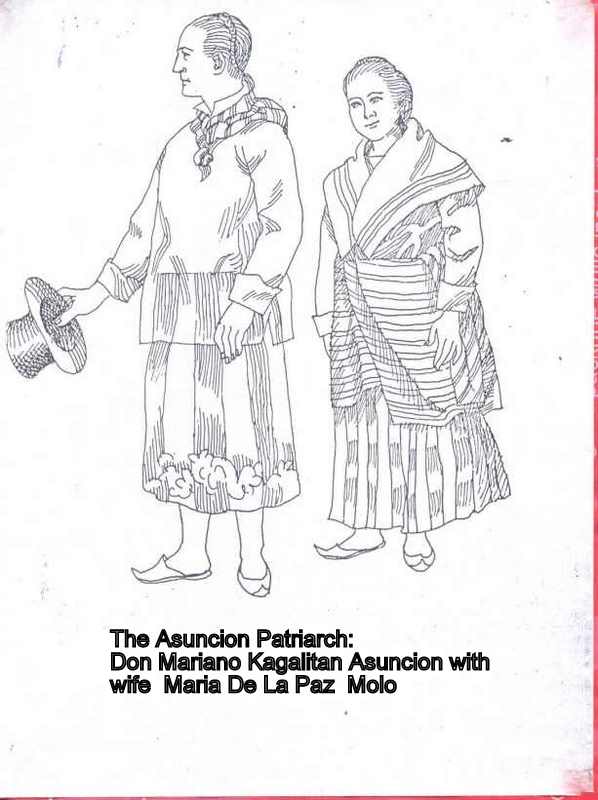
What was known was that Mariano was one of those prominent people who resided in Sta. Cruz, that he was an accomplished artist himself who, as many of you know by now, produced master artists  like Leoncio, Justiniano, Mariano, Jr. and Antonio. Marianos’ ancestors were unknown to us until now. But about his wife Maria de la Paz Molo much is known.            

 The Beginnings…Of What We Know Only Today.            

Maria De La Paz Molo’s father was Ming Mong Lo, who- according to the family history – was a Chinese apothecary of Mandarin origins and married a local woman. Ming Mong Lo adopted the Christian name Jose Molo upon baptism –  and that was before the Claveria decree of 1849 and prospered as a merchant in the district of Binondo. He was said to have bequeathed five children, among them Paterno Joseph Molo and  Maria de La Paz Molo.            

 No doubt Maria de La Paz was half-Chinese and half-Filipino – assuming that her mother was not a “local” Chinese ( I have problem understanding what a “local” woman or man meant at that time).  Her mother’s  identity is totally unknown to me until a few days ago.            

And there was some sort of confusions in my search because of this:            

Old Binondo, Manila


 In his book,  Brains Of The Nation (published 2006 by Ateneo de Manila University Press), Resil B. Mojares took up as subjects of study his  “three figures of Filipino Enlightenment”, namely, Pedro Paterno, Th. Pardo De Tavera and Isabelo De Los Reyes and their influence on the production of modern knowledge in the Philippines. He mentioned that Ming Mong Lo, the earliest known patriarch of both the present day Asuncion and Paterno families, got married to a local woman with “blue blood” in her veins, she being  the “direct descendant of the Great Maguinoo, or Prince of Luzon”.            

My question was: Does this mean that the Asuncions could go as far as Raja Soliman as one among their patriarchs? This Great Maguinoo or Prince of Luzon could only be Raja Soliman, the famous King Of Tondo who initially resisted the Spanish adelantados. Resil’s argument had led me to wrong places which increased the confusion.            

 Until I was summoned by Maning Yatco by way of his comment here at BO to visit Toto Gonzalez’  Blog Remembrance Of Things Awry because of the interesting discussions there about the Asuncion-Molo-Yatco’s connection. It was in this site where I got an authoritative argument coming from Mickey and Jean Paterno who said that Ming Mong Lo (Jose Molo), their ancestor, married Anastacia Michaela , the proofs of which are the “baptismal records of his sons circa 1780’s.” They argued that their ancestors originally belonged to the “parish of the Parian” and that most probably they moved to the “upcoming barrio San Sebastian in Quiapo, the place “which his children cite as their principality in their legal documents.”            

It was probably in Quiapo where Maria De La Paz was born to Ming Mong Lo and Anastacia. ( Her birth had fulfilled already one requirement among others for the realization of the Asuncion clan.) By this point, it was clear to me that we couldn’t count Raja Soliman as among our patriarchs, the “blue blood” in our veins is out of the question then. Resil’s argument was not right, unless Anastacia Michaela, the wife of Ming Mong Lo, could be proven as descendant of Rajah Matanda or Raja Lakandula, both uncles of Rajah Soliman (political dynasty is as old as our history!)            

But who was this woman with this blue blood in her veins whom Pedro Paterno was explaining to the English author Mr. Foreman?             

Well, at this point we have to clear up first another confusion about Molo and Paterno. Substantially, they are the same. The  family name Paterno of the succeeding Molo generations came to be adopted by 1849 (most probably in fulfillment of the Claveria decree) to honor Paterno Joseph, a son of Jose Molo (originally Ming Mong Lo). Notice that Paterno is actually a first name. But it was common at that time among the Chinese mestizos to acquire the first names of their parents as their family names- exactly what the Molos did, at least with certainty by Paterno Joseph’s son, Maximo Paterno who was the father of the widely known historical figure Pedro Paterno of the Pact of Biak- na- Bato.            

It was probably from the lineage of Paterno Joseph where this “blue blood” in the veins could be traced back among the succeeding generations of Paternos due to his marriage with Miguela Yamson, the daughter of Juan Yapson and Maria de la Cruz- the name which is claimed  to be a descendant of Raja Soliman. (Note that during the introduction of the Claveria Decree, those natives who couldn’t read and write were just asked -or ordered- to draw a cross after their first names, hence the family names De La Cruz).  But it was through this  “marriage to Miguela Yamson that opened to Paterno Joseph Agustin (Molo) opportunities available only to local royalty, or the “principalia”. Hereafter, he was addressed as Don Paterno Agustin and qualified to run for public office”, commented Micky and Jean Paterno of today.            

The Asuncion and Paterno (Molo) Connection            

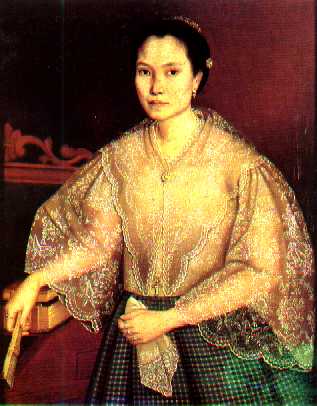
This started with the marriage of Mariano Kagalitan Asuncion to Maria De La Paz, the sister of Paterno Joseph. Paterno’s son Maximo was therefore a cousin of the first Asuncions — Justiniano, Leoncio, etc. It was Maximo who supported Justiniano Asuncion by commissioning portraits for the ladies of his house. Maximo had an astute sense for excellent investments and he had maximized his  fortune  in his capacity as gobernadorcillo of San Sebastian and Quiapo. He himself married thrice, the first with Valeriana Pineda, the second with Carmen De Vera Ignacio and the third with Carmen’s sister Theodora De Vera Ignacio whose portrait is shown here as painted by Justiniano.             

Hence, two things are clearer to me now: First,  that the Asuncions have partly  Chinese blood in their veins, second, that though they had also engaged in politics, like Mariano, Justiniano, etc., down to Don Zacarias and Adonis Asuncion their strength was not in politics, i.e.,  the way we understand “political strength”  in the Philippines before and now, but it is in the arts and the humanities and sciences that they excelled and earned recognition even beyond their times.            

                                                                                            —————             

Acknowledgement:  Sonny Rayos- Asuncion, Toto Gonzales’ Remembrance Of Things Awry, Micky and Jean Paterno, Resil B. Mojares, Wikipedia            

      ——————end——————–

A Man Named Omar


by Michelle Dayrit- Soliven*  

I had never known the joys of the ocean until I came across a man so at ease with the earth’s most awesome sea creatures. His persistence led me to a deeply moving encounter that gave me a richer appreciation of the gifts of God to Mother Nature. I arrived with a fearful heart and left with an electrified spirit, courtesy of our newfound family friend, a man named Omar.  

Omar Nepomuceno


God equips His children with specific talents and abilities in order to pursue their purpose in life. It is therefore no coincidence that Omar Nepomuceno was born in the seaside town of Donsol in Sorsogon, a blessed haven where the world’s largest concentration of butandings (whale sharks) abound.  

A strong self-taught swimmer, Omar’s fondest childhood memory is that of his grandfather Isidoro taking two styrofoam ice chest covers used in his ice candy business. Using rope made of straw, he securely tied one onto his grandson’s back, the other onto his stomach. Then he would say to his apo: “O, sige na hijo, maligo ka na.”  

His parents Rosalina and Isidoro Jr. watched over their fearless little son joyfully swimming around the river.  

He describes himself as “taong dagat” because he adores, protects and  

respects the ocean and everything in it. Omar completed a Marine Engineering course at Mariners Polytechnic Colleges Foundation in Legaspi City. When the Department of Tourism and the WWF conducted training for butanding interaction officers (BIOs) in Donsol, Omar emerged on top of his class. He loves butandings and he loves his job with a passion!  

I felt this when I met Omar last month in Donsol. I had been hearing his name from my younger sea-loving sisters Yvonne and Christine who had gone several times before me. For a very safe and enjoyable experience, they highly recommend Omar as my guide. Indeed they were right, but I experienced much more than they prepared me for.  

All butanding encounters are different and everyone has his or her own story to tell. Mine began on the morning of March 27.  

Incidentally, we were in Sorsogon the day before to attend the first graduation rites of The Divine Healer Learning Center. This is a school that provides quality education for underprivileged but deserving students founded by Father Gerard.  

It was a perfect day. Clear blue skies and glorious sunshine accompanied us on the scenic drive to Donsol. Upon our arrival on Vitton Beach, we received an enthusiastic welcome from a man named Omar, introduced as our BIO. He accompanied us to watch the orientation video in the registration office. “So it is you my sisters were talking about,” I told him as we walked into the boat and set off into the azure waters of the bay.  

He asked if we had with us some snorkeling gear. My son and husband nodded and showed it to him. He checked on them and seemed satisfied. Then he looked at me. The moment I dreaded came and I felt I just had to tell him: “Omar, there is something you need to know. I have never ever in my life used a mask and snorkel. This will be my very first time.” Instinctively he probably felt the fear I had because he immediately assured me that it was very easy. “Kaya mo yan, ma’am. Don’t worry, I will teach you now,” he told me.  

He put the mask over my face and adjusted it comfortably. Then he gently inserted the snorkel into my mouth and showed me how to breathe. “Now, remember, do not worry. When I say jump, just jump in and hold on to me when you get into the water,” he said. I nodded, trying to keep a brave front. Suddenly, I heard the boatman pointing and excitedly saying: “Ayan na! Nandyan na yung butanding.”  

I froze in fear! So soon! My sisters told me that they had to wait an hour or two to find a whale shark. I thought I would have more time to get used to the use of a mask and snorkel. They stopped the boat. I watched in horror as my hubby and my son jumped in. Omar was looking at me. “Ma’am, it’s time to jump. Let’s go!” I panicked! My heart was pounding as I hoisted myself unsteadily onto the edge of the boat. I was shaking while the boat bobbed up and down. I fought to keep my balance. Like a rag doll I was awkwardly teetering back and forth, so afraid to hit the water and almost fell back into the boat instead. I was trying to open my mouth to say, “I’m backing out! I changed my mind! I cant do this!” Suddenly I felt Omar’s strong hand taking mine as he jumped in pulling me into the water with him.  

I wanted to scream but the snorkel was in my mouth. I closed my eyes. Terror gripped me as we hit the water. But I heard Omar saying, “Ma’am relax ka lang. Just hold on to me and do not be afraid.” He readjusted my mask and snorkel and said, “Ready? Let’s go!” He held my hand firmly and swam away, not giving me time to think.  

“Look down,” Omar told me. “Just put your head down.” I obeyed… put my head down. And opened my eyes… and gasped! The sun’s rays penetrated the waters revealing a humongous blue gray figure with round white spots swimming gracefully beneath me. I was right smack on top of the butanding and the water was so clear I could see it breathing. Omar swam and supported my elbow lightly so that I could interact with this gentle being. As the silence enveloped me under water, a sudden peace pervaded my soul. I felt a deep spiritual connection between the whale shark and Omar as we all swam together side by side, basking in joyous tranquility.  

It was a successful conspiracy. These two soul mates (Omar and the whale shark) sensed my fear of the sun and the ocean kept me with them for a blissful 30 minutes, emptying me of all my fears.  

That was only the first of the six butandings I would encounter that day. We all emerged triumphant and invigorated. Omar was elated. BIO Florante Trinidad did such a good job with Lucy Lee’s new underwater camera that we each had a video of our interaction with these colossal yet amiable beings.  

We then enjoyed a sumptuous lunch courtesy of Sorsogon’s very gracious Gov. Sally Lee. Over succulent seafood and the best ginataang langka, Omar shared his stories.  

Very protective and caring in nature, Omar wants his visitors to make the most of the time and money they spend to come to Donsol. “I want everyone to be comfortable in the water and go home with wonderful stories to tell.”  

His most unforgettable experience in the ocean was the day in 2001. He had some American guests who flew all the way from Pittsburg wishing to see a whale shark. They didn’t just see one but a whole school of them, about 50 on a feeding frenzy. They were ecstatic!  

Another glorious moment was the day Omar and Florante successfully rescued a trapped butanding in Batangas. Asked how they did it, when several others before them failed, he humbly said, “I prayed for God’s assistance.”  

He takes every opportunity to share his insights to protect the precious butandings. “If a group of six fishermen kill a butanding, six families may have enough to live on for six months. But in exchange the rest of the other families in the community will all go hungry for years to come. Why? Because this brutal act could scare the butanding population away. And what do you think will happen to the van drivers who pick up guests, resort owners and restaurant owners, their employees, souvenir stall owners, boatmen, BIOs? With their livelihood gone, their families will go hungry,” he said.  

He prays often for the safety of his wife Yvette, a nurse in the Middle East, and is most grateful that his daughter Rayven graduated grade school at Aquinas School in Legaspi with honors. This nature lover feels God’s presence in the sunshine, the calmness of the sea, the magnificence of the gentle butandings. “I always ask God to please let my visitors see the butanding.” He is happiest when he sees his guests enjoying.  

“I always want to spread the sunshine,” he says of his motto in life. “Whatever blessings and gifts I receive from God, I must share.”  

To Omar, this means teaching others the skills he has mastered like swimming, being a good BIO, training others who want to be guides of other natural attractions, giving talks to the fishing community on the importance of not harming but preserving their environment, finding new activities and exciting destinations that guests to his beloved province of Sorsogon can enjoy and his fellowmen can benefit from. /  

——————————————–  

*Asking Michelle to publish her article in Bulan Observer, she replied :  

“Sure Andres! ( Andres?- that’s me, jun!) That was one experience I will never ever forget. Omar is the best. I am so glad you did not drown (she’s referring to my story of almost drowning in the sea of Donsol when I was 8). You must have a mission in life to fulfill. I am sure it is something that will be most rewarding. Be blessed in all you do.” MICHELLE DAYRIT-SOLIVEN  

Thank you Michelle!  

 Omar is my first cousin (mother’s side), he lives and works in Donsol. I have good memories of Donsol as I also partly spent my childhood there. The beautiful sceneries with Mt. Mayon against a lovely sunset, the quiet sea and the loving people and of course my dear grandparents Doro and “May” (mother) Nepomuceno with whom I used to go for a walk along the sea after dinner. I met Omar  last April 2009-  in Bulan!   

 jun asuncion  

————————HELP PROTECT THE WHALE SHARKS!————————–  


———————————end——————————  

Presentation of the Executive Agenda 2010-2013

Note: The following is the Executive Agenda presented by Hon. Mayor Helen C. De Castro before the Sangguniang Bayan of Bulan during its Inaugural Session on July 5, 2010 at the Sangguniang Bayan Session Hall. (PIO Bulan)

Inaugural Session

Presentation of the Executive Agenda

SB Session Hall

July 5, 2010/ Monday

EXECUTIVE AGENDA 2010-2013

By Mayor Helen C. De Castro

Honorable Vice-Mayor and Presiding Officer Marnellie Robles

Honorable Members of this August Council

Honorable Barangay Officials

Heads of Offices of the Local Government Unit

Ladies and Gentlemen:

Good morning to all of you!

It is with honor and pleasure that I congratulate the Honorable Vice-Mayor and the Members of the Sangguniang Bayan of Bulan.

Today, the just concluded political exercise had given us the fresh mandate to lead our people for the next three years. I am deeply elated by the warm trust and confidence. We venture into a new beginning for our Municipal Government. And it is us, the new officials of this beloved town who will be instruments in ushering in that new beginning.

Tradition has it that as we start our work as the new officials of Bulan, it is necessary that we first meet, and set down in fundamental terms the basic blueprints for the next three years. These fundamental principles of local governance shall guide and direct our actions. It is necessary that we should be able to work in solidarity.

It has been mandated by law that the Office of the Local Chief Executive, or the Mayor, and that of the Sangguniang Bayan, as a collegial body, are co-equal in power and authority. According to law, one cannot do without the other. It is my firm belief that collaboration and harmony, whether constructive or critical, between these two offices, must always work for the betterment and welfare of our community. Even ideologies or political differences must not be obstacles with what we want to achieve or accomplish. Even within a deliberative body like the Sangguniang Bayan, your discussions and debates, your opinions and views, your political differences and affiliations, can be worked out to produce a syntheses of ideas and plans that can be concretized into policies, programs and projects. Our people must not suffer or be sacrificed just because we differ in our views. We are supposed to be held together by our desire to serve Bulan. The Executive Department shall heavily rely and depend upon your ideas, crafted into legislations, which we pray shall be great in quality, pro-active, pro-poor and pro-peace.

If I were to be asked as a re-electionist mayor, all I want is that we shall be able to help realize the vision for our beloved community – a safe, peaceful, progressive place to live in. It is not an easy task however, in a growing town like ours. The challenges are multi-faceted; the tasks enormous, the efforts needed are great. But it shall all depend upon ourselves as leaders and stewards of Bulan. We are here for the next three years to keep, protect and take care of this community. It ought to be our political philosophy that while we have the privilege of power and authority, we are also servants and stewards of our people. And many of our people are expecting much from us.

Bulan, being a premier, first-class town in Sorsogon must continue in its eminence as a model community. We have been looked up to by many of our neighbor communities. But more importantly, Bulan has a bigger number of souls with more needs to take care of.

Honorable Ladies and Gentlemen, I am respectfully setting down before you our three –year Executive Agenda, which shall serve as the bases of our development plans. And this shall need the necessary legislative support. We are fortunate, that in this my third term, we shall be having the Community-based Monitoring System (CBMS) and the State of Local Governance Report (SLGR) and the data therein shall be guides for all of us in both the Executive and Legislative aspects.

Allow me therefore to enumerate on our three-year Agenda:

1. We shall continue all along to strengthen, improve, enhance and institutionalize the HELEN Program – Health, Education, Livelihood, Environment, Nutrition and Food. These are the major programs which include the auxiliary/component programs, we are pursuing. These wide-ranging and general scope of activities shall, in one way or another, necessitate legislation, especially in its funding and budgetary support; we are improving and streamlining our educational assistance and support to poor but deserving Bulaneno college students; we are going to build a bigger and better Bulan Health Center and Birthing Facility, and we wish to purchase a Mobile Clinic to serve our far-flung barangays;

2. We need to strengthen and improve on our Peace, Order and Public Safety programs, especially in the areas of anti-illegal drugs program, Traffic Management programs, Disaster Management and Risk-reduction Programs, and the protection of our women, children and the elderly. We shall strengthen our relationship with the Philippine National Police, and when opportunity arises in terms of funds, we shall make necessary provisions and facilities to our police, fire and force-multiplier groups;

3. We shall put more emphasis on our Economic Agenda. I believe that notwithstanding the gains we have, if our constituents do not have gainful employment, much is useless. It is an obligation that we have to look in to. In this regard, the concerns and tasks are daunting, considering our limited resources. But we shall make sure that we shall make strong steps in this area like helping our farmers and fishermen with a Revolving Fund or Capitalization Scheme to improve on their productivity; We shall institutionalize the Municipal Investment Incentive program to attract investors to our town; we shall improve on our technical-vocational training activities for the youth and women sector; strongly coordinate and network with job placement agencies;

It is our plan to institutionalize the Coastal Resource Management Programs as this is vital to the fishing industry of our municipality, through artificial reefs installations, strengthening of the Bantay-Dagat program; and plans for seaweeds production programs.

We want to provide a Bagsakan ng Bayan, or a convergence terminal for all our local products.

We intend to now construct a Poblacion Terminal for all our Tricycles, Pedicabs, and Jeepney and Aircon Vans Sector. This job sector is very important in our growing economy.

And we intend to pursue our Farm-to-Roads programs as we have been wont to do. Our Road Program has been one of the greatest assets of this incumbent Administration. These economic arteries provide the lifeline to and from our barangays. Life has been a lot easier with improved roads, better bridges and all the necessary infrastructures to help our constituents be fully engaged in economic activities, have better access to education, health and social services from the local government;

All we have to do is to be creative and be resourceful in sourcing out ways and means for these local projects.

4. It is our executive plan, that in my third and final term, we hope we shall finally be able to put and set in place a comprehensive Tourism, History and Culture Heritage Development Program. This is a legacy I wish to leave to our next set of leaders and to our people. It is an ardent dream that we can have a Bulan Heritage Museum. History and Culture is the soul of the Tourism Industry. While we have the Padaraw Festival now fully in place, we must let spring forth and let flower the beauty of our identity as a community. A political philosopher once said that our political maturity as a nation or as a community is greatly dependent on our historical maturity. Leaders are poor who have no sense of history and identity. And our people also need to be inspired and be transformed by the lessons of our local history. History is a bond that makes our present and future stronger.

In this regard, we also intend to put in place a concrete program for Poblacion Improvement as the Poblacion is the showcase of the whole town — cleaner and better-looking streets and walkways, a good marketplace and greener surroundings. We have to work hard to clean up and protect our Managa-naga River, which has been an icon of our town. There is a positive psychology in greener, cleaner surroundings, especially in the Poblacion.

5. We need a new Cemetery or Municipal Memorial Park. Our LCR data says that we have an average of 450 deaths a year. This goes along with our burgeoning population. Our cemeteries are now congested and it is time we look for and build a new one to give greater dignity to loved ones who have passed away. And this shall need your greatest support.

On top of all of these plans, we in the Executive Branch would like to inform this Honorable Body, that in line with the Executive implementations of vital ordinances and codes, I think it is necessary that we have to review the following:

A. The Bulan Revenue and Tax Code

B. The Bulan Public Market Code

C. The Bulan Integrated Traffic Management Code

D. The Agriculture and Fisheries Code of Bulan

E. The Municipal Investment Incentives Code

F. The Zoning Ordinance

The Sangguniang Bayan must also come up with the Integrated Safety Code of Bulan and an Investment and Business Code. We must review our Disaster Management Code. It is also a must that the Sangguniang Bayan must work with the Municipal Planning and Development Office in updating the Municipal Socio-Economic Profile. The MSEP is a comprehensive volume of local governance literature that is the very basis of all our development and investment efforts. We cannot do without it.

I wish to also respectfully inform you that I would like to certify as urgent legislative matter the reconstitution of the different LGU organizations like the Local Development Council, the Health Board, the School Board, the Personnel Selection Board, the Municipal Child Protection Council, the Local Peace and Order Council and all the mandated local councils necessary to immediately put in place our tasks and functions in governance.

Also, it has become imperative that with the modern methods of governance, administration and supervision and the complications of local governments, it is necessary that the executive department, together with the legislative branch, must be kept abreast of all department activities. Thus we are planning to go full computerization in our municipal government. We shall network and wire the office of the Local Chief Executive with all our departments. This will make our task of governance, easier, facile and more convenient.

I hope that with Vice-mayor Robles at the helm of this Honorable Body, there will be a new impetus for the Sangguniang Bayan. In other localities, the Sangguniang Bayan is a source of pride and honor for the community. We hope this Council shall be that.

We must have foresight in the next 20 years of governance. Bulan is fast-growing and fast-expanding. The Sangguniang Bayan must come up with a very comprehensive Urban Expansion Program from which we shall initiate our Urban Planning and Development activities.

I hope you will not begrudge me if each one of us shall keep this list as a checklist, and that we keep on checking it so that we shall be able to accomplish them.

“A Public Office is a Public Trust” so we are being constantly reminded, and as the motto of this Council goes that we have to render “Service with Integrity”. So be it.

We are looking to a very productive term of office. During the campaign period, we have promised a lot to our people, and now that we have been endowed with that privilege of service, and power, it behooves all of us to do so as a matter of gratitude to our people. It is a sacred oath, a duty, a call; we cannot turn our backs from.

Once more, congratulations to all of us. Good luck and may God bless us in our endeavors and may God bless our beloved town.  //

                                                                                                          ——end—–

From Code Of Kalantiyaw To Mt. Sinai


by jun asuncion


This post is not intended as an academic work but just my personal thoughts on this Independence Day and as my reply to a comment on my earlier post Strengths And Weaknesses Of The Filipino Political Character.


A Hindu-Muslim Archipelago. We know of Datu Puti as one of the Bornean Datus who ruled in the south during the pre-Hispanic period. During the Spanish time Raja Colambu was the King of Limasawa, Rajah Humabon of Cebu, Sultan Kudarat Of Maguinadanao, Datu Lapulapu of Mactan, Rajah Lakandula of Tondo, Datu Macabulos of Pampanga, Datu Urduja of Pangasinan and Rajah Sulaiman III of Manila. There were many other Datus and Rajas all over the archipelago whom the Spanish colonial power called Las Islas Filipinas,  the Islands of the Philippines. Hinduism came to the Philippines via traders between 1350 and 1389 from the island of  Java during the Majapahit Empire (1293-1500) and exerted great influence on the natives of the archipelago only to be superseded within a short time by the Islamic conquest of Majapahit empire and the coming of Islamic Indonesians and Arab missionaries in the 15th century. 

Hence, the archipelago was dominantly a Hindu- Muslim archipelago as Sultans, Datus and Rajahs are all Hindu-Muslim titles of rulers and nobilities. If I identify myself with the pre-Hispanic archipelago, then I’m a Hindu- Muslim; if I identify myself with the time and culture I was born in, then I am a Christian. 

Genetically of Malay race, our dominant ancestral, pre-Hispanic civilized society was a Hindu- Muslim society. However, not all people at that time were Hindu-Muslims as there were people who were trapped or isolated themselves up in the mountains and were neither islamized when the Muslims came nor catholicized with the coming of the Spaniards. They still exist today as “cultural minorities” (a label I dislike) like the Igorots, Aetas, Ati (Negritos ethnic group) etc. with their own culture, political organisation and system of beliefs.

 The very first people who inhabited the archipelago- or some places of it- long before the invention or evolution of today’s dominant religions were animistic in their belief and world view. If I identify myself with those primal ancestors of 20-30 thousand years ago – in the belief that my family and genetic lineage can be traced back to them-  then I am an animist, a being who is one with the forces of nature and see spirits in them, or much later a syncretist of Hinduistic origin who believes in Anitos, Diwatas or Bathala.

Hindu-Muslim Social Hierarchy. The independent Hindu-Muslim barangays in the archipelago and the sultanates in the south all attest to existing social communities, communities with hierarchical systems of Ruling class as Sultans, Datus or Rajahs, of Intermediate class as the Freemen or Maharlikas and of the Ruled or Unfree-class as the Alipins or slaves. 

There were interbarangay commerce, cultural exchanges, etc., all transactions suggesting a kind of confederative co-existence,yet  no common identity,  no common laws, no central government that kept them together or a court that settled interbarangay conflicts. The mythical legal code of Kalantiyaw which was supposed to bring order to the folks of Negros was proven to be a forgery.

From Code of Kalantiyaw to Mt. Sinai. This changed with the coming of the Spanish colonizers who already have in them the concept of  national government, of a nation or country, of a central powerful monarchy that rules over vast territories and colonies. But before that there was this catholization that took place, the biblization of the Hindu-Muslims, and later the changing of names, like Rajah Humabon becoming Carlos, or Mariano Kagalitan to Mariano Asuncion. 

But the social structures remained the same, more or less. Allowed to keep up their lordships over their barangays, the now catholized datus had to subjugate themselves however to the new ruling class, the Spaniards, or to the new omnipotent Catholic King of  Spain. In effect, the whole archipelago with all its barangays was reduced to the lower class level, if not to that of oppressed or slaves, the Alipins. In fact the new ruling class introduced a new form of intricate slavery- the polo y servicio which is a system of forced labor within the encomienda throughout the island colony. 

From Suppression to Explosion. The suppression of emotions through centuries of encomiend and hacienda slavery and injustices ultimately led to explosion. This big-bang in the history of the archipelago gave birth to the concept of freedom and nation during this colonial period which culminated by the end of the 19th century; by June 12,1898, 112 years ago, the Spanish dominion (which historically started in 1649 with the Sumoroy uprising in Samar) has ended and the first Philippine Republic was born. 

This short historical review is not meant to refresh our knowledge but to remind us that the past explains a lot of things the way that the Filipinos are now, our character strengths and weaknesses and offer us clues as to why reciprocity, “debt” of gratitude, passive-aggressive traits and the like are so intense and complex among the Filipinos for the Western observers. 

As one Western commenter has observed about Reciprocity and Utang Na Loob: 

“I am guessing that this (Reciprocity) basically a very deep instinctual drive in all cultures, but I am curious as to why it is so exaggerated and complex in Philippines…Philippines has intensely hierarchical family and tribal structures, probably even before the foreign oppressors arrived. Within such a system those beneath perceive themselves to be powerless and lacking in rights. Without rights, any act of support would therefore seem like a gift rather than a duty. I am guessing the intensity of Utang Na Loob is derived from this.” 

Utang na Loob is a form of reciprocity which, as the name suggests, a Filipino version or expression of it. The short historical review has shown that for the majority of the Filipinos- before, during and even after colonial times- their history is a history of slavery or servantry, from our tribal past to the alipin sagigilid or mamamahay during our Hindu- Muslim past and   to encomienda,  hacienda and peonage slaves during the catholization. (It is said that  peonage was the employed by the conquistadores wherein the Filipino workers were granted debt to their own slavery afterwards for failure to work off the debt, becoming permanently tied to their Spanish employers). Even up to now, the servantry is still very much a part of our  socio-economic culture. Only that now, the government exports this “labor force” to other countries. 

With the coming of other colonizers, the Americans and the Japanese, the Filipinos were again forced to assume the slave mode and to suppress aggression in order to survive. 

Nature or Nurture?Against this historical backdrop and if we believe that personality is also moulded by external forces, then we can rightly assume that the Filipino collective personality is a product of his total experience which is layered in complex mixtures of genetics and external circumstances over a long time. The resulting product is a distinctly Filipino character. This explains the complexity of our traits when juxtaposed against other Asian people and other cultural groups. 

We Have Our Own Identity. Hence, this cry for the search of Filipino identity is a travesty, a political distortion in my view aimed at controlling the masses by sneakily activating their slave mode. We already have our own identity. I’m very cautious when I hear such phrase as “landslide victory” for then I suspect that the old trick has functioned again, that  psychology has been politically abused or misused again. Also, it’s not wrong when a Westerner observes that there is exaggeration in our reciprocity trait, wrong maybe in the sense that it collides with their Western concepts of democracy and bureaucracy but in themselves our Filipino traits can never be wrong. It is not the search for identity but it’s about the search for a political system that fits our own character without sacrificing universal virtues as justice, freedom, human rights, etc. 

In truth, the past still lingers in us and this is where self-serving politics get their power. Our Western commenter has mentioned that “a number of deep human traits… could potentially be exploited. One of these was called reciprocity”. 

Landslide Win.When politics is just about power, then it’s only there to exploit available resources to support that power. This is very visible in our politics especially during elections. The character traits of the people are the number one target of this exploitation, material resources comes next to it. It’s not the vote that’s being bought but that Utang Na Loob of the people. A politician who is good in that will have that landslide win. 

Still In Progress. Indeed, the trait of Utang na Loob- as all other Filipino traits- has evolved out of this collective past, of the confluence of events and the need to survive physically, psychologically and socially. All traits had developed and been retained because they have this survival value. And while our social evolution is still in progress, I think that these traits that we have are also undergoing some mutations. Our Filipino traits are not static and final, we are changing or are being changed by events and time. We ourselves are witnesses to how these traits conflict with things new to us or  things which require other cultural tools or constructs that are either foreign to or less develop in us. 

Our Utang Na Loob is easily related to our slave mode than to our noble or lordship mode. This trait can only develop with such intensity and character out of social and economic survival necessity. You cannot experience the attitude of thankfulness with such intensity for things that are natural to you or that you have in abundance. Hence, from those who live in paradise, don’t expect Utang Na Loob; the same with our Tabon man in Palawan, our pre-historic ancestors who inhabited our caves thousands of years ago. I don’t think they knew Utang Na Loob as we know it now- or Hiya, Delicadeza, Freedom, Corruption, Alipin or Injustice. These things came to the archipelago with Islamization and Catholization. With these foreign oppressors, heaven is won but paradise is lost. 

You’ll find this Utang Na Loob in abundance from those who experienced hell or deprivation of basic things. For the majority of us our history was a history of deprivation. Those were hellish times under foreign enslavement. There were some Filipino families who profited from these periods of hell, who maintained their feudalistic vast haciendas even until now, who still practise landgrabbing and colonial slavery practices as peonage and force labor and many of them are in the government posing as public servants. But in truth they are masters of exploiting Utang Na Loob, Hiya and Pakikisama. 

Passive-Aggression. Certainly, with such a background of slavery where it was not safe to express anger or opinions but rather safer to resort to suppression and pakikisama in order to survive, we can only expect that passive-aggression is a part of colonized Filipinos’ coping or defense mechanisms. We know in psychology that families who forbid or deny their children the natural need to express feelings of hostilities produce adults who have this disorder. But it’s out of context to say- as our Western commenter has said- that it is a form of national sabotage if he means by it that Filipinos are using passive-aggression actively and consciously to destroy their nation and political development.

A Happy Nation? Though I can confirm the presence of this negative trait in our society, I disagree with its willful or conscious use of national sabotage. Yet I believe that this goes on in the unconscious level in our political dynamics and hinders progress. Passive-aggression might have been a form of rebellion- or sabotage- against the colonial government at that time, a conscious one. But now, I look at it instead as extension of colonial destruction. For the destruction of the people through colonial oppression and maltreatment doesn’t end with the disappearance of the oppressors but it continues, this trauma, this learned helplessness and passivity. Combined together, i.e., Spanish, Americans, Japanese, those were 425 years of trauma, suppression and slavery, of abuse and insult to the Filipino psyche. And add to that those nightmare decades under Marcos and Arroyo. Do you expect a healthy and happy nation by now?

I wish the Filipinos a happy Independence Day!

                                                                                          —-end—

The Asuncions In Politics, Arts And Sciences

by  jun asuncion


Part I: The Search Begins

This post is my reply to this comment from Jeffrey, an Asuncion. This made me take out my copy of our Family Tree which I got from my sister Menchu. The research for this Family tree is largely credited to my uncle Dr. Ronaldo Asuncion. So there is something private in this post, with the purpose of connecting with the other relatives of mine who would be willing to supply more information about our lineage and/or help me answer Jeffrey’s inquiry.The Asuncions have always been closely associated with the town of Bulan and they are proud of their town.

Here is Jeffrey’s comment:

hi i am jeffrey i grew up in manila but have roots in bulan. I learned that my great great grandfather rodolfo asuncion sr. is a son of zacarias. I wanted to know more about the line in the entry above stating that zacarias was among the many bulan residents persecuted by spaniards during the Revolution. would just like to know the exact details of what transpired that led to his detention. I presume this was the factor which led him to stay in pasig afterwards.”

Jeffrey was referring to this entry in Wikipedia/Bulan website which mentioned our great-grandfather Don Zacarias Asuncion:

“Don Teodoro De Castro y Zabala was arrested and incarcerated in Bilibid, because he was found in possession of letters written by anti-Spanish natives in Manila. Don Zacarias Asuncion and other residents suffered the same fate, for having no cedulas personales and for singing anti-Spanish songs.” (Wikipedia, Bulan website)

Personally, it interests me to know the music and lyrics of those anti- Spanish songs which my rebel great-grandfather sang and which led him behind bars. Composed or improvised?

Unable to find an answer, I went back to Justiniano Asuncion in search of any clue that might shed a little light to the Zacarias issue. Again, I found no answer but names after names of Asuncions in politics, arts and sciences. Verily, I’m proud of my grandfathers! To write about Justiniano alone would fill up pages, a task I wish I could do.

JUSTINIANO ASUNCION 

(1816-1901)

Religious Painter

Well-known as “Capitan Ting,” Justiniano Asuncion was one of the leading Filipino painters in the 19th century. He was born on September 26, 1816 in Sta. Cruz, Manila. He was the 11th among 12 children of Mariano Kagalitan, whose family name was changed to “Asuncion” following the Claveria Decree. In 1834, he studied at Escuela de Dibujo, where he obtained his skills in painting. Sometime in 1855, he became capitan municipal of Sta. Cruz, Manila. Asuncion was the painter of the famous “Coronation of the Virgin,” the “Virgin of Antipolo,” “Filomena Asuncion,” and “Romana A. Carillo.” He produced life-sized paintings of San Agustin, San Geronimo, San Antonio, and San Gregorio Magno which were kept at the Sta. Cruz Church before the Pacific War. These precious canvases were destroyed when the Japanese bombarded the church in February 1945. His works mirror the mannerism of that period – the first 75 years of the 19th century. The portraitists of those time carefully delineated features of the head; the hands and other minor details with linear accuracy; usually disregarding tonal values and emphasizing hardness of effect. The University of Santo Tomas Museum owns one of Asuncion’s paintings, dated February 1862. An unsigned portrait of Fr. Melchor Garcia de Sampedro at the UST Museum is said to be the work of Asuncion. Most of his other works are kept as national treasures at the Central Bank of the Philippines Museum. On September 12, 1983, at the façade of Sta. Cruz Church in Manila, a marker was installed in his honor. He died in 1901 at age of 85.

A painting of Justiniano:

Portrait of Teodora Devera Ygnacio

Justiniano Asuncion (1816-1901)

ca. 1880

References:

CCP Encyclopedia of Philippine Art, vol. IV. Manila: Cultural Center of the Philippines, 1994.

Manuel, E. Arsenio and Magdalena Avenir Manuel. Dictionary of Philippine Biography Volume

3. Quezon City: Filipinana Publications, 1986.

(Justiniano Asuncion [1816-1901] was my great-great- Grandfather. Married to Justina Farafina Gomez. Their children: Benita, Zacarias, Marcelina, Jacobo, Gabriel and Martiniana. Justiniano’s father was Mariano Kagalitan, Sr. (later Asuncion) whose other children were: Manuel (1792), Antonio (1794), Victoria (1796), Mamerta (1798), Justo (1800), Mariano,jr. (1802), Epifanio (1806), Ambrosio (1808), Pascula (1811), Leoncio (1813), Canuta (1819), Theodoro (18??).

————-

Don Zacarias Asuncion (son of Justiniano)

JEFE DEL PUEBLO (Municipal Mayor Of Bulan): 1898 – 1900

 “Don Teodoro De Castro y Zabala was arrested and incarcerated in Bilibid, because he was found in possession of letters written by anti-Spanish natives in Manila. Don Zacarias Asuncion and other residents suffered the same fate, for having no cedulas personales and for singing anti-Spanish songs.” (Wikipedia, bulan website)

Zacarias was  my great-grandfather. With Juana Zalvidea he had two daughters, Guia and Consuelo. With Remedios Ramirez he had I think 9 children: Adonis, Jacobo, Rodolfo, Salvador, Justina, Justiniano, Zacarias [jr?], Kenerino [founder of Southern Luzon Institute SLI, later KRAMS, married to Leonora Paras] and Digna.

————– 

 Adonis Asuncion

(son of Zacarias)

Municipal Mayor of Bulan:  1941-43; 1945-46


Adonis was my grandfather, grew up with him in our compound; in 1967 this wonderful grandfather of mine wandered all over Bulan South Central School looking for me with a handful of school supplies. It was just the opening of classes. He found me at the classroom of Miss Ceres McCoy Villareal (?), my grade one teacher. Unforgettable!

Uncles and aunties:

Rafael Asuncion ( national artist, he comes from the Leoncio Asuncion lineage. Leoncio was a brother of Justiniano).

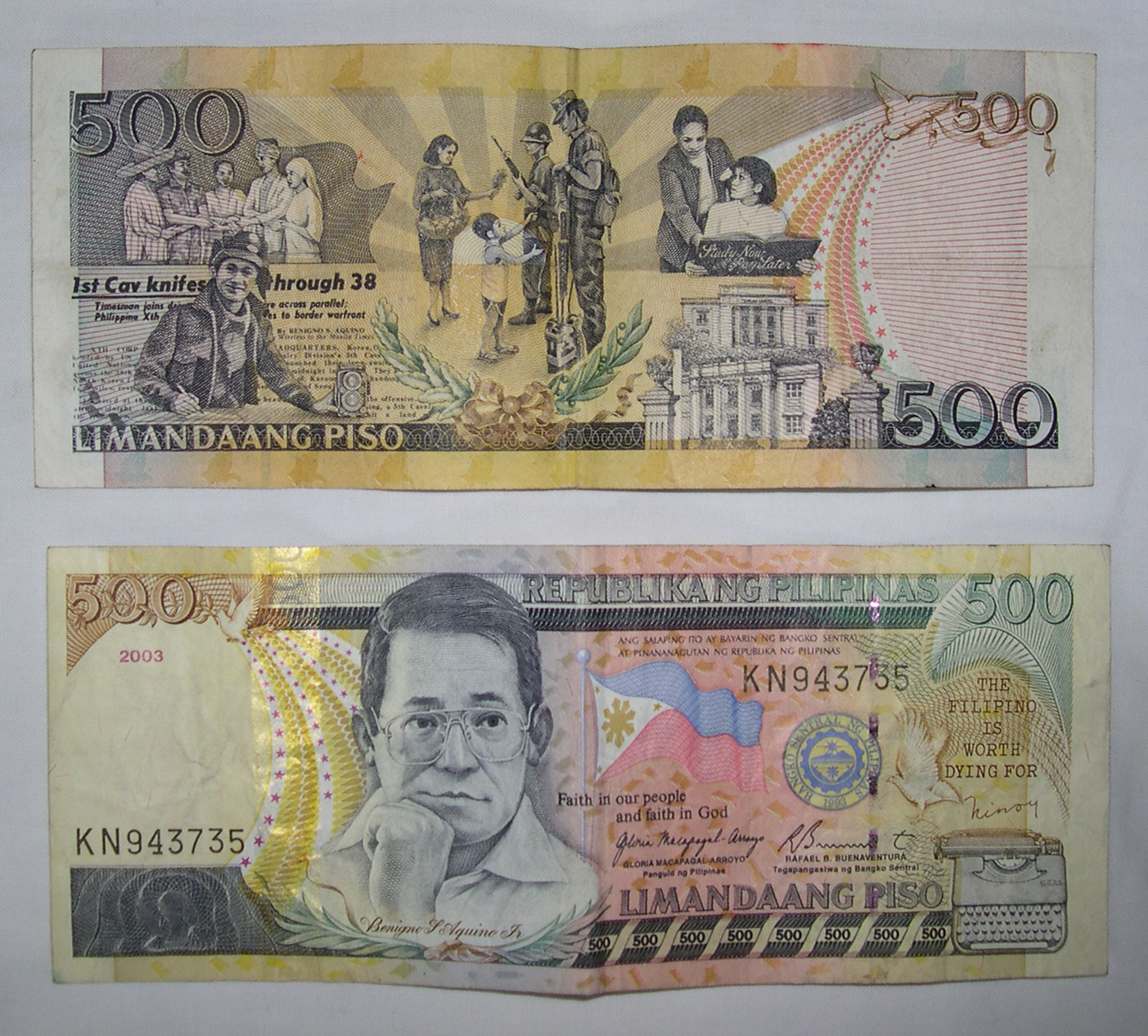
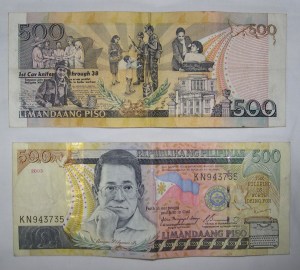
“Rafael Asuncion comes from the long line of Asuncion artists, namely Justiniano, Mariano, Leoncio and Jose Maria. This present-day Asuncion is a Master of Fine Arts graduate of theAsean Institute of Art. A recipient of many top awards, he was also a founding member of the Art Association of the Philippines and a president of the Art Directors Club of the Philippines. Asuncion is likewise credited with designing a dozen commemorative stamps and the 10, 50, and 500 Philippine peso banknotes and coins-flora and fauna series with two other artists. He is credited with designing the UP College of Fina Arts official seal. The Asuncion artistic lineage does not end with Rafael. His children, along with other members of the Asuncion clan are also artists and so the saga continues”

Among Rafael’s designs: The P500 bill
                                         

SCHOLASTIC ACHIEVERS/BOARD/ BAR TOPNOTCHERS

1. Digna Asuncion (sister of Adonis Asuncion)- Topnotcher, Pharmacy Board Exam/ Pre-War Doctor Of Philosophy and Letters, Universidad de Madrid (Spain) Summa Cum Laude

2. Rodolfo G. Asuncion, Jr. – No. 1 Marine Officers Examination (married to Remedios Grayda; his parents were Rodolfo Asuncion Sr. [brother of Adonis] and Monica Gerona; Among his siblings were Salvador [father of the actress Aurora Salve], Rizalina, Raquel, Ruben, Ronaldo [a medical Doctor, former Dean Of Radiology Department, UST] and Rene. )

3. Iluminada Asuncion (daughter of Jacobo, Adonis’ brother) 11th Place, Dentistry Board 1953

4. Consuelo Asuncion (sister of Iluminada)- 1st Place, Pharmacy Board 1954

5. Natividad R. Asuncion (sister of Iluminada)- 1st Place, Nursing Board 1954

6. Rizalina Asuncion (sister of Rodolfo, Jr.)- 1st Place, Sr. Teacher Exams for Physics 1956

——

 JOSE MARIA R. ASUNCION

(1869-1925)

Painter and Writer

The eldest of four children, Jose Ma. Asuncion was born to Hilarion Asuncion and Marcela Raymundo of Sta. Cruz, Manila, on December 14, 1869. His father, the son of LeoncioAsuncion, a notable wood carver, was a portraitist and painter of religious subjects. Asuncion enrolled at the Ateneo de Manila and obtained his Bachelor of Arts degree in 1888. At the time, he was studying at the Academia de Dibujo y Pintura, 1884-1889, then under the direction of Agustin Saez. Later, he transferred to the University of Santo Tomas to study under Felipe Roxas, who advised him to take further studies abroad. In 1890, both Roxas and Asuncion were in Paris. Asuncion received a grant from Agustina Medel, wealthy patroness of the arts from Manila and, later, owner of Teatro Zorilla.

While in Paris, he met the Filipino painters Juan Luna and Felix Resurreccion Hidalgo and French artists. The following year he enrolled at the Escuela de Bellas Artes in Madrid, where he studied for four years, 1891-1895. He garnered first prize in general history of art and costumes and obtained second prize in theory, aesthetics, and philosophy of art. While at the Escuela, he befriended Vicente Francisco, a government pensionado in sculpture who was then enrolled at the same academy. In 1895, he sailed back to Manila, passed a competitive examination, and was appointed assistant in the Escuela Profesional de Artes y Oficios, in Iloilo, which position he held until November 1898.

During the second stage of the Philippine Revolution, he served in the military administration and at one time took charge of the provisions for Filipino forces in Iloilo. He was transferred to the engineer corps as lieutenant under Gen. Adriano Hernandez. He helped in the construction of fortifications and trenches in Jaro, Leganes, La Paz and other strategic points. He also served under Gen. Pablo Araneta during the Filipino-American War. He was promoted to captain in February 1899, and three months later, to commander.

When the Americans gradually gained ground on his forces, he retreated to the mountains. After some time, Asuncion and his wife, Juana Hubero, whom he married in September 1899, went to Calbayog, Samar to join his father who ran a grocery store. It was in his town that his wife gave birth to their first child, Vicente. A year later, finding Samar not yet wholly pacified, he moved his family to Tacloban, Leyte. He stayed there for four years, spending his time painting landscapes and telons for local comedias. He also engaged in photography, a business which he left to his brother Gabriel’s management when he left for Manila in 1905.

He studied law, 1905-1909. He became a member of the Partido Independista, and was soon contributing articles on art and social and economic problems to the party’s organ, La Independencia. He also wrote for El Ilonguillo, La Voz de Mindanao, La Union, El Estudiante, El Renacimiento, The Independent, and Dia Filipino. Together with Rafael Enriquez, he founded the Sociedad Internacional de Artistas of Manila. Enriquez became its first president and Asuncion, its secretary. During their term, the Exposicion de Bellas Artes y Industrias Artisticas was held in December 1908, in time for the visit of an American squadron. This exhibition displayed more than 4,000 pieces of art. It aroused much interest and emphasized the need for a publicly supported institution in the arts.

Asuncion was a Freemason. His masonic writings may be found in Hojas Sueltas and The Cabletow. His studies on the history of Philippine art and his sketches of Filipino costumes are among the few exceedingly valuable contributions on these subjects. The drawings numbered 215 when Manuel Artigas y Cuerva saw them, but they were never wholly published. Some appeared in print under the title, “El Traje Filipino, 1750 a 1830,” in Revista Historica de Filipinas, for August 1905. He could have left a much more significant tribute to his memory had this collection of studies and drawings been published. But after his death, it was neglected. When another painter, Vicente Alcarez Dizon, saw Asuncion’s scattered works, they were already in a bad state. He acquired them and used them later for his studies.

When the University of the Philippines School of Fine Arts was opened, Asuncion accepted an appointment to its faculty on June 1, 1909. Two years later, on July 1, 1911, he was made secretary of the school. Asuncion’s paintings are included in the private collections of Alfonso T. Ongpin, Antonio Torres, Epifanio de los Santos Cristobal, and the Limjap family. He was considered by Fabian de la Rosa as a specialist in “still life” and, at the same time, as one who “devoted himself with notable ability, to the studies of art, archaeology and journalism.”

He died on May 2, 1925. His remains were buried in the Veteran’s Lot, Cementerio del Norte, Manila. In 1932, his heirs donated his collection of writings to the National Library. /

(References: CCP Encyclopedia of Philippine Art Volume 4. Manila: Cultural Center of the Philippines, 1994. Manuel, E. Arsenio. Dictionary of Philippine Biography Volume I. Quezon City: Filipiniana Publications, 1955.)/

Jose Maria R. Asuncion, the versatile Asuncion, painter, writer, soldier, educator, freemason, family man…what else shall we wish for? His father was Hilarion Asuncion, his grandfather was Leoncio, the brother of Justiniano. What else is there? Yes, he was the father of our living Asuncion artist Rafael Asuncion! Rafael has two other brothers,Vicente and Gabriel. That R in Jose’s name, his middle name, came from Marcela Raymundo, his mother, naturally.

—–

Part II  The Noodle In Asuncions’ Soup

Clarifying Some Confusions

I’ve tried to know whether our patriarch Mariano Kagalitan was originally a native Muslim. He was for sure not a mestizo of any kind nor a Spaniard for he also had to change his family name later on to a Christian name ( which is Assumption, later developed to its present form Asuncion) under the Claveria Decree of 1849.

What was known was that Mariano was one of those prominent people who resided in Sta. Cruz, that he was an accomplished artist himself who, as many of you know by now, produced master artists like Leoncio, Justiniano. Marianos’ ancestors were unknown to us until now. But about his wife Maria de la Paz Molo much is known.

The Beginnings…Of What We Know Only Today.

Maria De La Paz Molo’s father was Ming Mong Lo, who- according to the family history – was a Chinese apothecary of Mandarin origins and married a local woman.

Ming Mong Lo adopted the Christian name Jose Molo upon baptism – and that was before the Claveria decree of 1849 and prospered as a merchant in the district of Binondo. He was said to have bequeathed five children, among them Paterno Joseph Molo and Maria de La Paz Molo.

No doubt Maria de La Paz was half Chinese and half Filipino – assuming that her mother was not a “local” Chinese ( I have problem understanding what a “local” woman or man meant at that time). Her mother’s identity is totally unknown to me until a few days ago.

And there was some sort of confusion in my research because of this:

In his book, Brains Of The Nation (published 2006 by Ateneo de Manila University Press), Resil B. Mojares took up as subjects of study his “three figures of Filipino Enlightenment”, namely, Pedro Paterno, Th. Pardo De Tavera and Isabelo De Los Reyes and their influence on the production of modern knowledge in the Philippines. He mentioned that Ming Mong Lo, the earliest known patriarch of both the present day Asuncion and Paterno families, got married to a local woman with “blue blood” in her veins, she being the “direct descendant of the Great Maguinoo, or Prince of Luzon”.

My question was: Does this mean that the Asuncions could go as far as Raja Soliman as one among their patriarchs?

This Great Maguinoo or Prince of Luzon could only be Raja Soliman, the famous King Of Tondo who initially resisted the Spanish adelantados. Resil’s argument had led me to wrong places which increased the confusion.

Until I was summoned by Maning Yatco by way of his comment here at BO to visit Toto Gonzalez’ Blog Remembrance Of Things Awry because of the interesting discussions there about the Asuncion-Molo-Yatco’s connection.

It was in this site where I got an authoritative argument coming from Mickey and Jean Paterno who said that Ming Mong Lo (Jose Molo), their ancestor, married Anastacia Michaela , the proofs of which are the “baptismal records of his sons circa 1780’s.” They argued that their ancestors originally belonged to the “parish of the Parian” and that most probably they moved to the “upcoming barrio San Sebastian in Quiapo, the place “which his children cite as their principality in their legal documents.”

It was probably in Quiapo where Maria De La Paz was born to Ming Mong Lo and Anastacia.(Her birth had fulfilled already one requirement among others for the realization of the Asuncion clan.)

By this point, it was clear to me that we couldn’t count Raja Soliman as among our patriarchs, the “blue blood” in our veins is out of the question then. Resil’s argument was not right, unless Anastacia Michaela, the wife of Ming Mong Lo, could be proven as descendant of Rajah Matanda or Raja Lakadula, both uncles of Rajah Soliman (political dynasty is as old as our history!)

But who was this woman with this blue blood in her veins whom Pedro Paterno was explaining to the English author Mr. Foreman?

From Molo To Paterno

Well, at this point we have to clear up first another confusion about Molo and Paterno. Substantially, they are the same. The family name Paterno of the succeeding Molo generations came to be adopted by 1849 (most probably in fulfillment of the Claveria decree) to honor Paterno Joseph, a son of Jose Molo (originally Ming Mong Lo). Notice that Paterno is actually a first name. But it was common at that time among the Chinese mestizos to acquire the first names of their parents as their family names- exactly what the Molos did, at least with certainty by Paterno Joseph’s son, Maximo Paterno who was the father of the widely known historical figure Pedro Paterno of the Pact of Biak- na- Bato.

It was probably from the lineage of Paterno Joseph where this “blue blood” in the veins could be traced back among the succeeding generations of Paternos due to his marriage with Miguela Yamson, the daughter of Juan Yapson and Maria de la Cruz- the name which is claimed to be a descendant of Raja Soliman. (Note that during the introduction of the Claveria Decree, those natives who couldn’t read and write were just asked -or ordered- to draw a cross after their first names, hence the family names De La Cruz). But it was through this “marriage to Miguela Yamson that opened to Paterno Agustin opportunities available only to local royalty, or the “principalia”. hereafter, he was addressed as Don Paterno Agustin and qualified to run for public office”, commented Maxi and Jean Paterno of today.

The Asuncion and Paterno (Molo) Connection

This started with the marriage of Mariano Kagalitan Asuncion to Maria De La Paz, the sister of Paterno Joseph. Paterno’s son Maximo was therefore a cousin of the first Asuncions — Justiniano, Leoncio, etc. It was Maximo who supported Justiniano Asuncion by commissioning portraits for the ladies of his house. Maximo had an astute sense for excellent investments and he had maximized his fortune in his capacity as gobernadorcillo of San Sebastian and Quiapo. He himself married thrice, the first with Valeriana Pineda, the second with Carmen De Vera Ignacio and the third with Carmen’s sister Theodora De Vera Ignacio whose portrait is shown above as painted by Justiniano.

Hence, two things are clearer to me now: First, that the Asuncions have partly Chinese blood in their veins, second, that though they had also engaged in politics, like Mariano, Justiniano, etc., down to Don Zacarias and Adonis Asuncion their strength was not in politics, i.e., the way we understand “political strength” in the Philippines before and now , but it is in the arts and the humanities and sciences that they excelled and earned recognition even beyond their times.

—–

Acknowledgement: Toto Gonzales’ Remembrance Of Things Awry, Sonny Rayos, Micky and Jean Paterno, Resil B. Mojares, Wikipedia

Part III  The Roughness Of Times

The search for the roots can never be a one-man undertaking even if given the time and the means to pursue it. It is a teamwork. For unlike writing an article on a particular theme, for instance, where one has an infinite resources available on the web or libraries, the search for one’s lineage is like an archeological adventure: the material is scarce and one is dependent on that factor that we call luck. Luck in finding the right spot on a vast space to start digging and luck if you meet the people who are working with you, not against you. You may have the complete tools that you need for this kind of work but without luck and this teamwork, you wouldn’t bump on the materials you are searching for that will answer the questions you have posed at the start of your quest.

I’m for instance lucky and happy that the fundamental work on our family tree was done already by other relatives who worked hard together in gathering the data they needed. That’s teamwork. Now, my search focusses primarily on biographical details of our ancestors and in the future perhaps more on my own reflections on these.

Big thanks, of course, to today’s internet technology which has made many things a lot easier for us, from transfer of ideas to transfer of digital documents. Indeed, a lot easier and faster.

But still, your progress for this kind of work is still very much dependent on the materials you find or get from different sources, of documents that are relevant and could probably link you to another, or give meaning to the seemingly irrelevant material or even idea that you already have for long.

So, as in any work in progress, your grasp of the whole subject is constantly adapting to the new materials that you are getting or even losing because of being proven to be wrong. Here lies the excitement of the situation, here is the excitement when you find luck, here is the joy of teamwork.

One such excitements that occurred to me was when I got an E-mail with an attachment which I think the best E-mail attachment that I received so far in my yahoo career. The e-mail came from my cousin Sonny Rayos who lives in Texas and who has been very much ahead of me in his search for the Asuncion roots. He said that he also received this document from a cousin Gabriel Asuncion.

The attachment is an article authored by the now Prof. Santiago A. Pilar about Justiniano Asuncion entitled The Loving Eye For Detail which is a biographical sketch of the artist Justiniano Asuncion. I said authored by the now Prof. Santiago because the article was published 35 years ago in now defunct international magazine the Archipelago and that I don’t know if Santiago was already a professor at that time. I’ve tried to contact Professor Santiago to ask for his permission for the reprint of his article here in Bulan Observer but as of now I haven’t been successful. In any case. I consider it necessary not to let this article lay dormant for another decades before it will have its readers again. Indeed, for such a beautiful work, to risk being accused of copyright infringement is justified. But to the best of my estimation, a scholar in the caliber of Prof. Santiago wouldn’t lay about me if his work is appreciated for such a purpose that we have and within such circumstances.

In this article, and in other documents I received from Sonny Rayos, a few but very important questions were answered or earlier concept disproven. Disproven was my original conception that our patriarch Mariano Asuncion wasn’t a mestizo. He was indeed a mestizo with caucasian features and a prominent one in the 19th century Sta. Cruz. One solid proof of this argument is the existence of a sketch of him rendered by his son Justiniano, the master painter himself. And my question that was answered through Santiago’s article was whether Justiniano ever visited his son Zacarias in Bulan. Indeed, the ageing father visited his son in Bicol and remained there until his death.

But there is one big thrilling question here because Prof. Santiago mentioned another name of the town in Sorsogon which is Abueg, not Bulan which I expected. I thought for a while that Abueg must have been an old 19th century name for Bulan but my intensive net surfing rendered negative results. I really don’t know of any place in Sorsogon that bears this name today and in the last centuries. For the meantime I leave this issue open and just hold on to my assumption that this was a mistake until proven otherwise. Indeed, this is a work in progress.

With more and more inputs coming from other relatives about who is who and from whose line and where, this time is opportune to start updating the Tree. Hence, I urge whoever is in possession of valuable material related to this work, blood relative or not, to share it to us so we can move on. Information of this kind should be passed around for it is not about you and me but for the future family generations to come and of continuing what Justiniano had started to pass around: His portraits of the Asuncion women, his drawing of his father and his self-portrait which unfortunately was destroyed by the roughness of times.

—————

Featured article:

A 19th-century burgher records the faces of his people (originally published in the 1975 edition of the Archipelago magazine)

by Santiago A. Pilar

Perhaps the most satirical of witticisms expressed about the Philippines during the Spanish times was made by a visiting French nobleman in a report to his country in 1766. « I am writing you from the other side of the globe, and may I even add from the 14th century ! » declared M. Le Gentil de la Galasiere who, steeped in the ideas of the then modern French Enlightenment, must have been intensely shocked about the medieval lifeways of Spain’s territory in Asia.

The erudite Seigneur’s caustic esprit was only one of the volley of similar pointed comments hurled at the quality of the Spanish rule in the islands, criticisms which eventually stirred up some enlightened Spanish hearts into taking steps toward a better administration. Out of these attempts at reforms aimed primarily at improving the country’s unpredictable economy, one move was the institution of government-subsidized agricultural projects and incentives.

Whereas years of economic dependence on the Chinese silk trade with Mexico neglected the natural potentials of the islands, the colonial government now turned its attention to the development of natural resources and the stimulation of agricultural activities.

The much sought- after spices of yore no longer commanded a monopoly of interest; crops like sugar, tobacco, indigo and hemp began to be in demand. In 1834, when Spain at last officially opened Manila to international commerce, progress began to be seen in manifold manifestations, among which was art patronage.

Perhaps no other painter’s life was more intimately interwoven with the course of newly prosperous 19th-century Manila than that of the early master, Justiniano Asuncion. Gifted with a durable life of 80 years, he witnessed prosperity coming upon the once languid city and bringing new turns in the destinies of its awakened inhabitants. As a consequence of this long life, his painting career reflected the artistic preferences of his flourishing milieu perhaps more faithfully than any of his contemporaries.

Justiniano Asuncion was elected cabeza de barangay in the community of mestizos in Sta. Sruz, Manila. For this reason, he was ever after fondly called Capitan Ting. The biographer Manuel Artigas y Cuerva jotted a 14-sentence sketch of his life and called him modelo de honradez, an exemplar of tacto y prudencia.

The Sta. Cruz of 1816, when Capitan Ting was born still carried the features of what Le Gentil de la Galaisiere, 50 years earlier, referred to as the “fourteenth century”. As any other Christianized spot in the islands, the district reminded the monsieur of some medieval European faubourg: a self-complacent artisan’s village that only trembled when threatened with the fires of hell. Little surprise it is, therefore, that the quiet nest of sculptors, smiths, embroiderers and jewelry setters was noted for spectacular church processions, activities which must have absorbed the year-round material profits and efforts of its dexterous denizens.

According to the medieval scheme of things, the fine arts were crouched within the level of the crafts. The painter, however much praised, was seated between the tailor and the carpenter. In fact, he had to enlist himself in a guild encompassing all citizens who practiced his profession. This guild system was a mechanism of the colonial government to facilitate the collection of tributes.

Another medieval aspect of Sta. Cruz’ lifeways was the classification of its citizens into communities according to race- Chinese, mestizo or native. Each community elected its own officials and competed with each other in the civic and religious affairs of the district. The Gremio de Mestizos, to which the Asuncions belonged, since 1741 surpassed in prestige its father guild, the Gremio de Chinos.and continued to be the most influential group in the arrabal until the end of the 19th century.

It is often said that artistic genius runs in the family. Justiniano’s lineage is a shining example. His elder brothers, Antonio, Ambrosio and Mariano, were all recognized by religious organizations for their talents as painters. Antonio even earned a flattering epithet, Fra Angelico Filipino! Manuel and Leoncio- Justiniano was the youngest son in a family of 12- maintained a sculptors’ shop and executed many life-size figures, like the Tercera Caida which was carried during Holy Week processions in their home district.

Neither were the Asuncions an ordinary mestizo family. Their father, Don Mariano, assumed the coveted position of cabeza de barangay in 1805. An engraving of his ancestor, copied from a paste original by Justiniano, depicts him in the powerful pose of a grand patriarch. Of interest is his costume. Typical of his mestizo class, he wears loose pantaloons, an equally loose camiza, intricately embroidered at the hems, and a collar kerchief to simulate the European cravat. His hair is gathered at the back of his head into a Chinese pigtail. Curiously, he wears a pair of slippers with curled toes.

Perhaps it is important to mention that the family name was recently acquired. Don Mariano was originally surnamed Kagalitan. Perhaps the old man adopted a Spanish surname as he rose in position in society. The spirit of change was beginning to dominate the times.

Neither did the ambiance of progress leave the artistic world untouched. When Justiniano was about six years of age, the painter’s lot as a craftsman was elevated to better status with the establishment of Escuela de Dibujo, the first public art school in the community. Since the painter now went to school, the respectability of his position became fairly assured. Thus when young Ting reached schooling age, he had not only exposed himself to the artistic influences of his brothers, he must have also attended the Escuela wherein Don Damian seems to have been the sole professor.

When the school closed in 1834- “for lack of funds”- aspiring painters had to seek private tutorship from recognized masters. Both the lessons under Don Damian and those under private tutelage seem to have consisted of the same rigorous training designed to acquaint their pupils with the nuances of realistic painting, with the fastidious emphasis on details, as the standard of times dictated. The supreme test of this sensitivity to details was the limning of miniatures, religious portraits on a golden or ivory or cloth surface, usually the size of a thumb and later on framed on chains or rosary beads. Justiniano made many of these locket paintings but it is difficult to make infallible attributions of extant examples to his name.

One authenticated early work establishes his affiliation to Don Damian and his contemporaries. This religious painting, wrought on copper sheet, is entitled “The Coronation of the Virgin”. A favorite subject of religious paintings, the original picture may have been a polychromatic estampa. The subject, as further interpreted by local painters, has acquired an Oriental grace, a visual flatness or lightness as done in very fine polish with the Chinese brush. The young Justiniano’ painting of the Virgin had a cool sweetness that emanated from cautious hands.

Filomena Asuncion (Oil portrait, miniature, c. 1875/ click photo to enlarge)

Little drawings of native costumes and scenery such as those trajes painted by Don Damian in the 1820s grew in popularity as more foreign ships docked in the country. What today would be called picture post cards, these little mementos attracted foreign travelers no end. A recently discovered collection of these so- called tipos del pais was done by Justiniano to depict the attire of his times in the 1840s. This album attests to his mastery of water color in drawing the minutest details. A matter of interest is the fact that his album had both Spanish and English captions which hint that they were aimed at some English patrons.

A thriving contemporary, Juan Transfiguration Nepomuceno, also drew similarly costumed figures to illustrate the French scholar Jean Mallat’s Les Philippines. In comparing the two albums, an ineffable difference is at once apparent. While Nepomuceno’s models looked like garbed mannequins, cold and poised, Asuncion’s are breathing humans, pulsating and alive. The characterization of these figures indicate his realistic capturing of the particular personality of his portrait sitters.

Justiniano’s album de trajes was to become the standard to be copied, both in subject and configuration, by future magazine illustrations in his century. His influence is clearly evident beginning with the drawings of C.W. Andrews, the British illustrator of La Illustracion Filipina, a magazine which ran for publication between 1859 and 1860.

Toward the end of the 1840s, Justiniano’s name as a painter had grown in importance. In 1850, Rafael Diaz Arenas, a Spaniard who contributed articles to Diario de Manila, published his memoirs and in it made allusions to Justiniano’s fame. He wrote: “After Damian, Arceo excelled in portraiture…now it is said that there is one in Santa Cruz who paints very well but I do not know him”

By this time, Justiniano had married Justina Parafina. In February 25, 1853, he was elected cabeza de barangay de mestizos in his district like his father before him. During his term, he inaugurated a new street along the San Lazaro Hospital area which is known today as Oroquieta.

By the 1850s, a considerable number of truly affluent Filipino families began to emerge as a result of the flourishing trade with British and American firms. With more money to spend on the amenities of life, tastes for leisure, entertainment and material acquisition began to change accordingly. In the arts, for instance, a marked shift in interest from religious to secular paintings arose not out of sheer irreverence on th clientele’s part, but because it was almost mandatory to equate one’s wealth with more mundane signs. Moreover, the new bourgeoisie’s success in business and agriculture and their eventual ascent to society had precipitated their growing importance as individuals. Understandably, in posing for a portrait, one invariably underscored one’s position or consequence.

Understandably then the earliest known portrait painted by Capitan Ting was dated in the 1850s. The sitter was probably the most influential señor of his district, Don Paterno Molo y Agustin, businessman-proprietor of a chain of merchant boats that brought divers goods as far as Aparri. It was actually Don Paterno’s first name which was later adopted by his socially prominent and affluent descendants as their family name. When he posed for this portrait Don Paterno was in the twilight of his life and his son, the equally prestigious Don Maximo or Capitan Memo was already overseeing his business for him.

Another early portrait executed by Capitan Ting is a half-body close up of his niece, Filomena, eldest daughter of his brother, Leoncio. This retrato is dated to the late 1850s by inference of the style of the model’s costume. Interestingly, this is the only extant portrait depicting a Maria Clara of that period- the panuelo over a non-transparent blouse with striped and relatively tapered long sleeves. One can easily pick out Filomena’s costume among the female figures painted by the German Karuth in 1858.

By the early 1860s, the affluent in the provinces caught the fever for portraits. The portrait painters of Manila now traveled to the provinces to seek the patronage of the town principalia. In Candaba today, in what was once a great house there used to hang the magnificent life-size portrait of Don Norberto Castor, a wealthy landlord of that feudal town. Don Berto’s importance is more than suggested by Capitan Ting in the portrait he painted in 1861. Togged in the fine European fashion of his days, the retrato speaks of a bygone era now romanticized in the movies.

In the late 1870s, Justiniano went back to the Paterno mansion to paint Capitan Memo’s third wife, Doña Teodora, and his daughter, Dolores, composer of the ballad La Flor de Manila, now popularly known as Sampaguita.The three portraits executed by Capitan Ting for the Paternos- Don Paterno included- are of equal artistic merits all attest to the painters unsurpassed forte of capturing his sister’s individual personalities.

Comparatively speaking, however, Don Paterno’s portrait would perhaps draw the interest of the more analytic viewers. Here, the subject is the venerability of old age rather than the relatively common place topic of Filipina femininity or the intricate embroideries of the Maria Clara. Capitan Ting seems to be playing homage to senility rather than to the worldly prominence of his sitter. His interest is in the steady gaze, the heavily drawn lips and the highly domed forehead. The conscious stiffness of his model’s carriage seems to be the wisdom of one who has had battles with life and emerges with more resolute views about it. The infirmity of age is however lightened by the rich designs of his embroidered cuffs and collar. The bold vertical line of the barong gives the old man one last tenacious display of strength and power.

In contrast to the tone and temper of Don Paterno’s retrato, the one of Dolores is a visceral display of bourgeois ostentation. Justiniano justifiably eschews in this masterpiece the element of character- he is primarily concerned with what the eyes can behold rather than what the mind can analyze. The subject is a handsome young woman of the gentry class, and perhaps it should be so. Here, the actual and symbolic nuances of mundane prosperity is at once the order; the rich embroideries of the pañuelo and skirt, the rings on seven fingers, the bejeweled hairpin brooch, the matching fan and kerchief she clasps in one hand, the limpid eyes of one who has not seen much hardship in life, and the fine lips set in an aristocratic smile. The viewer is held back however of begrudging Dolores all her well-appointed fineries because Justiniano imbues her with a kind of inner warmth emanating from an Arcadian purity of mind and spirit. The eyes and the suppressed smile definitely conveys Dolores’ genial nature.

Capitan Ting devotes equally meticulous attention to the exquisite embroidery of the pañuelo in the portrait of Doña Teodora. Yet still, the gracious-but-firm character, which a woman so young had to evolve as matriarch of Capitan Memo’s brood by two previous marriages and as manager of a complex joyeria, or jewelry store and workshop could not but illumine the smooth wood of the picture.

The portraits executed by Capitan Ting, each a unique statement on the nature of a particular individual, always draw out fresh and varying experiences from their viewers. The opposite effect is what is rather felt in portraits done by his contemporaries who almost never went beyond idealizing their sitter’s physical appearance and whose work therefore when seen as a body, despite the variety of subjects, rather leave their viewers with a sense of the monotonous: that you’ve-seen-all-if-you’ve-seen-one-effect.

The impression does not hold with the works of Capitan Ting. An admirer would, on the contrary, be even more amazed upon seeing his portrait of his niece Romana, daughter of his brother Antonio, married to a Carillo from Biñan. This, he painted in 1875. Here, the Master, can no longer be held back by the rigid artistic convention of his setting. The strict surveillance made upon the painter in the previous century conditioned the artist to merely copying engravings or actual objects and forbade him to express any personal interpretation of his subject. Now, the highly individualistic artist that Capitan Ting was, breaks away from the professional distance that he is expected to keep to his work and unabashedly suffuses it with his own presence, his own fine madness. His painting therefore reaches the level of a poet-artist’s manifesto.

Unless other works of similar temperament come to the fore in order that a stylistic lyrical period among Manila’s painters of that time could be established, the portrait of Roman Carillio remains a phenomenon of expression in the entire history of painting in the Philippines. The presently known paintings dated to that decade are likeness-portraits by Antonio Malantik, Lorenzo Rocha, and Simon Flores.

In 1875, neither Juan Luna nor Felix Resurrection Hidalgo had yet reached Europe to experience artistic emancipation. It could only have been through the spark of some book of artistic reproductions or the temperament of some circulating foreign novels that led the highly sensitive Capitan to the possible heights of freedom of spirit that the artist could enjoy in places outside of his environment.

The decade during which Capitan Ting lived, the 1870s, was the decade of Cavite mutiny, a period of witchhunting and, as a whole, was stiflingly repressive. Perhaps such atmosphere was what precisely sent the Maestro to soar into some Elysian sphere. Indeed, the sublime aspiration to transcend the harsh, the bitter or the cruel is the one and only theme of the portrait of Romana Carillo. Just as Romana clasps a book, Capitan Ting’s oeuvre is an appeal to Reason, to Knowledge, to the Order that sometimes only art is capable of. Perhaps it is necessary to mention here that Justiniano went through a very bitter experience when in 1863, the calamitous earthquake that wrecked Manila, ruined his home and killed his bachelor brother, Ambrosio.

There is much more to the merits of “The Woman with a Book” as a phenomenal milestone in the stylistic evolution of Philippine painting. In this work, Justiniano rises above the ground on which he and his artistic predecessors have hitherto worked. In painting the sunset behind Romana Carillo, he advanced the possibilities of the local realistic style, shifting it from its mere use as a technique to render life-likeness to its possible virtue as an idiom of temperament, a mode of self-expression. The landscape, not as a scene per se, but as an instrument to create atmosphere, was itself a novelty and the use of the colors of the sunset could have been a point of departure from the extremely linear predisposition of the current realism.

Indeed, a highly creative person like the Capitan was now bored with the miniaturistic style and wanted to move to another direction in his art.His milieu, however, the entire powerful force actually lagging behind him compelled him to work with it. Hence the detailed workmanship of the portraits of the Paterno ladies. The spirit of the 1880s all the more called for the artist to record his setting in the graphic detail. The decade that cried for reforms- for material, specific changes- obliged the artist to graphically immortalize whatever was gained.

After the earthquake of 1863, there was a rebuilding and renovating of church buildings and the most ornate of ornamentation possible, present evidences seem to say, was the natural defensive reaction toward the witnessed perishability of things.

Four life- size oval frames painted by Capitan Ting, which used to hang on the predentives of Sta. Cruz Church depicting the figures of Saint Augustine, Jerome, Ambrose and Gregory the Grant were typical of the taste of the period. These works were done in the trompe l’oeil tradition, offering occasional distractions upon devotees who would look up now and then to wonder whether the adornment of the Saints’ robes were real or painted. An extant example he did in this phase of realism is the painting, “Virgen de Antipolo.” As in paintings of a truly realistic nature, the Capitan was able to capture the natural light that, translated to the canvas, projected the holy image’s priceless jewels to very high relief. Here is realism at its full development, and here was Capitan Ting, bored with it but desperately tied to it whenever commissioned by his powerful patrons.

In the state of boredom, he often used his skills to amuse and confuse his guests and admirers alike. He is remembered to have painted on the downstairs wall of his newly built house, right under the window balustrade, a life-size infant falling in midair. The picture never failed to startle or evoke shrieks from passersby who at first glance thought the child was real. Once he also painted on the top of the chest, a scattering of very realistic coins, causing embarrassment to guests who stopped to pick them up.

It was indeed time for Capitan Ting to amuse not only others but himself. The spirit of change seemed to be no longer working on his side. In 1884, Luna and Hidalgo become a sensational dou when they won major medals at the Exposition de Bellas Artes in Madrid. This achievement created a completely new turn in the artistic tastes of the time, for now artists who were educated abroad were lionized over those who stayed home and did not have the benefits of a European training. The wily ones began to copy Luna’s or Hidalgo’s techniques and concepts. Others who chose to remain as they were risked the danger of vanishing from the success scene.

Capitan Ting who was in his 70s probably considered himself too old to compete with the young and trendy painters. In Manila’s art circles and to Capitan, it was clear that the miniaturistic style of realism had passed.

Gray times too fell on the mestizo businessmen of Manila. The many foreign firms that had branches in Manila found faster market for their goods in the retail store of Chinese merchants. The Chinese, in turn, by virtue of their business connections with these big foreign firms, began to move steadily toward gaining control of the retail trade, once the domain of the mestizo businessmen.

In the ambiance of this redoubtable financial losses, Capitan Ting’s adventurous son, Zacarias, set out for the province of Sorsogon about 1886, there to find better business opportunities where the Chinese had not yet gained foothold. It is said that his was the first “supermarket of Abueg town. With his marriage to a girl from nearby Masbate, Remedios Ramires, Zacarias so firmly established himself in that province that Capitan Ting felt sufficiently called upon to make the long and arduous trip to visit him.

While in faraway Sorsogon, Capitan Ting learned of a new reform introduced in Manila. In a decree signed by the Overseas Minister of Spain, the guild system was abolished and replaced by a more systematized structurazation of the municipal government itself. By a stroke of the pen, the world of the Gremio de Mestizo, in which Capitan Ting figured most prominently, was cancelled. Capitan Ting never returned to Manila. In 1896 at the age of 80, Capitan Ting died in Abueg, Sorsogon, far removed from the middle class milieu that nurtured him and gave him fame.

Rather ironically for such a meticulous portraitist, Capitan Ting’s own self-portrait does not exist today. It was kept in the house of one of his descendants in Malate, a southern district of Manila, which saw heavy damage not only during the battle for the liberation of the city in 1942, but also during two subsequent fires that leveled many houses to the ground. Yet more works of Capitan Ting, however, may surface. The Paterno family is supposed to have a representative collection. There has also been word that there are several works of Don Justiniano in Spain. When all his works are accounted for, another chapter in the life of Capitan Ting and his generation will reveal yet more delights.

————–

The Archipelago Magazine 1975

To see the scanned fotos of the original1975 publication of the Archipelago magazine, please click here.

About the author: Santiago Albano Pilar is a professor of art history at the University of the Philippines College of Fine Arts. He teaches advanced courses in art history and connoisseurship in both the undergraduate and graduate programs. Pilar has authored several art books which include Juan Luna: the Filipino as a Painter, Pamana: The Jorge B. Vargas Art Collection and Domingo Celis: Inspired Calm and Harvest of Saints. He is associate editor of the Cultural Center of the Philippines‘ Encyclopedia of Philippine Art Volume IV: The Visual Arts. He was the 1980 TOYM (Ten Outstanding Young Men) Awardee for Art History and won the Araw ng Maynila Award: Tagapag-alaga ng Sining in 1996. He is also a consultant of exhibition projects for the Ayala Museum, Metropolitan Museum of Manila and Cultural Center of the Philippines.

—–

An Asuncion at Mensa- Switzerland

A personal note, written primarily for my relatives and for those interested in child psychology.

Way back in the 1980′s, during my college years in Manila, my favorite psychology subjects were psychological testing (psychometrics), projective techniques, psychopathology, mental hygiene, theories of personality, experimental psychology and seminar on exceptional children. In projective techniques, the student learns the rudiments administering and evaluating personality tests. Throughout these courses, the student begins to be confronted with the question of personalities, the reality of individual differences, inborn and acquired traits, the nature of intelligence in all its theoretical aspects.

A college freshman is faced with these basic questions: First, what is personality? Second, what is intelligence? And then you slide into the third: Is there a direct correlation between personality and intelligence? Do intelligent people have more pleasant personality than less intelligent ones or is there no direct correlation at all between these two factors? The next thing that confronts the student is the relationship between high intelligence or genius and insanity? Is this true that geniuses are prone to mental illness and personality disorders whereas the normal ones not? Or is this just a myth or a hollywood invention? And then comes this simple issue: Are intelligent people practical and independent?

Well, four years of basic psychology studies will not give you instantly the answers to these questions and give you peace of mind. I have learned that my favorite subjects had only given me a good starting point to continue the inquiry. One thing that I have learned after all these years is that everything is a matter of definition and the context to which this definition is being applied. Or, even better, let the context offer the definition of such things as intelligence, normalcy, perfection, etc. The other thing that has taught me more is experience. Experience gives you a solid understanding or even doubt about the subject. My years of experience in observing psychiatric patients have no doubt taught me more than anything else to evaluate roughly a person almost at a glance: Is he/she a schizophrenic, a psychopath, a drug dependent, an alcoholic, a manic-depressive one, a borderline personality, suicidal person or a sexual deviate; or, to evaluate indirectly by way of any available product of that person: a written piece, a drawing or illustration, etc.

But intelligence is something else. It’s requires more to gauge it. A mere glance cannot tell me if one is an average, genius or retarded (except for genetic abnormalities as Down syndrome, etc.). But this time, through indirect way, i.e. by way of a written piece or work of art, etc., I could tell more about the intelligence of the person.

On the other side, my experience has shown me how tricky this aspect is: For example, relying on school performance alone does not give you the real intelligence of a child or a youth. Behind an average or even below average performing child could be a gifted one. It is in the extremes of appearances that we have to exercise caution and observe more. But in general, we can say that a child is intelligent if it grasps abstract relationships within a short time than other children and translates his ideas successfully into concretely observable results for the observers. But what if this translation doesn’t occur, or if the child consciously – or even unconsciously – distorts this translation? It follows that our picture of the child is also distorted.

Then it’s time that we observers, parents or educators must look at ourselves. Are we competent enough to make the right judgment(evaluation) and do we have the necessary experience in this area?

I always recommend observing the child who has problems at school in the totality of his behavior and when needed to send the child to a recognized testing institution for aptitude and intelligence test. Ideally, school – pubic or private – should have also a team of counsellors which includes one or more school psychologists to help troubled parents and children.

In my neighborhood, I have given advice to concerned and troubled parents this way and even offered my on – the – spot analysis of the child’s personality and general mental aptitude drawing out of my experience in this field. I admit, that though it’s really hard to determine the child’s intelligence, still I can say that experience gives me a solid ground to base my guess or intuition. I was right in many cases because these grown-up children are now high achievers, out of the initially hopeless situation when they were in the elementary years.

But now, we come to my experience of this subject within the four walls of my home, an experience that has given me doubts about what I know and challenges that almost went beyond our limit as parents. And that is when my second son, Samuel, came into our life. From birth, I already sensed that he is intelligent. As a child he rarely cried, was very quite, curious and independent in his ways. At age three, he was reading until three in the morning that at times I had to switch off his bed lamp so he would sleep. At this age he had memorized the books he had in his room, performed weird chemistry experiments, etc. He protested by crying when we brought him to a play group but showed great joy when we brought him to a painting group for children.

His week, together with his older brother Cyril, was full of activities already before the age of five: music group for pre-school children and, a few months after, violin lessons where he always astonished his teacher for his excellent hearing, private English, French and cooking courses every Saturday for several years and swimming where he also excelled. Later on he switched to piano and about the same time he started with hip-hop dancing course from a known dancer and teacher and won second place in the Swiss dance team competition. With 16, he started teaching this dance style, now with 18, he resumed his Thai boxing lessons and intends after graduation this summer to go to Thailand for Muay Thai boxing teacher course.

Before entering primary class, he underwent a thorough intelligence and aptitude tests in a private human potential evaluation clinic that took the whole morning with a short break in between. The results showed him belonging to the top 2% of the population of children of his age group. The effect was that he jumped directly from kindergarten to Grade 2 and parallel to normal schooling, he had to attend special courses for gifted children organized and supported by the city of Zürich where they learned other supplementary subjects as chemistry, mathematics, physics, philosophy, etc. This satisfied all of his “mental needs”. During this time, at age 9, he was admitted to Mensa-Switzerland whose only criterion for membership is an IQ score in the top 2% of the general population on a battery of standardized intelligence tests (“normally” from above 130 IQ scores). But this too went not without a little problem because he was “under age”, which means below 15. But they readily made an exception to the rule. And so it went that he became the youngest member in the history of Mensa-Switzerland.

Parents can only be proud of this story but we had our own worries. His normal schooling went on not without problems for he showed little interest in his homework and in most of his teachers in the public school who were not trained for such a child with a different quality of perception. In fact, some of his new teachers in the primary school considered him below average. He was – and is even now – behaving like that so that, at age 12, I let him undergo another intelligence and aptitude test, this time administered by the school psychologist in that private school we found for him after we pulled him out from the Volksschule. I was there again to observe as he made his written and oral examination for hours. From the answers to the oral tests I heard and the awed facial expressions of the psychologist , I knew already that he was still in his “old” intellectual status. Hence, nothing was changed only that he needed the right environment that suits his needs.

But he remained an ordinary boy before the eyes of our friends and relatives and with time we got used to this fact. Only a handful of his friends (who are gifted themselves) realize and appreciate the gift that is in him. Same feathers flock together? Intuitively, I observed, they do.

With 15, he was turned down by many firms as he applied for apprenticeship because of his not-so-shining secondary school grades. Again, another problem for all of us. Until he was admitted to a Swiss Federal Institute of Technology or ETH (Einstein’s alma mater) spin-off IT firm. There his mentor, an ETH IT lecturer, himself a very intelligent man, has told us that “no doubt, your son is very intelligent”.

So, what’s the problem? Samuel will graduate this summer at age 19 as IT specialist. /

jun asuncion

—————–

Asuncion Genealogy: Additional Information from  relatives

The Asuncion and Gerona Connection

Dear fellow Asuncion relatives,

Had breakfast with neighbor Horace Gillego and he supplied me a copy of their family tree. In our previous emails last year, we mentioned that Horace pointed us to the Bulan Observer website of Jun Asuncion (Horace’s roots come from Bulan). Lately, Horace discovered in their late dad’s house an old folder which contained the family tree of Rafael Espiritu Gerona (died April 14, 1871) and Ma. Justaquia Gray (died Jan 1, 1873).

The family tree traces the line from the Gerona & Gray union (they were married July 30, 1821). One of their seven children was Casimiro Gerona (married Zenona Antiado). Their union brought forth four children, the youngest Salvador Gerona (married Rita Gimpaya). And the latter couple produced ten children, one of them was Monica Gerona.

Monica Gerona married Rodolfo Asuncion. Rodolfo Asuncion was one of the children of Zacharias Asuncion. Rodolfo’s mom is Zacharias’ third wife – Remedios Ramirez. Zacharias’ dad is Justinano. Zacharias’ grandpa is Mariano “Kagalitan” Asuncion.

From Rodolfo Asuncion and Monica Gerona came papa Ronnie Asuncion.

From Rodolfo’s brother Adonis came Andres Asuncion (dad of Andres “Jun” Asuncion & Malou Asuncion Lao).

From Rodolfo’s brother Jacobo came Sor Marissa Asuncion’s line.

Ed (Rojas)

—————-

Justiniano Asuncion’s Album Of Watercolors Mirrors 19th Century Filipino Life

( A reprint of Mrs. Florina Capistrano -Baker’s article in Philstar in connection with our search for the artist Justiniano Asuncion. junasun)

By Florina H. Capistrano-Baker

Not a few art enthusiasts are under the mistaken notion that the 19th century album of watercolors depicting various peoples and costumes of the Philippines in a special collection at the New York Public Library is yet another version of the Damian Domingo album at the Newberry Library in Chicago, a misconception apparently stemming at least in part from a typed commentary on a small slip of paper appended to the album stating thus: “Artists: Damian Domingo and Justiniano Asuncion, according to Mr. A. Roces, July 8, 1980.”Further, an earlier notation presumably handwritten shortly after the album was completed, indicates that: “These figures were painted for the sake of the costumes by a native artist of Manila [sic] for M. Soden Esq. of Bath — in the year 1841 or 2 (9 in number). The other four by an inferior artist the former being ill. [signed M.M.S.]“If we were to believe the 1980 notation that the artists were indeed Damian Domingo and Justiniano Asuncion, the logical assumption of most would be that the nine superior paintings were by Domingo, and the other four by Asuncion, who was the more junior of the two. Closer scrutiny, however, disputes the attribution to Damian Domingo, for the rendering of the figures is distinct from that of the signed Domingo album in the Edward Ayer collection at the Newberry Library.

Moreover, it is the opinion of many that Justiniano Asuncion surpassed his erstwhile mentor in artistic skill and virtuosity. It is therefore unlikely that the “other four by an inferior artist the former being ill” could refer to the talented Asuncion. Rather, the nine superior works are clearly those of Asuncion himself, and the four inferior works by another, unidentified artist.The handwritten notation placing the year of manufacture to the early 1840s similarly refutes authorship by Damian Domingo, who is said to have died a decade earlier in the early 1830s. A careful reading of the images, in fact, brings to mind the many unsigned 19th-century prints attributed to Justiniano Asuncion that are still seen occasionally offered for sale in various art shops today.Belonging to the genre popularly called tipos del pais, this album labeled simply as Philippine costumes consists of 13 gouache images of individual types and costumes of the Philippines on European wove paper, with three additional images that do not seem to belong to the set, namely fragments of an image of a Chinese lady, an illustration of different types of butterflies, and a print of a European hunting scene.

The album was formally accessioned by the New York Public Library in 1927, although, even before this date, it was most likely in the collection of one of the three philanthropic institutions that were consolidated to create the core collections of the New York Public Library – namely, the Astor, Lenox and Tilden foundations.Ironically but most appropriately, I first experienced the Justiniano Asuncion album at the New York Public Library two years ago, on the afternoon of July 3, while in pursuit of Damian Domingo albums overseas. As with my first encounter with Damian Domingo at the Newberry Library in Chicago, I sat transfixed as the album was placed before me, prolonging the chase a bit longer, relishing the anticipation, savoring the warmth of the lustrous wood around me – the rhythmic rows of reading tables embraced by luxuriously paneled walls, the hushed readers consumed by their particular passions and obsessions.

Subjecting the exquisite images to my trustworthy magnifying loupe, Asuncion’s distinctive rendering of facial features was magnificently revealed in consistent details otherwise invisible to the naked eye – a dab of red here, a bit of gray there, a dot of white strategically situated to simulate those vibrant, luminous eyes. Painted in a different style from that of Domingo, the Asuncion images appear more European in both features and skin coloring, in stark contrast to the Domingo images which are more Southeast Asian. Despite the marked stylistic differences between Domingo and Asuncion, it is clear upon careful comparison of the images of the Newberry and the New York Public Library that the types and costumes portrayed in the Asuncion album were inspired by, if not directly derived from, the Domingo album.

Besides its artistic virtuosity, the Asuncion album is particularly valuable because of the copious handwritten notes accompanying the images. Thwarted by the Fourth of July celebrations during my first visit, I successfully completed my own transcription of all the notes during my second, longer visit last year.

This revealing essay, for example, accompanies an image of a man with his fighting cock:

“No. IX. This is one of the best. The color, the dress, and the character altogether is exactly that of a Manila man. The fighting cock under his arm is very characteristic; for the two are inseparable — quite! They are constantly training their cocks to fight, and as they meet in the streets they always let their cocks have a little sparring. The peg attached to their leg is stuck in the ground when their owner is tired of carrying them, and they are allowed the range of the string. The natives like gambling better than work, and the Spanish government instead of discouraging, do all they can to encourage them to gamble. In every town or village is a theater built by the government for the sole purpose of cock-fighting; and upon every bird that enters they impose a tax which yields to government 100,000 or 200,0000 sterling.”

How little has changed today, from the lowly jueteng and small-town cockfights, to world-class government-sponsored gambling casinos similarly entrenched, siphoning hand-earned monies to line the pockets of some morally decrepit few!

A chatty commentary describes the customary way of wearing tresses of Rapunzelian proportions:

“No. VII. This is by the same artist as the two first – A Spanish mestiza of Manila. – The most striking part of this figure is the manner of wearing the hair, which gives a most fascinating appearance to the tout ensemble, but unfortunately this is not correctly painted; the hair when worn in this fashion is parted in the center of the head and allowed to fall gracefully and naturally from each side of the forehead over the shoulders and down the back: The comb has no business here; it being quite unnecessary. The hair is so abundant as nearly to obscure the whole figure if not thrown off the face. When bathing it has the strangest effect to see such a quantity of hair floating over the surface of the water and extending such a distance.”

Another detailed account describes the well-dressed damsel’s complete ensemble:

“No. II. Is a Mestiza. This gives a very good idea of the female costume. The blue stripe is a little jacket made of the same material as the man’s shirt; it has not so much work upon it, the cuffs only being embroidered. It reaches to the waist, and is made very loose: Under it is tied the red and yellow plaid petticoat; over which is the cabaya, a long piece made either of silk or cotton, as the wearer can afford; which is wrapped tightly around the body and the end tucked in; which if properly done never comes loose; this is so tight over the hips as to appear to impede the free motion of the limbs… Their slippers, which are very small, only just sufficient to cover the foot, are very prettily embroidered in gold, generally done by themselves. They are so small that the little toe is always outside, which helps to keep them on. They are never worn out of doors in dirty weather, but carried in the hand, and when the señorita arrives at her destination, she finds at the door a pan of water into which she immerses her feet before putting on the slippers. The handkerchief over her shoulders is made of piña cloth, or cloth made of the pineapple fiber, this is peculiar to Manila; in no other part of the world has it ever been made. It is as fine or finer than the finest cambric, and beautifully embroidered; all the señoritas excelling in that kind of work, and in doing which they spend a great portion of their time. The fair sex… pride themselves much in their hair, with which their heads are most luxuriously covered; if they were seen in this country, it would excite much envy… It is all combed to the back of the head where it is dressed; plaited or otherwise according to fancy; but it is always particularly neat.”

While clearly impressed with the mestiza’s charms, the author did not seem to think too highly of her male counterpart:

“No. 1. An exact representation of a rich Mestizo. The complexion is admirably painted and likewise the dress. He is a great dandy and fond of imitating the Europeans, as you may see by his hat and umbrella… The umbrella is to preserve his complexion from the sun. Most people use them when walking in the heat of the day… This man leads a most idle dissipated life; he spends his day in gambling and cockfighting; his evenings in playing and singing the guitar; the songs are limited to very few in number.”

Certainly not a very inspiring image of the ideal Romeo, but most likely gifted with such charisma as to render hapless ladies oblivious to such deficiencies. Nonetheless, one must keep in mind that these commentaries are from a western, presumably male, perspective – male colonial gave undoubtedly swayed by the legendary charms of the winsome Filipina. How much or how little out world has changed since the 1840s!

About the author:

Florina H. Capistrano-Baker

Director, International Exhibitions, Ayala Museum

Born in Manila, the Philippines. Ph.D. from Columbia University. Visiting lecturer at Skidmore College, Saratoga Springs, New York. Specializes in Pacific and Island Southeast Asian art history. Publications include Art of Island Southeast Asia: The Fred and Rita Richman Collection in the Metropolitan Museum of Art (MMA, 1994), “Containing Life: Basketry Traditions on the Cordillera” (Basketry of the Luzon Cordillera, Philippines, Roy Hamilton, ed., UCLA Fowler Museum of Cultural History, 1999), and Multiple Originals, Original Multiples: 19th-century Images of Philippine Costumes (Ayala Foundation, 2004). Works in New York and Manila

——————————-

An Asuncion Riding On The Crest Of A Wave

My cousin Eduardo Rojas just informed me about Amado Gabriel Esteban, a cousin who is now President of Seton Hall University in the United States Of America, the first Filipino so far to hold this prestigious position. Bulan Observer congratulates Amado for his excellent achievement! jun asuncion

Here is Eduardo’s info about the family roots of Amado:

// We have an Asuncion relative who will be the first (and non priest) Filipino president of the well-known Seton Hall University . His name is Amado Gabriel Esteban. He is an Asuncion through his mom, Isabel “Lita” Munson Esteban. Lita’s mom is Paz Maria Asuncion Intengan (married to Amado Munson). Paz Maria Asuncion Intengan’s mom is Consuelo Asuncion (married to Dr Gabriel Intengan). Consuelo and sister Guia Asuncion came from Zacharias Asuncion, son of Justiniano and grand son of Mariano Kagalitan Asuncion. //

Filipino Amado Gabriel Esteban Seton Hall University President

BY INQUIRER.NETON January 24, 2011 CATEGORIZED UNDER OUTSTANDING FILIPINOS, UNITED STATES

“Other than the food, I miss the sights and sounds of Manila—the packed Sunday Masses, big family gatherings and going out with the ‘barkada,’” he said in an e-mail interview with the Inquirer.

“I have to admit though that the Manila of my youth only exists in my mind. You know you are getting old when I was looking for a CD of Basil, I was asked to go to the oldies section!”

Putting the Filipino brand of leadership on the international spotlight once again, 49-year-old Esteban was recently appointed president of Seton Hall University (SHU) in New Jersey.

Esteban had been serving as interim president of the oldest diocesan university in America and New Jersey’s largest Catholic university with more than 10,000 students before he was named to the post last December.

Two priests in the running withdrew during the search proceedings, according to a New York Times online report.

“As a Filipino, I hope I can serve as a reminder, along with all the other kababayan who have been able to advance themselves, of our potential wherever we are in the world,” Esteban said.

His mother, Lita Munson Esteban, and his late Tarlaqueño father, Jose Esteban, were both educators.

Building consensus

Esteban credits his upbringing for a leadership style that listens and nurtures.

“Growing up in a Filipino-Catholic environment, I learned early on the value of building consensus, learning from past mistakes and failures, and most importantly treating everyone with respect and dignity,” he said.

“In leading Seton Hall University, I hope to never forget something my late father used to say, ‘A great university is not made up of bricks and mortar, but people of great minds with good intentions,’” he added.

Serving a term of five and a half years, Esteban aims to pursue a strategic development plan that would entail “strengthening our Catholic identity, strengthening and increasing our investment in key academic programs, increasing our student selectivity, and developing the financial resources to fund our shared vision.”

Exception to rule

Esteban’s appointment broke tradition based on SHU’s 25-year-old by-laws, where only Catholic priests were qualified to head the university. The university’s board of trustees adopted an exception to the by-laws a week before his appointment.

Two other laymen had assumed the SHU presidency before Esteban, but his appointment was the first for a nonpriest since the university adopted its priests-only selection criteria in the 1980s.

Esteban received praise from the university for his calming presence after the tragic shooting of 19-year-old sophomore student Jessica Moore near SHU in September last year, when he was still interim head.

SHU officials called him the right fit for the job.

In a broadcast e-mail announcing Esteban’s appointment, Patrick Murray, chair of the SHU board of regents, said: “Dr. Esteban has successfully navigated through many challenges during his interim presidency; we are extremely fortunate to have such a proven, compassionate leader at the helm of our University. He is ideally positioned to carry on Seton Hall’s Catholic mission and its tradition of academic excellence.”

UP studies

Esteban finished a bachelor’s degree in Mathematics and a master’s degree in Business Administration at the University of the Philippines before taking up master of science in Japanese Business Studies at Chaminade University in Honolulu.

He and his wife Josephine, a UP Economics graduate, came back to the Philippines in 1986, just as the country returned to democracy after 14 years of martial rule. He landed a job at San Miguel Corp. while his wife worked for the then Center for Research and Communications (now University of Asia and the Pacific).

The couple later went back to the United States for further studies.

“We had every intention of returning to the Philippines. In fact in the late nineties, I interviewed for and was offered a couple of faculty positions in the Philippines. As we were making preliminary plans to return, the Asian financial crisis hit,” Esteban said.

“Upon deliberation and reflection, we realized that over the short to medium term we had better opportunities in the United States,” he added.

Connecting home

But life seems to have come full circle for Esteban, as his connection to home has become even stronger with the position he holds.

SHU’s College of Arts and Sciences is studying student demand for the Filipino language, which it previously offered. At the university, Esteban has also met several Filipino seminarians and students.

“Seton Hall has a very active student group called FLASH (Filipino League at Seton Hall). We even have Simbang Gabi!” he said.

As an SHU official, Esteban has also established institutional relations with UP, De La Salle University and its College of St. Benilde and Health Sciences Institute.

“Since the establishment of relationships with sister institutions in the Philippines, I have been fortunate to be able to go to Manila almost every year for the past few years,” Esteban said.

The Internet has also made touching base with the Philippines easier, he said. “Connecting to home and friends in Manila was more difficult until the widespread use of technology, including YahooGroups and more recently Facebook.”

Esteban and his family came home for Christmas last year, their first since 1987. With Josephine and his daughter Ysabella, an SHU junior, he traveled to Boracay and Cagayan de Oro City and “spent almost all our time with family.” /

——-

Faces Of My Fathers

 by jun asuncion

Early in life I have learned to accept that some things shall just remain as dreams, as persistent longings that I’ll be carrying around. Since the start of this search for my Asuncion roots, my longings to know more about my fathers (and mothers) and to find any related information have intensified. And how my great grandfathers may have looked like have greatly preoccupied my imagination but came to terms with the fact that this was all to it and nothing more since even the known self-portrait of Justiniano Asuncion was lost. I thought that was all, lost forever. I thought, but I did not know. I did not know that a certain family by the name of Quintos – Guirzon had been keeping my dream in their photo collection and that one day I’ll be receiving a copy of it from my cousin Ding Asuncion.

Unbelievable but this time it was true. I admit that in my age, even a lightning strike wouldn’t make my eyes bluesy and wet. But that moment when the image unfolds itself by the click of the mouse, I lost almost a river of tears from this great joy and this feeling of reunion with my ancestral roots. I was speechless when I saw the faces of Justiniano, Zacarias, Benita and Jacobo! Zacarias is my great-grandfather. What I remember to have seen in my childhood was just a piece of Zacarias’ gravestone in our compound in Canipaan which unluckily I didn’t find anymore when I came home a few years ago. When times were getting rough for the Asuncions in Binondo, Zacarias left for Bicol in search of new possibilities. A different time, indeed, for who would think today of going to a distant town of Bulan in search of better opportunities? Whatever his true motivation was, Zacarias’ travel established the Asuncions’ connection with this town.

This photo has closed those gaps in my mind and fulfilled those deepest longings of seeing the faces of my fathers.

It was my younger relative Christopher Yatco who first drew my attention to the existence of a new book about Damian Domingo with the photo of Justiniano and his children. My excitement soared even beyond the moon. But being out-of-town, I still do not have this book. And then, a few weeks after, Ding Asuncion, grandson of Kenerino Asuncion and Lola Leny, sent me this copy of the photo together with some excerpts of this book.

Usually, I share such document to my relatives immediately but this time I kept this photo for a while, viewing it many times a day in the intimacy of solitude, immersing myself deeply in my own part of the story, staring at their eyes being my only possibility of communication as I try to imagine many things about them, their pains of living as second class citizens in their own country (a situation I cannot accept) during the Spanish time, their thoughts about the future…

Here, you see the master painter himself, Justiniano Asuncion, the creator of those art pieces we’ve been talking about, those portraits of the Asuncion women, those watercolor paintings at the New York Public Library, etc. He was the first Filipino painter who allowed himself to be “drawn with light”, i.e., to be photographed. Luckily he posed before a camera, a kind of high-tech gadget in the early 19th century which, to my view, seemed to have been invented to ultimately challenge Justiniano’s perfect eyes for capturing details of the subject when all other painters had given up the fight.

In 1816 Johann Heinrich Schultz discovered that a mixture of silver and chalk darkens when exposed to light. But for our case, a star was born that brightened the world of 19th Century Filipino art when the baby Justiniano was exposed to light also in 1816. Justiniano possessed a pair of highly photographic eyes that perfectly fitted to the miniaturist, realism painting style of his time.

To this perceptual acuity, Prof. Santiago wrote: “In the state of boredom, he often used his skills to amuse and confuse his guests and admirers alike. He is remembered to have painted on the downstairs wall of his newly built house, right under the window balustrade, a life-size infant falling in midair. The picture never failed to startle or evoke shrieks from passersby who at first glance thought the child was real. Once he also painted on the top of the chest, a scattering of very realistic coins, causing embarrassment to guests who stopped to pick them up”.

It was ca. 1894 when Schultz’s mixture went off into action which today – 117 years later – would have a profound effect on many of us, up to this very moment as I try to write while poring over this photo which seems to me a gift fallen from heaven. I’m highly indebted to the prime mover of this event, Hilarion Asuncion, the man behind the camera, my great grand-uncle and for all those good things and chain of events that worked together – in obedience to the inner logic of Asuncion’s fate – that ultimately preserved this image over a century, over these rough and repressive times.

Like his father before him who served as cabeza de barangay of Sta. Cruz in 1805, Justiniano became cabeza de barangay in this community of mestizos in February 25, 1853. By this time Justiniano was already established as a master painter. Thirty years after, his son Zacarias, in search of more better business opportunities, set out for Bulan, Sorsogon in 1886. Hence, this year was a milestone in the history of Asuncions of Bulan. There, twelve years later, at the turn of the century – and of the nation’s colonial history – Zacarias became Jefe del Pueblo (old name for Municipal Mayor) of Bulan from 1898 – 1900.

If artistic genius was in the Family of Justiniano Asuncion and so was community leadership, I think. It was due to Zacarias’ successful Bulan’s adventure that brought Justiniano Asuncion to Bulan, already old and grey, a man behind the sparkle of success, within the silhouette of death. Bulan became his refuge, the sanctuary of his tired body and soul and the gate to his eternal rest. If the biographer Manuel Artigas called him “modelo de honradez, an exemplar of tacto y prudencia”, then it was an honor for Bulan to have such qualities be buried in its grounds. For these qualities had to come out again forty-five years later after his death in the person of Adonis Asuncion, my grandfather, who became Mayor of Bulan in 1941.

My grandfather Adonis Asuncion had led Bulan not in times of political Padrenos, vote buying, plundering and pork barrel but in times of foreign aggression where one must have to defend the basic rights of Bulaneños. So my fathers were community leaders when three superior nations ruled our land; Justiniano in Sta. Cruz during the Spanish time, Zacarias in Bulan just at the beginning of the American rule and Adonis, also in Bulan, during the Japanese occupation. All three men had their share of what I call the roughness of times but all came out hardened in their character, in their convictions. From their stories I learned the lesson that political leadership is about self-respect in the first place. Methinks that the political, civil and military leaders of today who are now facing corruption and plunder charges had failed to respect themselves and their very own families in the first place. Hence, how could they ever respect the community of people they don’t personally know?

The three foreign aggressors may have ruined the Filipinos by introducing to us the culture of corruption, aggression and militarism but it seems that the families of Mariano Kagalitan- Asuncion were among those Filipino families blessed with the immunity from these foreign viruses that they were able to keep their name clean and their being “modelo de honradez, tacto y prudencia” while serving the people – in those times of conspiracies, opportunism and collaboration with the aggressors (survival of the “fittest”).

Their thoughts about the future? That future is here with me in this very moment as I search for my past and found it here in my room where I have spent hours of thinking about my fathers, bending my six strings to soaring bluesy heights as I figure out their faces, how they had lived, to what degree had they suffered from the roughness of times, from the yoke of colonialism and how much they had longed for freedom and dreamt for a better future. I was born 59 years, my father, Andres, Sr., 19 years after Justiniano’s death. Indeed, it seems not too long ago but if I add to it my own life where memories fade out already after a short moment of recollection then everything about my fathers becomes an abyssal zone except for some floating traces they had left which serve only to tickle my inquisitive mind and my longing to know more, thus eventually blowing my mind away every time I was trapped in some of these black holes of imagination.

The first couple, Mariano and Maria de La Paz Molo Asuncion

Faces Of My Fathers

Mariano Kagalitan Asuncion

Justiniano Asuncion (1816 – 1901)
Zacarias Asuncion

Adonis Asuncion (June 14, 1889 – January 8, 1976)

Andres Sus Asuncion, Sr. ( November 9, 1920 –  November 3, 2005)

Remembering My Father, Andres Sus Asuncion, Sr. (an old post added here)

The Primordial Pain

The demise of our father last November 3, 2005 was certainly a big blow to all of us. Now three years after, we all seem to have accepted the reality of our beloved father no longer physically with us. There are moments though when I am caught unaware and seem not to realize this fact. Then I feel instantly transported back to these moments of grief last November 2005. It is surely not easy to lose a father and I think I will never get over it. There are absolutely irreplaceable privileges that you get only once in your life time. A father is one of these privileges. The pain that you experience tells you how much you love somebody who has been taken away from you. There is nothing on earth can equal that pain. There are no words to describe it. It is an experience beyond our language. It is a primordial event and that is why it is just purely pain that comes out of our innermost being. It’s like when a newly born cries responding to a sensed change and discomfort. Only when the pain subsides with time that the experience of loss can be captured in words.

I don’t know how my mother and my brothers and sisters deal with such moment of despair and pain. We all experienced our father differently, we all have a different image of him that each of us has carried throughout those years. But there is one thing in common that I am sure of, and that is, that we all love him. The way that each of us remembers him in his/her own way-  that sums up the whole image of our father. I am not referring only to the images arising from incidental experience of him as other people had of him but this exclusive experience of inner connectedness to him as his children. This blood connection that goes all the way to the spiritual sphere of our existence.

I have been deprived of my father physically, for instance, for many years. But not a day had passed that I did not think of him. If not in dreams then just in my waking hours are these flashings of his images in my mind, and his voice was and is just there; vivid scenes of my childhood days with him in Ilawod and Canipaan, in Manila and here in Zürich when he came with my mother. In all those years of being away from him there was always this desire in me to have a coffee with him and talk with him about the world, yes, just about anything else. With my father I had always enjoyed sharing thoughts or just sitting together in silence. I felt this freedom, this feeling of fullness as a human being whenever I was with him.

Smoke gets in your eyes

I was about to go to work when I got a call from my sister Menchu bringing me the sad news. My world literally fell apart. As I look back to this moment, I wonder how I could have reacted if I did not know how to use these six strings and a piece of wood that has always accompanied my life ever since. That evening I just bended the strings as high as I could to express what I could not with words. My father played piano not a guitar but he did love its sound. I particularly remember that moment when he was humming the song Smoke Gets In Your Eyes, saying this was one of his favorite tunes. In the meantime I have finally arranged this tune for solo guitar after a long time of wishing to be able to do it. I dedicate this song to my father and when I play it, it’s solely for him for when he left smoke really got in my eyes…

A man of peace

A man of peace that he was and very dignified in his ways, his presence was always a source of joy to those who love him and perhaps an irritation to those who believe in approaching things and issues the more aggressive way. Yes, he remained true to himself to the very last moment of his existence. That’s the measure of being a man. His quiet countenance radiated an inner strength that came from deep insights and wisdom about life and situations. His courage was never because of alcohol content in the blood (he never drunk), but in his refined ways of dealing with things due to his education and his unending patience, sharp intellect, broad knowledge and humility.

My father and the Japanese officer

My father experienced the cruelty of the Japanese invasion in 1945. He was then a young man of 25. He related his stories for the last time last August 2006 to me and my sons Cyril and Samuel, and I feel really privileged to have experienced this. This answered the question I’ve been carrying at the back of my mind for many years, a question that I always failed to ask him whenever I was with him: Why did you not take up your arms and fight side by side with your brother Agusto Asuncion ? (who at that time was the head of the Lapuz Guerilla movement in Bulan). His recounting of his war story last August finally revealed the answer to me. He said, his brother Agusto advised him not to shoot but rather to take charge of the logistics. My father had a very sharp memory and he could remember the details he experienced at that time, names of people and places, to the astonishment of my boys. I noticed his fair judgements of people and events involved. So Papa knew his own role in this war right at the outset. People like me would have instantly joined the front line at that time. But in the long run, justice and history is at the side of the wise and peace-loving people. One should know that my father came from a different tradition, from a tradition of love and compassion to all God’s creation. He came out right from a theological seminary in Paco, Manila when the war broke out.

The Japanese bombed Manila and that seminary where he was one of the three candidates for ordination. They had to separate ways and Pa went home to Bulan to his family, where his father Adonis Asuncion was the town mayor. He walked from Manila to Bulan, Sorsogon for around three weeks and survived the hazards in the streets, especially that critical moment when from under the tree trunk suddenly came out a handful of Japanese soldiers, stopped him, asked questions and inspected his backpack. “I remained quiet, and the officer caught an eye at the shaving blade (Labaha) I had and took it in his hands…(now the officer could have just swung this blade to his neck, if he wanted to.) He seemed to be interested in it so I just nodded my head and they let me go!” Wow, Papa would have flown like a bird if he could at this moment. Kidding aside, I thank this officer so much for letting my father go and, in retrospect, I respect this Japanese officer for his intuition. He must have felt that Pa was not an enemy. And, indeed, Pa did not kill a single Japanese soldier! Now the thing is, if you are proud that your father killed hundreds of Japanese soldiers at that time, I support that for it was wartime, and your father was destined to kill. That my father came out alive without harming anybody’s life, I’m certainly proud of this; he was simply not destined to kill. He was true to his convictions and fate was true to him whole life long. That unknown gentle Japanese officer was right.

The Family Man

I can imagine Pa in his prime: neatly dressed with hair soaked in pomade, misplacing probably his eyeglasses but never his smile. Beside him my mother, excited, and around them the eight of us.The flash went off and here is the picture on my table in front of me, taken about 40 years ago. I treasure this only family picture where we are complete. Those were memories to keep and live by, when my world was young and innocent in the true sense of the word. The family was my ground and I felt safe and fear was foreign to me. I was just happy being embedded in the family and that was everything that mattered most, not the hardships or the lack of other things. A boy who is happy has everything he needs to master the challenges and hardships that are normal concomitants to life. Deprived of this, you can not expect a better course of life.

So, I thank you Pa and Ma for laying down a solid foundation which was a mixture of fine ingredients, – of love, trust and compassion, coupled with patience and loyalty. This was how I perceived my parents and understand their role even up to now. How the rest of us had experienced my parents in our growing years, only they can tell. Throughout those years, there was one trait of my father that impressed me most, and that was his unassuming character. I’d never experienced him boasting around about anything. In fact there was always this permanent aura of understatement accompanying him throughout his life. Simple in his ways and in his daily needs, he would always put you first before him, giving you space and making you feel comfortable in the modest means available. He did not desire for more. For an opportunistic in character, a chance to attempt a coup’d’etat, for a sensitive in spirit a feeling of meeting with a teacher.

Unassuming and reticent that he was, the most profound insights and comments that I heard in life came from him. Being modest in his ways and putting others first, he showed them how to respect themselves. No wonder why he got respected in return by people around him. This was my first lesson about authority, not a coerced one nor based on a false assumption of something but a natural process of growth from within that manifests itself as a result quite naturally in your essence . So harmless that he was before you, you got no choice but to respect him and show the best in you. This was exactly this respect that we learned from him that kept us together in our long journey as a family.

The Hanging Bridge of Magsaysay

With my father, I learned to cross a hanging bridge for the first time in my life in the barrio of Magsaysay where he used to teach. For Papa that was a daily routine, for me an adventure and a source of anxiety. I nearly got sick when I looked down for it was deep and the river beneath was wild and the bridge swinging to its sides, step was not stable and there were holes on the floor. I was then 9 or 10. Pa did not say anything at that moment that I could remember. He just looked at me, stepped on it and I followed him. It was an incredible act of balancing and I became dizzy. I was alarmed, gathered myself together to make it to the other end. He was already at the other end and was watching me, smiling. Reaching the end a feeling of relief and I felt proud as I looked back at the now empty hanging bridge that was still undulating like a long snake. My tension was transformed instantly to fascination when I saw the wonderful garden all around the school buildings and the school children also about my age. Flowers of all kinds. I especially remember the red roses.

Barrio Magsaysay, a world so beautiful abounding with floras and faunas and friendly people. A piece of paradise, just nature as she is. Looking back now, I just realized that Papa spent almost his entire teaching career in places like Magsaysay. I knew that he was also assigned in Sta. Remedios and in other remote places I don’t even know the names anymore. Those years had cultivated in my father the love for simple people, for farmers and nature. I went back to Magsaysay a few times with Papa, most of the times carrying ballot boxes hanged on my shoulders. During election day the teachers were busy and so was Pa. I was always with him to carry those boxes. Crossing the hanging bridge became an enjoyable experience then. I began to love it and in fact now it keeps me wondering if it still exists. That was many years ago but the memories remain. That hanging bridge connected me to my father ever more. I wish to visit that bridge someday for on that bridge were those nice moments left hanging in time.

A schoolbag with guavas- and sometimes a bird.

As a young child it was always a highlight in my life when the day was about to close for then my father would arrive from school. I used to wait for him in the street in front of our house while I played with other children. Then I would run to him the moment I recognized his silhouette at the horizon moving in front of the setting sun that was about to disappear behind the China sea. I would literally dive into his bag to find out what was in there. I remember well the smell of guava fruits of his bag. Indeed, he always brought home fruits of all kinds everyday but it was always the smell of a guava that dominated inside his bag, even without guavas in there. And I loved that smell always. But it was not the guava fruit that I was excited to find, rather it was a bird or two! Pa used to bring home birds he received along the way from his pupils in Magsaysay and he would just put the cage in his schoolbag together with his pens and notebooks. At that time I came to know the most lovely local birds in Bulan through Papa. One time I discovered in that bag a Kingfisher and it was the joy of my childhood to have such a noble bird as a house pet for sometime. I thank my father now for all those nice little surprises every afternoon.

Dinner for the mind by candlelight

Everyday after dinner the same routine: Help wash the dishes and restore order on the table for then comes the next dinner,- the dinner for the mind by candlelight. I would empty my schoolbag on the table and I would begin to work on my homework while Pa on his lesson plan. This went on during my entire elementary years. I also remember my sister Malou being on this scene. I did my homework religiously at that time. But one evening I was so tired that I think I just left my notebooks open on the table, leaving my homework haf-done only as I scrambled for bed. I was then in grade three.

The next morning at school my teacher Miss Chavenia ordered us to open the assignments for checking. So, as usual, she went from one desk to another scanning with her sharp eyes every pupil’s work and with a look which tells you “with me you can’t bargain”, or “you better run for your life”. I was nervous then for I was not sure if my work was finished or not, for I never bothered at all to check my things before going to school. So you can imagine how I’d wished to disappear, to be invisible before she could come to my desk. As I opened my notebook, my eyes nearly fell out on the floor out of disbelief that my homework was done! I instantly remembered Pa and marveled if he finished my homework when I deserted the war zone and went already half-sleeping to bed. Until now this remains a mystery to me and, as usual, I never came to the point of asking Pa about it. In any case I was spared from standing still for an hour in a schoolroom’s corner, a punishment for lazy pupils in my time. Thank you Pa for saving my life – and for all those dinners for the mind by candlelight

(to be continued)

…………………………………………………

Some tidbits from Sor Marissa

From Ed Rojas

Dear fellow Asuncions,

Last Saturday I picked up Sor Marissa at her sister’s house, Dr Numen Gonzales, we were then to proceed to Noel’s (my brother) place. At Dr Numen’s house I met one of our second cousins Xavier Asuncion (son of Roberto Asuncion of Bulan). Roberto is the oldest sibling of Sor Naty Asuncion, Dr Iluminada “Numen” Asuncion-Gonzales and Sor Marissa Asuncion. The siblings are the children of Jacobo Asuncion (Jacobo married to Trinidad Rosales).

Jacobo Asuncion’s siblings include Adonis (line of Jun Asuncion ), Justiniano (founder of UPSILON), Kenerino (founder of Southern Luzon Institute: Kenerino Ramirez Asuncion Memorial School or SLI-KRAMS) and Rodolfo (married to Monica Gerona and dad of papa Ronnie).

Jacobo, Adonis, Justiniano, Kenerino and Rodolfo are five of the thirteen children of Zacharias with Remedios Ramirez (based on the copy of the Asuncion family tree I have)..

Some tidbits from Sor Marissa:

1) Zacharias had a second wife after Juana Zalvidea & before his wife Remedios Ramirez. Her surname was Loilo. They had a child, but the child died, and in the Asuncion family tree we have, no mention of their names appeared.

2) Zacharias must have done well in Bulan, as he was able to send his children to Manila to pursue higher education. According to Sor Marissa, when Kenerino came back to Bulan after college in UP, he was shocked that his elementary classmates never got to higher education (no high school and no college). That inspired him to establish the Southern Luzon Institute, which later became SLI-KRAMS.

The information is interesting; because we know our great grandparents (generation of the children of Zacharias) got to finish college, so that must have been in Manila . And if there was no high school in Bulan then, they must have been shipped to Manila for high school at an early age and on to college.

In a past family get together, Auntie Nellie Intengan Jocson remembers her mother Consuelo Asuncion and aunt Ghia Asuncion (both daughters of Zacharias with Juana Zalvidea) were brought up by their unmarried aunt Benita, the older sister of Zacharias. Since Consuelo & Ghia knew Bicolano, can we assume they took their elementary schooling in Bulan? Was their aunt Benita also in Bulan during their elementary school days?

Or was Benita the guardian of Consuelo and Ghia when they had to go to Manila for high school? Who took care of their siblings Jacobo, Adonis, Justiniano, Kenerino, Rodolfo when they too had to go to Manila for high school and college?

Hope the other Asuncions can help.

Thanks,

Ed

——————–

Change or Keep The Change?

 by jun asuncion

 Part I: Notes of a silent traveller.

It seems that I was not alone who went home  to capture the election “fever” in the Philippines. I was in Bulan for actually just two full days (May 4-5) to deliver medicines to the Sta. Remedios Charity Clinic and left for Manila in the early morning of May 6. Just two days of walking and driving around and enjoying the sights and sounds of Bulan community. I made an unscheduled visit to the Municipio to talk with Mayor Helen De Castro but she wasn’t there ( though I listened intently to her speech in Canipaan the evening I arrived; but better luck next time!).  I noticed a long queue of young people on the first floor just before the mayor’s office. I supposed they were job-seekers, or there to claim what has been promised to them.

Before Bulan I was already in many places in the northern part of Luzon. That’s the reason why I said to some people there in Bulan that our town is relatively a clean town, cleaner than the other towns I saw. I used to go  before 6: oo in the morning to the market and at this time you could already see some workers dusting up the main streets of Bulan. I particularly enjoy Maclane Street for its proportions: for a town, its such a long and wide street. Now that it has lamp posts on each side, one feels like being in a city. A City? Well, for a town we love there is no limit to the dreams we can dream for it. For we only desire the best for it, isn’t it? Personally, that’s the reason why I sometimes laugh about our politics because this diverts us from our most common dream for Bulan. I am for leaders who don’t miss this dream, who don’t abuse their power and do not enrich themselves at the expense of the people. It’s not about Guyala, Gotladera or De Castro but about  leadership with social responsibility and conscience.

With the daily temperature of 39-39 degrees centigrade, the election day was sweltering hot, a real fever. But I have seen how the people braved the heat the whole day queuing just to give their votes. In a place where I receive the ballots per mail, read the issues in the quite of my room, make my choice in between sips of coffee and then just drop them in the next mailbox, I could only give my highest respect to those voters last May 10 who waited for hours. I especially think about those people who did not sell their votes but voted according to their convictions. I think the future of a better Philippines rests on these people- and on the political candidates who opposed this bad tradition of vote-buying. Still, it’s in opposition that change can happen.

But what is basically wrong with this tradition of vote-buying and why don’t we just tacitly consent it? In my view, money used in this context robs the people (including the politicians) of their senses. This explains all our problems.

A tradition is always hard to change, but it can be changed, and I guess that’s the point that every Bulaneño should know. We don’t need a bloody revolution for that. All that is needed is reflection and a little sacrifice. A political candidate who is proudly sure of the support of the people because of good leadership and achievements doesn’t need to buy the people, and the people who support the agenda of a politician, do not need to sell themselves. You may again blame poverty for this behavior, but there were many poor local voters who did not sell themselves. I guess that if people wouldn’t prefer to “keep the change”, decent change would occur.

I was in Biton for a swim. The sea was clean and the scenery fantastic. So I was in my element for such experiences always inspire me-  no longer to swim but just to sit and walk around and absorb and be absorbed by the beauty of being. It should have been a perfect day had it not for this ear-rupturing comment that I heard from a German who lives there: “Ohne corruption, würde es keine Filipinos mehr geben”- that “Without corruption, Filipinos would cease to exist.” What a disparaging generalization coming from somebody who doesn’t even know Heine or Feuerbach. The poetry of the day was instantly gone! Now comes dirty  politics again- in a place I never expected. But that German did not expect the same that this time he won’t go unpunished for his arrogant comments. The winds changed direction as I began to frame the debate within the greater context of world history and current events in Germany. Were it not for the gentle kicks under the table and oculesics coming from my “camp” telling me to slow down, the place would have burned- in the fire of my apologia, naturally.

Yes, incompetent leaders, corrupt presidents, justices and generals, Ampatuan monsters, astronomic foreign debts, corruption, vote-buying, political violence, poor education and ignorance have increased our vulnerability. You can’t help but defend- it’s instinctive – even if you know there is a kernel of truth  and even when it comes from a primitive German whose trunk reminds one of a huge barrel of beer about to break. (He told me his family name is Krüger. Krug is the German for jug or pitcher, and Krüger means a jugmaker. There is a German idiomatic expression which says, “Der Krug geht so lange zum Brunnen, bis er bricht.” or, ” The jug goes to the well until it breaks”, which means, one day you’ll take it too far and you’ll come to grief. I think Mr. Krüger went too far that lovely afternoon…but we sailed home quick before the breaking.)

Now, as a nation, as a town, how do we manage vulnerability, how do we keep ourselves from breaking totally? This brings us back to the old discussions about electoral, political, educational and moral reforms. For now, I would say go for change, but avoid keeping the change for when money dictates, the bad tradition continues and so as this social order with all its problems.

Noynoy Aquino has vowed to combat corruption, hence, to introduce vulnerability management-“If there were no corrupt, there would be no poor.” He said that “Corruption is the single biggest threat to our democracy. It deprives the poor of the social services they badly need. It destroys the very moral fiber of our society. No reform agenda will succeed without a determined program to eradicate corruption.”

Well, this sounds good to start with. Good intention deserves support. Be reminded, however, that a campaign mantra is not a solution yet to the problem of corruption. I expect to see his concrete vulnerability management plan as soon as he assumes office.

But it’s in planning that one is faced with various factors that must be considered: He needs to have a solid presence in the Congress; the huge national debt of over P4.358 trillion and the pressures from the international lending institutions (IMF, WB) will surely have effects on his policies on taxations and budget spending. Fighting corruption means not only law enforcement and putting behind bars corrupt colleagues but-in my view- a fight against poverty and for better education. And here I see the problem that Aquino will face in his fight against corruption: it’s the problem of capital. How can he spend more  for education and against poverty amidst the huge national debt and pressures from the lending institutions? Don’t you know that you owe these institutions P47, 247? Yes, each of us 92 million Filipinos carry this debt burden.

But still, the point that he is determined to fight corruption is already a good attitude (what Arroyo has lacked) as president-elect. For as Nietzsche  says “‘He who has a why to live can bear with almost any how”.  I suggest though that the people should support Aquino’s why but be cautious with his almost anyhow. Pay back the debts, but not at the expense of education and health programs.

Back to the poor people, it is right not to forget the poor and aim for the reduction and elimination of poverty in the Philippines – this is a social and moral responsibility of modern man. But in my observation, this slogan of helping the poor is a tool being used and abused by the rich, the oligarchs, and trapos to maintain their power and status quo. Truth be told, politics (Erap para sa mahirap, Kung walang corrupt, walang mahirap, etc…) and religion in our country capitalize on the poor. It is easy to manipulate a hungry man or community, the reason why vote-buying works perfectly(and this first automated election has intensified it because there were no more ballot boxes for politicians to hijack) – the same with the promises of better (After-) life by materialistic religious preachers. 

But did Philippine politics and church ever mention  protecting, sustaining and strengthening  the middle class? The middle class in the Philippines is disappearing and many of these people have been displaced outside the Philippines – those skilled migrant workers and intellectual capital. We know that the middle class stabilizes the society, it’s not easily manipulated, hence serves as the catalyst of social change and reforms. As Aristotle had observed during his time- and that was between 384-322 BC!- “The best political community is formed by citizens of the middle class”.  I think  Aristotle would find in Switzerland of today a fine example of  his community.

What made the voters brave the sun and wait for hours just to vote a corrupt candidate? That bloated German would argue that they were paid, that’s why. But even if I were paid, I would back out just because of the heat and the thirst and would not fall in line again. Indeed, faith moves mountain. For in that election day, I travelled around Luzon to observe and I was moved by the scenes I have seen. I thought that there must be something more to this. It’s neither just because of the most despised Arroyo administration nor of the cash that the politicians distributed but I think the Filipinos of today still have this faith that they could improve their country – and repay the debts we owe.

But there is a backlash to this, and that is the psychology of Filipino voters: This month’s election has shown that Filipino voters- bought or not – vote in terms of what is familiar already regardless of the records. Old names like Marcos, Estrada, Revilla, Enrile, Aquino- and even Arroyo or Ampatuans are back or have remained in the political scene. This mental attitude prevents change and gives the impression to any observer that Filipinos have impaired memory or simply “crazy” to vote for an ex-convict for president or support murdering political clans in the south.

And still, there are the local municipalities with their entrenched ruling warlords who won’t be ready to give up their extra sources of income like jueting, illegal logging, mining or sneaky little daily forms of deceit like that of adding an extra 0 (zero) on the receipt/check than the amount actually spent or issued (900 pesos is swiftly earned out of 100 pesos!). Laws against such crimes already exist, what Noynoy needs is to “enforce” law enforcement. Noynoy was not a high performance congressman of Tarlac(1998 to 2007) and senator (2007-2010) and not a single bill that he passed became a law but he could use his “moral” and political capital in defining his position in the country and using the right momentum to get things running  from Day One, a difficult task for he has to wrestle first against  the midnight sabotage that Gloria Arroyo has orchestrated.

Well, again we have an economist as president-elect and we all hope that he is not for keeping the change as Arroyo was but for a reduction of our national vulnerabilities, no matter how “noynoy” (little) it is.

                                                                     —-end—–

Sports and Politics

 By Oliver Geronilla

I join BO in congratulating Mayor Helen De Castro for winning another term as Bulan’s chief executive. This “resounding mandate,” as Mr. Gilana astutely phrased it, will give her ample time to collaborate with Bulan’s crème de la crème in close consultation with her “mga padaba na kabungto” in bringing about meaningful change in our town, to continue all the laudable projects she has spearheaded, and of course, to address the issues that have been left unsolved if not overlooked.

The election fever is over. Yet, some are still “feverish.” I hope both losers and winners can go through this “stage” without angst or grudge for it’s time to buckle down to work. There will be election protests, doubts, accusations, etc, but I wish these won’t spoil the true essence of election as a democratic process.

In sports, there’s a great tradition where athletes play fair and square and handle both victory and defeat with grace, style, and dignity. That’s what we call sportsmanship. Ideally, it should be a code of behavior that should be followed not only by athletes but also by politicians and their supporters. As they say, “sportsmanship is a distinctive trait that defines one’s character and mettle.”

How about in politics?

Well, Jun Asuncion gallantly set the tone by positively responding to the post made by the PIO. That’s what we call local diplomacy at its finest. A few expressed the same view; and as expected, others dissented. It’s no surprise that a nebulously phrased comment from who-is-it of Timbuktu created a stir because of his bitter and unfounded disparagement. Boy, that’s what we call dirty politics.

Winners should always bear in mind to be cordial and munificent. Victories should be acknowledged without mortifying opponents; being quietly proud of success and letting victories speak for themselves are virtues worth keeping and observing. Good sportsmanship, when practiced in politics, dictates finding ways to compliment our “opponents”—even if we win by landslide.

Losing, of course, is difficult to come to terms with. It takes time. So, it doesn’t help when people incessantly “jeer” at the losers or their team after the “game” is over.

When we lose, we sometimes take it out on our opponents, blame election officials, or even our own party mates. The best thing to do is to take it in stride. When we lose, we ought to lose with class. So, here’s my unsolicited advice for the losers and their supporters: Thank those who supported you, congratulate the winners promptly and willingly. That shows maturity and courage. And for the winners and their supporters? Be true to your words through and through.


  ———end——-

Yasmin Busran-LAO: Walking Her Talk By Running

By Elena Masilungan


Yasmin Buran-Lao, peace activist, women’s rights advocate, community organizer, is walking her talk by running — that is, running for senator in this year’s election as a candidate of the Liberal party.

The 48-year old Lao has made public service her life’s mission. She works with disadvantaged communities and the women of Muslim Mindanao, having grown up amid its violent conflicts and grinding poverty. For her efforts, she was awarded the Benigno S. Aquino Jr. Fellowship for Professional Development. The award was given by the American embassy and the Benigno S. Aquino Foundation in 2005.

“Fighting for the rights of Muslim women and other marginalized groups is something personal for me. I get enough satisfaction helping people gain a certain control over their lives,” she said.

Reframing politics

Lao believes that ordinary people must be given opportunities to serve the country even if “they do not have the money and the clout that most politicians have.”

“There has to be new politics that can come in. This kind of new politics comes from ordinary people like us (who) have the capacity and the ability to serve this country…. It is time for the citizenry to be the spokesperson of its own agenda,” she said in a recent interview.

Running for any electoral post was not in Lao’s immediate future. She was all set to leave for Hawaii for an academic fellowship early this year. Her nomination to fill the 12th slot of the LP’s senatorial slate was a “shock” not only to her sisters in the women’s group PILIPINA and her fellow advocates in civil society but, more so, to her.

“For quite some time, the NoyMar campaign team had been headhunting for a Muslim candidate who would embody the reform-oriented politics of the team,” related Elizabeth Yang, national coordinator of PILIPINA, in her email to other PILIPINA members. Lao was one of those nominated, and eventually chosen, to represent Muslim Mindanao, grassroots leadership, and women in the LP’s senatorial slate.

“In our talks after she filed her (candidacy), Yasmin said she felt she had to accept the challenge to raise the bar for her (and our) advocacies on gender rights, peace and good governance,” Yang said. “We need to connect the dots of the struggle for democratic rights and good governance with meaningful engagement in electoral (partisan) politics.”

 “I have been advocating for women seizing the center of power and reframing politics. And how can I go to the community of women and talk about women’s political participation when I was given the opportunity and I said “No?,” Lao added..

 A woman, a Moro and a Muslim

 Lao’s advocacies have been founded to a large extent on her being a woman, a Moro, and a Muslim. Moro is the collective term that ethnic groups living in southern Philippines who have separate local cultures and who belong to the Islamic faith use in referring to themselves. Lao, who hails from Lanao del Sur, is from the Maranao ethnic group.

“They impact my life in such sweeping, profound ways that my life’s work and purpose have become firmly grounded on them. On account of my being a woman, a Moro, and a Muslim, I came to know the meaning of violence, discrimination, injustice and inequality. I not only witnessed them as a regular occurrence within my family and community. I have been personally living through them ever since I was a child,” she explained.

As a woman and mother, the war in Muslim Mindanao, particularly, weighs heavily on Lao.

“Whenever war breaks out between the army and the Moro rebels, or between various clans, it is the civilians who are caught in the middle. They leave their homes and communities for the evacuation centers. But conditions in the evacuations centers are no better, especially for the women and children. They are not favorable to one’s peace of mind nor sense of dignity. When you live in an evacuation center, however temporary, your family does not have access to food, safe shelter, sanitation, education for the children, and income. This weighs heavily on the women who constantly worry about their families’ wellbeing and safety,” she said in describing the ordeal of women and children in evacuation centers.

A peacebuilder

As an NGO (nongovernment organization) worker, Lao has been focused on peacebuilding, the right of local communities to self-determination, and good governance in the Bangsamoro homeland.

 “The war in Mindanao, which is a consequence of bad governance, has shortchanged not just the people of Mindanao but the rest of the country…. In 2008, government spent P50 billion of taxpayers’ money on it, equivalent to the cost of building 50,000 public school classrooms. It costs the country P20 million a day, money that could instead go to creating livelihood opportunities to help our people live better, more productive lives,” she rued, connecting how what is happening in Muslim Mindanao is also affecting the rest of the country.

“Running for the Senate gives me a chance to translate my advocacies to a legislative agenda that is borne out of the experiences of marginalized people who have been confronting poverty and armed conflicts for most of their lives. I have the chance to bring my message of hope that we can achieve lasting peace, justice and equality among all Filipinos, regardless of gender, ethnicity, and religion, even in war-torn Muslim Mindanao. Our hope is to build a country that is inclusive and respectful of each other’s differences despite all the diversities that divide us,” she said.

Lao admits she faces a daunting run for the Senate, what with her limited campaign funds and her being a relative unknown to voters, except perhaps in the NGO community. But she shrugs this off. “I cannot disregard the opportunity the campaign provides to impart my message of hope to different sectors of Filipinos. And of course, it’s time for me to walk my talk,” Lao said with a confident smile.

                                                                             ——————————–

He Laughs Best Who Laughs Last

by jun asuncion 


Post-Easter Reflections

Accused, convicted and resurrected- three events in the life of Jesus at the end of his earthly existence. But before disappearing, He made a new covenant with men, a covenant of peace and love, of moral uprightness and compassion, of obedience to the law of God and of men.

The Philippines observe easter celebration for centuries already. I think, the fact that we take this event as a time for families to gather is great. Hence, it serves clearly its purpose on this level.

Talking about Christian themes (and I guess Islamic as well) to anyone is not always easy and does not come as natural and without any sense of uncertainty as when one talks about Buddhism, Taoism, Shintoism, Hinduism, Jainism, etc. The reason is partly due  to the dark, conflicting  and politicized history of the Catholic Church and  to man’s tendency to compare scientific and biblical arguments. But I think that religious experience is a very personal one, i.e., your belief and understanding of phenomena lying between science and religion is defined ultimately by your own experience, not as taught or retold  but through  the intimate experience of the numinosum as revealed  inside of you.

But all the while, I’ve been tempted to believe that either it’s not in our nature-  or maybe the time hasn’t come yet-  for us to learn the lessons of Christ on a political level. If you  insist on separating religion and politics  or state,  you have the right to do so. But does this hold true with the teachings of Jesus? Is there such a conclusive moral or legal ground to insist on their separation? Of separating peace, love, moral uprightness and compassion, obedience to the law  from our politics or state affairs? Jesus and real politik? Well, Jesus had not written anything but had pursued a life of action as he was confronted daily with hard facts that people face as injustice, corruption, persecution, poverty,  prostitution, sickness, death, etc.,- things that are politically real.

The same way, whatever you understand about Jesus is a purely personal experience and is not church-bound. The message of Christ was transcendental, cross-cultural, non-partisan and globally sustainable for it is about justice, love, compassion and obedience to the law and He did not only preach but lived abundantly what he preached. From this aspect alone it’s already night and day difference if you think of how the church leaders of today live in abundance of  luxury, political power, moral pretensions and sexual perversions. The church, be it Protestant or Catholic, can no longer fool the people to believe in the illusion of morality that they’ve sold to them as evident in the fact that people- at least in Europe- are seceding in swarms from their churches. In the face of all these socio-economic uncertainties, people are disillusioned with the church when- instead of spiritual comfort- they receive shock from news of grotesque crimes within the walls of monasteries and cover-ups from the Vatican.

Jesus’ life was a life of compassion on one side and opposition on the other. He served the poor, fed the hungry and healed the sick but opposed the greediest of the hypocrites of the religious and secular movements. All his life, he showed to his disciples the  way to righteousness and the love for truth,-  things that should liberate us from our lowly and purely instinctive existence.

Because of  this He was betrayed by a disciple, arrested, accused of inciting rebellion and blasphemy, was convicted not beyond reasonable doubt, tortured and crucified.

The whole story shows us that many people cannot stand law and order, truth and compassion, that many self-proclaimed followers cannot stand His teachings and would rather prefer pieces of silver in their pockets  than priceless virtues in their hearts.

Next month’s election is another show of silver and gold. May this not lead to the crucifixion of the most basic tenets of democratic electoral process and to massive fraud and manipulations of results. This is the first electronic voting to be held. Some say this system would eliminate fraud since the results would be  known faster than the conventional method. Yet, some others claim the contrary, that massive fraud and manipulations would be carried out much more faster than the old method.

Frequent power outages are now being observed in some places in Manila. We are a generation who grew up with brown or blackouts. For the adults in my time, they were unspectacular but for us young ones they were in a way a source of excitement and sometimes an excuse for not doing the school homework.

In view of the coming election, such power outages may acquire a new socio-political dimension when election results would depend on them, hence, the future of the nation. For we know that sudden loss of power or voltage surges when power is restored damage computer systems and other electronic storage devices resulting to data loss. And this time, maybe it would be the most influential adults running for elective office who would rejoice over power outages should they occur on May 10.

Accusation and convictions are the buzzwords today. We know of accused and convicted corrupt and murdering politicians and terrible homosexual and  pedophile priests and bishops, of the pope covering up all these abuses, of  lying cardinals defending the pope. Infallibility with regards to the doctrines? What kind of doctrines? What has happened to the self- appointed vicar of Christ on earth, Pope Ratzinger? Still tongue doesn’t make a wise head if it only obstructs justice.

Well, men of politics and religion are human after all- fallible and succumb easily to all sorts of neuroses. The hypocrisy lies in politicians’  claim for public trust and accountability and the churchmen claim for being Christ’s representative. Jesus would have rebelled again against this hypocrisy and Gotteslästerung- or blasphemy.

Accountability and transparency are also lacking among the churchmen, the reason why all these sexual abuses in the Catholic Church have escaped the public eye and the eye of the law. Playing politics or playing down heinous crimes?

In any case, for both politics and religion, it’s all about power and material possession. And whoever has them has the control of the people and of the territory. Again, the reason why the Philippines seem to have a hard time moving forward for it is being controlled and plundered by politics and religion-  from within and without. To spread Christianity was a misnomer, for in truth colonization was to access the territory and control the people, nothing more. A chicken and egg question: which comes first to your mind when you hear corruption, religion or politics?

In truth, it’s more practical to ask why people of such institutions as government and church are prone to corrupting their very own raison d’ etre. This is because of the opportunity that their office affords them. A priest abuses young people who stand in relationship of dependence to him,- novices in seminaries or friaries or repenters in their parish community. Politicians having access to public funds become blinded by the glossy golden public coffers. The fact that such misconduct or crimes easily get scandalized is attributable to their enantiodromic nature which blows the public’s mindset and send off aftershock tremors across the continents, across the web.

 Not a case of imitatio Christi, but Attybenji’s courage to draft and propose a covenant for a new election culture in our Bicol region, particularly in our town Bulan is the first of its kind. Indeed, if the town of Bulan is different, then Bulaneños are different people! It is in the relentless pursuit of a better place that drives us to take new step that should break that parochial mental stupor and broaden our horizon. We are for the retention of good traditions but not of certain traditions that stunt or have stunted the growth of our town.

Until now no single candidate has signed or even left a comment on the posted covenant for peace and order, clean and honest election. But this should not bother Attybenji and the rest of the observers. What is important is that we have given the signal that we are for a better election culture in our region. There is nothing wrong to desire for good things even when this would make us to be the laughingstock of the village and to some people who want to keep their mental stupor and political myopia.

Still, it holds true that all politics is local, and any wise Bicolano knows that he laughs best who laughs last.  /

———————

COVENANT FOR PEACE, ORDER, FAIR, CLEAN AND HONEST LOCAL ELECTIONS IN THE PROVINCE OF SORSOGON

The campaign period for local election has started last 26 March 2010, In today’s local politics, the only way by which candidates will assure victory is to engage in wholesale vote-buying or any act of bribing voters, ”umpisa ng mamulat ako sa isyung pulitika, ay wala akong natatandaan na halalan na walang nagaganap na bilihan ng mga boto. As always, the victors and the losers are guilty of vote-buying or bribing voters, an election offense, but nobody has been charged nor punished for such offense. Now, it’s time to change this culture and state of mind of the “Kandidatos” in bribing the “Botantes”, On the other hand, the Botantes would look up to the Kandidatos as an instant charitable institution/s,  the giver of money to the deprived people in the community.

 To change this culture, I would encourage all the Kandidatos in Sorsogon to be the catalyst of change for clean, peace, fair and honest elections, by signing in the proposed COVENANT herein below. The signing of the peace covenant will assure our constituents in Sorsogon to have an honest and peaceful election this May 10, 2010, san vote-buying, etc.

 The covenant enjoins all the candidates to uphold the fundamental principle of democracy that sovereignty resides on the people and all government authority emanates from them.

It also enjoins the candidates not to resort to vote-buying or intimidation in any manner and destroy the voters’ power and freedom of choice.

Furthermore, the covenant enjoins all of the candidates from Governor down to municipal/city councilors to campaign in accordance by the law and rules in the spirit of good grace and friendly rivalry.

Finally, the candidates will be answerable to the public if and when they will violate the covenant they have signed by voluntary withdrawing their certificate of candidacy. /

 Atty. Benjamin Gaspi

———————————————————————


PROPOSED

COVENANT FOR AN HONEST, PEACE, FAIR

AND CLEAN LOCAL ELECTIONS IN SORSOGON 


This Covenant made and entered by and among:


ALL CANDIDATES IN THE FORTHCOMING MAY 10, 2010 LOCAL ELECTIONS IN THE PROVINCE OF SORSOGON


– WITNESSETH –


 WHEREAS, Undersigned signatories are Candidates in the May 10, 2010 local elections vying for the position of Governors, Vice Governors, Board Members, House Representatives, Mayors, Vice Mayors and Councilors in the Province of Sorsogon

  WHEREAS, the Constitution declares that the Philippine is a democratic and republican state. Sovereignty resides in the people (the electorates/voters) and all government authority emanates from them. And, the same charter guarantees every citizen of the state (of competent age) to have equal access to public service (and prohibit political dynasties as maybe defined by law), regardless of the status in the society.

  WHEREAS, in order to ensure a fair, honest, peace and clean elections in the Province of Sorsogon as well as to prevent electoral fraud, bribery, unnecessary spending, vote buying/selling and that every bonafide candidate/s be free from any form of harassment and discrimination in the upcoming local elections, the undersigned candidates have entered into this covenant in the spirit of peace and order electoral exercise regardless of political party affiliation, principle and belief.

 IN VIEW OF THE FOREGOING, the parties hereby agreed and covenanted, as follows:


 Section 1.

COVENANTS AND STIPULATIONS


The following are prohibited acts during the start of campaign period or election.

 As candidates, undersigned signatories are duty bound to abide by and comply with, in conscience and in principle, the provisions of the Omnibus Election Code (BP Blg. 881) specifically ARTICLE XI (Re, Electoral Contributions and Expenditures) under Section 96, (Soliciting and Receiving Contributions from Foreign Funds), Section 97 (Prohibited Raising of Funds), Section 99 (Report of Contributions), Section 100 (Limitations upon Expenses of Candidates), Section 101 (Limitations upon Expenses of Political Parties), Section 102 (Lawful Expenditures), Section 103 (Person Authorized to Incur Elections Expenditures), Section 104 (Prohibited Donations by Candidates) and to also observe religiously the mandates as stated in the following provisions ARTICLE XXII (Re, Election Offense), particularly Section 261 and all sub-paragraphs as provided in the said Code.

 Furthermore, the candidates who joined the peace accord have agreed not to engage in either vote buying or vote selling, not to bribe voters with money, directly or indirectly nor to intimidate them through violence or threat.

 They have also agreed to abide by the COMELEC rules and regulations not to carry or transport firearms and other deadly weapons as well as to hire security aides and bodyguards more than the allowable limit prescribed by the COMELEC.

 They have also agreed to a friendly rivalry and to observe the rules and regulations on prohibited propaganda such as the posting of posters, billboards, streamers and other propaganda materials outside the COMELEC poster areas.

 Any of the undersigned candidate who violates, or attempt to violate the afore-quoted stipulation, re, engaging in vote-buying, and giving money or material consideration to influence, induce or corrupt the voters or public officials performing electoral functions, committed acts of terrorism to enhance his/her candidacy, spending election campaign an amount in excess of that allowed by the Code and among other acts constituting election offenses, shall motu proprio voluntarily withdraw his/her certificate of candidacy from the COMELEC. No court action is necessary, but in conscience, she/he must tender and withdraw his/her from the political race for committing such violations.

 Undersigned commit themselves to be catalysts of reformation and transformation for a better society, insulated from the old system of traditional politics or politics of patronage and promise not resort to vote-buying to enhance the chances of winning in the election.


Section 2.

BINDING EFFECT OF THE COVENANT


This covenant shall remain in force and effect until May 10, 2010 local election, and shall be binding between and among the undersigned candidates, who are law-abiding citizens.


Section 3.

 EFFECTIVITY


This Agreement shall be effective immediately upon signing by the parties hereof.


 IN WITNESS WHEREOF, the parties, hereto signed this _____ day of April 2010 in Bulan, Sorsogon, Philippines.


SIGNATORIES CANDIDATES

(To sign online, please use the reply or comment  box  with your name, official e-mail and relevant candidate’s profile information. Or the candidates may print out this covenant and sign it among themselves.)

On Accusation And Conviction


by jun asuncion


Since quite a few of  the observers had indirectly suggested in their comments that the decisions made by the Sandiganbayan do not possess finality in their character, I reproduced herewith-  for clarification purposes and with due acknowledgement to the authors- entries from the Wikipedia about the Sandiganbayan Court, The Court Of Appeals and the Supreme Court.

First, it had astonished me to know that some of our Bulan Observers and writers do not classify the Sandiganbayan as an independent court by itself, that many of us do not know that verdict or convictions  made and promulgated  by its jurors are in themselves final, which means that if the convicted would not appeal his case to the Supreme Court for review, then  he or she must serve the sentence given by the Sandiganbayan.

Second, there seems to be a confusion among us about the meaning of accusation and conviction and quite a few suggest in their comments that conviction is the same as accusation.

Definitions

most dictionaries define accuse (transitive verb) as follows:

1 : to charge with a fault or offense : blame

2 : to charge with an offense judicially or by a public process

 and con·vict is defined as follows:

1. Law : To find or prove (someone) guilty of an offense or crime, especially by the verdict of a court.

2. To show or declare to be blameworthy; condemn

3. To make aware of one’s sinfulness or guilt.

And in common parlance, we call a person who is released from prison after serving his sentence as ex-convict, not ex-accused.

These two legal terms are two different things, the usage of which clearly suggests the momentary stage of the court trial. Accusation is used before and during the court hearing and conviction is used to denote the end of the court hearing when the final verdict has been made.

Hence, during the court hearing, the accused or defendant can either be convicted or even vindicated.

(Perhaps the term vindication may help us also clarify the confusion. Vindication  is defined as “to clear of accusation, blame, suspicion, or doubt with supporting arguments or proof.” Notice, it is to clear of accusation, not to clear of conviction!  Synonymous with it is the verb to acquit someone of something which means “to establish someone’s innocence of a criminal charge or the blame for some wrongdoing”)

It is clear then, that an accused cannot be declared a convict unless a court of law hands in a verdict to this effect.

And Sandiganbayan is a court of law.

Now, back to Jose Solis’ case,- and just talking about facts and things as they are known : Mr. Jose Solis (who is probably on temporary liberty) was convicted last March 3-  after he was accused by the Ombudsman and tried at the Sandiganbayan of violating anti-graft laws and of falsifying documents.

Part of the confusion about the terms accusation and conviction may be traced to how the reporters in some of the newspapers of national – and internet – circulation have interchangeably used the two terms as in the Manila Bulletin report reproduced hereunder. Note that in the first paragraph, the reporter used “convicted” only to use the term accused” again in 8th paragraph.

Now, when the Solis’ Case is elevated to the Supreme Court, decisions made by the Sandiganbayan and Solis’ renewed defense will be reviewed. In my understanding (and I stand to be corrected), alone this act of appealing  to the Supreme Court does not make yet the prior conviction made by the Sandiganbayan null and void. This phase of the case is actually the main cause of confusing conviction with accusation since the public now expects from the Supreme Court  either conviction (or confirmation of Sandiganbayan’s findings and sentence) or acquittal ( or non-confirmation or reversal), hence, putting Solis’ status by this sole expectation (at this stage of event) back to that of an accused!

But actually, “review on appeal is not as a matter of right, but “of sound judicial discretion and will be granted only when there are special and important reasons therefor”.[13] In the exercise of appellate review, the Supreme Court may reverse the decision of lower courts upon a finding of an “error of law”. The Court generally declines to engage in review the findings of fact made by the lower courts, although there are notable exceptions to this rule. The Court also refuses to entertain cases originally filed before it that should have been filed first with the trial courts.” (Wikipedia)

Now, what these “sound judicial discretion”, “error of laws” and “notable exceptions” mean, are things that define Philippine judicial system within the given political landscape that we all know.

jun asuncion

———-

Manila Bulletin

Sandiganbayan convicts Sorsogon representative

By GABRIEL S. MABUTAS March 4, 2010, 10:16am

The Sandiganbayan convicted on Wednesday Sorsogon Rep. Jose G. Solis for charges of graft and falsification of public documents allegedly for allowing the transfer of an inalienable land in favor of a private individual when he was still the Administrator of National Mapping and Resource Information Administration.

In a 67-page decision written by Associate Justice Efren Dela Cruz, the Sandiganbayan’s 3rd Division rendered the decision after finding the lawmaker guilty beyond reasonable doubt of violating Section 3-G of Republic Act 3019 or the Anti-Graft and Corrupt Practices Act. The ruling was concurred in by Associate Justices Francisco Villaruz and Alex Quiroz.

Solis, along with private individual Florencia Garcia-Diaz, was slapped a jail term of six years and one month to 10 years.

The lawmaker was also meted out an accessory penalty of perpetual disqualification from holding public office.

In the falsification case, Solis alone was sentenced to suffer an imprisonment of two years and four months and one day to six years and one day.

Solis personally appeared before the Sandiganbayan 3rd Division to hear the verdict.

“In every prosecution, the guilt of the accused has to be established invariably by proof beyond reasonable doubt. The elements of the crime must be shown to exist and be adequately proven. In this case, we are convinced that the prosecution has ably discharged this quantum of proof to sustain the conviction of accused Solis and Garcia-Diaz for violation of Section 3G of RA 3019,” the Sandiganbayan said.

It has given the accused five days to double their bail bond which shall be used for their temporary liberty. This, after the accused manifested that they are filing their motion for reconsideration.

The Sandiganbayan, however, acquitted other accused in the case namely Salvador Bonnevie, Virgilio Fabian Jr., Ireneo Valencia and Arthur Viernes, being the officials of NAMRIA who entered into the contract with Diaz, due to the failure of the prosecution to establish their guilt beyond reasonable doubt. The case against former Solicitor General Ricardo Galvez was dismissed since he passed away before the case was promulgated.

Court records show that on May 18, 1999, Solis, then official of NAMRIA, conspired with Diaz to enter into a compromise agreement for the registration of a real property, with a land area of 4,689 hectares, in favor of the latter and in gross disadvantage to the government.

It was alleged that the said parcel of land is not alienable or registerable as the same falls within the Fort Magsaysay Military Reservation in Laur, Nueva Ecija.

The title of the land was issued in the name of Melecio Padilla, from whom the title applicant Flora Garcia and now her heiress claimant Garcia-Diaz, derived her claim. But the Supreme Court later ruled that it is seriously flawed. On February 26, 1992, the Court of Appeals denied, in a ruling, the application of Garcia to have the lands registered in accordance with the agreement

——————————

manilastandardtoday.com

MANILA, Philippines–The antigraft court Sandiganbayan on Wednesday sentenced to up to 10 years in jail an incumbent Sorsogon congressman after finding him guilty of graft and falsification for wrongly classifying a government lot to favor a private claimant more than 10 years ago.

The court’s third Division also disqualified from holding any public office Sorsogon second District Rep. Jose Solis, who is running for governor.

The court also found guilty of graft his co-accused, Florencia Garcia-Diaz, the private claimant who stood to benefit from the wrong classification of almost 5,000 hectares of the Fort Magsaysay Military Reservation in Nueva Ecija.

Solis, who was present when the decision was promulgated, is planning to appeal his conviction. His lawyers, however, refused to give any statement when approached by the Inquirer.

Congressman gets 6 years for fake land sale

THE anti-graft court on Wednesday sentenced Sorsogon Rep. Jose Solis to six to 10 years in jail for illegally awarding the title of a piece of land in Laur, Nueva Ecija, to a private person in 1999, when he was head of the National Mapping and Resource Information Administration.

The Sandiganbayan’s Third Division found Solis and his co-defendant, Florencia Garcia-Diaz, guilty beyond reasonable doubt of violating anti-graft laws.

“We are convinced that the prosecution has ably discharged [its duty] to sustain the conviction of [the accused],” the court said.

Solis, 70, a civil engineer and on his third term as congressman, was also perpetually disqualified from holding public office.

The court gave him and Diaz five days to post bail for their temporary liberty.

Associate Justice Efren Dela Cruz cleared three other defendants after prosecutors failed to establish their guilt. Another accused was not arraigned because he was at large.

The court said that on May 18, 1999, Solis conspired with Diaz to register in her name 4,689 hectares of land in Laur, Nueva Ecija, that was part of Fort Magsaysay, a military reservation.

It dismissed Solis’ defense that he was no longer connected with the Mapping Administration when the case happened, and that he had merely recommended the transfer of the piece of property on his subordinates’ recommendations.

“Accused Solis could not extricate himself from liability … [because] he was no longer connected with [the agency] at the time the compromise agreement was executed,” the court said. Macon Ramos Araneta

———————

 Sandiganbayan

From Wikipedia, the free encyclopedia

The Sandiganbayan is a special court in the Philippines which was established under Presidential Decree No. 1606. Its rank is equivalent to the Court of Appeals. The court consists of 14 Associate Justices and 1 Presiding Justice. The Sandiganbayan building is located at Centennial Building, Commonwealth Ave., Batasan Road, Quezon City in Metro Manila.

The creation of the Sandiganbayan was originally provided for by Article XIII of the 1973 Constitution of the Philippines:

“SEC. 5. The National Assembly shall create a special court, to be known as Sandiganbayan, which shall have jurisdiction over criminal and civil cases involving graft and corrupt practices and such other offenses committed by public officers and employees, including those in government-owned or controlled corporations, in relation to their office as may be determined by law.”

In obedience to this mandate, the late President Ferdinand Marcos, exercising the emergency legislative power granted him under Amendment No. 6 of the 1976 Amendments to the 1973 Constitution, issued on June 11, 1978, Presidential Decree No. 1486 creating the Sandiganbayan and putting it on the same level as what were then known as the Courts of First Instance, now the Regional Trial Courts. Shortly thereafter, however, the Sandiganbayan was elevated to the level of the Court of Appeals by virtue of Presidential Decree No. 1606 issued on December 10, 1978.

At the start of its operation on February 12, 1979, the Sandiganbayan had only one Division, composed of the Presiding Justice, Hon. Manuel R. Pamaran, and two Associate Justices, Hon. Bernardo P. Fernandez and Hon. Romeo M. Escareal, and a skeleton force of fifteen (15). The start of the third year of the Court’s operation in 1981 was marked by the activation of the Second Division. The appointment of three more Justices of the Third Division in August 4, 1982 completed the full membership of the Court.

The People Power Revolution of February 1986 signaled the beginning of a new dispensation, caused substantial changes in the entire government machinery, including the judiciary. However, both the “Freedom Constitution” and the new Constitution have seen fit to maintain the Sandiganbayan as one of the principal instruments of public accountability. In furtherance of this, its jurisdiction has been broadened to include the so-called “ill-gotten wealth” cases investigated by the Presidential Commission on Good Government (PCGG) through Executive Orders No. 14 and No. 14-A. In the reorganization program of the new government, the resignation of some of the members of the Court was accepted leading to the appointment of a new Presiding Justice in the person of Hon. Francis E. Garchitorena.

To further strengthen the functional and structural organization of the Sandiganbayan, several amendments have been introduced to the original law creating it, the latest of which are Republic Acts No. 7975 and No. 8249. Under these new laws, the jurisdiction of the Sandiganbayan is now confined to cases involving public officials occupying positions classified as salary grade “27” and higher. As restructured, the Sandiganbayan is presently composed of a Presiding Justice and fourteen (14) Associate Justices who sit in five (5) Divisions of three Justices each in the trial and determination of cases.

————–

Philippine Court of Appeals

From Wikipedia, the free encyclopedia

The Philippine Court of Appeals (Filipino: Hukumang Paghahabol ng Pilipinas) is the Philippines’ second highest judicial court, just after the Supreme Court. The court consists of 68 Associate Justices and 1 Presiding Justice. Pursuant to the Constitution, the Court of Appeals “reviews not only the decisions and orders of the Regional Trial Courts nationwide but also those of the Court of Tax Appeals, as well as the awards, judgments, final orders or resolutions of, or authorized by 21 Quasi-Judicial Agencies exercising quasi-judicial functions mentioned in Rule 43 of the 1997 Rules of Civil Procedure, plus the National Amnesty Commission (Pres. Proclamation No. 347 of 1994) and Office of the Ombudsman (Fabian v. Desierto, 295 SCRA 470). Added to the formidable list are the decisions and resolutions of the National Labor Relations Commission (NLRC) which are now initially reviewable by this court, instead of a direct recourse to the Supreme Court, via petition for certiorari under Rule 65 (St. Martin Funeral Homes v. NLRC, 295 SCRA 414)”. 

 On July 28, 1986, President Aquino issued Executive Order No.33 restoring the original name of the Court of Appeals with a Presiding Justice and fifty (50) Associate Justices.

On February 23, 1995, R.A. No. 7902 was passed expanding the jurisdiction of the Court effective March 18, 1995. On December 30, 1996, R.A. No. 8246 created six (6) more divisions in the Court, thereby increasing its membership from 51 to 69 Justices. These additional divisions – 3 for Visayas and 3 for Mindanao paved the way for the appellate court’s regionalization. The CA in the Visayas sits in Cebu City while Cagayan de Oro City is home to the CA for Mindanao.

On February 1, 2010, the Court celebrated its 74th Anniversary.[2]

———–

Supreme Court of the Philippines

From Wikipedia, the free encyclopedia

 The Supreme Court of the Philippines (Filipino: Kataas-taasang Hukuman ng Pilipinas or Korte Suprema) is the Philippines’ highest judicial court, as well as the court of last resort. The court consists of 14 Associate Justices and 1 Chief Justice. Pursuant to the Constitution, the Supreme Court has “administrative supervision over all courts and the personnel thereof”.

Functions

The powers of the Supreme Court are defined in Article VIII of the 1987 Constitution. These functions may be generally divided into two – judicial functions and administrative functions. The administrative functions of the Court pertain to the supervision and control over the Philippine judiciary and its employees, as well as over members of the Philippine bar. Pursuant to these functions, the Court is empowered to order a change of venue of trial in order to avoid a miscarriage of justice and to appoint all officials and employees of the judiciary.[10] The Court is further authorized to promulgate the rules for admission to the practice of law, for legal assistance to the underprivileged, and the procedural rules to be observed in all courts.[11]

The more prominent role of the Court is located in the exercise of its judicial functions. Section 1 of Article VIII contains definition of judicial power that had not been found in previous constitutions. The provision states in part that:

Judicial power includes the duty of courts of justice to settle actual controversies involving rights which are legally demandable and enforceable, and to determine whether or not there has been a grave abuse of discretion amounting to lack or excess of jurisdiction on the part of any branch or instrumentality of the government.

The definition reaffirms the power of the Supreme Court to engage in judicial review, a power that had traditionally belonged to the Court even before this provision was enacted. Still, this new provision effectively dissuades from the easy resort to the political question doctrine as a means of declining to review a law or state action, as was often done by the Court during the rule of President Ferdinand Marcos.[12] As a result, the existence of “grave abuse of discretion” on the part of any branch or instrumentality of the government is sufficient basis to nullify state action.

 Cases

The Court is authorized to sit either en banc or in divisions of 3, 5 or 7 members. Since the 1970s, the Court has constituted itself in 3 divisions with 5 members each. Majority of the cases are heard and decided by the divisions, rather than the court en banc. However, the Constitution requires that the Court hear en banc “[a]ll cases involving the constitutionality of a treaty, international or executive agreement, as well as “those involving the constitutionality, application, or operation of presidential decrees, proclamations, orders, instructions, ordinances, and other regulations”.[4] The Court en banc also decides cases originally heard by a division when a majority vote cannot be reached within the division. The Court also has the discretion to hear a case en banc even if no constitutional issue is involved, as it typically does if the decision would reverse precedent or presents novel or important questions.

Appellate review

Far and away the most common mode by which a case reaches the Supreme Court is through an appeal from a decision rendered by a lower court. Appealed cases generally originate from lawsuits or criminal indictments filed and tried before the trial courts. These decisions of the trial courts may then be elevated on appeal to the Court of Appeals, or more rarely, directly to the Supreme Court if only “questions of law” are involved. Apart from decisions of the Court of Appeals, the Supreme Court may also directly review on appeal decisions rendered by the Sandiganbayan and the Court of Tax Appeals. Decisions rendered by administrative agencies are not directly appealable to the Supreme Court, they must be first challenged before the Court of Appeals. However, decisions of the Commission on Elections may be elevated directly for review to the Supreme Court, although the procedure is not, strictly speaking, in the nature of an appeal.

Review on appeal is not as a matter of right, but “of sound judicial discretion and will be granted only when there are special and important reasons therefor”.[13] In the exercise of appellate review, the Supreme Court may reverse the decision of lower courts upon a finding of an “error of law”. The Court generally declines to engage in review the findings of fact made by the lower courts, although there are notable exceptions to this rule. The Court also refuses to entertain cases originally filed before it that should have been filed first with the trial courts.

……………………..

Judicial corruption

On January 25, 2005, and on December 10, 2006, Philippines Social Weather Stations released the results of its 2 surveys on corruption in the judiciary; it published that: a) like 1995, 1/4 of lawyers said many/very many judges are corrupt. But (49%) stated that a judges received bribes, just 8% of lawyers admitted they reported the bribery, because they could not prove it. [Tables 8-9]; judges, however, said, just 7% call many/very many judges as corrupt[Tables 10-11];b) “Judges see some corruption; proportions who said – many/very many corrupt judges or justices: 17% in reference to RTC judges, 14% to MTC judges, 12% to Court of Appeals justices, 4% i to Shari’a Court judges, 4% to Sandiganbayan justices and 2% in reference to Supreme Court justices [Table 15].[27][28]

The September 14, 2008, Political and Economic Risk Consultancy (PERC) survey, ranked the Philippines 6th (6.10) among corrupt Asian judicial systems. PERC stated that “despite India and the Philippines being democracies, expatriates did not look favourably on their judicial systems because of corruption.” PERC reported Hong Kong and Singapore have the best judicial systems in Asia, with Indonesia and Vietnam the worst: Hong Kong’s judicial system scored 1.45 on the scale (zero representing the best performance and 10 the worst); Singapore with a grade of 1.92, followed by Japan (3.50), South Korea (4.62), Taiwan (4.93), the Philippines (6.10), Malaysia (6.47), India (6.50), Thailand (7.00), China (7.25), Vietnam’s (8.10) and Indonesia (8.26).[29][30]

In the September 23, 2008, Transparency International Corruption Perceptions Index (global survey ranking countries in terms of perceived corruption), the Philippines dropped to 141st, down 10 places from 2007, among 180 countries surveyed. It scored a 2.3 in the Corruption Perceptions Index (CPI), lower than 2007’s 2.5, on a scale where 10 is the highest possible grade.[31][32][33] Vincent Lazatin, TAN executive director, said: “We are compared to our nearest neighbors Thailand, Malaysia, Indonesia and Vietnam, with Vietnam seen as eventually overtaking us in a few years. The difference is that (in other countries) when business sets aside money to grease the wheels, they know that they will get what they paid for. In the Philippines, there is no certainty.”[34]

“Bantay Korte Suprema”

“Watch the Supreme Court” coalition was launched at the Training Center, Ground Floor, Supreme Court Centennial Bldg on November 17, 2008, “to ensure the fair and honest selection of the 7 Associate Justices of the Supreme Court on 2009.” Members of “Bantay Korte Suprema” include retired Philippine presidents, retired Supreme Court justices, legislators, legal practitioners, the academe, the business community and the media. Senate President Jovito Salonga, UP Law Dean Marvic Leonen, Senate Majority Leader and JBC member Kiko Pangilinan, the Philippine Bar Association, Artemio Panganiban, and Atty. Rodolfo Urbiztondo, of the 48,000-strong Integrated Bar of the Philippines (IBP), and the chambers of commerce, witnessed the landmark event. BKS will neither select nor endorse a candidate, “but if it receive information that makes a candidate incompetent, it will divulge this to the public and inform the JBC.” At the BKS launching, the memorandum of understanding (MOU) on the public monitoring of the selection of justices to the SC was signed.

Meanwhile, the Supreme Court Appointments Watch (SCAW) coalition of law groups and civil society to monitor the appointment of persons to judicial positions was also re-launched. The SCAW consortium, composed of the Alternative Law Groups, Libertas, Philippine Association of law Schools and the Transparency and Accountability Network, together with the online news magazine Newsbreak, reactivated itself for the JBC selection process of candidates.[35][36][37][38]

—————————end———————–

Still Tongue Makes a Wise Head


By Oliver Geronilla


Politicians and their apologists have never failed to amaze me. From their empty rhetoric to their convoluted orchestration of truth down to their infuriating chutzpah, everything seems to bring me to a fleeting rapture of guffaws every time I see them on national TV unsuspectingly shedding their own skin.

That’s true for national politics where the media seem to follow political demagogues quite naturally for juicy bits of information and commentaries. But does it also hold true for local politics? I’m afraid not. Perhaps it’s too parochial to merit the giant TV networks’ costly airtime and the major broadsheets’ precious op-ed page. Thank God we have Bulan Observer.

A couple of days ago, while dining with Dr. W. Scott Thompson, FVR’s biographer and former US assistant secretary of state, I mentioned how frustrated I was with the LGU’s nonchalance over some pressing matters in our hometown. He laughed and said: “Oh, perhaps they have forgotten what Thomas Tip O’Neill, a longtime Speaker of the House in the U.S. Congress, once said.” He paused, banged the table (perhaps for theatrical effects), looked at me, and said: “Remind them that all politics is local.”

I nearly drew a blank. In fact, it took me almost half a minute before I recognized that he was waiting for me to react. When I was about to give my rejoinder, he started speaking again and ended up giving me a “lecture” on the dynamics of Asian politics particularly that of ours. He went on and on only stopping to have a sip of wine. Then, he mentioned “hiya” as one of the culprits of our flawed perception of leading and following—our own rendition of democracy.

According to Dr. Thompson, hiya, loosely translated as shame or sense of propriety, is a Filipino cultural trait that unites and divides us as a people. How? Well, look at those comments generated by the article posted by Mr. Jun Asuncion regarding the “fate” of Congressman Jose Solis. Most of them can be described just by using the word hiya and its cousins: nanghihiya, hiniya, walang hiya, nahiya, kahiyahiya, etc.

All these can either be a coping mechanism or a mere defense mechanism. But I could evidently see the angst, frustration, and resentment in their words. These, I suppose, were bottled up emotions just waiting to be “unleashed.”

In no time, BO became a temporary theater of word war. Yes, explosive bursts of emotions flooded BO’s comment page making it a repository of genuine sentiments and scathing remarks worthy of being “processed” to redefine our atavistic views.

I cringed in utter disbelief when I found out, through this site, how some of us could be vindictive—at least verbally. Still, I think there are many things that we can learn from out of this issue. One of them, and perhaps the most salient, is how we view success, failure, and downfall vis-à-vis “hiya.” We always bask in our victories walking tall thinking that our triumphs would last forever. That, of course, is an example of delusions of grandeur. Even mighty monarchs of great civilizations were dethroned. And in our case, we had the Marcoses who tried to cling to power at all costs disregarding that Filipino virtue of hiya (sense of propriety). In recent history, Erap suffered from more or less the same fate; but as we can see, he’s back in politics trying to have his last shot at the presidency. The Marcoses have long been back and, without a shadow of doubt, have reintegrated themselves to the local and national politics. Where is their sense of propriety?

What about Congressman Solis’ case? Is this the end of his political career? Maybe yes, maybe not. It’s just too bad that the verdict came out very close to the election season. Bad timing for Congressman Solis; good timing for his critics and political opponents. Well, as the cliché goes, “bad publicity or good publicity…it’s still publicity.”

Now, on the issue of hiya, is this something that is kahiyahiya? Perhaps, yes… for it has tarnished his reputation both as a public servant and as a private individual. But this is not the end. Vindication is not included in our lexicon for nothing. As pointed out by some observers, there are ways to prove his innocence. It is, in my own reckoning, clear to everyone how to do that, and where to do that.

BO writers and observers have no business defaming anyone. That’s for certain. Admittedly, some observers might have gone overboard. And their best defense? Of course, a good offense.

As I write this, things aren’t fizzling out yet. In fact, everything seems to be coming to a head. I join Mr. Jun Asuncion in asking everyone to remain level-headed and to avoid mudslinging. Let’s give our readers something worthwhile to read, something that is edifying, something that identifies us as civilized Bulanenos. Remember, what sauce is for the goose is sauce for the gander. That can perhaps change our warped views, and put hiya to proper use.

Generally speaking, we, Filipinos, are magnanimous. That’s something to bank on especially for Congressman Solis and his family members. Criticisms are part and parcel of politics. Noynoy said it well when he reminded Kris “that in any election, we’ll have our share of fervent supporters and harshest critics. And if you can’t take the heat, then politics isn’t for you.”

                                                                        ……end—

A Better Place


by jun asuncion


The Solis event was for sure a big political event nationwide so we have allowed these emotional discussions to go on for a while since they’re in a way a part of the whole event.

But now it’s time to bring the discussions to a higher level after all these purely personal squabbles or family feud.

For though we react to political corruption cases, Bulan Observer remains a place for constructive dialogue and criticism and was never meant to be a hate site.

Again, we ask for more cultured reflections in relation to the Solis’ case after we had allowed enough room for the most basic of human emotions and after we had realized that we couldn’t achieve more if we have to remain in this level of discussion or in dealing with one another.

Joanne Solis has of course the right anytime to counter any hurled criticisms or insult to her or her family. But I ask the others now to refrain from posting purely personal attacks. In this way, we help one another break this cycle of aggression and hate and give way to a more civil and intelligent cycle of discussion.

Young people grew up in this kind of political system and, as expected, we have seen it mirrored in their dialogues. You cannot blame them. As I mentioned long ago, the younger ones suffer the most in this dog-eat-dog political landscape.

But remember that if we continue this way, we are voluntarily supporting the system that we oppose. That would be an insult to all of us.

So, we all are wanting to do a new landscaping for our younger people so that they grow more in an atmosphere of trust, which is healthier I supposed; for the minds of the youth reflect only the social reality that they perceive. And the fact that social perception differs from society to society, it gives us an important hint that a change in landscaping will change the social perception of the younger people.

But truth be told, this is a very complex issue, too vast that we don’t even know when or where this new landscaping (or social change) can start. We have talked about electoral reforms, etc., but all of these require time and many other factors to happen.

For the meantime we just forget its complexity and begin this new landscaping in the way that we treat one another here in this column with respect without sacrificing our right to freely express our own opinions on issues that matter to us all.

The Solis’ case is a matter of public interest and so we will observe its continuation. It’s also a chance for us to start this new landscaping.

With this in mind, I also personally hope that the people who post their comments here also learn something better about themselves- or experience new landscaping- every time they come back to review them.

Let’s all work for a better place.          

                                                                          ——end—-

Yasmin Busran-Lao


by jun asuncion


Yasmin Busran was a good classmate of mine  in college and we both majored in clinical psychology. That was  in the early 80’s in FEU.  There we founded the FEU Psychological Society together with some other classmates, I being the first elected president and Yasmin being the technical adviser. She was very good in organization and in bringing clarity to some complicated issues, especially during our society’s regular meetings.

After graduation, I lost sight of Yasmin but I knew that she went back  to Marawi,  back to her people and ancestors, to serve and fight for the rights of disadvantaged  Filipino Muslim women and children on one side and- on the other side-  to continue with her scholarly interests by teaching at the Marawi University.

We parted ways with the same theories, college memories, friends and professors in our heads.  These figures of  Muslim women and children in her heart and mind  brought her immediately back to Marawi, while  figures like Bleuler, Marx, Freud and Jung brought me to Zürich University and to the C.G. Jung Institute of analytical psychology in Küsnacht.

Looking back, I had already sensed during that time  Yasmin’s strong political mind as I had admired her high sense for justice and human rights and for her belief in the usefulness of communication in resolving conflicting issues; looking back, Yasmin embodied that perfect harmony of sharp intellect and compassionate heart in ways very  feminine in an unassuming, modest character.

Now, she’s a senatorial candidate of  Sen. Benigno “Noynoy” Aquino  and Sen. Mar Roxas ticket of the Liberal Party-  presidential and vice-presidential candidates, respectively.

I just wrote her two weeks ago and she said she remembers me and I told her I would help in ways I can to spread her message to the Filipino people, particularly to the Bicolanos at home and abroad.

 I like to help introduce Yasmin to the readers of Bulan Observer not only because she was a good classmate of mine but because I support Article II, Section 26 of our Constitution which says that ” The State shall guarantee equal access to opportunities for public service and prohibit political dynasties as may be defined by law.”

Yasmin is almost unknown outside Marawi City, for she is not a movie star but a Muslim scholar, a political mind yet not coming from a political dynasty. She represents those  lost segments of democracy which have been ignored by the current system and which we have been advocating for. In short, Yasmin represents an essential part of that  social change that we have recently  been talking about. 

I do not say vote Yasmin for that would sound very impolite, rather know her and reflect on the deeper meanings of her message and how they relate to the issues that have always been of interest to us here at BO-  the issues of social justice, human rights, peace and understanding  through dialogue and inclusive governance, political reforms and more democracy, indeed, issues that stand for a brighter Philippines. /

 jun asuncion

—————————–

By Nixon Kua


Pagbigyan naman natin ang mga kandidatong walang pambayad ng ads o di kaya’y hindi masyadong kilala bagama’t karapat dapat manungkulan kung ibabase sa kanilang track record.

Unahin natin si Yasmin Busran – Lao, isa sa kandidato ni Sen. Benigno “Noynoy” Aquino at ni Sen. Mar Roxas ng partido Liberal sa pagka senador.

Ito ho ang liham ni dating Sec. Teresita “Ging” Quintos Deles (kasama ng Hyatt 10 na nagbitiw sa gabinete ni Madam Senyora Donya Gloria dahil hindi nila masikmura ang Hello Garci at kasama ng inyong lingkod sa pakikipaglaban sa mga katiwalian ng kasalukuyang administrasyon) tungkol kay Yasmin.

“I have known Yasmin Busran-Lao for more than a decade. We first met as civil society advocates in the Philippine peace movement. I headed a peace institute and several national-level peace networks with secretariats based in Manila, while she was and continues to be based in Marawi City in Mindanao, heading a Muslim women’s NGO and, I think, initially also serving on the faculty of the Mindanao State University. Almost at the same time that she became engaged in the peace movement, she also joined the national women’s organization PILIPINA, to which I belong and was a co-founder, and she came to head the organization’s chapter in Marawi. In 2000-2005, I joined government as a member of the Cabinet, initially heading the National Anti-Poverty Commission until September, 2003, and then as the Presidential Adviser on the Peace Process until my resignation from government in 2005. Throughout this period, Yas and I retained a close working and personal relationship, closely cooperating in advancing the peace and feminist agenda from our respective sides of the governance fence.

I consider Yas a truly outstanding champion for peace and women’s rights, particularly from the perspective of the Bangsamoro. Her work has been extraordinary in that it has combined both grassroots organizing and development work, on the one hand, with a high level of scholarship and public advocacy—both streams of her efforts contributing to both improving the conditions of communities, especially women and children, caught in the middle of armed conflict, and strengthening public awareness of the challenges confronting the search for peace in Mindanao as well as the rights of Filipino women under Islam.

I admire Yasmin for her clarity of vision and her courage in speaking out on issues, not only when they involve external sources of injustice and oppression but even when they reflect internal contradictions and challenge traditional powers and hierarchies within the Bangsamoro. She has demonstrated rigor and passion in advancing the causes of peace and feminism in national discourse, even as she has remained rooted in her community and island of origin. With the Al Mujadillah Development Foundation and the Nisa Ul-Haqq Fi Bangsamoro, which she founded with other Moro women, Yasmin has worked tirelessly and relentlessly, even through periods of personal trial and affliction, to bring about women’s empowerment, improved local and regional governance, civil society consensus-building and conflict mediation, and humanitarian assistance for families displaced by war in Central Mindanao.

She has been steadfast in her commitment to the cause of women, peace for her people, and the national welfare. I think the Philippines is badly in need of having someone like Yasmin Busran-Lao in the Senate.”

————————————–

SINO SI YASMIN BUSRAN-LAO?:

Mula sa magigiting na lahi at mabuting angkan

– Kaisa-isang Muslim (Maranaw) na babaeng tumatakbo sa Senado

– Anak ni Justice Mama Busran, ang kauna-unahang Muslim na husgado na naluklok sa Court of Appeals

May kakayahan at kasanayan

– Nagtapos ng Bachelor of Science in Psychology, Magna Cum Laude sa Far Eastern University

– Benigno S. Aquino Jr. Fellowship for Professional Development awardee (2005)

Tumataya para sa kabutihan ng Sambayanan

– Tagasulong ng kapayapaan sa Mindanaw at karapatan ng kababaihan; nagtatag at namumuno ng Al Mujadillah (babaeng sumasamo sa Kor’an) Development Foundation

– Naninindigan para sa tapat na pamahalaan; Regional Coordinator ng Change Politics Movement (CPM) sa Muslim Mindanaw

Boses ng Kapayapaan sa Senado

– Magtatrabaho upang tapusin ang tunggalian/digmaan ng mga armadong grupo tungo sa pangmatagalang kapayapaan sa mga komunidad

– Ipapawalang-bisa ang R.A. 9372 o Human Security Act

– Isusulong ang reporma sa militar at kapulisan upang sila ay mas tunay na makapagsilbi sa taong-bayan

– Babantayan ang Pambansang Badyet, lalong-lalo na ang nakalaan para sa Mindanaw at Gender and Development (GAD)

– Itutulak ang pagtuturo ng madrasah sa mga batang estudyanteng Muslim

– Palalawigin ang kaalaman ng mga kababaihan at kabataang Muslim ukol sa Code of Muslim Personal Laws (CMPL)

– Magpapasa ng batas ukol sa kalusugan ng kababaihan at pagpapaplano ng pamilya.

———————–

IN 2005 YASMIN BUSRAN-LAO was granted the Benigno S. Aquino Jr. Fellowship for Professional Development Award given by the American embassy and the Benigno S. Aquino Foundation. The award came as a surprise to the woman who had repeatedly spurned similar nominations by conveniently forgetting to submit her credentials. “I never expected to be publicly recognized for what I do,” she says. “Fighting for the rights of Muslim women and other marginalized groups is something personal for me. I get enough satisfaction helping people gain a certain control over their lives.”

What is not surprising is how this Psychology graduate of Far Eastern University came upon her advocacy. Yasmin recalls how, as an 11-year-old probinsyana, she had to contend with seatmates who would suddenly edge away when she was introduced before the class.

“Muslims were seen as devils, complete with tails and horns,” she recalls of the prejudice and stigma she had to put up with when her family moved to Manila in 1972. Like thousands of other families, they had to flee war-torn Marawi where private armies like the Ilagas and Barracudas had established a reign of terror. Her father, too, had just been appointed as the first Muslim judge in the Court of Appeals, and had to stay in Manila.

The experience, Yasmin says, made her conscious at an early age of the “impact of bigotry and discrimination on human relationships, especially on dignity and communal harmony.” It also made her a thorn in her mother’s side. She recounts: “It was at the Quiapo mosque where I met these women who were abandoned by their Iranian husbands. This was during the time of Khomeini in Iran. The women were disowned by their families and kicked out of their homes, so I decided to bring them with me. I was running some sort of a woman’s crisis center at home, and my mother could only shake her head.”

Soon, she was joining other activists when they visited Muslims in death row. “I just wanted to know what was happening,” says Yasmin. It was an unusual show of spunk for one who was only in her third year high school then.

Such dissonance ushered her into an existentialist phase at 16, when she studied the Qur’an, Buddhism and other religions to find where some oppressive practices were coming from. “They were not in the Qur’an, so why are Muslims embracing them?” she asked.

The questions led her to establish the Al-Mujadilah Development Foundation (AMDF) in 1997, shortly after she attended the 1995 Beijing Conference on Women as a representative of the feminist group PILIPINA. “In Beijing, I was able to interact with Muslim women from other countries,” recounts Yasmin. “I realized that much of the Islamic teachings we adhered to, particularly those pertaining to women, are not really what is in the Qur’an, but rather cultural interpretations of Islam.”

What followed was intensive research on the situation of Muslim women-from their domestic roles to reproductive health and poverty, from politics to the impact of armed conflict. “This we did in response to allegations that gender issues are Western issues that have no resonance in Muslim Moro communities,” says Yasmin.

Main advocacy

The Foundation was inspired by a Qur’anic verse, Al-Mujadilah (Qur’an verse 58), which, depending on one’s source, either means “The Woman who Pleads,” “The Woman who Seeketh (Justice),” or “The Woman who Disputeth.”

The AMDF has been acknowledged by its partner networks for the significant role it plays in Maranao society, the Bangsamoro struggle, and society in general.

As an institutional partner, Oxfam NOVIB, the Dutch organization for international aid, had this to say about AMDF: “(It) has proven its worth in community organizing, convening of civil society organizations, organizing youth clubs for high school students, breaking the barriers with (Muslim) women theologians and other conservative sectors of the community, capacitating local government units (LGUs) in mainstreaming gender and pushing for the implementation of the gender and development (GAD) budget, legal literacy and popularization of the Code of Muslim Personal Laws, and the construction of a grassroots’ women training center. The AMDF has a good opportunity to further develop its distinctive role in the Lanao Sur area as a community-based nongovernment organization (NGO) advocating for women’s rights, peace and governance.

The Gaston Z. Ortigas Peace Institute has been working with the AMDF since its inception and has been supportive of its various initiatives on peace building in the region. The AMDF is a member of civil society third party mediator for the declaration of ceasefire and third party observer to the peace process undertaken by government and Moro Islamic Liberation Front. It has created venues for the diverse civil society organizations to come together, share perspectives and collaborate in addressing the various peace, governance, poverty and other social issues confronting Maranao society. It has also trained LGU officials on conflict resolution, negotiation, counseling and paralegal in selected municipalities and their consequent organization into Barangay Justice Advocates (BJAs).

PILIPINA recognizes AMDF as its affiliate institution in Lanao del Sur. As such, it acknowledges its pioneering and unique contributions in advancing the discourse and praxis of putting gender values and principles in the center of peacebuilding, right to self- determination and governance efforts in the Bangsamoro homeland.

CO Multiversity, on the other hand, as the partner of AMDF in crafting its community-based strategies, acknowledges the remarkable transformative processes the organization has been able to catalyze as breakthroughs in Maranao culture as it makes a difference in governance and electoral politics while taking stock of the challenges it has to face such as (a) sustaining existing initiatives in people’s planning and decision making process; (b) maximizing participation in the barangay development planning and management; (c) participating in the educational processes for electoral reforms; and (d) sustaining initiatives on gender mainstreaming.

In 2007 Yasmin also cofounded the Nisa Ul-Haqq Fi Bangsamoro (Women for Truth and Justice in the Bangsamoro) to respond to the need of Bangsamoro women for a deeper understanding of Islam from a feminist perspective and reclaim the spaces and voices of women in Islamic discourse and praxis. Under her leadership as its current chair, the foundation has initiated the following activities: (a) conduct of study group sessions and round-table discussions on Islam and gender; (b) conduct of evidence-based researches to address the issues of Bangsamoro women such as early and forced marriages, polygamy, divorce, inheritance, reproductive health and rights, political participation, and economic empowerment; (c) engagement with the regional government of the Autonomous Region of Muslim Mindanao (ARMM) on gender-responsive governance; and (d) collaborate with the ARMM regional government and the Philippine Commission on Women on the development of a GAD Code for ARMM.

——————–

Busran-Lao in Naga City


NAGA CITY – It was a very brief visit, lasting just under seven hours.

But, it was also a memorable visit that left enduring impressions on

Yasmin Busran-Lao.

Busran-Lao was in the Camarines Sur to drop by the johor, a Muslim

religious fellowship attended by thousands of Muslim males from all

over the country. This year’s three-day johor is being held in Naga

upon the invitation of Mayor Jesse Robredo since the city is home to a

significant number of Muslims.

Robredo brought Busran-Lao and Col. Joey Forteza, chief of staff of

fellow LP candidate Alex Lacson, around the grounds of Metro Naga

Sports Complex to meet Muslims who attended the johor. While the two

men were able to go inside the sports complex, religious traditions

prohibited Busran-Lao from going with them. This did not faze her,

however. She held a spontaneous dialogue with the men right on the

grounds of the sports complex. They were all one in saying that it’s

been too long since Muslims were represented in the Senate. That is

why they fully support candidate Busran-Lao for senator.

Aside from meeting with Muslim men, Busran-Lao, together with some

women kagawad, also met with ordinary women from four of Naga’s 27

barangays during their Bayanihan sa Barangay. She saw for herself why

Naga under Robredo is a perfect model of active citizen’s

participation and engagement in governance, a cause that is very dear

to Busran-Lao’s heart since she herself has been advocating for

transformative politics and active citizenship.

Busran-Lao was also interviewed by RMN Naga where she cited the city

as an example of how Christians and Muslims can co-exist in peace and

harmony and work for the community’s progress.

Accompanying Busran-Lao around Naga were barangay kagawads Medith

Bollosa, Lolita Nantes, Regina Alcantara, Janet Ayubo, Wenifreda

Villacruz, Jesus Barcena, Susan Bragais, and punong barangay Elmer

Baldemoro.

————————————-

(click image for more)

                                                                                  ———-end———-

BENJIE GASPI DISCLAIMER


February 27, 2010

Sta. Ana, Manila, Philippines


Mr. Jun Asuncion;

 Dios marhay na hapon po.

 Last Thursday (Feb. 25), on my way to Manila from Davao City, I was bombarded with calls and text messages from friends and relatives abroad and also in the Philippines to confirm the message/s appearing and circulating in the email accounts, particularly the accounts of my contacts, allegedly coming from me that I am asking people for financial assistance amounting to 1600 pounds to pay for my hotel bills, as I was stranded in UK for a project and that I am in dire need of money and asking for financial assistance, etc.

 Apparently, the same messages were sent and forwarded to my other contacts, if not all, by the impostor, who was able to gain access to my password (benjiegaspi@yahoo.com). Even  “dora the mouse” (Angelita Kowalewski) was shocked upon reading the message, and according to her, she was already contemplating of sending money to me, had she not received my email to her disclaiming the doing of the hacker/swindler. Worst, upon my arrival in Manila, I could no longer open my email account, its password has been altered or changed by the hacker/swindler. Even worst, I could not recall the email addresses of all my other contacts out there, and because of this incident, I could not anymore send information or clarification to them on the matter.

 Jun, thru your blog (BO), I would like to take this opportunity to inform everyone that the message/s appearing below (italics in Red) are not true and fictitious. Because, I’ve never been to UK and I did not even attempt to enter UK. I am here in the Philippines, working as Legal Officer in the anti-narcotics agency of the government. I would assume that the message/s herein below is the work of a swindler/crook to deceive the public, using somebody’s name for personal gain, advantage and interest.

 I denounce and condemn this act in the strongest possible terms. Thank you very much, Jun.

 Sincerely,

 Benjamin “Benjie” Gaspi


 NB: My new official email add: (attybenjiegaspi@yahoo.com) but, I am also using (gwapo_sagitarius@yahoo.com) as my unofficial alternate email. Kindly disregard or delete the email add (benjiegaspi@yahoo.com), salamatunon tabi, mabuhay ka!

 REPRODUCED  hereunder are the email message/s sent by the swindler/hacker to all my contacts to deceive people, and enrich himself/herself at my expense.

——-

From: Benjamin Gaspi benjiegaspi@yahoo.com

Sent: Thu, February 25, 2010 5:38:02 PM

Subject: Please help

“Hope you get this on time, sorry I didn’t inform you about my trip in UK for a Program, I’m presently in UK and am having some difficulties here because i misplaced my wallet on my way to the hotel where my money and other valuable things were kept. presently i have limited access to internet, I will like you to assist me with the loan of 1600 pounds to sort-out my hotel bills and to get myself back home.

 I have spoken to the embassy here but they are not responding to the matter effectively, I will appreciate whatever you can afford to assist me with, I’ll Refund the money back to you as soon as i return,let me know if you can be of any help.I don’t have a phone where i can be reached.

Please let me know immediately.

 Regards.

Benjie”


—————————

Reflections On The Realities Of Social Change


 by  jun asuncion


Part I


I. Bulan Observers and Social Change

Social change comes in different ways,  from different directions, tools- and even distances. The “mighty pen” is one of the most economical tools for social change but its message cuts across time and space. So it’s not bad to be away from home because  then we are left only with this economical yet powerful option. To go home and actually change the politics sounds also interesting but, for me and for now, we just leave it to our people in Bulan as we continue with our goal of creating a big Bulan-On-line Community of observers. Writing and observing have also their proper place in social change and in the culture of Bulan in general and has a deeper effect on Bulanenõs perception.

 For social change begins in the minds of the people, a perceptual re-organization as people adjust to the totality of their experience as Bulanenõs resulting to changed behavior. To this experience belong also things that they read, see and hear.

 Hence, it is important that communication exists between our people and our local leaders, between people like us who are away yet send messages if we sincerely desire to contribute to a positive change in Bulan. Writing alone can not effect change, so as leadership that is just concerned with power and self-aggrandizement. It needs this communication in form of a constructive dialogue, a working together for the good of each. 

We cannot change the system in Bulan if there would be no change in the national level in terms of concrete electoral reforms or totally blame the De Castros for their permanent political  eminence for as many other local political clans throughout the country, they are just beneficiaries of this defective democratic culture, defective from the perspective of people who suffer from its imperfections, or from a nation whose reputation internationally is bad, but a perfect democracy from the perspective of those who benefit from its imperfections.

The least thing we can do is to help in a way as to make Bulan a different town from the rest, – a growth-sensitive town with freedom-loving and responsible people, support only the good intentions of the De Castros and those of future leaders so that when the electoral reforms  become a reality, Bulan would be the first to respond positively.

Going home can not change the politics that we decry for it is about the whole system that is to be changed. To paraphrase Marx, “Filipino intellectuals have only interpreted Philippine politics, the point however is to change it”.

In our setting, this change  is not to be achieved through revolution or “call to arms”  for these had already achieved their goal, namely, that of restoring  some pieces of democracy in our recent history, or, as  in the earlier revolutions, that of achieving freedom from foreign oppressors.  Some pieces because “our”democracy is incomplete when leadership and constituency are still miles apart from each other, meaning, political leadership that can not respond to the needs of the constituency and a constituency which has no proper representations in Congress and which has no direct influence to the affairs of government except during election every three or six years wherein things do not go properly anyway for votes are sold and bought, politicians promise fictions, cheat and kill one another, voters tyrannized, misled or abused.

It is neither achievable through moral revolution for we really do not know concretely what it is or what constitutes moral revolution. For me this is an empty phrase that’s why it has never functioned in the Philippines,  a phrase invented by those leaders to excuse themselves from their corrupt practices and to fool the masses.

But before everything, it is proper to ask this: Did we ever have a democracy before? I’m afraid there was  none not even during the time of the Americans who took pride in introducing it to the Filipinos. What we inherited was a corrupted form of democracy over a hundred years ago when the Americans left and plundered what  the Spanish plunderers could no longer take with them. What Marcos did was to corrupt it more that the pain went beyond what was  tolerable, forcing  the people to regain it by force. (You see that the strength of tyranny depends after all on  the capacity of the people to be patient with it. At the moment, the Iranians are losing their patience with their dictators and it’s just a matter of time before the whole repressive system will collapse. Social change in Middle East  happening before our eyes.)

Again, the  “democratic” America helped Marcos in all his endeavors of ridiculing this “American” legacy.  I still vividly recall how George Bush, Sr. lauded Marcos for his “adherence to democratic principles” during his visit in Malacañang, a capitalistic statement that pierced through the hearts  of repressed and suffering Filipino people. Well, this is real politik, a face with many ugly faces.  America has a double definition of democracy.

In essence,  during the EDSA  revolutions what we regained or restored was the old form of corrupted democracy. Hence, the pain continues.

 This pain is the reason for all of these outcries for systemic change and reforms, the reason for all our acute sensitivities to all forms of social inequalities and political corruption.

The cry for social change  that fosters social justice is in the heart of every compassionate Filipino. There are however stumbling blocks to these goals aside from the reforms in question. Namely, people tend to be very passive and concerned with their own security. This stops them from involving themselves with social change movements. Or, as in culture theory of social change, there is this problem of free-riding, meaning that if someone believes  the movement will succeed without him, “he can avoid participation in the movement, save his resources, and still reap the benefits“.

This is naturally bad to have such “social change parasites”, but this is a phenomenon everywhere. We just don’t have to focus on that but rather on those people who want to actively shape the future of their town and nation- and I  guess there are many of them in Bulan.

Hence, we  can view Bulan Observer as a movement for social change, not just an ordinary blog, but a movement that aims to mobilize Bulaneños at home and abroad to be sensitive to the greater  principles that shape a brighter future for Bulan. As pointed out, there are many ways and small intermediate steps that lead to this goal as we (actively) wait for that legislative  national reforms. In the same way that we care for our town’s future, we should not forget that Bulan has also an active role to play in achieving those urgent reforms that the nation needs. Bulaneños can show it this coming election by choosing carefully the right group of candidates to occupy the legislative and executive seats of the national government.

 II. To The Victor Go The Spoils

Social change in Maguindanao

 Looking back, the Ampatuan massacre has shown us that it is not after all impossible to dismantle  powerful and murderous political families  in the Philippines. Any Filipino president- as this experience has shown us- is after all also able to enforce justice,  peace and order if he or she is willing or possesses the right political skills.

But no one would buy it that Mrs. Arroyo was willing in this case- she was just  forced to yield to the pressure from the Filipinos and from the international community.  Thanks to modern technology which allows communication to spread with a lightning speed, hence, allowing people to quickly  expose  such disasters or tragedies.

Not willing? For according to the presidential spokeswoman Fajardo (who  left her post already), President Arroyo remains friends with the Ampatuans despite allegations that the clan perpetrated the massacre of 57 people in Maguindanao last November 23… that the president “would not turn her back on political allies even though they (Ampatuans) were in that situation”. Yes, perhaps declaring Martial law in Maguindanao was one of the ways of not turning her back from her political allies who cheated and intimidated Maguindanao folks  a couple of times for her to win the previous elections.

This is a murderous statement of loyalty: murderous for the Filipino people, for truth and justice and for journalism. This is the dirtiest political statement I have ever heard, a president declaring her loyalty to bestial criminals. Or was Fajardo just out of her mind to issue such a statement before the  world? In a way we sympathize with Fajardo for she’s got a difficult job of always lying for the president. So we just hope she was lying on her own at that time.

Ideally, people from the political  clans should also be subjected to punitive measure when they commit felony, should be treated like any criminal offender. But political patronage also distorts the judicial, the legislative, the military and to some extent the private and business sector- even the arts and education. On the other hand, big time businessmen and industrialists expecting  government favors- are also instruments of corruption in the Philippines for they are the ones offering bribes.

But the greatest mistake starts with the power of the president to appoint “his or her “officials and the lack of control mechanism (which is again due to this patronage system) in the Philippines, high-level appointments made by the president go uncontrolled by the legislative branch. Therefore,  in the Philippines the president has her private chief justice, her private ombudsman, her private  generals,  etc.

Hence, what can you expect when the president has privatized the country,  having her fingers everywhere? The nation is dirty- and bloody, the same situation as the Marcos’ time.

Marcos appointed allied generals and even let them occupy civilian posts, a practice started by Ramon Magsaysay only that he got good intention; Marcos who had the selfish intention of remaining in power by all means abrogated  democracy and used  the military to achieve his ends.

As I have mentioned somewhere, this massacre just went out of proportion and so it became a problem for Arroyo. Critics say that declaring Martial Law over Maguindanao was just a trick to help the Ampatuans because then the  administration can limit public access to important objects and places that could be very relevant for the trial against the Ampatuans.

In any case, this Ampatuan massacre  will be the legacy- or, if you want it, the diploma-  of Arroyo’s presidency. I have no idea why she’s running for a congressional seat this coming election. Has she not given up the idea of charter change and her ambition of becoming a prime minister?  To make up for her mess- or to continue with her mess? Well, with the Ampatuans in jail, she has lost one of her important allies and protectors, with some military generals and officers  suspected of being involved in this massacre she had lost some personal bodyguards. And there are other corruption cases waiting for her outside the doors of Malacañang once she steps out of it. Would congress offer her the needed sanctuary of her troubled soul, would it shield her from eventually joining her southern allies in prison?

Praying for a peaceful election?

These political candidates on the lists for the 2010 election- whether from a political dynasty or not-  should not just be proud in telling the nation that they are praying for a peaceful election. They should rather realize by now the urgency of the need for electoral reforms, that to have peace in the Philippines is  to serve the people  in the first place and to put into practice the democratic principles that have existed in theory already as early as  1935.

The Philippines is in need of a good president next year, not a movie star, but somebody who respects the laws and push for these urgent reforms,  a president who puts the country first and not his political allies and who is willing to lead the millions of hardworking Filipinos to a better and decent place they deserve.

 It’s the system that corrupts any good politician from realizing his or her initially good dreams for the town, for the country, that the system should change for the Philippines to improve. But since the system can not change itself, it needs a strong president who knows how to use properly his  great deal of authority as provided by the constitution. A president with political skills and  the strong political will  to change the system by strengthening the existing democratic institutions (Congress, Supreme Court..) and push for the realization of  political reforms we all have wanted since ages, like:

1. Abolishing or Prohibiting Political Patronage

 Political patronage ruins the Philippines because:

–  it leads to widespread political corruption, poor and inefficient governance and delivery of basic services. This happened in the U.S. in the 1800’s, the time when the Filipinos  were still fighting for freedom from Spain.

–  it  interrupts continuity. This is typical characteristic of political patronage system as a wholesale turnover occurs when a political party losses election. Appointed positions being taken over by the next appointed people who supported the victorious party or official during the election campaign; unfinished projects of the predecessor will not be finished or continued.

– the power to appoint positions by the executive official undermines democratic process and growth for such appointments are generally not being checked; sinecures- or paid offices without responsibilities- are created.

– Patronage is the pervasive political virus. It infects  all other institutions- the Judiciary, the Legislative, the Ombudsman, the military officers and so on.

The nucleus of the patronage system is the Filipino Utang na loob, a negative trait within the Philippine political context. Any candidate for higher government position who wins the election appoints people who helped campaign for him. This contributes to the downgrading of public service as important positions may go to unqualified appointees or spoils.

The Civil Service Commission is mandated by law to safeguard the quality of public service. I’ve visited its site and was impressed by their missions and visions, the professionalism, etc. But I wondered why we still have all these serious problems of quality service in the Philippines, prompting me to think that this commission is also suffering from the Lip Service Commission that is very dominant in our country.

 2. Abolishing the Pork Barrel & Budget Process

These two institutions nurture corruption at the national level in the real sense of the word because they give the money to the congressmen of each district and senator and the freedom to deal with them at their own discretion, uncontrolled.

This Pork Barrel or the Priority Development Assistance Fund does not reach its proper benefactors, namely, the local communities represented by each congressman, funds supposedly for infrastructures ( hospitals, school buildings,  roads…) environmental projects and other developments.

(And if the Congressman representing our region is not really in good terms with the governor and/or with the town mayor, then there are problems with funds for certain projects, perhaps  like what is happening until now with our sick Pawa Hospital.)

 The Budget Processing that occurs in Congress offers the opportunity for our greedy congressmen to inject more pork barrel in their departmental budgets with the argument that public funds appropriation is a legislative priority. This “legislative priority” opens the door to their kickbacks. Indeed, many of our  lawmakers are there to break the law and to cheat the public.

3. Enforce The Development Of Strong and Program-Oriented Political Parties

This is the only way to abolish personality politics (usually screen, sports, media personalities- or  young military coup leaders) in the country, prohibit “political prostitution”– or the shifting of party depending on the politicians’ caprice, and re-introduce the  straight party voting.

Historically, it was America who left behind a colony in the hands of those they had used for their own colonial purposes, namely, the  landlord families and few elite- the first oligarchs in the Philippines who made it a point to control the masses just where they are, namely, away from affairs of the government- for there  are the instruments for  social change which could only threaten the way things as they are now.

Leave  things as they are now? This cannot be. For as long as there are enough people with the ability to reflect, the reality of social change is inevitable.

And we are for a brighter nation. We are for a brighter Bulan.

Part II

Marcos’  Revolution From Within, or The Abduction Of The People.

Revolution is the twin brother of dictatorship, and Marcos the dictator had his twin brother- this Revolution From Within. The world has produced ruthless dictators with their ruthless twin brothers: Hitler annihilated over 6 million Jews, countless other people like the the European Zigeuner or gypsies, socially misfits and regime enemies, not to mention all the other civilians killed during its occupation and/ or attacks on countries like France, Poland, Finland and Russia; Lenin Stalin with their October Revolution, Mao, with his Cultural Revolution and Great Leap, Mussolini, Pol-pot , Suharto, the Military regime in Burma, all those African, Caribbean and south American military dictators had also their own bloody style of revolution. Hence, Marcos had to invent one for him and he called it the Revolution From Within.

With him and his revolution, the Philippines had involuntarily joined the list of nations that had produced high-profile dictators. But Marcos’ revolution from within did not help our national treasury from remaining within the country, as opposed to Suharto who kept the money within Indonesia. No wonder why the Indonesians also kept him when he died, while Marcos was also shipped out of the country when he fell, with his remains when he died being allowed only to be shipped back for “humanitarian” reason.

Bloody revolutions as vehicle for social change? Definitely. The Filipinos had fought several wars and revolutions already within the country’s borders and even outside its borders as in Korea and Vietnam. Its war against the communists and Muslim separatists movements are its longest wars being waged. Wars  had definitely changed the Phiippines- socially, culturally and economically.

But had all these revolutions changed the Filipinos from within? Did it change his Kaloob-looban? Did he learn from these experiences?

Definitely the Filipino psyche was changed after all those revolutions and social upheavals. But to what extent and how?

This is the point that tells us that it is difficult to talk about moral revolution or revolution from within an individual and take it as a starting point for socio-political chage for the whole nation. It is true that a group is after all made up of individuals, and that the kind of individuals define the quality of the group.

But for a nation it is futile to wait for every Filipino to change for the better for there is no way to gauge it and then use this moment so to speak to make a complete turn. In fact, many of us are already inherently good within but these good qualities do not come to the fore because there are no good political structures and political culture that support and stimulate such good intentions. A political culture needs good leadership, a series of national leaders and reforms that would serve as the basis of a new and sustainable political culture in the Philippines. Here, the picture of a “single stone that ripples, spreads out and creates bigger circle” is actually more fitting in this context: a good national leadership ripples and creates bigger circle at a predictable time and quality of social change.

The OFW experience shows that within a good system, Filipinos can also shine and deliver excellent performances in their fields.

Hence, quite the contrary to Marcos’ concept of change, I believe that change must start from those who have the power and the tools, from government leaders, from within Malacañang, Congress, Senate, Supreme Court, the Military and the police, the Civil Service down to the local governments.

I’m not suggesting that the individual political attitude and degree of consciousness are not important (in fact, Bulan Observer is focussing on these areas). They are important catalysts of socio- political change (especially in countries with direct democracy like Switzerland) but the igniter of such catalysts reside in our government leaders in a country where the people have no direct political influence except during elections.

As I have observed, only corrupt politicians and dictators sell this idea of revolution from within or  moral revolution. Elsewhere, where government leaders are competent, honest and sincere, you don’t hear them urging the people for moral revolution or revolution from within.

Centuries of colonization and foreign oppressions had instilled in the Filipino mind that it is inferior and that those who are at the helm are superior. Filipino intellectuals call it as a social ill or social cancer and ill-willed politicians used it to their advantage.

Marcos, who had the intention of controlling the whole nation according to his own greed-dominated logic, did it, hence his concept of revolution from within to divert attention and fool the people by making them responsible for the social decline during his rule of repression and plundering.

You may also call it a social cancer or whatever but this is not proper for there is no cancer but just this habit of viewing ourselves as victims. But this is an old habit, not really a grave illness that invalidates the Filipinos, for Filipinos could be very energetic, patient, productive and industrious when motivated. And is not a good national leadership a valid motivation?

Having seen what Marcos did during those years, I found no convincing reason to read his written works. It must have been better if he were a dictator in his writings, but a democrat in his actions. In this case I would have been impelled to read his books.

But then again, to put things in proper perspective, Marcos’ Revolution From Within was politically a revolution against the people of the Philippines, against the democratic processes. This occured in 1973 when Marcos issued Proclamation No. 1102 proclaiming his personally tailored 1972 Constitution as ratified by the Citizen’s Assembly, an assembly consisting of  individuals hand-picked by Marcos to substitute for the Congress which he disbanded earlier and as substitute for the people themselves when he stopped the holding of the initially announced and scheduled February 1973 plebiscite by issuing the General Order No. 20. With the backing of the Supreme Court and the military, Marcos easily achieved his goals. In essence, this was a revolution within the government or within the Malacañang or of the highest executive office against the people.

It is against this background that we have to understand Marcos’ concept of social change, a social change through a revolution against the people at the same time advising the people to help him by undergoing a kind of moral revolution in order for his New Society to prosper. Wasn’t everything a form of deception? How could anyone call this a better solution to the alleged social ills of the Filipinos? Treachery and deception are no solutions. The 1986 revolution- a revolution from without, or outside the Malacañang-  had shown that they were indeed not the solutions.

Part III

Change or Keep The Change?

It seems that I was not alone who went home to capture the election “fever” in the Philippines. I was in Bulan for actually just two full days (May 4-5) to deliver medicines to the Sta. Remedios Charity Clinic and left for Manila in the early morning of May 6. Just two days of walking and driving around and enjoying the sights and sounds of Bulan community. I made an unscheduled visit to the Municipio to talk with Mayor Helen De Castro but she wasn’t there ( though I listened intently to her speech in Canipaan the evening I arrived; but better luck next time!). I noticed a long queue of young people on the first floor just before the mayor’s office. I supposed they were job-seekers, or there to claim what has been promised to them.

Before Bulan I was already in many places in the northern part of Luzon. That’s the reason why I said to some people there in Bulan that our town is relatively a clean town, cleaner than the other towns I saw. I used to go before 6: oo in the morning to the market and at this time you could already see some workers dusting up the main streets of Bulan. I particularly enjoy Maclane Street for its proportions: for a town, its such a long and wide street. Now that it has lamp posts on each side, one feels like being in a city. A City? Well, for a town we love there is no limit to the dreams we can dream for it. For we only desire the best for it, isn’t it? Personally, that’s the reason why I sometimes laugh about our politics because this diverts us from our most common dream for Bulan. I am for leaders who don’t miss this dream, who don’t abuse their power and do not enrich themselves at the expense of the people. It’s not about Guyala, Gotladera or De Castro but about leadership with social responsibility and conscience.

With the daily temperature of 39-39 degrees centigrade, the election day was sweltering hot, a real fever. But I have seen how the people braved the heat the whole day queuing just to give their votes. In a place where I receive the ballots per mail, read the issues in the quite of my room, make my choice in between sips of coffee and then just drop them in the next mailbox, I could only give my highest respect to those voters last May 10 who waited for hours. I especially think about those people who did not sell their votes but voted according to their convictions. I think the future of a better Philippines rests on these people- and on the political candidates who opposed this bad tradition of vote-buying. Still, it’s in opposition that change can happen.

But what is basically wrong with this tradition of vote-buying and why don’t we just tacitly consent it? In my view, money used in this context robs the people (including the politicians) of their senses. This explains all our problems.

A tradition is always hard to change, but it can be changed, and I guess that’s the point that every Bulaneño should know. We don’t need a bloody revolution for that. All that is needed is reflection and a little sacrifice. A political candidate who is proudly sure of the support of the people because of good leadership and achievements doesn’t need to buy the people, and the people who support the agenda of a politician, do not need to sell themselves. You may again blame poverty for this behavior, but there were many poor local voters who did not sell themselves. I guess that if people wouldn’t prefer to “keep the change”, decent change would occur.

I was in Biton for a swim. The sea was clean and the scenery fantastic. So I was in my element for such experiences always inspire me- no longer to swim but just to sit and walk around and absorb and be absorbed by the beauty of being. It should have been a perfect day had it not for this ear-rupturing comment that I heard from a German who lives there: “Ohne corruption, würde es keine Filipinos mehr geben”- that “Without corruption, Filipinos would cease to exist.” What a disparaging generalization coming from somebody who doesn’t even know Heine or Feuerbach. The poetry of the day was instantly gone! Now comes dirty politics again- in a place I never expected. But that German did not expect the same that this time he won’t go unpunished for his arrogant comments. The winds changed direction as I began to frame the debate within the greater context of world history and current events in Germany. Were it not for the gentle kicks under the table and oculesics coming from my “camp” telling me to slow down, the place would have burned- in the fire of my apologia, naturally.

Yes, incompetent leaders, corrupt presidents, justices and generals, Ampatuan monsters, astronomic foreign debts, corruption, vote-buying, political violence, poor education and ignorance have increased our vulnerability. You can’t help but defend- it’s instinctive- even if you know there is a kernel of truth and even when it comes from a primitive German whose trunk reminds one of a huge barrel of beer about to break. (He told me his family name is Krüger. Krug is the German for jug or pitcher, and Krüger means a jugmaker. There is a Geman idomatic expression which says, “Der Krug geht so lange zum Brunnen, bis er bricht.” or, ” The jug goes to the well until it breaks”, which means, one day you’ll take it too far and you’ll come to grief. I think Mr. Krüger went too far that lovely afternoon…but we sailed home quick before the breaking.)

Now, as a nation, as a town, how do we manage vulnerability, how do we keep ourselves from breaking totally? This brings us back to the old discussions about electoral, political, educational and moral reforms. For now, I would say go for change, but avoid keeping the change for when money dictates, the bad tradition continues and so as this social order with all its problems.

Ninoy Aquino has vowed to combat corruption, hence, to introduce vulnerability management-“If there were no corrupt, there would be no poor.” He said that “Corruption is the single biggest threat to our democracy. It deprives the poor of the social services they badly need. It destroys the very moral fiber of our society. No reform agenda will succeed without a determined program to eradicate corruption.”

Well, this sounds good to start with. Good intention deserves support. Be reminded, however, that a campaign mantra is not a solution yet to the problem of corruption. I expect to see his concrete vulnerability management plan as soon as he assumes office.

But it’s in planning that one is faced with various factors that must be considered: He needs to have a solid presence in the Congress; the huge national debt of over P4.358 trillion and the pressures from the international lending institutions (IMF, WB) will surely have effects on his policies on taxations and budget spending. Fighting corruption means not only law enforcement and putting behind bar corrupt colleagues but-in my view- a fight against poverty and for better education. And here I see the problem that Aquino will face in his fight against corruption: it’s the problem of capital. How can he spend more for education and against poverty amidst the huge national debt and pressures from the lending institutions? Don’t you know that you owe these institutions P47, 247? Yes, each of us 92 million Filipinos carry this debt burden.

But still, the point that he is determined to fight corruption is already a good attitude (what Arroyo has lacked) as president-elect. For as Nietzsche says “‘He who has a why to live can bear with almost any how”. I suggest though that the people should support Aquino’s why but be cautious with his almost anyhow. Pay back the debts, but not at the expense of education and health programs.

Back to the poor people, it is right not to forget the poor and aim for the reduction and elimination of poverty in the Philippines- this is a social and moral responsibility of modern man. But in my observation, this slogan of helping the poor is a tool being used and abused by the rich, the oligarchs, and trapos to maintain their power and status quo. Truth be told, politics (Erap para sa mahirap, Kung walang corrupt, walang mahirap, etc…) and religion in our country capitalize on the poor. It is easy to manipulate a hungry man or community, the reason why vote-buying works perfectly(and this first automated election has intensified it because there were no more ballot boxes for politicians to hijack) – the same with the promises of better (After-) life by materialistic religious preachers.

But did Philippine politics and church ever mention protecting, sustaining and strengthening the middle class? The middle class in the Philippines is disappearing and many of these people have been displaced outside the Philippines- those skilled migrant workers and intellectual capital. We know that the middle class stabilizes the society, it’s not easily manipulated, hence serves as the catalyst of social change and reforms. As Aristotle had observed during his time- and that was between 384-322 BC!- “The best political community is formed by citizens of the middle class”. I think Aristole would find in Switzerland of today a fine example of his community.

What made the voters brave the sun and wait for hours just to vote a corrupt candidate? That bloated German would argue that they were paid, that’s why. But even if I were paid, I would back out just because of the heat and the thirst and would not fall in line again. Indeed, faith moves mountain. For in that election day, I travelled around Luzon to observe and I was moved by the scenes I have seen. I thought that there must be something more to this. It’s neither just because of the most despised Arroyo administration nor of the cash that the politicians distributed but I think the Filipinos of today still have this faith that they could improve their country- and repay the debts we owe.

But there is a backlash to this, and that is the psychology of Filipino voters: This month’s election has shown that Filipino voters- bought or not- vote in terms of what is familiar already regardless of the records. Old names like Marcos, Estrada, Revilla, Enrile, Aquino- and even Arroyo or Ampatuans are back or have remained in the political scene. This mental attitude prevents change and gives the impression to any observer that Filipinos have impaired memory or simply “crazy” to vote for an ex-convict for president or support murdering political clans in the south.

And still, there are the local municipalities with their entrenched ruling warlords who won’t be ready to give up their extra sources of income like jueting, illegal logging, mining or sneaky little daily forms of deceit like that of adding an extra 0 (zero) on the receipt/check than the amount actually spent or issued (900 pesos is swiftly earned out of 100 pesos!). Laws against such crimes already exist, what Noynoy needs is to “enforce” law enforcement. Noynoy was not a high performance congressman of Tarlac(1998 to 2007) and senator (2007-2010) and not a single bill that he passed became a law but he could use his “moral” and political capital in defining his position in the country and using the right momentum to get things running from Day One, a difficult task for he has to wrestle first against the midnight sabotage that Gloria Arroyo has orchestrated.

Well, again we have an economist as president-elect and we all hope that he is not for keeping the change as Arroyo was but for a reduction of our national vulnerabilities, no matter how “noynoy” (little) it is.

                                 —-end—- 

Playing Politics


By Oliver Geronilla


Ask the children around you what they know about Bulan politics. I’m dead certain that you’d get the same answer that my childhood friends and I used to give: it’s all about the bigwigs plus their phalanx of entertainers and never about the nonentities.

Not a bad answer. At least they, or should I say we, know their names and the good and the bad things associated with them. What worries me is that these innocent children might have the notion that politics is all about these politicians, the external and internal struggles that they face, and how they paint reality according to their own world.

But why be bothered by these kids when they have no direct stake in the upcoming local election?

Well, we were all once like them. And we knew how amusing it was when election seasons kicked in. There were endless sources of entertainment to look forward to. Political junkets made us feel like we’re in a circus where music, dance, and other similar tricks were dime a dozen.

We didn’t care; we just took pleasure in all these jollities which went on and on like eternity. Then without us noticing it, the time came when we could start exercising our right to vote. Sadly, we’re no longer amused with their old tricks. But…oh yes, we still remember the names that entertained us every election season. And lo and behold! They’re still part of the “numbers game.”

Of course, there are some variations. For instance, when I was 16, it was Mr. Guillermo De Castro who was at the helm; and now that I’m 31, it’s his wife who’s there. She’s running for office again, and many say that she will once again win.

I was told about the many fine accomplishments of the De Castros: they’ve done these and those and have made our town more attuned to the times. According to my high school classmates, the signs of progress are everywhere. In fact, they enumerated quite a lot. Good tidings, aren’t they?

Bulanenos won’t forget these things. For sure, such accomplishments can help the incumbent mayor win the race again. That’s a good track record that’s hard to beat and the best launch pad she can ever have.

Are these things due to her efforts and of those manning the LGU? Or is it because of what we call “concurrent development” which might result in progress trap if not properly carried out?

I think it’s mainly due to concurrent development wherein we don’t have much of a choice but to forge ahead; otherwise, we’d be facing problems that are difficult to solve due to lack of resources which can of course halt further progress. It does not really matter who is in control. Progress in our town is inevitable given the kind of people that we have, not because of the kind of politicians that we have.

Remove them from the office, and the whole state of affairs will continue. A new set of  leaders will come to the rescue, and things will get back to normal. No one is so indispensable.

The opposition members will certainly have the “burden of proof” for they have not proven anything substantial yet. They’ll be articulating their promises, their aspirations. And you and I know that these are the main fares of election banquets. Partake but never be fooled for most of them are just empty roughage meant to satiate us temporarily. Forewarned is forearmed.

The official campaign period for local posts next month is nothing more than what we call “cramming.” Political candidates make themselves busy with all kinds of sorties conceivable just to get the figures that they need to win the battle of bailiwicks.

Do Bulanenos still get amused with the candidates’ old tricks? What I know is that nowadays, people cast their votes not based on these last- minute efforts to make the electorate vote for them. They cast their votes based on how these candidates –novice or not–measure up to their expectations from childhood to the present.

That’s their gauge. No more, no less.

My question is: What are these expectations? Well, they come in full spectrum.

I’m no longer a kid, and I know what’s right and what’s wrong; who are sincere, and who are not. And election season is not really about entertainment and the bigwigs. It is about making the right choice.


———end—-

Doing Things Right and Doing the Right Thing


By Oliver Geronilla


 Most of the columns that I write for dailies and the articles that I turn in here at BO dwell on empirical matters that reflect our current state of affairs including, of course, my take on them.

For the columns that I write or co-write for newspapers, I get paid. For the articles I write for BO, I don’t get paid, but I feel elated. In both cases, I do my best to turn out highly credible and well-written commentaries. That’s my pledge, my commitment to the art of writing. And that, for me, is the right thing to do, isn’t it?

 Here at BO, after reading some pieces or comments, observers can opt to do many things. In fact, they have a wide range of alternatives to choose from in order to express their views on what they read and perceive. They can talk about them with their neighbors, their colleagues, their friends, and their family members; they can also keep a journal; or they can even “harness” BO as a platform to share their thoughts and ideas. After all, it is a “place” where such observations can be expressed and hopefully read and understood by the readers.

 Talking about reading, we all know that there are what we call passive readers and active readers. Both of them are observers, but not both of them are active participant-observers. When participation takes place, that observer joins the discussion by giving comments and suggestions or by writing articles. Mr. Jess Guim is a good example of an active participant-observer. He does not simply pontificate, he practices what he preaches.

 We have more examples of active participant-observers who have graced the electronic pages of BO with their well-thought-out articles. Sometimes, you see them, sometimes you don’t. Just like good neighbors, we refrain from being intrusive, from giving unnecessary provocation, from being snooty. We just give them all the space and time that they need; and in some rare occasions, we coax “observers” to say their piece in a unified prose. Alas, only a few have risen to that challenge. Do I have qualms about that? No, I don’t. Not even an iota.

 That’s doing the right thing.

 Going back to the subject of writing, we know that normally, effective writers are good observers. But are good observers also effective writers? Your guess is as good as mine. Writing style is a matter of taste. Effective writing is a matter of discipline; it reflects erudition; it promotes learning. There’s no single formula towards achieving fluidity in prose. Otherwise, it’d be like math where precision and accuracy reign.

 Writing should not be confused with the rules of grammar or diction. Writing is the end-result of our experiences, both professional and personal.

 So, my question is: why do we give pieces of advice on the ropes of writing when some of us have not even shown a proof of what constitutes “good writing”? Remember, the proof of the pudding is in the eating.

 Our discussion on “writing” has drawn many comments from our readers. I just don’t see the need to tell others what to do. Even in writing workshops, we try to do away from giving run-of-the-mill suggestions. What we usually do is to encourage and guide participants to express themselves more succinctly without sacrificing clarity and content. And this entails practice and professional training. That’s doing things right.

 I am a writer, and I know what it takes to be one. For the serious ones, writing is a highly cerebral artistic expression; for the uninitiated, it is nothing but a mere form of human communication.

 Sadly, I can see a correlation between the issues we’ve tackled here about writing and the issues that haunt the kind of politics and politicians that we have in Bulan. They share the same problem.

 We always seem to know what is right. We always tell them what to do. And when we don’t get what we want, we raise a hue and cry about them.

 But can we blame them? Can you blame us? Until now, the LGU appears to have been under a spell of silence. Its PIO has remained mum about my queries. Is this the right thing to do? Is he doing things right? My blind horse neighs. Is it because I am just crying wolf? Beats me.

 Well, Mr. Gilana is an able participant-observer. And he is a good writer too. That is sure as God made little green apples. But what happened? Has he been reduced to silence with my questions?

 I am sometimes tempted to give him unsolicited advice—to do this, to do that. But that is simply not me. And that is not the right thing to do.

                                                  —–end—–

From Everything To Nothing


by jun asuncion


Transparency and accountability are two things that are so earthly. You don’t blame the universe if it’s hard for people on Earth in responsible governmental positions to cultivate these two qualities while in office and having access to the material which the Bible calls the source of evil: Money. But one time I reasoned out that it’s not money but our basic instincts that are the real causes of our “evil” actions- the instinct of hunger, the libido instinct, etc. Later, I realized that instincts per se  are not evil for how can they be evil  if they keep you survive, protect you from dying?

What is the source of evil then, a source that is true for all men? I found out, however, that- to come to a satisfying answer to this question- first we should know what is evil. What then is evil? What  is an evil thought, what is an evil action?

Again, I realized that there are many definitions of evil, depending on the  discipline from which you view it, – philosophical, legal, theological, psychological, etc. I also think that it is indeed a relative case because people from different professions, cultures, and people having different views of the world have different conceptions or even experiences of evil. Therefore, since, I had no intention of writing a  lengthy “Treatise On Evil” for anyway I just wanted to make use of my coffee break  and post my thoughts as soon as it was time to go again,  I’ve concluded that evil is hard to define and so I just went back to the most personal knowledge of  evil or source of evil as I view it.

And exactly here,  I bounced my head against a thick wall  where I no longer knew what I know, where my thinking has failed me and led me  from everything to nothing. But in truth, it was not that there  was nothing left in my head but it was  my thinking that seemed to prevent me from arriving at a quick and simple solution to my coffee break dilemma: what is the source of evil?

About to go back to the music room when I remembered a video clip that was forwarded to me  by my  music teacher some years back. It is called the Black Hole. Alas, I found the answer in the middle of being within a black hole myself. It is Greed, that I think is the source of evil, and evil is the  negative, painful or destructive result or results that it brings to others and to the doer itself. Greed is not a basic instinct but is a distortion of the basic ones. For  there are no greedy animals, only hungry ones.

 And we know of greedy human beings even though they are not hungry. It can afflict everybody, rich or poor, weak or strong, educated or not, religious or not. If Greed is a human problem, then evil is a human problem. If  it’s our intelligence that created human civilization, it also distorted our instincts and the corresponding negative events that accompanied civilization.

 Hence, greed is the distortion of basic instincts by way of the mind. Colonization, wars, etc.. were basically driven by greed. On the personal level, it is responsible for many of our problems in human relationships like failed marriages, felonies of all sorts and even leads us to self-destruction or  self-imprisonment. Let’s watch the video:

Greed among our government officials is the root of all our problems in the Philippines, of all the evils of our society such as poverty. Poverty is evil because it is not supposed to occur in a country with abundant natural resources. It is evil because it leads to many other problems; it is evil because its root goes back to the greed of our political leaders. But at least its the same root that destroys them, the same evil that leads them  from everything to nothing- to their own black hole.

This video speaks the truth.

                                                                                    …end…

From Nothing To Everything


by jun asuncion


Today’s condensed thoughts while reading the write-ups of  Mr. Guim,  Mr. Geronilla and  Mayor Helen De Castro.


On Chess and Politics. Up to a certain point,  chess and politics do fit together because they both are concerned with power and winning. Only that in chess, the players have more intelligent options to choose from, whereas in politics you hardly have options, let alone intelligent ones; in chess you can sacrifice a move for the good of all, in Philippine politics, things or even people are sacrificed for the good of a few only.

Desire into action? It’s important that good desires be translated into action while in office; but of course there are lots of actions occurring in Philippine politics but mostly they are  translations of these permanent personal desires (interests).

Therefore, our people should empower themselves, should not wait to be empowered for the system does not allow it and- as the ruling class tend to see their power as God-given-  it would never voluntarily pass it to other people. The first step to empowerment of the people is for the people to realize that the power that their leaders enjoy is not God-given but People-given, that sovereignty resides in them and that all government authority emanates from them.

Leadership as God-given? Mayor Helen de Castro’s New Year 2010 Message to the people of Bulan has an over-all quality of a humble  reflection, But there was just this line in there that seem to reflect and reinforce the notion that our leaders still cling to the idea, albeit subconsciously, that leadership is God-given.

I qoute:

“Help us pray that we leaders must realize that we are nothing, and that from God emanates everything, especially this gift of leadership.”

Said privately this line is a prayer- and would not be open to interpretation or misinterpretation,  done publicly and in a Church,  it is, both ways. At the outset, I already saw  that  it collides  with the Article II,  Section 1 of the constitution which states  that “The Philippines is a democratic and republican State. Sovereignty resides in the people and all government authority emanates from them.”

Render unto Caesar the things which are Caesar’s. We acknowledge that life emanates from God, but that by His act of grace, we humans have been given this ability and intelligence to organize ourselves, make rules and laws for ourselves (positive law) to provide for peace, security and protection for our  rights  and responsibilities so that  a just society of humans be made possible.

We don’t take issue on the fact that our good human qualities- including the gift of leadership- have their origin from God, but we should formally separate  leadership that’s  emanating from God (God-given) from leadership that’s emanating or mandated  by the people; separate Church and the State, religion and politics.

 We know that political leadership is connected with power and authority, rights and privileges and that all of these- in a republic and democratic state-  should rather be viewed as emanating  from the people, thus making sure  that our government does not slide to Absolutism or Theocracy by putting things in proper places.

Therefore, it’s a tightrope walk for a  municipal executive  belonging to a local political clan to combine words like “especially”, “gift”, ” leadership”, “God” , “emanation” and to choose a church as a venue to deliver such a speech. But verily I think that this is not done on purpose – at least this line in the speech- but only a heedless sentence construction.

I think that  for an elected public leader, it is more safer to use such phrase  like God- fearing or God-inspired leadership,

Or, if I may rewrite this line in the speech, it would be simply like this: ” God, from whom all good things flow, guide us leaders  to humbly serve You as we lead and serve the people of Bulan.”

Popular sovereignty:  A Filipino illusion? Popular sovereignty is defined in most dictionaries or in Wikipedia  as the “belief that the legitimacy of the state is created by the will or consent of the people who are the source of every political power.” The Philippine Constitution clearly defines it as residing in the people and that all political authority emanates  from them.

But where are the Filipino people and where is this popular sovereignty? The fact  is that this sovereignty is not well-respected in the Philippines by our government officials. They make use of this sovereignty during the election and forget about it the next day once they got elected. Our presidents- with the exception perhaps of the late President Cory Aquino- were leading in this respect. The best proof of this is this culture of impunity and corruption. Only the chief executive can be held responsible for such a mess when corrupt or criminal people from politics, business and military go unpunished. Such a mess is an insult to people’s sovereignty, an abuse of the power entrusted to them.

Indeed, it is true that popular sovereignty is just a concept, it is not a full reality in our society, not yet;  for now, it begins and ends with election. In some societies, this concept as defined by Hobbes, Rousseau, Locke and Franklin is a fully translated reality and the absence of  culture of impunity, grand scale corruption and state treasury  plunderers are  proofs to this.

Hence, the key to our progress definitely lies in this concept of popular sovereignty. This constitutional “desire” could be translated into action in two ways: The government should respect and protect it, and the people should be aware of it and use it effectively. One concrete example: For 2010 candidates, don’t buy people’s votes, for the people, don’t sell your votes. This is a simple working definition of respected popular sovereignty. 

Kairos: From Nothing to Everything. Back to chess and politics: When politicians humbly sacrifice anything, it is done to make something in their favor, like a chess player sacrificing the bishop to capture the queen. Hence, to show humility, make oneself small by acknowledging nothingness and asking for  forgiveness before a crowd of constituents has actually the hidden effect of making oneself bigger and stronger in the minds and hearts of the people. Who would not forgive a kneeling and pleading Ina san bungto? But don’t fail to see that forgiving is accepting, and that acceptance by the people is precisely that what every politician highly desires. For this means secured votes in the coming election; hence, from nothing to everything.

Contrasting points or events in a speech, play or music are moments when magic things happen, from nothing to everything, when this Kairos happens, a  Tyllichian-inspired word as  employed in our mayor’s New Year’s speech,  this part of which I now quote:

“Ini na presente na panahon nato niyan, nan an maabot na mga adlaw nan taon, kisyera maging sayo na Kairos, o panahon sin pambihira na engkuentro san Mahal na Dios nan Tawo. Let 2010 be a Kairos, a supreme moment of encounter between us and our God. Let it be a Kairos, o momento na kun haen an mga krises sa buhay ta maging panahon sin oportunidad. Let this year be a Kairos of Grace.”

Kairos means time for the ancient Greeks, the right time  or  supreme moment, hence, is qualitative in nature as opposed to  chronos which is the ordinary sequential time, hence, quantitative in nature.

However, it is unknown to many of us that Kairos is a rhetorical technique employed  by the ancient Greek Sophists.

Election is a Kairos in itself, a special moment for the country and for each candidate. But then again, it is also a rhetoric time,  a time of promises, of verbal combats, of personal advertisement in every imaginable venue- even a Church.

This reminds me of those inuman sa kanto in Canipaan or elsewhere in Bulan where verbosity increases with the number of shots of gin. That’s also a moment of Kairos when the discussants reach the heights of their geniuses and  agree without knowing, in loud, drunken voices that everything  discussed shall be forgotten the next day.

We are not suggesting that Mayor De Castro’s prayer for a Kairos of Grace  will lead to nothing the next day. For already at that very  moment of delivering her New Year’s speech, a Kairos  of Grace already occurred to her because the people who were  in the  church were also in search for a Kairos, for magic moments.

                                                   ———– end———


Three D’s of Success

by Jess Guim, Taga-Bulan sa New York City

Whatever you do in life, you always expect success as the end result of your efforts. But victory is not easy and could not be achieved without nurturing these three D’s of success. Remember this, one of them can not help you succeed in life without the other. So, nurture them all within yourself, and you will reap the fruit of success.

First, you need the DESIRE or motivation to achieve your objective. The starting point of all achievements is desire. Some people might say your dream is impossible to achieve, but with your own desire to accomplish it, there’s nothing you can’t fulfill without it. A poor man becomes a millionaire because of his desire to have more money. An NBA star believes he could fly to shoot a ball in the ring, because of his desire for fame. A writer never sleeps at night, as long as ideas come out of his mind, because of his desire to become a blockbuster novelist and movie screenwriter.

The desire (motivation or passion), on the other hand, should be strengthened by DISCIPLINE. There are people, who in the midst of their near-success, meet temptations that lead them to the wrong direction. A student who’s almost graduating in college failed to finish his course, because he joined a fraternity that buried him into the ravine of drug addiction. An entrepreneur who’s almost becoming a millionaire with his innovative marketing ideas, went bankrupt when he associated with gamblers who turned him into compulsive gambler. These are simple examples of temptations, that lead people to failure when someone’s discipline is not strong enough to achieve one’s objective to succeed. So, strengthen the discipline in you by surrounding yourself with like-minded people.

DETERMINATION is the father of desire and discipline. You can never achieve and win what you desire if you have no definiteness in acquiring such victory. But simply having determination doesn’t mean you’re already on the road to success. Determination should be powered by knowledge of the skills needed to achieve an objective. You need to learn about the skills and place them into practice. Then, when you have enough training to strategize your steps, you need to develop your experiences into expertise. It is these expertise that strengthens your determination to achieve success.

About the Author:

Jess Guim was born in Canipaan, Bulan; raised by his parents in Gubat; and got married to a Sorsoganon (Kapitolyo). He is currently living in New York City. He is the owner and web developer of the new web site “Experts Write About…” at http://expertswriteabout.com/

This Or These: The Tyranny Of Words And The Agony Of Choice


by  jun asuncion


 To Bulan Observers

We always enjoy constructive discussion or criticism for it  leads us to improvement or stimulate our thinking- as opposed to discussion or criticism that is closed, no substance, undifferentiated, egoistic and even sadistic.

On Perfection and the striving for Excellence

I give credit to the arguments presented both by Mr. Geronilla and Mr. Bulan in conjunction with Mr. Geronilla’s posted article  Have A Way With Words  in as much as we are operating within the context of constructive discussion.

Language is a tool to convey our thoughts and feelings, the very substance of communication. If you can get this substance across with simple English, then why not? This is what Mr. Bulan had in mind, a more practical application of the tool.

But language as a tool becomes an art when one strives to use it to show the beauty of its form; hence, the striving for excellence  according to Mr. Oliver Geronilla. This entails sticking to the formal rules. And so, if you can get your substance across in an artistic way, why not?

The next thing  is that this tool can become not only as an art but a profession. And here is the crux of the matter, of this discussion.

What’s the signficant difference when a pistol is in the hands of a trained law-enforcer- as in the hands of a criminal? The pistol is in the hands of  someone restricted by laws and by profession with respect to his public behaviour and right usage of the pistol (or any other weapon) at any given situation.

This is Oliver’s situation; he carries this responsibility in any given (written) situation  for that is his profession and this explains his being particular in expressing himself in perfect English. Why not express (write) the professional way?

But, if I may add something, it’s not totally fitting when he says that he is not striving for perfection but for excellence, for it is by trying to be excellent that we are actually striving for perfection, and also because these two words are just the two sides of the same coin; perfection is that ideal form (the highest state or goal) and excellence is the striving (action) for this ideal form.

But perfection is not equal to impossibility- at least when talking about the language. If you abide by the agreed or standard rules of  the American English grammar for instance, you can surely construct a perfect sentence and then a perfect paragraph. Isn’t it so?

Hence, to  recognize the error and to correct it is just a proof of our striving for perfection.

Nobody is perfect?

This is a cliche’ and normally by this we mean or understand that  everybody makes mistakes or has some flaws in character, judgement or in appearance.

But who’s definition of Perfection is being used in this statement?

 We will not go deeper into it it but at least let us mention Aristotle’s definition of perfection (In his book of Metaphysics) which is,  that 1. which is complete — which contains all the requisite parts; 2. which is so good that nothing of the kind could be better; 3. which has attained its purpose.

Therefore, if I would look at any normal  human being or an apple tree with Aristotle’s definition of perfection, I would say that human being or apple tree is perfect.

If human being could be perfect, why not a sentence or a paragraph?

But, roughly speaking, if you prefer Mr. Bulan’s view of accepting imperfections as along as the argument has a substance, it is also alright for this view has also its philosophical tradition, namely that of another Greek, Empedocles, who maintained that the world is imperfect and  that imperfection possesses that pull to completeness and ultimately to perfection as it develops with time, a concept adopted by the Italian esthetics in the baroque period by insisting that perfection is completed in the mind and imagination of the one viewing an art work.

Viewing an art work?  How about in reading a comment or article here in BO with such minor lapses in grammar or spelling? Can we really apply here Mr. Empedocles’ view on perfection?

Of Bulan pupils perfecting in their minds the imperfect  grammar or spelling they are noticing here in Bulan Observer?

Well, there is a hope. Because if they “notice” such errors, this means they have learned their lessons well at school.

Hence, it is imperative for the language instructors in our schools in Bulan to master the language they are teaching.

The other side of the coin:

A Necessity

“Necessity is blind until it becomes conscious. Freedom is the consciousness of necessity.” Karl Marx

 Mr. Geronilla is right to say that edition is needed for any printed message. For me alone, an editor would have a very hard job editing “my” English, a language which-before I even  had the chance to master it, has been buried deep in time, eaten up by the worms of oblivion when I went back to it  for a purpose. I wasn’t sure anymore if I could ever use it to even  form some basic phrases. I tried because there was this necessity.

Now, had I let myself be intimidated by English, I wouldn’t have met some good friends from Bulan. Sometimes you just need to do it, don’t wait for perfection for it will never come- at least in my case! That you just go for it. This is the lesson I learned in jazz music. Afraid to play an improvised solo in front of an audience? Forget it, just play! My guitar teacher was right. Perfection is a goal in every artist, even for the ones whom we think are already at the crest of the wave. The way to it is only through practice and deep reflection- this is the only way, again the way to something we cannot after all reach- at least subjectively. For perfection is not only the technical side of the craft, but it involves the question of the longing of our soul for something even better, something new- the will 0′ the wisp.

Afraid to make mistakes? Well, who’s not? Again, it takes courage and the will to overcome that which we set as our own limits. Courage can indeed open up new horizons, new possibilities for positive changes. At least you have tried- even you have failed, but definitely you also have learned something during the entire process.

Kein Master ist vom Himmel gefallen as they used to say it in German- or No one is born a master. No one, yes but it seems that for some it doesn’t take long to be one. No matter in which group you may belong, there is no reason not to try to master any craft available here on earth and to try other crafts as well. In this way you don’t waste your precious time.

My back  up against the wall

I’ve been writing English for two years now and I’m still glued in the most basic level. There were moments though when I was  almost eaten up by my doubts that I almost removed Bulan Observer from the net. But the strong pull to send message to Bulaneños took the upper hand and so BO exists until now.

Now we have grown a little bit, we Bulan netizens. I’m glad about this development.

BO was conceived not as an On-Line Newspaper for flawless plain reporting or write-ups but as a platform where Bulaneños could loosely meet and express their views. That’s the reason why I was not particular about editing comments or contributions. One thing more, it needs a lot of time even- as I’ve mentioned- for my own posted articles alone. It is right that lapses in grammar in written form are not permissible to protect the young mind from being corrupted at least in this subject. I cannot argue against it.

LIFE itself is a flux

But, in essence, all our mistakes here are not intentional, and so,- placed against a greater context,- forgivable. That greater context is LIFE itself. Life allows growth, trials and experimentations; it allows spontaneity of activity, of emotions, fantasy and thinking. In short it is free. And for those who try, they make mistakes. For those who do not try, don’t make a lot of mistakes, just a bigger one.

In BO everybody is welcome to participate in this freedom. We will keep this blog form still for a while since it reflects our philosophy of life as a flux, a continues flowing event. A new message covers the last one; what is gone, is gone; the moment is the most important for here is the chance to be free, to be better than the past.

Like The back Of Our hands

Going back to language, there is no doubt as to the beauty and advantages of having mastered it, so in effect there’s nothing else to write about it. How about just being at the basic level, is there also beauty and advantages left to it?

I think there is: One is forced to be simple and make the most out of one’s limitations. Isn’t it great also? This is very much in line with our goals for our town: To be a different town from the rest aside from its given limitations.

With time, I have observed though that my limitation is becoming my strength for I can – with my simple style- give form to my simple way of thinking. Why make it complicated? My way of thinking has always been between intuitive and analytical, my writing expositional. The focus is primarily on insights and logical argumentation. For this purpose, it suffices an English level for everyone, with the set of vocabulary that we know like the back of our hands. Indeed, I discovered- without suggesting anything in my favor- that many great writers/thinkers whose impact were far-reaching and have changed history (Marx, Einstein…) were so simple in their writing style, without idioms overdrive or distortions, or as we say, without being  flowery. I’ve read their works in German.

Language and Thinking

The survival value or goal of communication through language is for two or more persons to make their personal needs or perception be known to others or for them to have common understanding of whatever issue that concerns them.

Hence, verbal and non-verbal forms of communication are of central importance and are present in all human societies and in lower animal forms as well. Language use is the expression of thoughts in man and in lower animals as well. But since man’s thinking is motivated by variety of needs and largely determined by his particular cultural setting, language has grown to be a very complex and specialized phenomenon.

With the increasing speed and specialization in communication technology, the global proliferation of subcultures on internet platforms, miscommunication seems to be increasing also as new words are coined all the time. How would you explain to your grandfather (or even to your wife!) words like Software Engineering, Blogging, Netizens, Netbook? Or Cloud Computing, Buzz Compliant, Green Washing? Many of us “younger” ones do not even know instantly the meaning of these words.

The tyranny of words

But even before the global invasion of these hi-tech neologisms, we even have to continue wrestling with the many idiomatic expressions that come across our reading or listening dasein. If you have to do with westerners you will notice that they just “open fire ” at you with their mother tongue(s) loaded with never-heard idiomatic expressions, words half-eaten but with the velocity of a bmw sports car- without the slightest respect to your language of origin. This is a sign of their assumed superiority or dominance, the expectation being that you should adjust to him- not he to you- if you want to understand him. Very much the same situation during our colonial times when they came and opened fire at us; thereafter, they decreed that we  learn their languages, on the condition that we keep our mouth shut.

The Agony Of Choice

Whether This or These, our tongue has been a split and twisted since the invasion of the aggressive and dominating Europeans and north Americans, forcing the local inhabitants to adopt their languages and relegate their own behind for they were inferior. The reason why most of us write in English and not in Tagalog for we are “educated,”- educated the western way, not the Filipino way, hence, we are not- as a rule- masters of our own mother languages. For this reason, we suffer this agony of choice, a suffering symptomatic of the lack of cohesive cultural identity.

 Too many choices split not only the tongue but also the mind,  hinder the mastery of anything we can call “perfectly” our own. I have always dreamed of writing in a mother language, of how it would feel to observe foreigners writing in Tagalog, have often envied a good German friend of mine with whom I write some articles in German, his own mother language. Speaking about language,  Germany is a country without too many choices and therefore had produced people like Heine, Goethe, Nietzsche, Kant, Marx, Böll, Grass and all other philosophers and poets that we know. All of them wrote their masterpieces in German, their everyday language!

On Idioms: a cultural invasion

Idioms are great to spice up the language and I wish I possessed this knowledge. Idioms for idiot? Why not. I’ve read that both idiom and idiot came from Greek root “idios” which means “of one’s own” or “private”, that at that time idiot meant someone not interested in public affairs- a key duty in ancient Athens. Huh, If I don’t know these idioms, I should at least be interested in Bulan public affairs!

Roughly speaking, I have a somewhat ambivalent attitude towards idiomatic expressions-  or the overly use of them: On the one side, idioms seem to facilitate communication, on the other, they seem to obscure communication as they inject- mentally or even just visually- unwanted associations. But evidently idioms of a foreign language appear illogical to non-native speakers.

Idioms are “figures of speech” whose meaning is derived not from the meaning of collocated words literally but from a group’s consensus or experience of how a phrase should mean whose meaning naturally evolves with time. But basically, idiom is a colloquial language (partly a slang) , hence, is understood only within a particular cultural context.

 And there are many of these cultural contexts! But what’s the connection, you may ask. It is because we are- as average language users (as opposed to language super-users, like Mr. Geronilla), are frequently encountering idioms in the English language that are in themselves not originating from the English or American cultures but from other non-English speaking cultures as well. These foreign idioms are translated in English naturally. Take for instance this expression Not hanging noodles on your ears. Originally, this is a Russian expression which means in American idiom Not pulling  someone’s leg – or not  kidding  or fooling someone. It appears that to know all these idioms, it is like seizing the moon by the teeth (has nothing to do with capturing Bulan by the teeth), this time a French expression for attempting the impossible. And what has death to do with Kicking the bucket? And how about these:

To reheat cabbage: to rekindle an old flame (Italian).

When the crayfish sings on the mountain: never (Russian).

Cleaner than a frog’s armpit: to be poor, broke (Spanish).

To think one is the last suck of the mango: to be conceited (South American Spanish).

Onions should grow in your navel: a mild insult (Yiddish).

Brew tea from dirt under another’s fingernails: to learn a bitter lesson (Japanese).

Belch smoke from the seven orifices of the head: to be furious (Chinese).

Don’t be intimidated by just these few examples for there are tens of thousands of them.

It is interesting to note that many academic elite, scholars take pride in using idiomatic expressions to delineate their higher status from others, mostly from the less educated social strata or subgroups, when in fact most idiomatic expressions originated from these subgroups, from the street people, from the ghettos, from the urban working-class, rural folks, from the farmers, fishers…

The How’s and Why’s Of Language

Idioms- along with phonetics and phonology (the study of speech sounds), morphology (word structures), syntax (word combinations, sentences), semantics (actual  meaning of words and sentences), pragmatics (role of context)- are subjects of study  belonging  to the science of linguistics, or psycholinguistics. Here, you go deeper than just learning the rules, spellings, idioms, vocabularies and writing style,  a field which is very interesting  for it takes into account the  psychological and neurobiological factors that enable humans to acquire, use, comprehend and produce language.

A great authority on this subject is  the psycholiguinguist ( and a politica observer)  Noam Chomsky, whose concept of generative grammar- his term for syntax- is based on the concept of Universal Grammar, an innate apparatus in every human being and is simply evident in the tremendous speeed the children absorb the language(s) around them, able to form complex sentences right after they have learned the most basic features. This connects us to depth psychology, to Carl Gustav Jung’s concept of the archetype (such as the mother, hero, animus, anima, etc.) which is all about the innate psychological dispositions- or prototypes of human experience as contained in the collective unconscious-  in man. But this will bring us too far and too technical so we’d rather stop at this point.

But why do human beings communicate with such distorting and seemingly illogical combination of words as in idiomatic expressions? Indeed, there seems to be a lot of psychology and a lot of Freudian components in each language. Why for instance say Wait till the fat lady sings when one can simply say wait till the final moment? I wouldn’t use it when a lady twice my weight is sitting beside me.

The German language is also overflowing with such expressions and they even take  more grotesque forms in some cases. Expression like In der Not frisst der Teufel Fliegen (literally translated, in dire straits the devil eats flies) which is roughly equivalent to Beggars can’t be choosers. But why the words devil (Teufel) and flies (Fliegen)?  In any case, this whole affair with the idioms shows us that language communication does not allow only perfectly constructed sentences but also combination of seemingly unrelated words  or  “imperfect” sentences. And if  you would do a study on the text messages of our young Bulaneños today, then I wish you by now good luck.

                                                                ——-end———

LGU-Bulan 2010 Budget At 118 Million Pesos

From PIO- LGU Bulan  Mr. Tonyboy Gilana


Bulan, Sorsogon, December 31, 2009:

The Sangguniang Bayan has passed Appropriation Ordinance No. 02, series of 2009, authorizing the Annual Budget of the Local Government Unit for Fiscal Year 2010 in the total amount of 118,197,163.00 pesos covering the various expenditures for the municipal government.

In her Budget Message, Mayor Helen De Castro emphasized the need to judiciously manage the finances of the Local Government Unit to properly address the growing needs of about a hundred thousand people in the municipality, through the various programs of her Administration especially in the areas of Health, Education, Livelihood, Environment and Nutrition/Social Services (HELEN Program).

Of this amount, P98,197,163.00 shall come from the Local Government share from the Internal Revenue Allotment, while an estimated P20,000,000.00 shall be from the local taxes and revenues to be generated by the economic enterprises facilities like the Public Market, the Terminal, the Community Park, the Muncipal Fishport and various other revenue-generating activities.

The bulk of the expenditures, amounting to P54,173,506.00 shall go to General Services accounts like personnel services. Social Services Sector gets a share of P15,989,236.41, with Health taking in P8,884,993.00.The Economic Services Sector expenditures are expected next year to be in the amount of P11,281,176.60.

For Other Services, which includes Statutory Obligations, the 20% Community Development Fund comes in the amount of P19,639,432.60. Five percent or P5,909,858.15 is reserved for the Calamity Fund. P63,000 has been allotted as Aid to Barangays. A Lumpsum Appropriations of P2,500,000.00 as Terminal Leave Pay is also intended this year for out-going elective and other appointive officials.

Debt-servicing stands at P8,640,000.00 to cover payments for loans made by the Local Government Unit, and these include the Bulan Integrated Terminal and the DOF Premiumed Loans for the public market.

More municipal roads are due for repair and rehabilitation this year on account of the floods that caused much destruction this year, and the LGU is making sure that the pool of equipment is properly maintained to ensure consistent operation.

The municipal government is still waiting for the full implementation of the budget pending final approval by the Sangguniang Panlalawigan, which has the power to review and/or reject the municipal proposal. /

Addendum:

“The Municipal Budget last year 2009 was P103,873,243.00. In 2008, the Budget was P102,078,480.70. So there was a marked increase especially in the share the municipal government got from the national government through the IRA or Internal Revenue Allotment.”

Please take note that the Local Revenues/ Incomes (P20,000,000.00) are mostly estimates. This amount will be possible only if we can realize our collection targets, through our economic enterprises and revenue-generating activities like business licenses, local taxes, service facility charges, etc.

The purpose why we released this news is because it is necessary that we in the LGU of Bulan be  TRANSPARENT  in our fiscal responsibilities and duties to the people of Bulan.

                                                    ……end…..